1 free read left. Create a free account for unlimited reading + AI research.
Create free accountWhitepaper DiGRA
1 free read left. Create a free account for unlimited reading + AI research.
Create free accountWhitepaperDiGRA
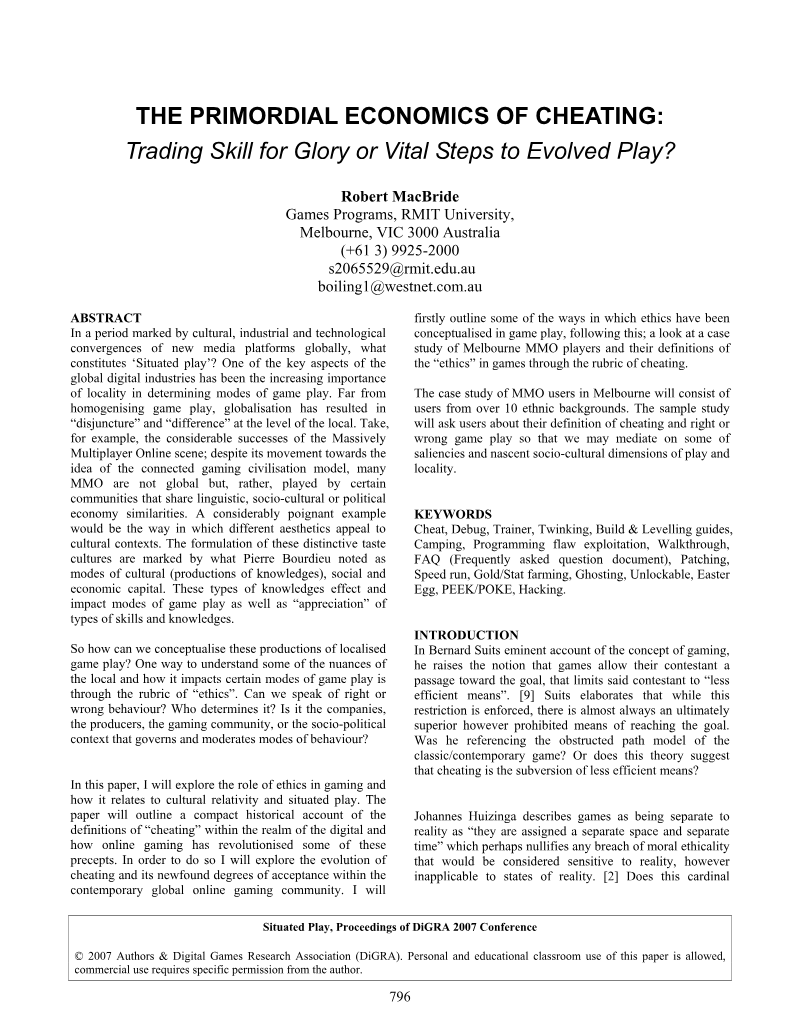
The author treats the ethics of cheating as locally situated rather than universal. Single-player cheats are often celebrated, while multiplayer cheating is policed through detection tools and blacklists.
MacBride's DiGRA 2007 paper examines how the meaning of cheating in games has shifted over time, using Huizinga's "magic circle" and Suits' "less efficient means" as theoretical anchors. Tracing a lineage from Easter eggs and debug tools through cartridge cheats and trainers to online exploits such as map hacks and ghosting, the study argues that cheating's acceptability is shaped by platform and culture. Single-player cheats are often celebrated, while multiplayer cheating is policed through community detection tools and blacklists, leading the author to frame the ethics of cheating as locally situated rather than universal.
To test this framing, the study surveys ten Melbourne gamers aged 18 to 35. Most respondents accepted certain practices, such as using walkthroughs, exploiting bugs, or consulting guides, while condemning game-altering hacks that disrupt multiplayer balance. Roughly 90 percent admitted to having cheated at some point, and 80 percent believed in a distinction between "right" and "wrong" cheating. A majority judged cheating most objectionable when it degrades other players' experience. The boundary between acceptable and unacceptable practice proved largely self-determined and inconsistent, and participants frequently placed responsibility on developers whose bugs or unlisted codes enabled cheats.
A follow-up focus-group study with the same ten participants finds that cheating is viewed as a mixed phenomenon. Some respondents regard it as evidence of insufficient skill or as an evasion of designed challenge, while others see it as a legitimate "vital step" when a game is poorly balanced. Participants noted that cheats often fail to unlock achievements or trophies, and speedrunning was cited as an example of skillful, documented play that sits comfortably within accepted practice. The group concluded that the ethics of cheating depend heavily on design quality and developer intent. The author acknowledges that these qualitative findings, drawn from a small and localized sample, are suggestive rather than definitive.
DiGRA · 2018
DiGRA · 2018
DiGRA · 2018
DiGRA · 2018
DiGRA · 2018
DiGRA · 2018
DiGRA · 2018
DiGRA · 2018
DiGRA · 2018
DiGRA · 2018
DiGRA · 2018
DiGRA · 2018
Game Developers Conference · 2018