
DiGRA
The Digital Games Research Association: the international association of academics and professionals who study digital games. Its Digital Library holds the proceedings of the DiGRA conferences since 2002.
Documents
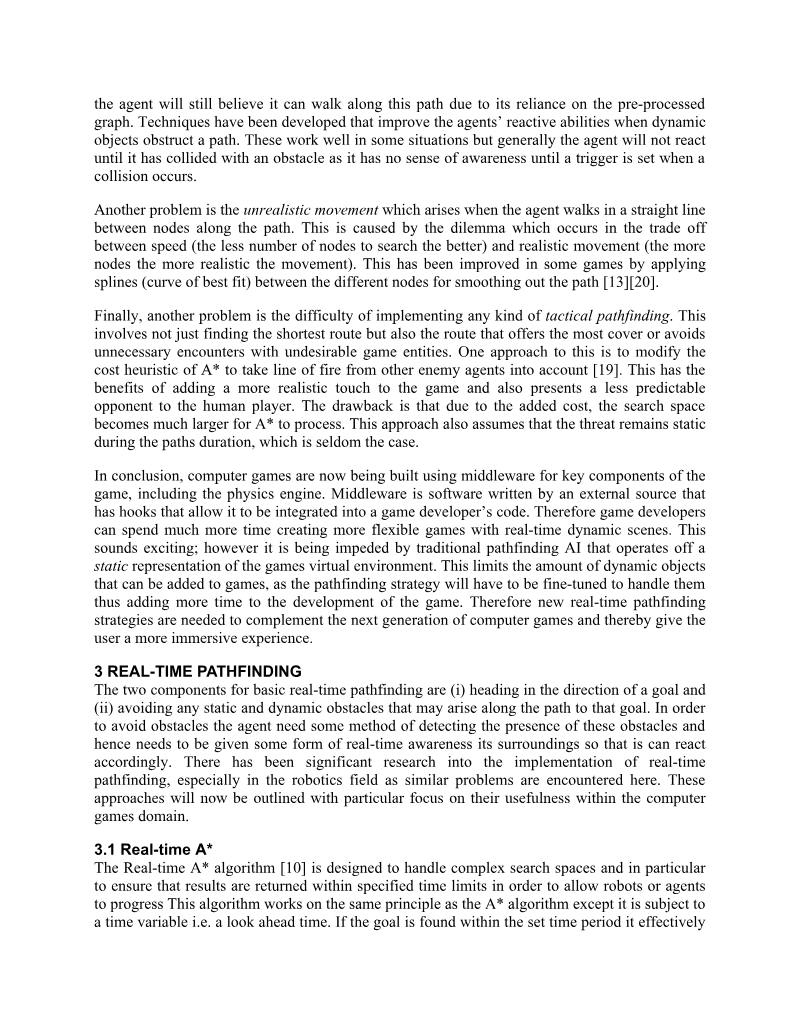
Realistic Agent Movement in Dynamic Game Environments
This paper addresses the challenge of realistic agent movement in computer games, particularly pathfinding in dynamic environments where the game world can change in real time.
- The paper argues that traditional pathfinding methods such as A and navigation meshes rely on static, pre-processed map representations, which become inadequate once physics middleware lets players and agents alter level geometry in real time.
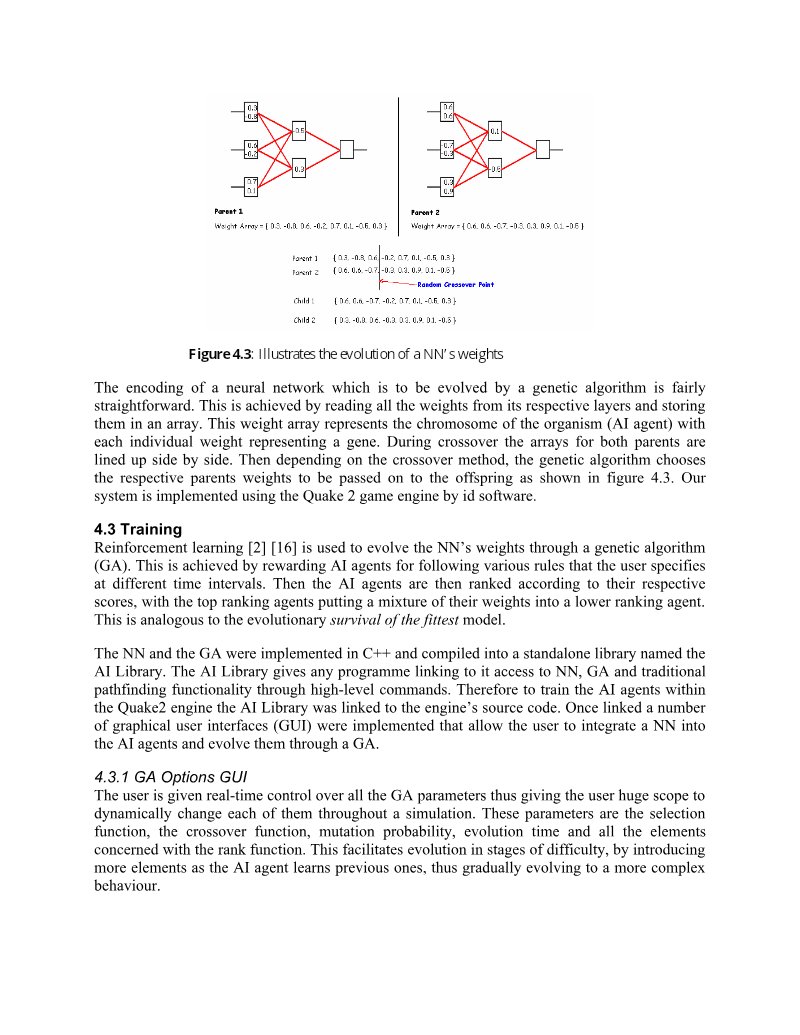
- The authors propose giving agents real-time awareness via four ray-casting sensors spanning a 90-degree field of vision, feeding an artificial neural network that controls movement, with weights evolved by a genetic algorithm guided by reinforcement-style scoring.
- The approach was implemented as a test bed on the Quake 2 engine using a custom C++ AI library, with graphical tools allowing users to adjust evolution and network parameters during training.

An Irrational Black Market? Boundary Work Perspective on the Stigma of In-Game Asset Transactions
This study examines the social stigma surrounding cash trades of in-game assets in Taiwan, a market in which players sell virtual currency and items for real money.
- The stigma around cash trades of in-game assets stems less from the virtual nature of the goods than from how the market blurs boundaries between work and play, adulthood and adolescence, and real and virtual, based on interviews with eleven participants (six sellers, five buyers) of Lineage, Lineage2, and Ragnarok Online in Taiwan.
- A Bahamut forum survey found 42.75% of respondents supported in-game asset transactions versus 22.57% opposed, suggesting Taiwanese gamers prioritize player interaction over strict adherence to game rules.
- Taiwan's roughly 1.9 million online gamers form a substantial base for a secondary market that has grown from individual trades into commercial operations employing low-wage workers in China as "currency farmers."


Designing Puzzles for Collaborative Gaming Experience: CASE eScape
The document examines the design of collaborative puzzles for multiplayer games, using CASE eScape, a four-player social action-adventure built as a total conversion of Unreal Tournament 2003, as its test case.
- Designing multiplayer puzzles that truly require cooperation has received little systematic attention, since single-player puzzle design is well documented but collaborative puzzle guidance is scarce.
- In observations of six groups of four non-gamers playing CASE eScape, participants consistently reported stronger collaboration than the recordings showed, with puzzles such as the climbing and bee puzzles often solved by only one to three players.
- Trial-and-error approaches frequently caused coordination problems, and awareness of other players suffered partly because name tags were invisible at a distance.
When Game Design and Narratives Unite
Dominic Arsenault's paper, presented as an extended version of a 2005 DiGRA conference talk, proposes the "dynamic range" as an analytical tool for examining how game systems grant players freedom, and uses that tool to explore the relationship between game design and narrative.
- Arsenault's central thesis is that game design actively shapes narrative content, and the two work well together only when the game system's openness matches the designer's narrative intentions.
- The paper introduces 'dynamic range' as a tool measuring how far a player can manipulate a game's internal dynamics to meet a challenge, drawing on the MDA framework of mechanics, dynamics, and aesthetics, and treats openness as a matter of degree rather than a binary.
- Diablo's resource-driven system offers wide internal manipulation, whereas Splinter Cell relies on external player skill and so offers a narrow dynamic range, as shown through character charts of a level-22 Warrior and Sam Fisher.
A Brief Social History of Game Play
Dmitri Williams's paper examines the social history of video game play in the United States, the birthplace of commercial video games.
- The popular stereotype of the isolated teenage gamer diverges sharply from the statistical and historical record, which points instead to vibrant social settings and diverse playing communities.
- The early 1980s were a pivotal turning point: gaming, initially an open and free space for cultural and social mixing, was rapidly reshaped by industrial and political forces rather than by game content, producer goals, or consumer demand.
- Age, gender, and place have been framed as seemingly natural characteristics of gaming, a framing that obscures issues of power and control in ways that favor some groups over others.
Cinematic Camera as Videogame Cliché
This paper argues that the videogame camera is fundamentally a computational construct rather than an optical one, and therefore is not bound to the linear, lens-based perspective that dominates cinema and photography.
- The videogame camera is a computational construct, not an optical one, so it is not bound to the linear, lens-based perspective that dominates cinema and photography.
- The authors argue that contemporary game design has increasingly adopted cinematic camera conventions, a tendency they describe as a cliché that narrows games' expressive vocabulary and blurs the boundary between games and film.
- The paper traces linear perspective from Renaissance scientific perspective through Cubism's rejection of it, and cites Lev Manovich's account of how linear perspective became an unquestioned default in computer interfaces.
The Pervasive Interface: Tracing the Magic Circle
Eva Nieuwdorp's DiGRA 2005 paper, "The Pervasive Interface: Tracing the Magic Circle," argues that pervasive games, which embed fantasy within everyday physical and social settings, demand a rethinking of what counts as an interface.
- Eva Nieuwdorp's DiGRA 2005 paper argues that pervasive games, which embed fantasy within everyday physical and social settings, require rethinking the concept of an interface beyond hardware and screens.
- The paper proposes a "liminal interface" crossed in two stages: the paratelic interface, a playful state where players set aside lifeworld conventions through Goffman's rules of irrelevance, and the paraludic interface, a rule-bound structure where the game world's semiotic conventions dominate.
- The paper reworks the magic circle as a permeable, two-way boundary rather than a sealed space, and contends that the game world must feel omnipresent and internally consistent or the magic circle is pierced and the game collapses.

The Narrative and Ludic Nexus in Computer Games: Diverse Worlds II
The Diverse Worlds II study examines how narrative structure and game mechanics relate in computer games, aiming to move past the long-standing narratology-ludology debate by investigating dynamic relationships rather than fixed categories.
- The study analyses 80 critically acclaimed 2003 titles using Jenkins' four dimensions of narrative architecture and Aarseth, Smedstad and Sunnanå's thirteen-factor ludological typology, aiming to move past the narratology-ludology debate by examining how story and mechanics interact dynamically.
- Narrative formal systems appear in roughly three-quarters of the sampled games, with evoked and enacted narrative the most prevalent forms, while flashback and flash-forward techniques are rare and story information is predominantly presented objectively.
- Most titles feature geometrical topography, finite goal structures, real-world-paced time, and single- or two-player configurations, with deterministic responses, real-time environments, and objective-based rules common, and overcoming evil the dominant strategic objective.
The Localization of Digital Games: A Case Study in China
This paper examines the challenges facing digital game localization, using China as a case study to explore why some foreign games succeed in the Chinese market while others fail.
- Game localization is more complex than general software localization because games function simultaneously as commercial and cultural products.
- The authors propose a three-dimensional model comprising the In-Game Environment (storyline, gameplay, engagement, interface), the External Environment (social, political, legal, ideological factors), and the Users, who link the two.
- The central contention is that all three dimensions should be considered throughout the entire game design process rather than treated as a late-stage adjustment.
The Use of Video Game Technology for Investigating Perceptual and Cognitive Awareness in Sports
This paper, presented at the DiGRA 2005 conference, proposes a framework for using video game technology to study and enhance the perceptual, attentional, and cognitive skills underlying expertise in sport, with ice hockey as the focal domain.
- The paper is a 2005 DiGRA conference proposal, not a completed study, and it reports no empirical results; its planned experiment's outcome remains untested.
- The authors argue that expert athletes and skilled video game players both build advanced perceptual and decision-making abilities through immersive practice, with ice hockey as the focal sport domain.
- The central claim is that expertise depends on holding and shifting between multiple knowledge types (cue utilization, pattern recognition, visual search, situational probability assignment) within ecologically realistic contexts rather than isolated lab trials.
Possibilities of Non-Commercial Games: The Case of Amateur Role Playing Games Designers in Japan
Kenji Ito's study examines amateur role-playing game designers in Japan who build games with Tkool 2000, a freeware toolkit whose simple 2D graphics and menu-based scripting lower the barriers of hardware and technical skill.
- The study surveyed 102 self-identified Tkool 2000 designers ("Tkoolers"), a freeware RPG toolkit with simple 2D graphics and menu-based scripting that lowers hardware and technical barriers; the author notes self-reported data and possible sampling bias as limitations.
- Tkoolers are predominantly young males, many not especially drawn to computers, and are motivated mainly by fantasy fulfillment, storytelling, and extending games they enjoyed rather than by financial reward.
- The internet is indispensable to amateur designers: online communities, graphics and music repositories, and sites and review boards such as 2ch enable collaboration, distribution, and feedback.

Contexts, Pleasures and Preferences: Girls Playing Computer Games
Diane Carr's study examines how girls' gaming preferences are formed, drawing on observations of a computer games club at a single-sex state school in South London.
- Preferences are not fixed: over one school term, the nine participating girls expanded their favourite-game lists from 26 titles to include 16 newly encountered games, suggesting that simply offering new games in a new context was enough to alter stated tastes.
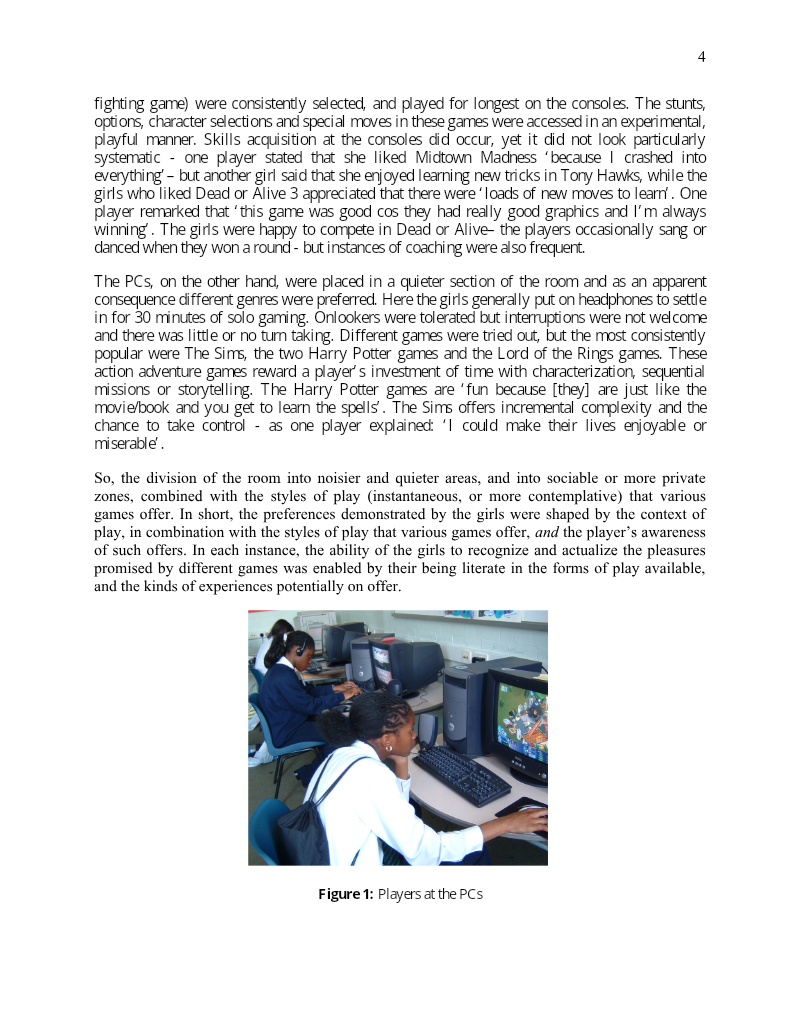
- Physical site features shaped genre choice: consoles placed near the noisy social area drew girls to instantly gratifying, turn-taking games such as Tony Hawk's Pro Skater 4 and Dead or Alive 3, while the solitary PC corner favoured narrative-driven titles like The Sims and the Harry Potter and Lord of the Rings games.
- Avatar gender mattered less than assumed: the girls showed little interest in female-led games, and questionnaire responses about ideal characters rarely specified gender, with those who did sometimes choosing male avatars, most pronounced among girls with the greatest home access.