
DiGRA
The Digital Games Research Association: the international association of academics and professionals who study digital games. Its Digital Library holds the proceedings of the DiGRA conferences since 2002.
Documents
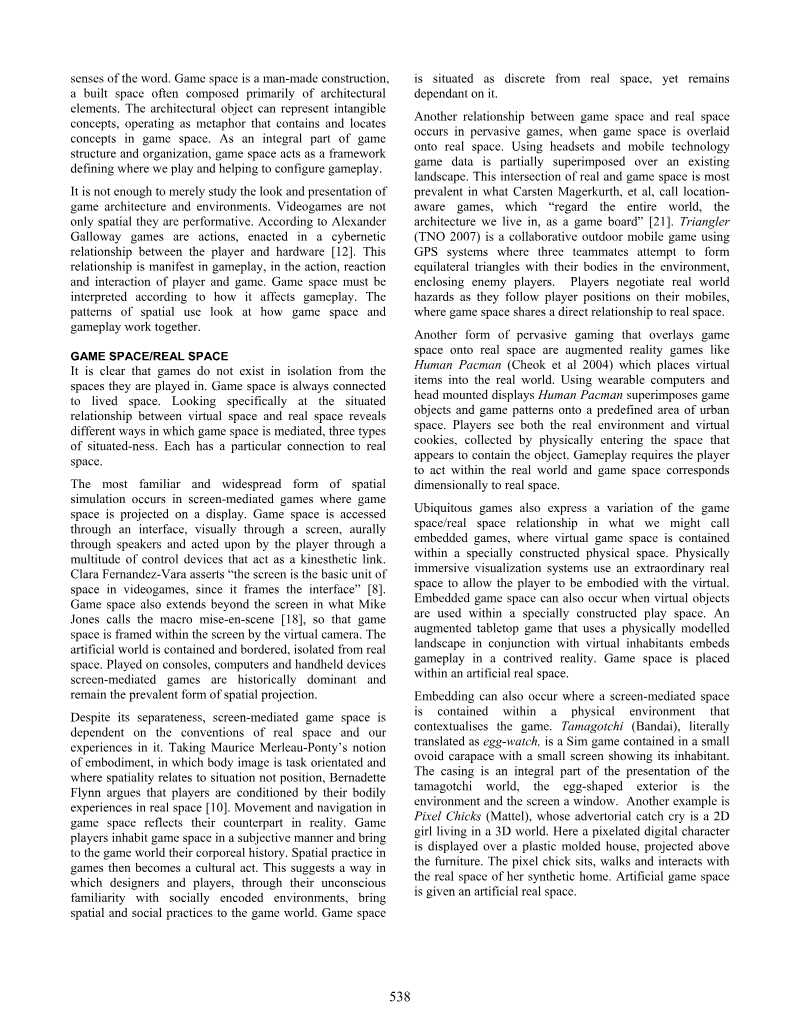
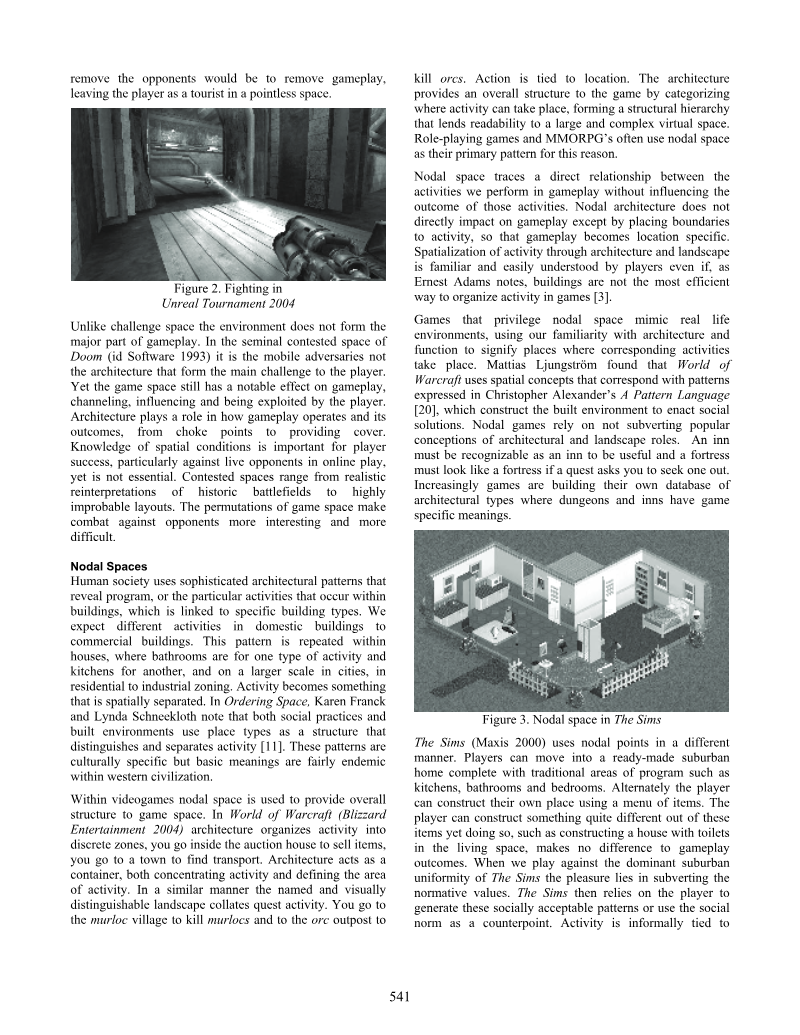
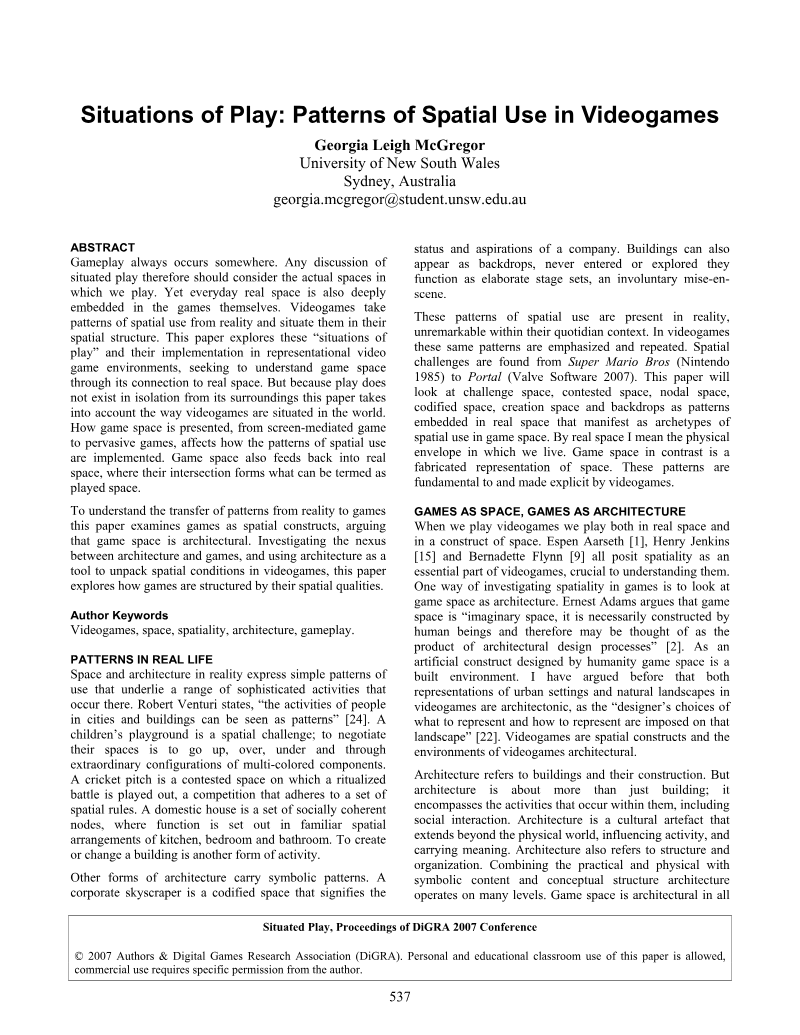
Situations of Play: Patterns of Spatial Use in Videogames
"Situations of Play: Patterns of Spatial Use in Videogames" argues that game environments are not merely backdrops but architectural and performative spaces that reproduce and formalize recurring patterns drawn from the real world.
- Game environments are defined by six recurring spatial patterns—challenge, contested, nodal, codified, creation, and backdrop—which dictate the range of permissible player actions.
- Game space is not merely a backdrop but a formalization of real-world spatial patterns that players internalize through repeated gameplay, potentially influencing how they perceive physical environments.
- The report categorizes play into three distinct types: screen-mediated, embedded, and pervasive, noting that modern titles increasingly blend these patterns into complex configurations.
Situating Gaming as a Sonic Experience: The Acoustic Ecology of First-Person Shooters
This study argues that sound in first-person shooters has been neglected within Game Studies, which has long treated games as primarily visual media.
- First-person shooter (FPS) sound functions as an 'acoustic ecology' where players are active participants who both generate the soundscape and have their behavior shaped by it.
- Sound in FPS games serves as a critical navigational and semantic tool, providing essential spatial and contextual information that directly influences player performance and immersion.
- The study introduces 'navigational listening' as a fourth mode of listening to complement Michel Chion’s existing framework, specifically addressing how players process audio to move through virtual environments.

The Quest in a Generated World
This paper presents a method for generating quests within procedurally generated three-dimensional game worlds, arguing that procedural content creation alone lacks the context necessary to make game spaces meaningful.
- Procedural world generation requires quest structures—defined by setting, space, challenge, and goal—to provide meaningful context and player direction.
- The Charbitat prototype, built on the Unreal Tournament 2004 engine, utilizes a graph-based analysis to integrate key-and-lock puzzles into infinite, procedurally generated 3D environments.
- World generation relies on an incremental construction method that scores candidate tile configurations using approximately twelve distinct design evaluators.
A Certain Level of Abstraction
Jesper Juul's paper "A Certain Level of Abstraction" examines how abstraction operates in video games, arguing that it is a central element of game design, a process players decode during play, and an optimization strategy developed over time.
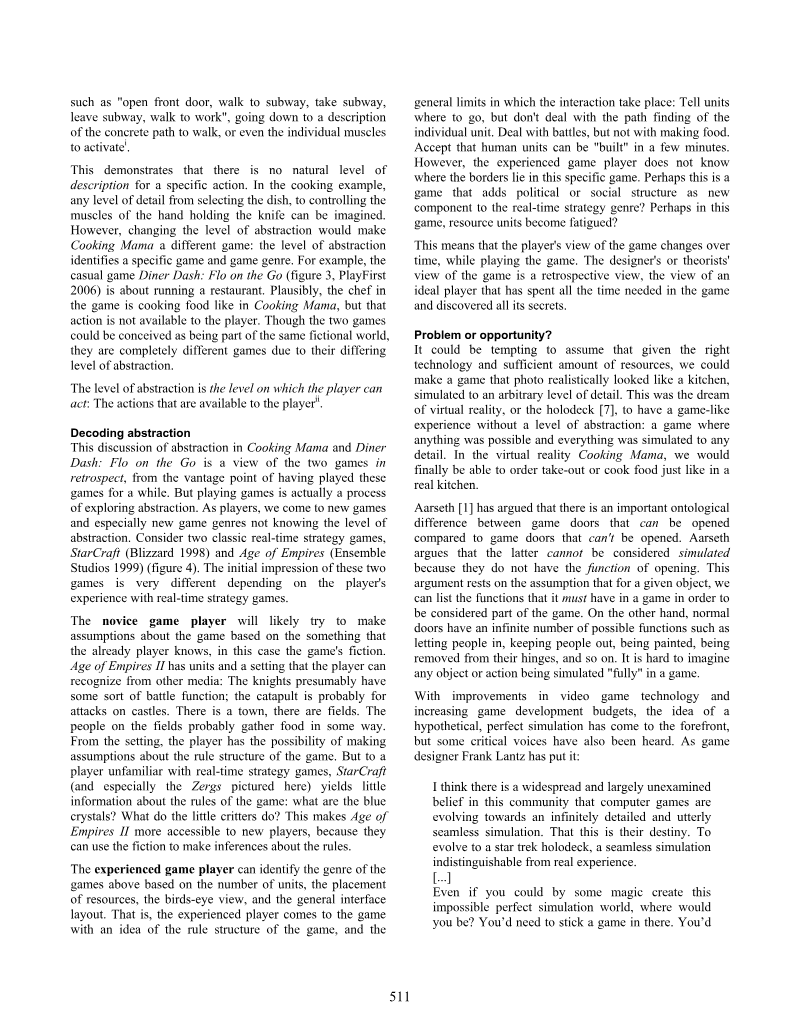
- Abstraction is a central design element in games: there is no natural level of detail for any action, and the chosen level defines a game and its genre, as shown by Cooking Mama omitting actions like ordering take-out and contrasting with Diner Dash: Flo on the Go.
- Juul's framework places game content on a spectrum from purely fictional to purely rule-based, with the most interesting design territory where rules are motivated by the fiction.
- Experienced players recognize genres through learned conventions, while novices rely on the fiction to infer rules, illustrated with real-time strategy titles such as StarCraft and Age of Empires II.


Extending the Serious Game Boundary: Virtual Instructors in Mobile Mixed Reality Learning Games
This paper proposes that mobile augmented reality learning (MARL) games, in which learners wear see-through heads-up displays and interact with a 3D animated virtual instructor, can deliver personalized, context-aware education that is both engaging and pedagogically sound.
- The paper proposes mobile augmented reality learning (MARL) games in which learners wear see-through heads-up displays and interact with a 3D animated virtual instructor that adapts to learning style, emotion, and pedagogical technique, guiding real-world quests anytime, anywhere, and at the learner's own pace.
- Its central contribution is the Context-Aware Augmented Reality System (CAARS), originally developed for manufacturing training and extended to MARL, combining a lightweight optical see-through headset (camera, speaker, microphone, inertial sensors, roughly eight hours of battery life) with a service-oriented software architecture.
- The training subsystem uses software agents and pedagogical models, such as scaffolding that gives novices more step-by-step guidance than experienced learners, and generates virtual instructors from the PECA (Pedagogical Embodied Conversational Agent) product line architecture, which supports gesture, speech, and optional physiological biosensor input.
Recognizing New Literacies: Teachers and Students Negotiating the Creation of Video Games in School
This paper reports initial findings from the first year of a three-year ethnographic study examining how video game creation functions as a learning and literacy practice in secondary school classrooms.
- Video game creation is framed as a sophisticated learning and literacy practice that schools should recognize as valuable rather than dismiss as distraction, drawing on new literacies theory that treats digital and multimodal texts as part of literacy.
- The study is an exploratory, first-year qualitative ethnography at one large high school in Western Canada, with two technology teachers using Kid's Programming Language (Grades 11-12) and Game Maker (Grades 9-10), so its findings are not generalizable.
- Data came from several weeks of classroom observation, interviews with nine students and two teachers, and stimulated-recall sessions in which students explained their reasoning while watching recordings of their own work, analyzed in NVivo.


Video Games and the Training of Sociality: A Survey of Video Game Players
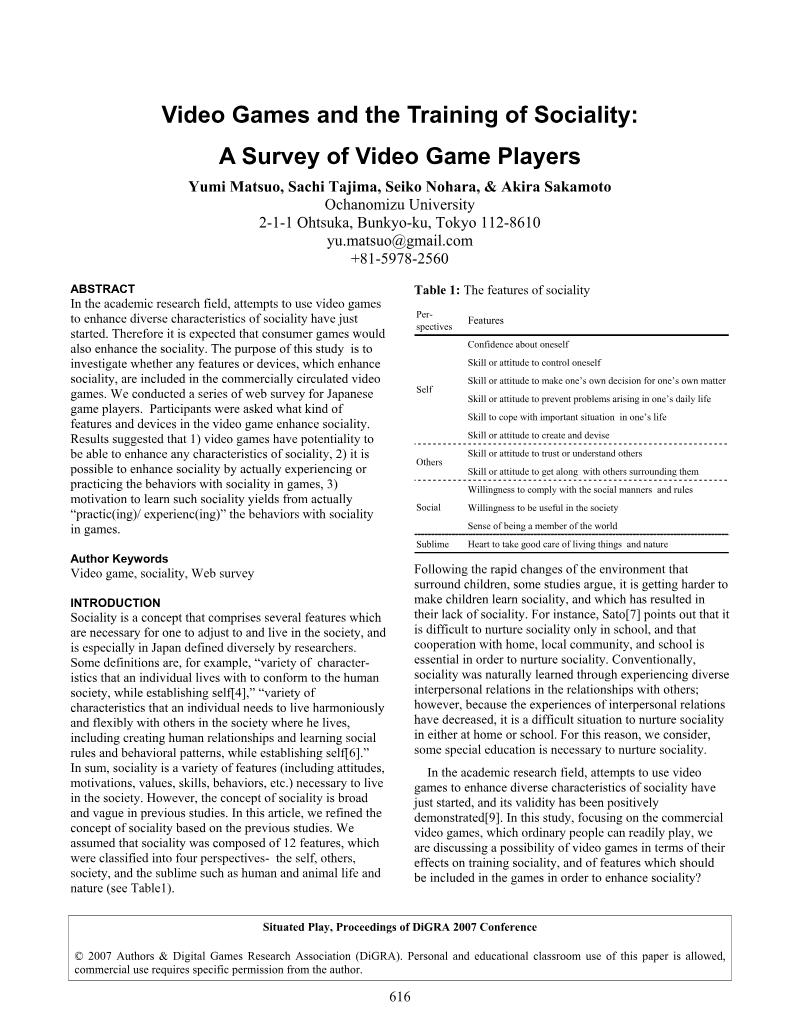
This study examines whether commercial video games can help train sociality, drawing on four social-skill learning principles (modeling, verbal instruction or coaching, operant conditioning, and rehearsal) to assess how game design might cultivate social abilities.
- The study drew on a three-wave web survey conducted December 2005 to January 2006 among adults in the Tokyo metropolitan area, yielding 1,367 valid responses from an initial screened pool of 1,519.
- About 65.5 percent of responses attributed gains in sociality to practicing or experiencing social behaviors within games, while explicit learning-theory mechanisms such as modeling admired characters, verbal instruction, or gaining explicit knowledge appeared far less often.
- The most frequently reported change was increased motivation to learn sociality, and many players subjectively judged their own social abilities to have improved.
A Typology of Speeches within Board Game Players for Analyzing the Process of Games
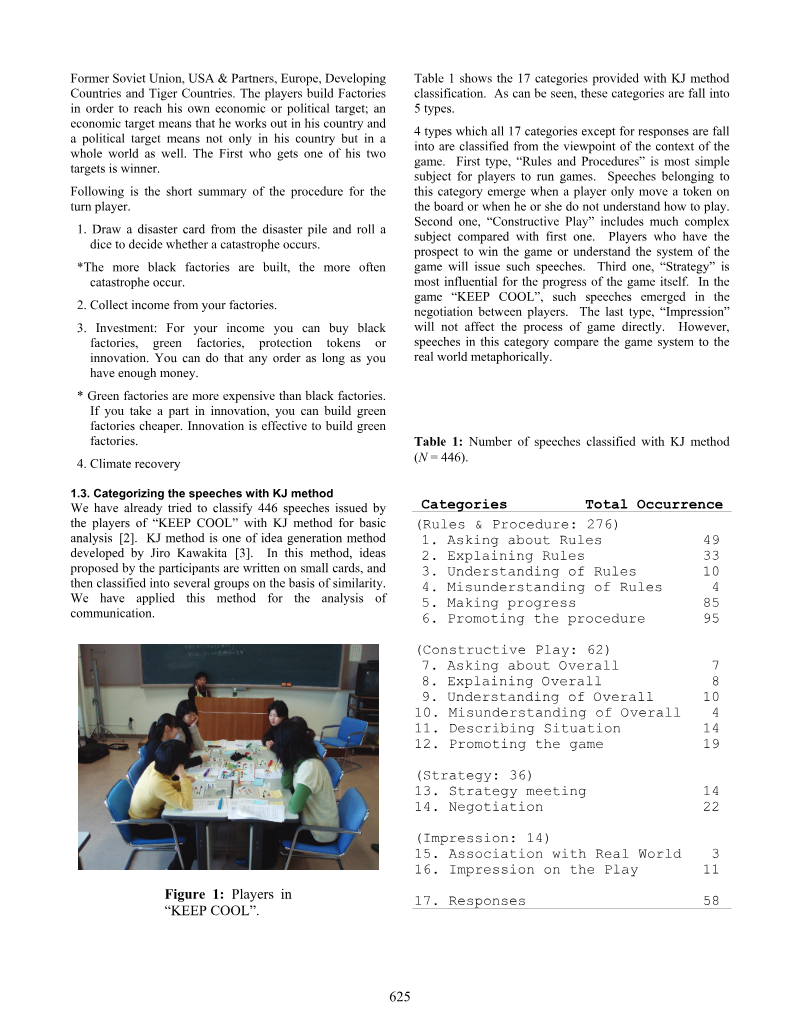
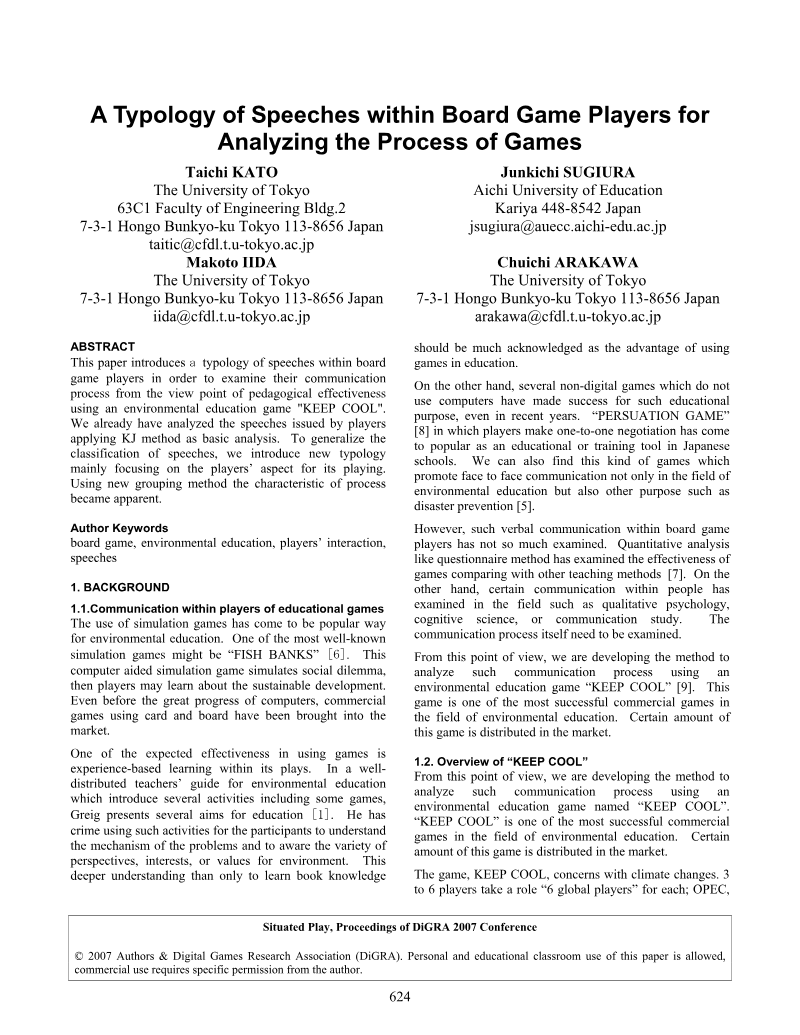
This paper proposes a typology for classifying verbal communication among players of board games, using the environmental education game "KEEP COOL" as its test case.
- The paper proposes a two-dimensional typology for classifying player speech in board games, using the environmental education game KEEP COOL as the test case, to replace time-consuming and inconsistent methods like the KJ method.
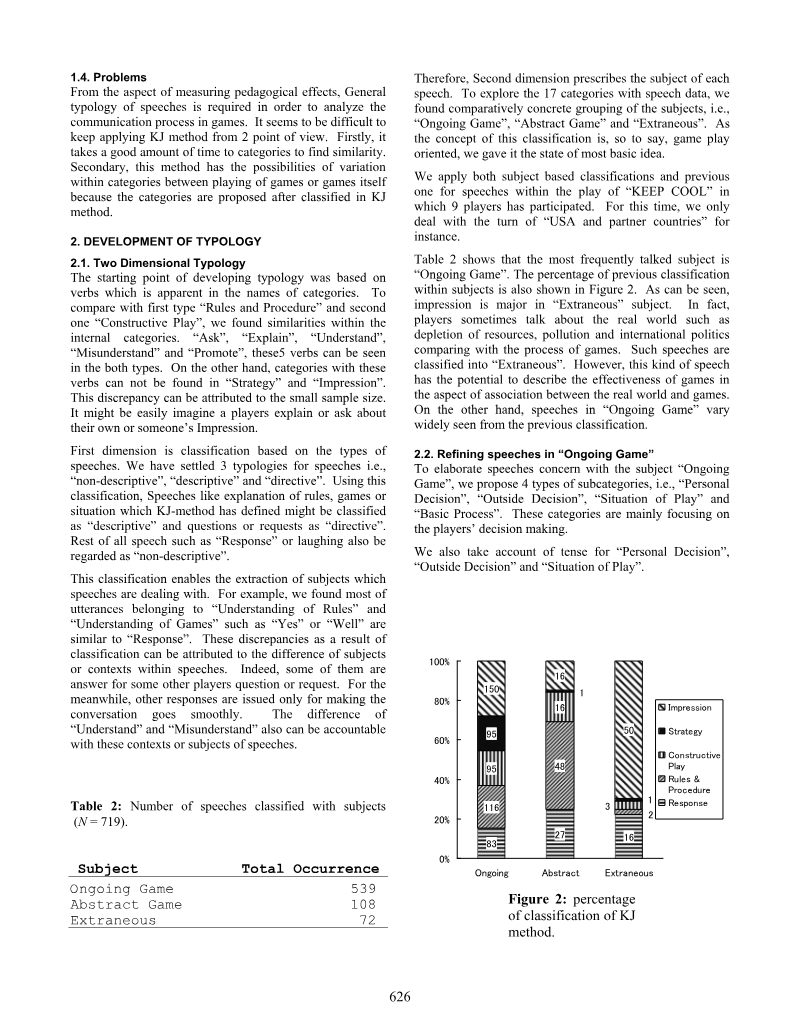
- The typology classifies each speech on two axes: its type (non-descriptive, descriptive, or directive) and its subject (Ongoing Game, Abstract Game, or Extraneous).
- Ongoing Game speech dominated the dataset, accounting for 539 of 719 analyzed speeches, and was further refined into Basic Process, Personal Decision, Outside Decision, and Situation of Play, with tense added as a feature.
Self and Selfishness in Online Social Play
David Myers argues that online social play is more fundamentally self-oriented and oppositional than prevailing research assumes, and that it should be understood as a form of social control rather than as a natural expression of cooperation.
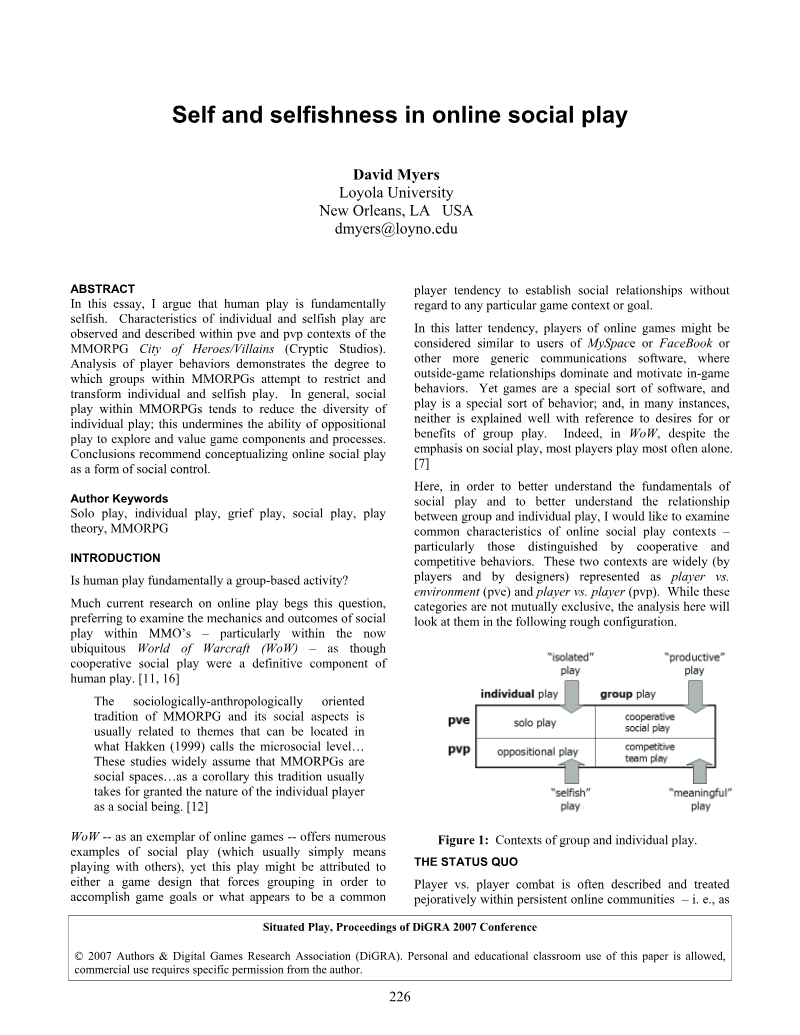
- Myers argues that online social play is fundamentally self-oriented and oppositional rather than a natural expression of cooperation, and should be understood as a form of social control.
- Using City of Heroes/Villains and World of Warcraft as case studies, the report challenges the assumption that social and cooperative play is the default or endpoint of MMORPG engagement.
- One-on-one player-versus-player combat proved a faster and more accurate indicator of relative character value than player-versus-environment play, while larger team matches on the test server were highly variable, distorted by lag, bugs, and imbalances, and often avoided on repeat.
The Disappearance and Reappearance and Disappearance of the Player in Videogame Advertising
This paper examines how videogame advertising has shaped consumer understanding of both the devices and the people who use them, arguing that ads have repeatedly alternated between showing players and showing games.
- The core thesis is that videogame ads have alternated between showing players and showing games: early ads featured players to teach consumers how to operate new hardware, while later ads dropped them once the medium became familiar.
- Early home videogame advertising, beginning with Atari's Pong in 1976, paired games with unrelated household goods such as sweaters, clocks, and garden products, reflecting uncertainty about where the new category fit in consumers' lives.
- The paper draws on Lynn Spigel's account of television's entry into the postwar home and Louis Althusser's concept of interpellation to explain how ads 'hail' particular consumers as players.

Exploring the Uncanny Valley with Japanese Video Game Characters
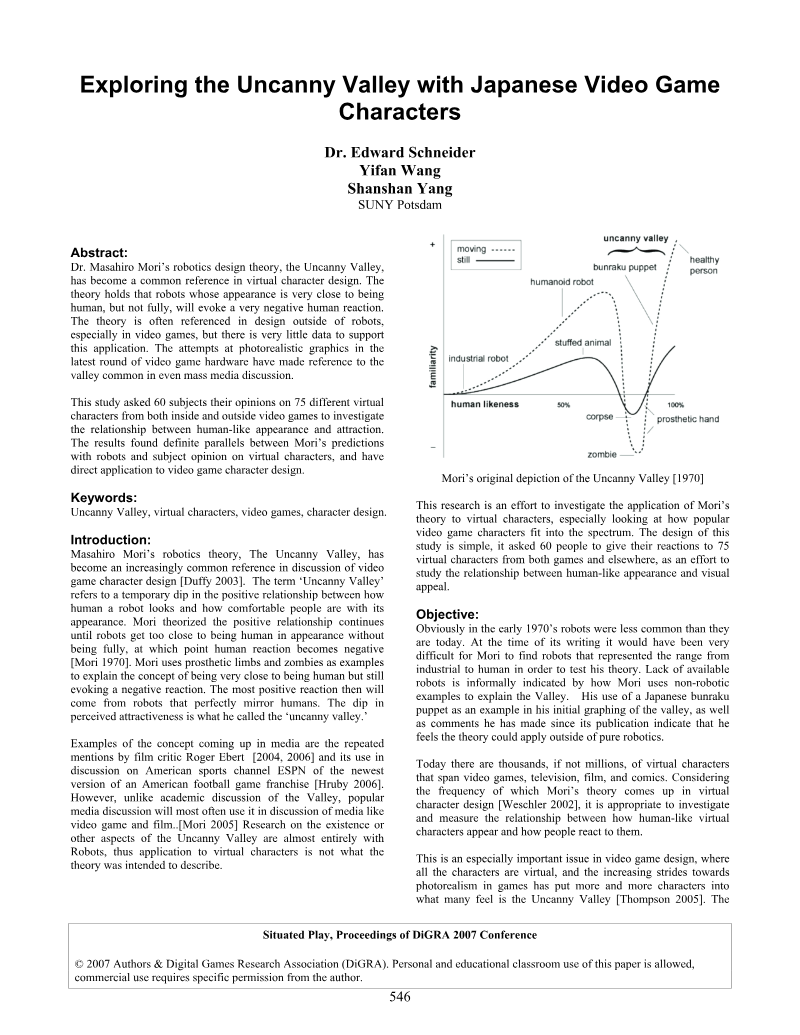
This study, co-authored by researchers at SUNY Potsdam, investigates whether Masahiro Mori's Uncanny Valley theory, originally formulated for robotics, applies to virtual characters in video games and other media.
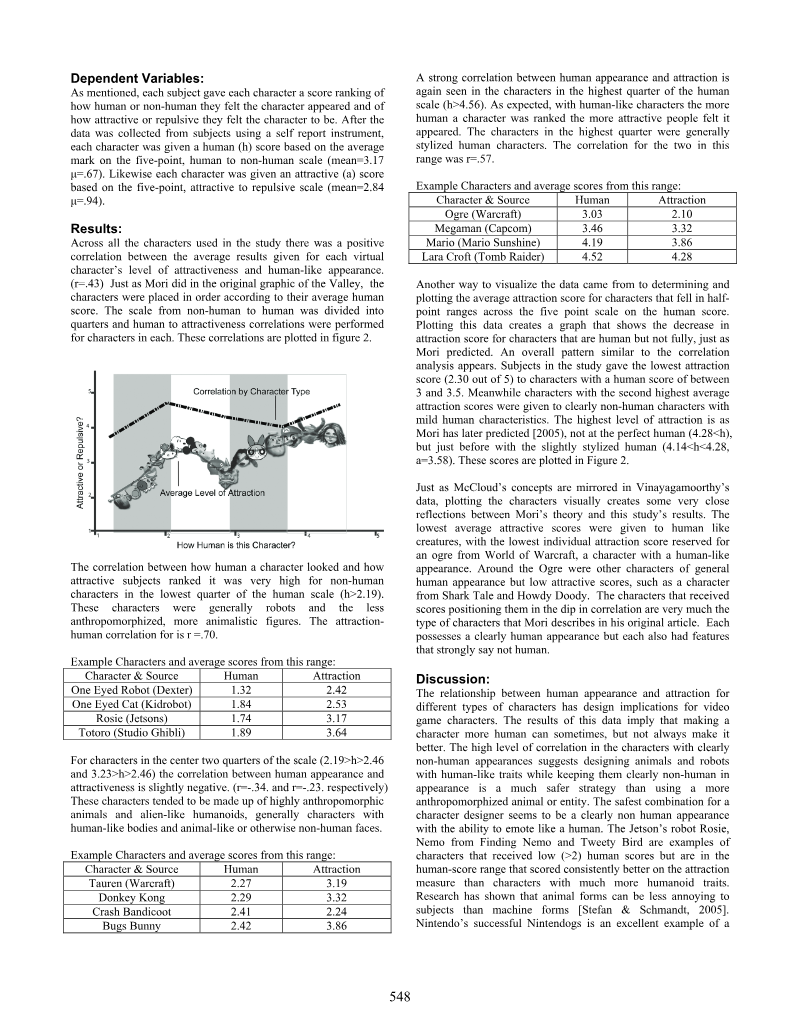
- The study tested Masahiro Mori's Uncanny Valley theory on virtual characters, using 60 participants who rated 75 characters from games, film, TV, and animation on human-likeness and attractiveness using a five-point scale.
- Overall, human-likeness and attractiveness were positively correlated (r=.43), matching the rising portion of Mori's curve, but the relationship reversed in the middle range of human-likeness, forming the predicted dip.
- The lowest average attraction (2.30 out of 5) occurred for characters with human-likeness scores between 3 and 3.5, while characters in the lowest quarter of the human scale, such as robots and anthropomorphic animals, showed a strong positive correlation (r=.70) between human-likeness and attractiveness.
Please Biofeed the Zombies: Enhancing the Gameplay and Display of a Horror Game Using Biofeedback
This paper, presented at a 2007 DiGRA conference, explores whether low-cost biometric sensing can personalize the emotional experience of a video game without altering its core design.
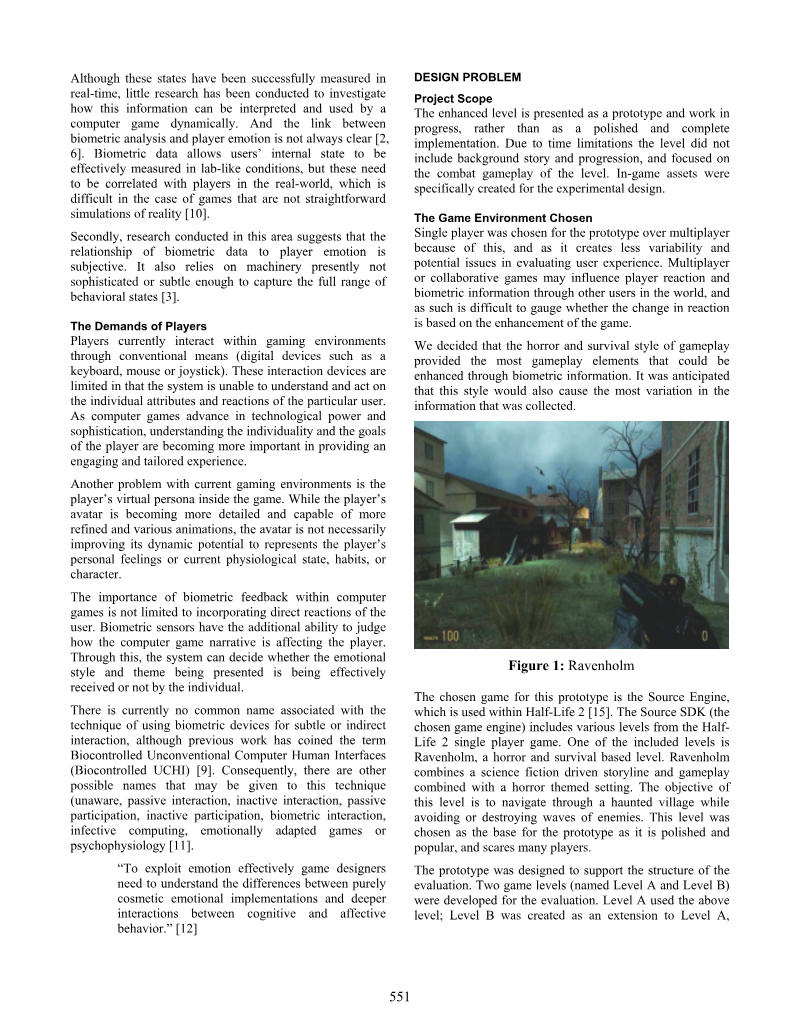
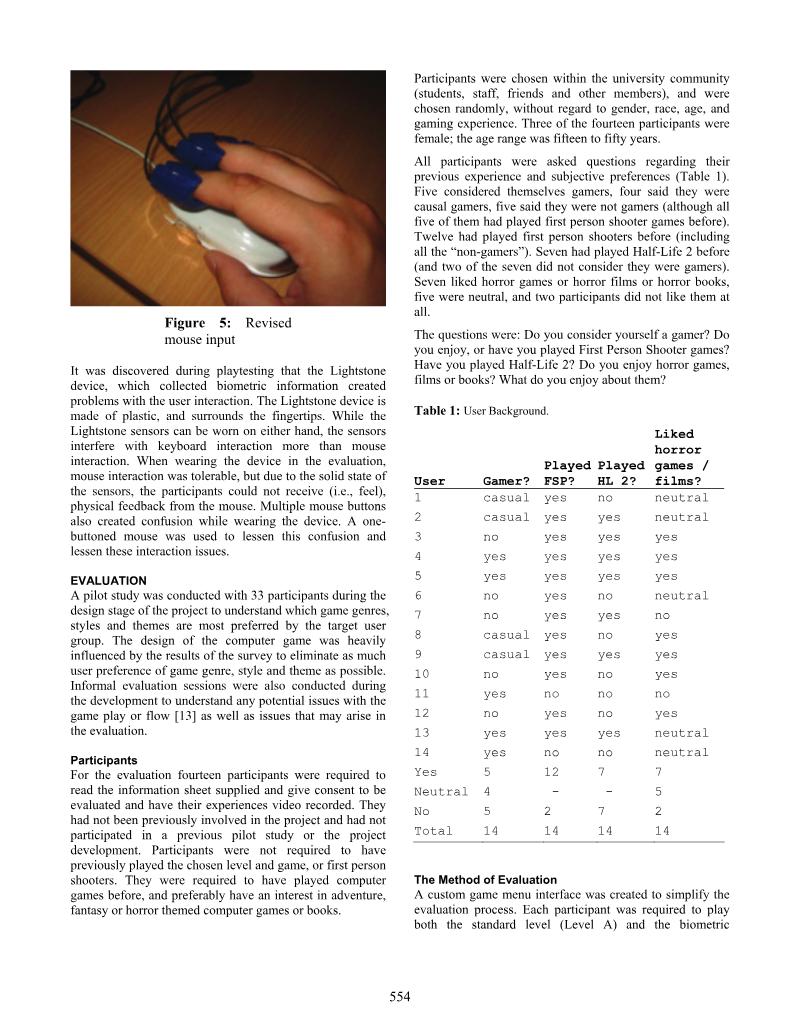
- The authors adapted the sub-$200 Wild Divine Lightstone, which measures heart rate variability and galvanic skin response, to dynamically scale horror elements (shaders, screen shake, enemy spawning, movement speed, weapon damage) in the Ravenholm zombie level of Half-Life 2 via the Source engine, using multipliers relative to each player's calibration baseline smoothed over two-second intervals.
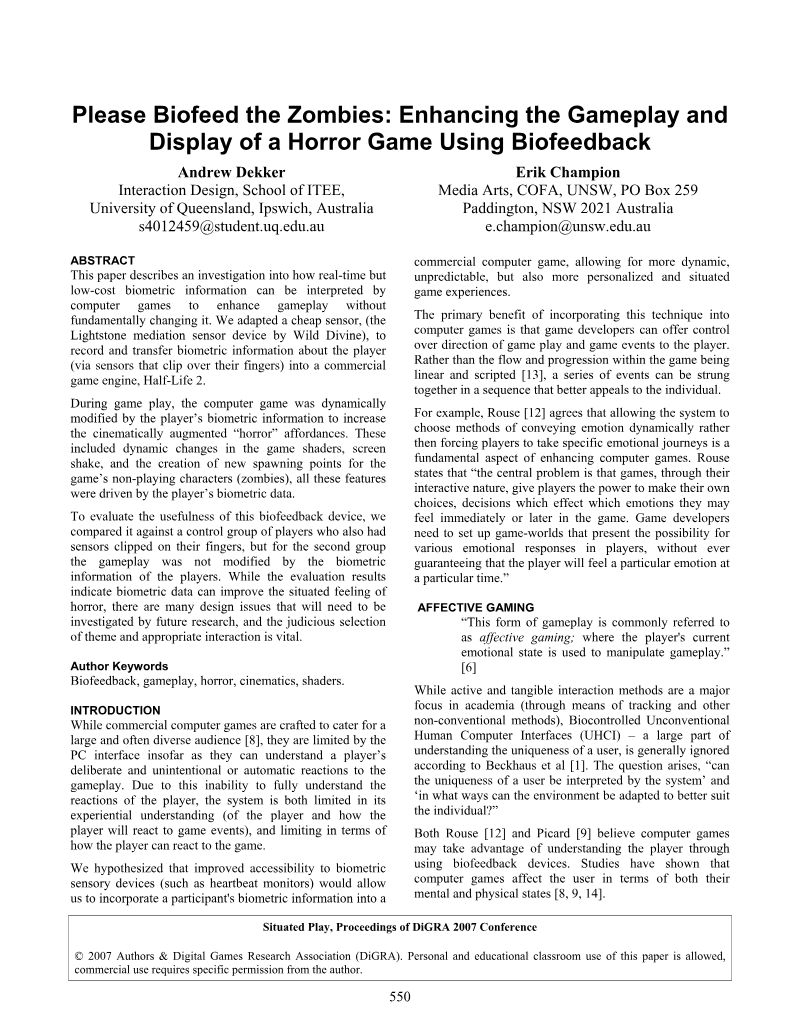
- In a 14-participant user study (mostly university-recruited, only three women), 9 of 14 players preferred the biometrically enhanced version of the zombie level, and 11 believed biometric information could make games more engaging.
- Engagement benefits depended heavily on prior enjoyment of horror games: the authors conclude biometric enhancement can deepen engagement for genre-receptive players while potentially diminishing it for others.