1 free read left. Create a free account for unlimited reading + AI research.
Create free accountWhitepaper DiGRA
1 free read left. Create a free account for unlimited reading + AI research.
Create free accountWhitepaperDiGRA
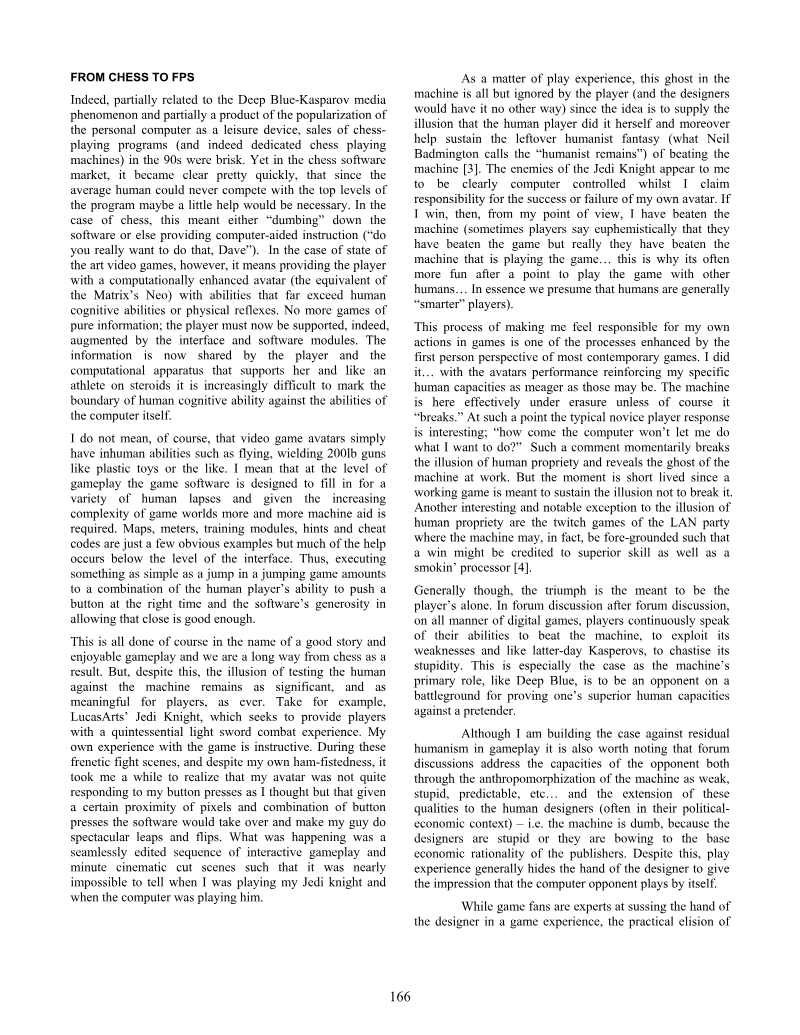
This study argues that sound in first-person shooters has been neglected within Game Studies, which has long treated games as primarily visual media. Its central thesis is that FPS sound should be understood as an "acoustic ecology," in which players are integral participants rather than passive recipients. To support this claim, the authors adapt film sound theory and introduce a set of new concepts, including ideodiegetic and telediegetic sounds, along with the terms choraplasts, topoplasts, and aionoplasts, which describe how sounds define virtual space and time. The framework also adds a fourth listening mode, navigational listening, to Chion's existing three.
The authors contend that sound conveys spatial, navigational, and contextual information essential to immersion and performance. Their account describes a two-way relationship in which player actions generate much of the soundscape, while that soundscape in turn shapes player behavior. Immersion is presented as increasing as sounds become more frequent, dense, and responsive to player input. Sound is positioned as the semantic and contextual nexus linking players to one another and to the game engine, and the work frames this as a theoretical proposal rather than an empirically established finding.
The concluding argument describes game sound as producing a sonified, resonating space that merges with the player's physical environment, using audio to confirm the scale of on-screen space and to guide players through navigational, causal, and semantic listening modes. The scope is conceptual and focused on first-person shooters as a genre, drawing on the broader literatures of game audio, immersion, sonification, and soundscape theory. The work presents no quantitative data or new empirical results, so its contribution rests on theoretical synthesis and terminological development that future empirical research could test.



DiGRA · 2016



DiGRA · 2016



DiGRA · 2016



DiGRA · 2016



DiGRA · 2016



DiGRA · 2016

DiGRA · 2015



DiGRA · 2015



DiGRA · 2015
DiGRA · 2015
DiGRA · 2015
DiGRA · 2015
Deconstructor of Fun · 2026