1 free read left. Create a free account for unlimited reading + AI research.
Create free accountWhitepaper DiGRA
1 free read left. Create a free account for unlimited reading + AI research.
Create free accountWhitepaperDiGRA
The authors argue that the KJ method is time-consuming and prone to variation across games and sessions. They aim for a more systematic framework.
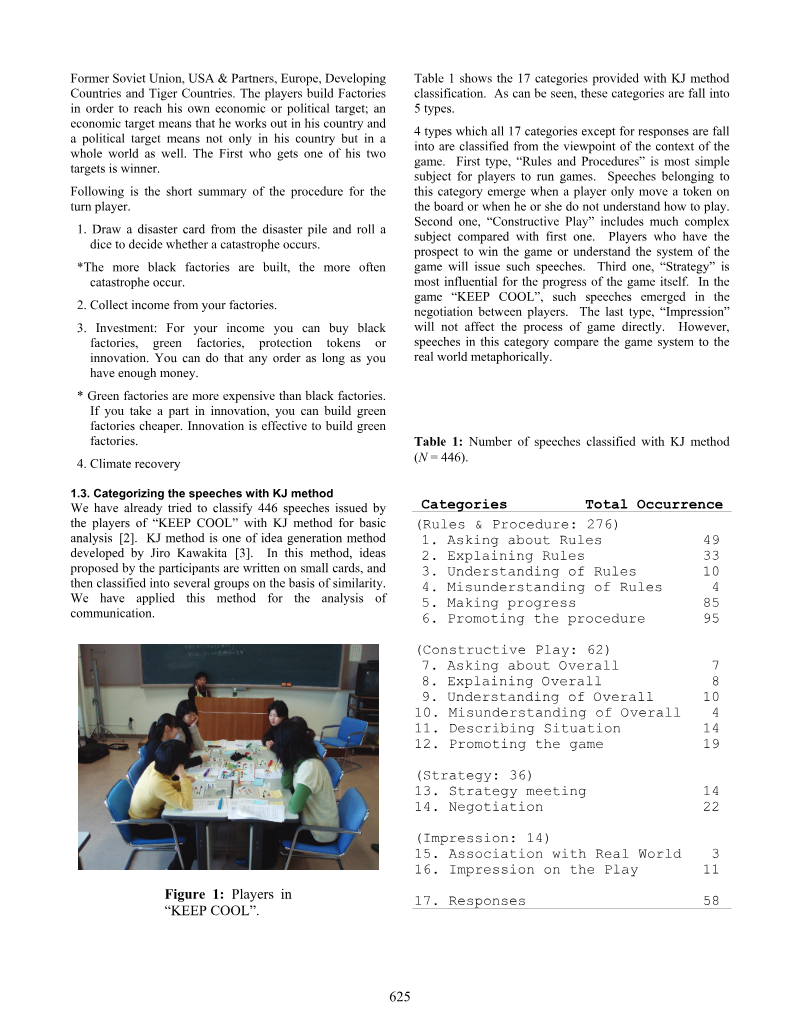
This paper proposes a typology for classifying verbal communication among players of board games, using the environmental education game "KEEP COOL" as its test case. The authors argue that existing methods such as KJ method are time-consuming and prone to variation across games and sessions, and they aim to develop a more systematic framework for analyzing how players communicate during play, with the ultimate goal of assessing pedagogical effectiveness. The study builds on an earlier KJ-method analysis of 446 player speeches, which had produced 17 categories grouped into five broader types: Rules and Procedures, Constructive Play, Strategy, Impression, and Responses.
The proposed typology is two-dimensional. The first dimension classifies speeches as non-descriptive, descriptive, or directive, while the second assigns each speech a subject: Ongoing Game, Abstract Game, or Extraneous. The Ongoing Game category, which accounted for 539 of 719 speeches analyzed, was further refined into Basic Process, Personal Decision, Outside Decision, and Situation of Play, with tense (past, present, future) added as a feature. The analysis draws on speeches from a single session involving nine players, focusing on the USA and partner countries' turns across three rounds and a break.
Key findings include that speech about Basic Process declined over the rounds as players became familiar with rules, while speeches about Outside Decision (negotiation) grew steadily, and future-oriented speech rose, suggesting strategic planning even during breaks. The authors note limitations: the dataset is small, emotional reactions were not coded, and the typology has yet to be validated on digital game chat logs or classroom settings, which they identify as future directions.
DiGRA · 2018
DiGRA · 2018
DiGRA · 2018
DiGRA · 2018
DiGRA · 2018
DiGRA · 2018
DiGRA · 2018
DiGRA · 2018
DiGRA · 2018
DiGRA · 2018
DiGRA · 2018
DiGRA · 2018
Game Developers Conference · 2018