1 free read left. Create a free account for unlimited reading + AI research.
Create free accountWhitepaper DiGRA
1 free read left. Create a free account for unlimited reading + AI research.
Create free accountWhitepaperDiGRA
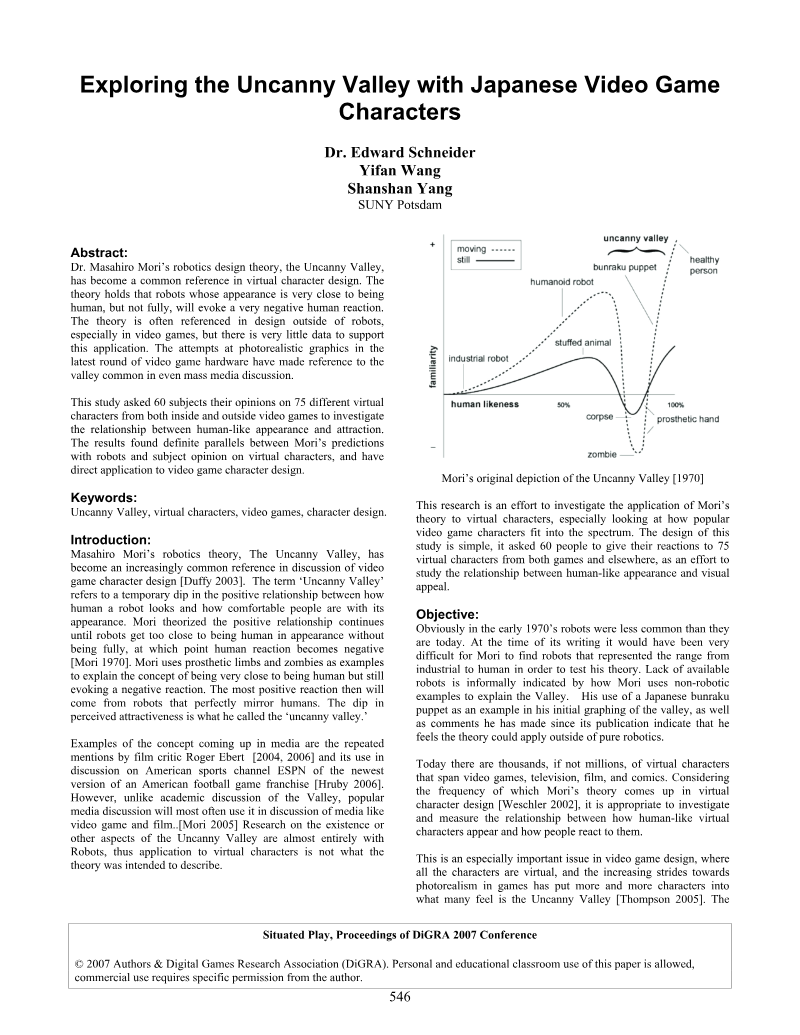
Mori's theory was formulated for robotics, and the study notes empirical support for virtual characters has been scarce.
This study, co-authored by researchers at SUNY Potsdam, investigates whether Masahiro Mori's Uncanny Valley theory, originally formulated for robotics, applies to virtual characters in video games and other media. The authors note that the concept is frequently invoked in discussions of game design, particularly as photorealistic graphics advance, yet empirical support for its application to virtual characters has been scarce. To address this gap, 60 participants (28 men and 32 women) rated 75 characters drawn from games, film, television, and animation, scoring each on a five-point scale for how human-like and how attractive they appeared. Characters were presented on white backgrounds to reduce contextual bias.
The results showed a positive overall correlation between human-likeness and attractiveness (r=.43), consistent with the rising portion of Mori's curve. However, characters in the lowest quarter of the human scale, including robots and anthropomorphic animals, showed a strong positive correlation (r=.70), while characters in the middle range showed negative correlations (r=-.34 and r=-.23), forming the dip the theory predicts. Attractiveness peaked not at perfect realism but at slightly stylized human characters, with the lowest average attraction (2.30 out of 5) falling among characters with human scores between 3 and 3.5.
The authors conclude that the findings lend qualified support to Mori's theory when applied to virtual characters and offer practical guidance for designers. Characters that are clearly non-human but emotionally expressive, such as Nintendo's Nintendogs or Totoro, appear to be safer than near-human designs that fall into the valley. The study acknowledges limitations, including its static image format and relatively small sample, and suggests that future work examine motion, narrower character categories, and video stimuli.
Each row is a game or company this document names, each column a document, oldest first. A mark means that document names it. Select a row to see those documents.
DiGRA · 2022
DiGRA · 2022
DiGRA · 2022
DiGRA · 2022
DiGRA · 2022
DiGRA · 2022
DiGRA · 2022
DiGRA · 2022
DiGRA · 2022
DiGRA · 2022
DiGRA · 2022
DiGRA · 2022

PocketGamer.biz · 2026