1 free read left. Create a free account for unlimited reading + AI research.
Create free accountWhitepaper DiGRA
1 free read left. Create a free account for unlimited reading + AI research.
Create free accountWhitepaperDiGRA
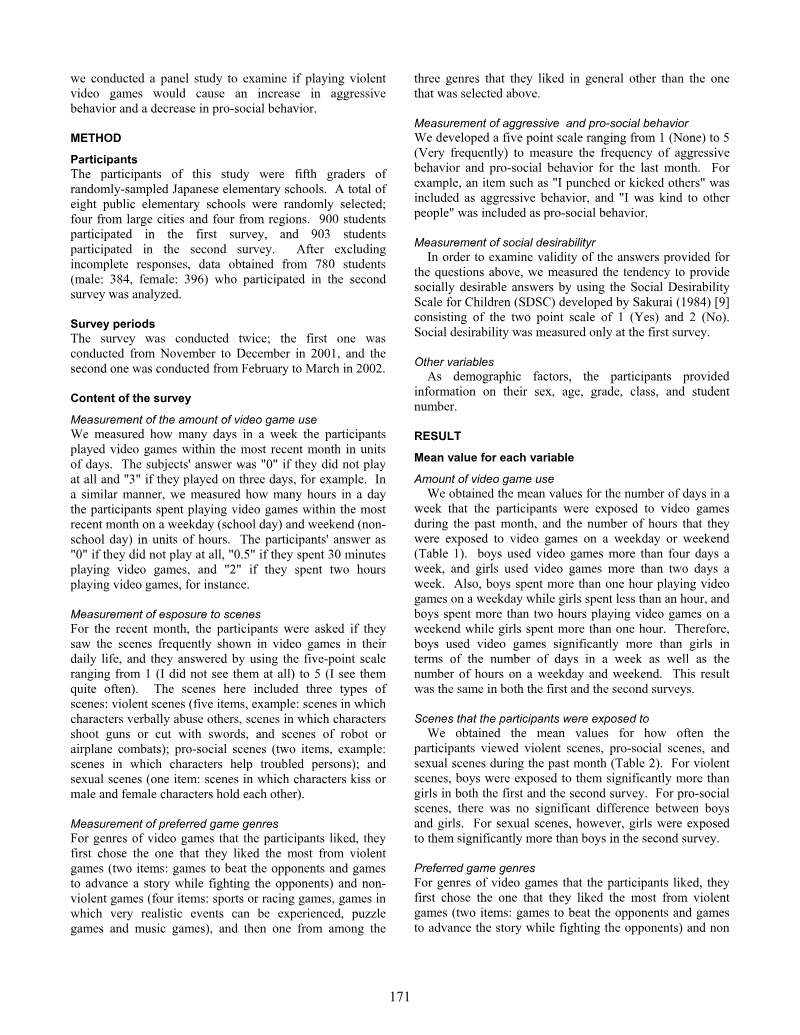
A three-wave web survey among adults in the Tokyo metropolitan area yielded 1,367 valid responses.
Sample. The survey yielded 1,367 valid responses from an initial screened pool of 1,519.
This study examines whether commercial video games can help train sociality, drawing on four social-skill learning principles (modeling, verbal instruction or coaching, operant conditioning, and rehearsal) to assess how game design might cultivate social abilities. Its central question is whether games already embed such features and how players perceive their effects. The research relies on a three-wave web survey conducted between December 2005 and January 2006 among adults in the Tokyo metropolitan area, yielding 1,367 valid responses from an initial screened pool of 1,519, with players' open-ended descriptions coded for sociality-enhancing features and reported outcomes.
The findings show that the majority of responses (roughly 65.5 percent) attribute sociality gains to practicing or experiencing social behaviors within games, while mechanisms rooted in explicit learning theory, such as modeling admired characters, receiving verbal instructions, or gaining explicit knowledge, appeared far less often. Responses were unevenly distributed across sociality traits: qualities such as preventing everyday problems, following social rules, and feeling a sense of belonging to the game world drew few mentions, which the authors interpret either as a scarcity of games targeting these traits or as players failing to recognize such benefits.
The most frequently reported change was increased motivation to learn sociality, and many players subjectively judged their own social abilities to have improved. The authors conclude that commercial games, particularly those emphasizing trust, understanding others, and caring for living things, may nurture sociality by simulating experiences that motivate real-world behavior. Because these conclusions rest on self-reported perceptions from a single urban Japanese population, the authors emphasize that further research is needed to determine whether the effects transfer to actual social conduct.

DiGRA · 2022

DiGRA · 2022



DiGRA · 2022



DiGRA · 2022

DiGRA · 2022

DiGRA · 2022



DiGRA · 2022

DiGRA · 2022

DiGRA · 2022



DiGRA · 2022



DiGRA · 2022

DiGRA · 2022
Bryter · 2026