
DiGRA
The Digital Games Research Association: the international association of academics and professionals who study digital games. Its Digital Library holds the proceedings of the DiGRA conferences since 2002.
Documents
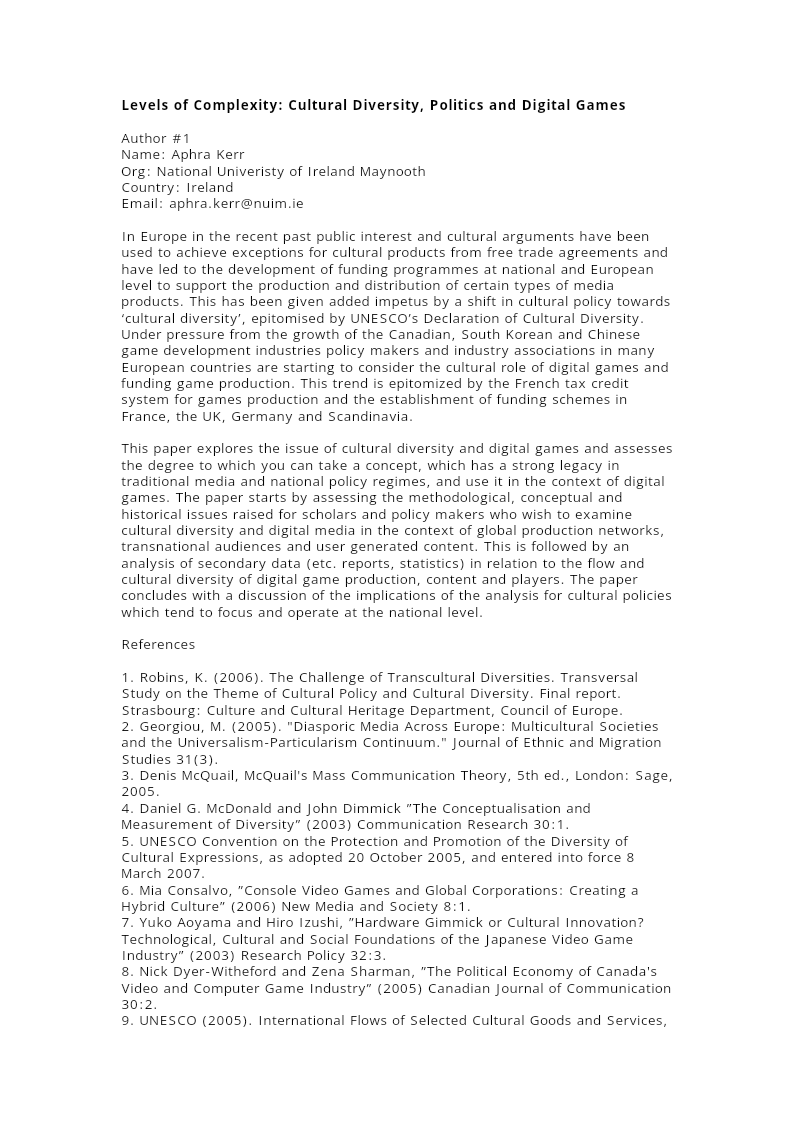
Levels of Complexity: Cultural Diversity, Politics and Digital Games
This paper examines whether the concept of cultural diversity, which has a long history in traditional media and national cultural policy, can meaningfully be applied to digital games.
- The paper argues that cultural diversity, a concept rooted in traditional media and national cultural policy, must be rethought for digital games shaped by global production networks, transnational audiences, and user-generated content.
- European policymakers increasingly treat digital games as a cultural industry deserving public support, but the author contends that existing national policy frameworks are poorly matched to how games are produced and consumed.
- Support mechanisms cited include the French tax credit system and dedicated schemes in the United Kingdom, Germany, and Scandinavia, while Canada, South Korea, and China are noted as competitive pressures on European game industries.
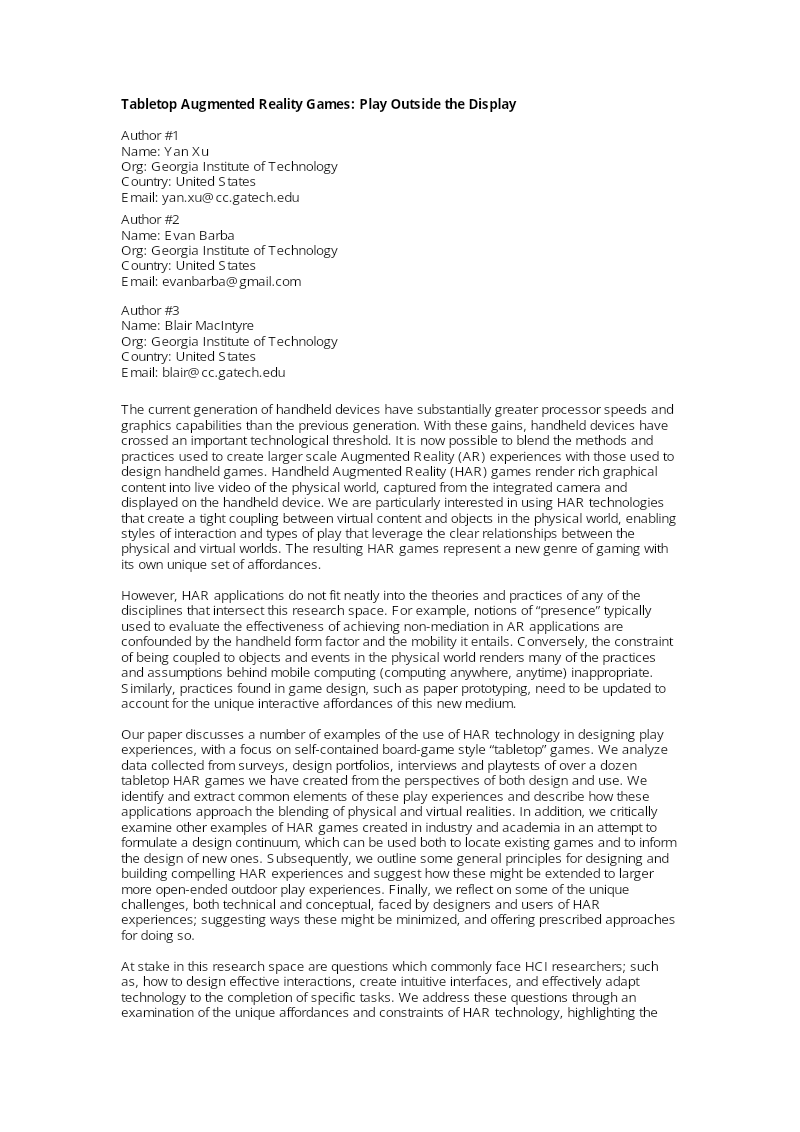
Tabletop Augmented Reality Games: Play Outside the Display
This paper from Georgia Institute of Technology examines handheld augmented reality (HAR) games, arguing that recent gains in mobile processing and graphics have made it possible to blend large-scale AR techniques with handheld game design.
- Handheld augmented reality (HAR) games are presented as a new genre, enabled by recent gains in mobile processing and graphics, whose tight coupling of virtual content with physical objects creates distinctive forms of play that existing AR, mobile computing, and game design frameworks do not adequately account for.
- The paper focuses on self-contained, board-game-style "tabletop" HAR games, drawing on surveys, design portfolios, interviews, and playtests of more than a dozen such games created by the authors.
- The authors identify common elements of play and how these applications merge physical and virtual realities, and they propose a design continuum for classifying existing HAR titles and guiding new ones.
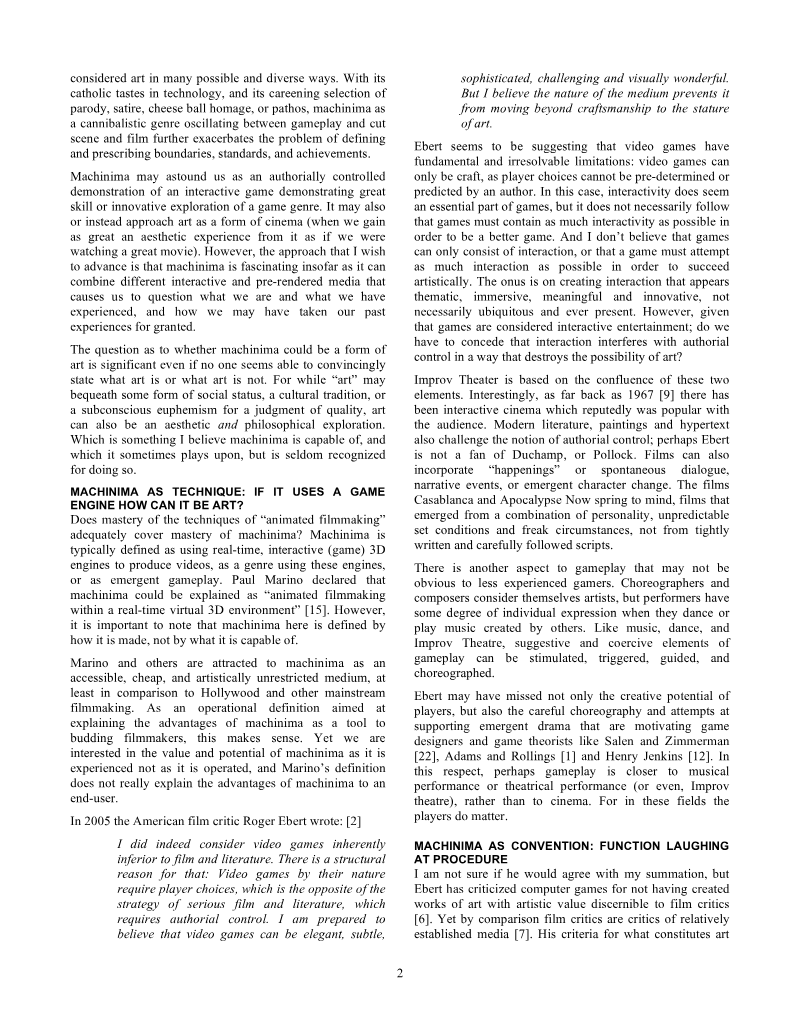
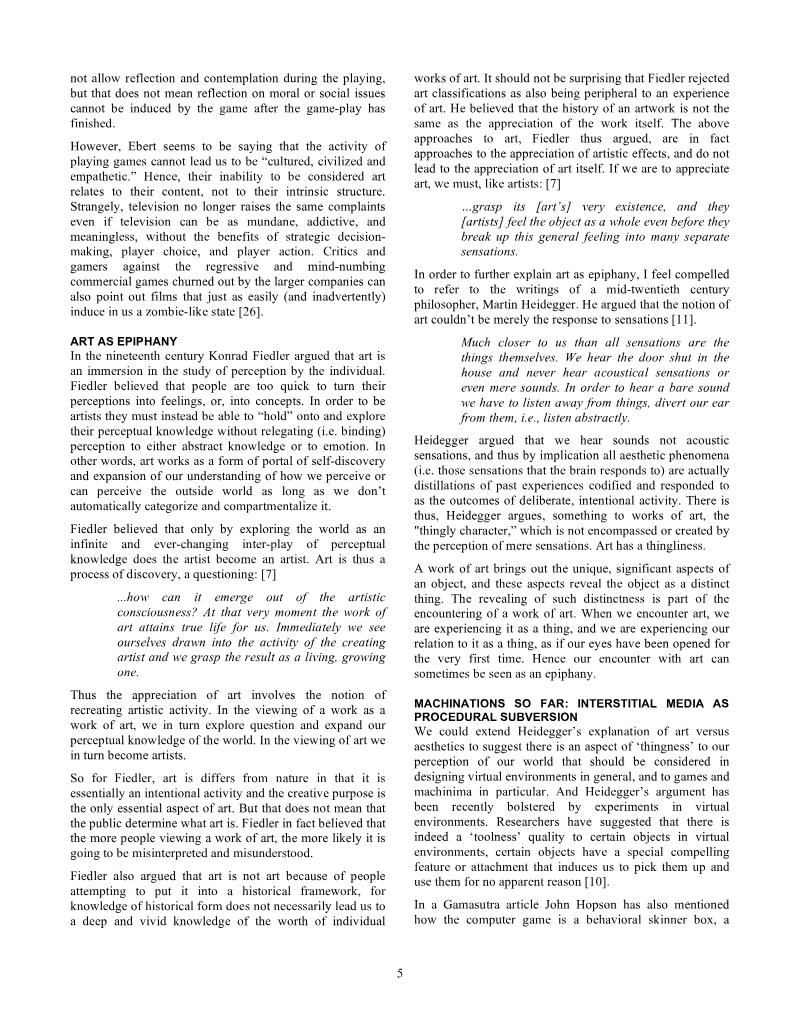
Keeping It Reel: Is Machinima a Form of Art?
Champion's paper, presented at DiGRA 2009, asks whether machinima, films produced inside game engines, can be regarded as art.
- The paper treats whether machinima (films made inside game engines) counts as art as an open question, noting that no agreed definition of art exists and that cinema-derived criteria fit games and machinima poorly.
- The author rejects the premise that games are inherently inferior to film, arguing that machinima's interactivity, procedural constraints, and parody of game conventions give it artistic potential of its own.
- Drawing on Fiedler and Heidegger, the paper holds that art is defined by intentional activity and the revealing of an object's "thingliness," and argues that machinima's blend of pre-scripted and real-time elements can produce reflective, artistic experience.
The Cheating Assemblage in MMORPGs: Toward a Sociotechnical Description of Cheating
This paper reframes cheating in massively multiplayer online role-playing games (MMORPGs) as a sociotechnical assemblage rather than a simple set of player actions that confer unfair advantage.
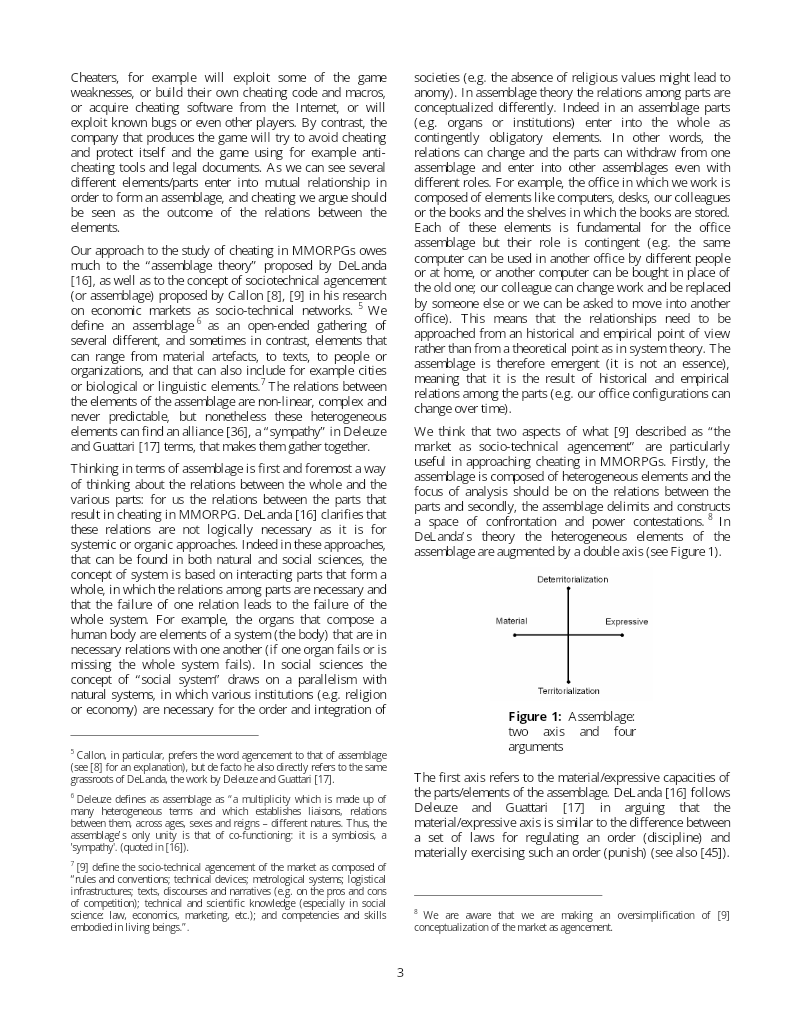
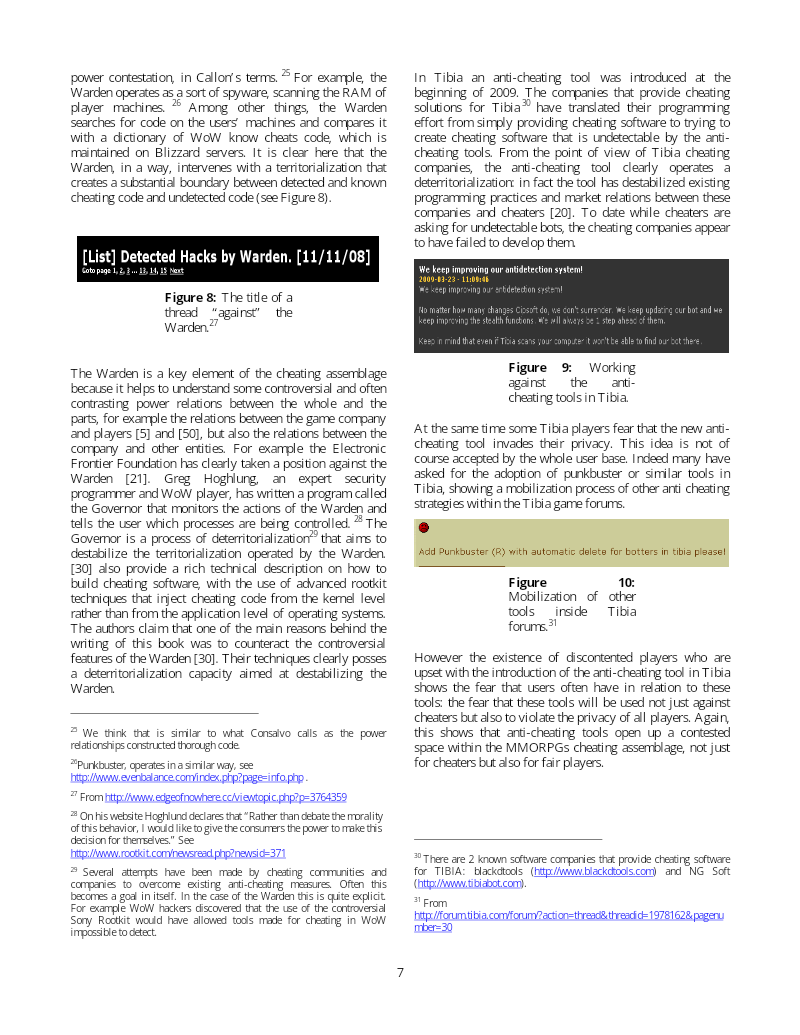
- The paper reframes cheating in MMORPGs as a sociotechnical assemblage, drawing on DeLanda and Callon, in which players, EULAs, anti-cheating tools, forums, server and client code, and gameplay design interact non-linearly rather than cheating being a simple set of player actions.
- The authors argue cheating should be analyzed through multi-level relationships rather than solely through technical prevention, positioning the work as a bridge between technical anti-cheating literature and media literature that treats cheating as intentional play.
- The empirical basis is qualitative: a pilot study of Tibia (roughly 300,000 players, September to November 2008), participant observation, forum posts, and the EULAs and Terms of Service of several MMORPGs including World of Warcraft, with no quantitative findings reported.
Commoditization of Helping Players Play: Rise of the Service Paradigm
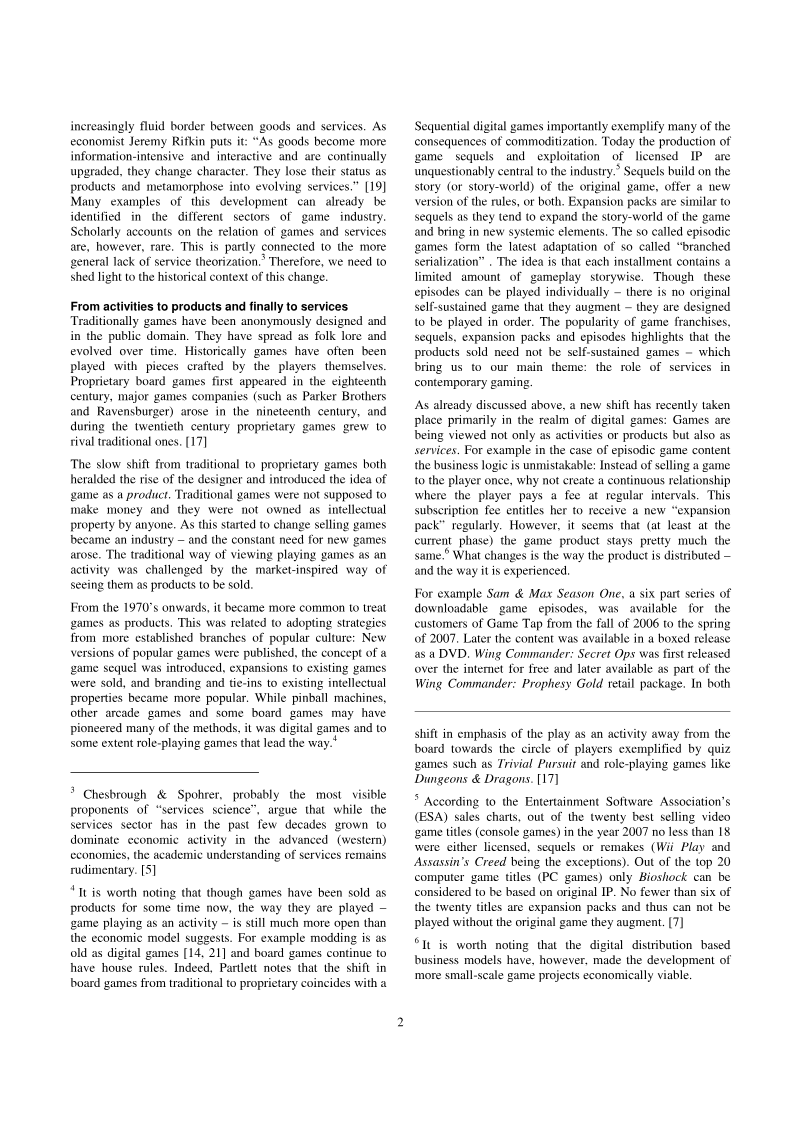
The game industry's shift from selling fixed products to delivering ongoing services is the central subject of this analysis, which situates the transformation within broader post-Fordist patterns of commodification.
- The central argument is that the game industry's shift from selling fixed products to delivering ongoing services lies less in the game artifact itself than in how games are sold, delivered, and sustained over time.
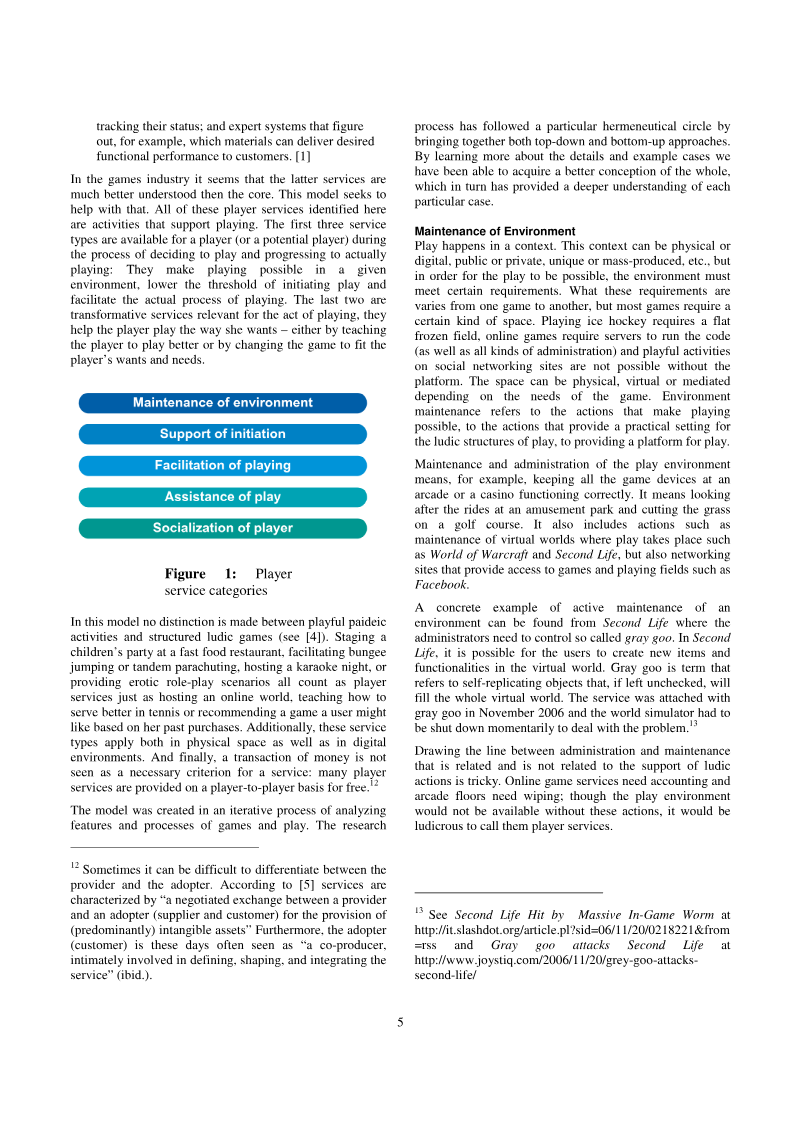
- Subscriptions, expansion packs, episodic content, and persistent worlds are framed as mechanisms for building long-term customer relationships, and the authors contend that prevailing 'games as services' economic models tend to overlook the player's own experience.
- Evidence centers on console and PC markets around 2007, when most top-selling console titles were licensed properties, sequels, or remakes and expansion packs dominated PC sales, showing a service orientation before subscription models became dominant.
The Gigue Is Up: High Culture Gets Game
"The Gigue Is Up: High Culture Gets Game" examines whether Baroque music education can succeed when delivered through interactive game design rather than conventional instruction.
- The project is a 2009 DiGRA exploratory design account: 'Tafelkids: The Quest for Arundo Donax,' a free Flash-based game for ages 8–14, teaches Baroque music through mini-games covering orchestra identification, musical inscription, and a rhythm-action-style Baroque dance game.
- Play-testing with more than 150 students aged 12–14 across three sessions showed high engagement but only mixed evidence of learning, as students often ignored instructions and curricular information bubbles.
- Post-play recall of dance types, instrument sounds, and historical facts was encouraging but not conclusive evidence that the game produced learning.
From Simulation to Imitation: New Controllers, New Forms of Play
This paper, by Jennifer Jenson and Suzanne de Castell, argues that the recent proliferation of new game controllers, such as the Wii remote, plastic guitars, microphones, dance pads, and the Nintendo DS touch screen, marks an epistemological shift in digital gameplay from simulation toward imitation.
- The paper argues that new controllers such as the Wii remote, plastic guitars, microphones, dance pads, and the Nintendo DS touch screen shift digital gameplay from simulation (translating button presses into on-screen actions) toward imitation (requiring players to physically mirror real-world movements).
- The authors propose the simulation-versus-imitation distinction as a conceptual tool for understanding digital game-based learning, grounding it in actor-network theory, educational theory, and philosophical accounts of mimesis from Aristotle and Adorno.
- A pilot study in summer 2007 with four young adults (two with musical training, two without) found that musically trained players picked up Guitar Hero II and American Idol-style karaoke games far more quickly than untrained players.
Teleporters, Tunnels & Time: Understanding Warp Devices in Videogames
Gazzard's paper examines the warp as a recurring "time/space" device in videogames, arguing that warps disrupt the fluidity of paths and remove the player's navigational control, converting open routes into predetermined "tracks."
- Warps break the one-to-one correspondence between play time and fictional time, and they disrupt the fluidity of paths by removing the player's navigational control, turning open routes into predetermined "tracks."
- The paper classifies puzzle warps into three types: jump warps (unidirectional, typically single-use, with visible or randomized destinations), return warps (bidirectional, sending players back to a prior location or elsewhere), and portals (the most flexible, with both endpoints fully visible).
- Warps can speed up exploration and shorten completion times, but they can also disrupt learning progression, strand players in dead ends, and enable cheating or temporal distortions.
What Videogame Making Can Teach Us About Access and Ethics in Participatory Culture
This study by Kafai, Burke, and Fields examines how access and ethics shape participation in game-making among young people, with particular attention to the tensions between sharing, remixing, and appropriation in digital culture.
- Youth participation in game-making deepened over time: students who initially hesitated to share their work publicly gradually moved from offline tinkering to downloading and remixing others' projects.
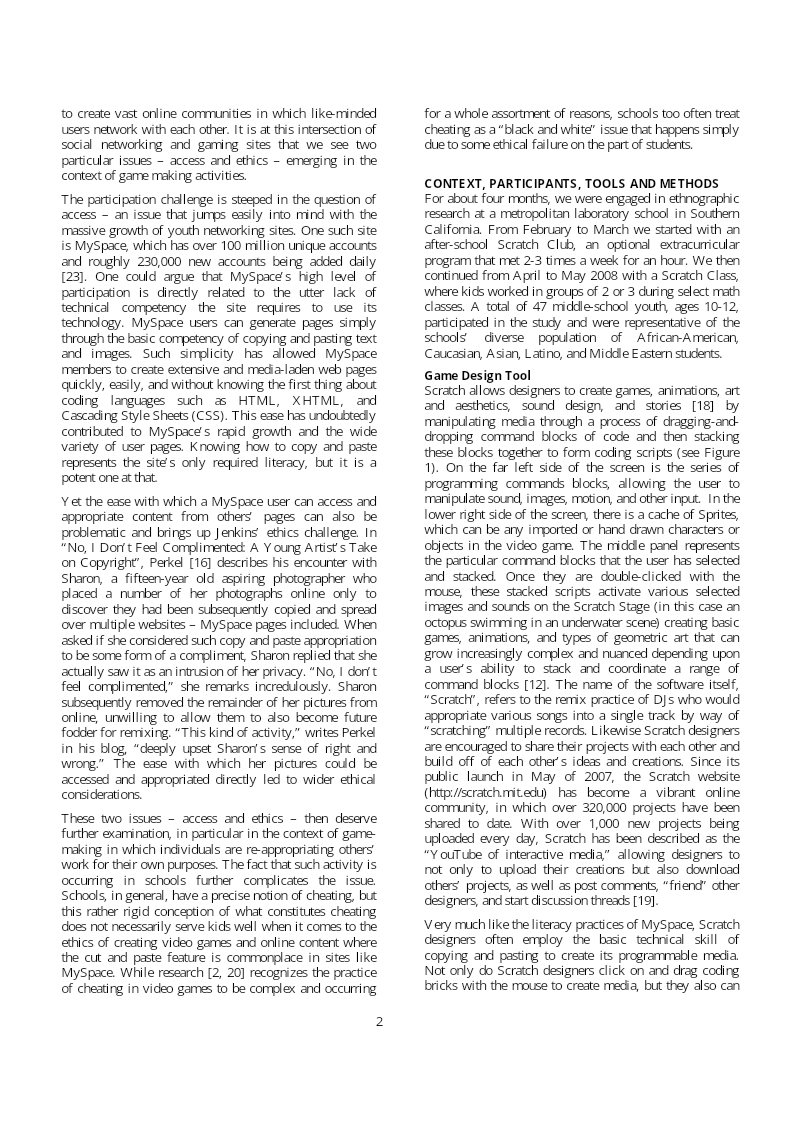
- Remix culture raises real ethical tensions around appropriation, since copy-and-paste is easy on platforms like Scratch (which hosted more than 320,000 projects) and MySpace, and students' reactions ranged from valuing shared code for improving their own work to feeling wronged when their creations were reused without credit.
- The study's findings are drawn from a four-month ethnographic investigation of 47 middle-school students aged 10 to 12 in a Scratch after-school club and classroom.
In the Horrifying Magic Cycle of Resident Evil 5: A Case Study
Bernard Perron's paper uses Resident Evil 5 (Capcom, 2009) as a case study to test and refine his gameplay-centric model of play, which he frames as an ongoing cognitive process rather than the static "magic circle" proposed by Huizinga.
- Bernard Perron's paper uses Resident Evil 5 (Capcom, 2009) to test and refine a gameplay-centric model of play, framing it as an ongoing cognitive process rather than Huizinga's static "magic circle."
- The model rests on three interconnected spirals: the heuristic spiral of gameplay (considered the most important), the heuristic spiral of narrative, and the hermeneutic spiral of interpretation, with each pass through the loop building player skill and knowledge.
- The study is a first-person autoethnographic account tracing Perron's progression from first contact to first ending, recording how long it took to master controls, manage inventory, develop strategies against enemies and bosses, and clear chapters on the first attempt.
A Platform-Independent Model for Videogame Gameplay Specification
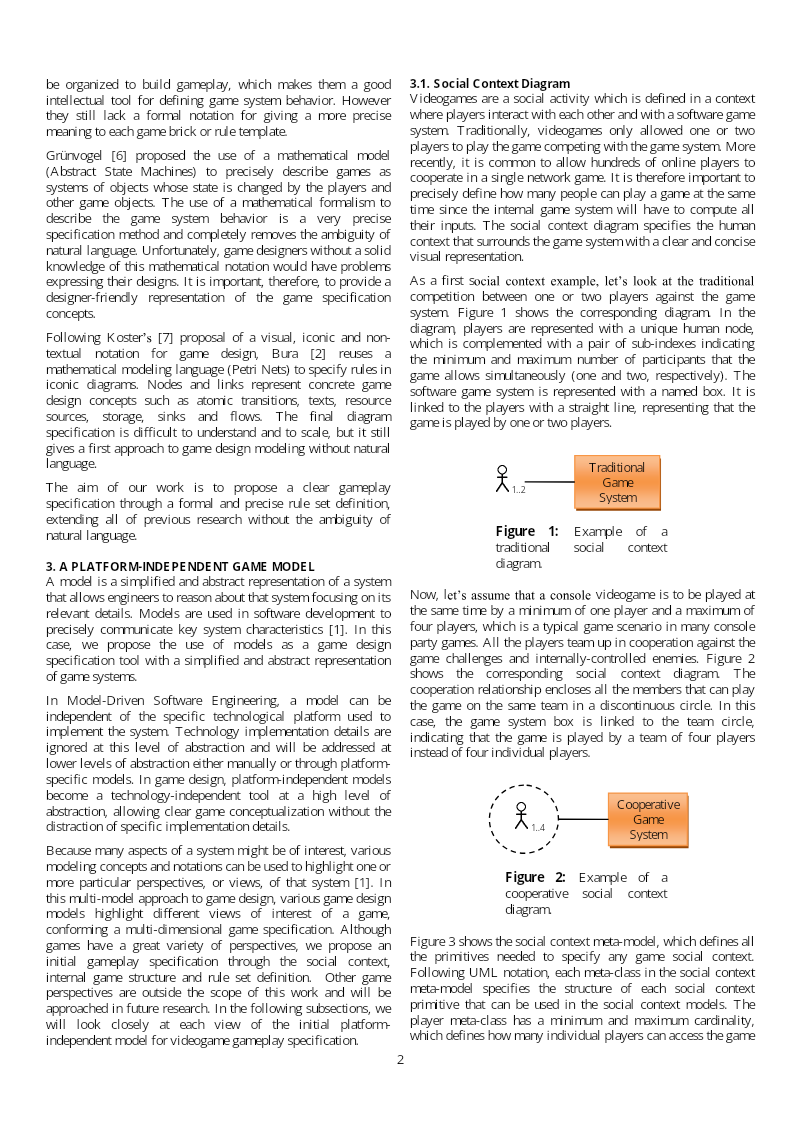
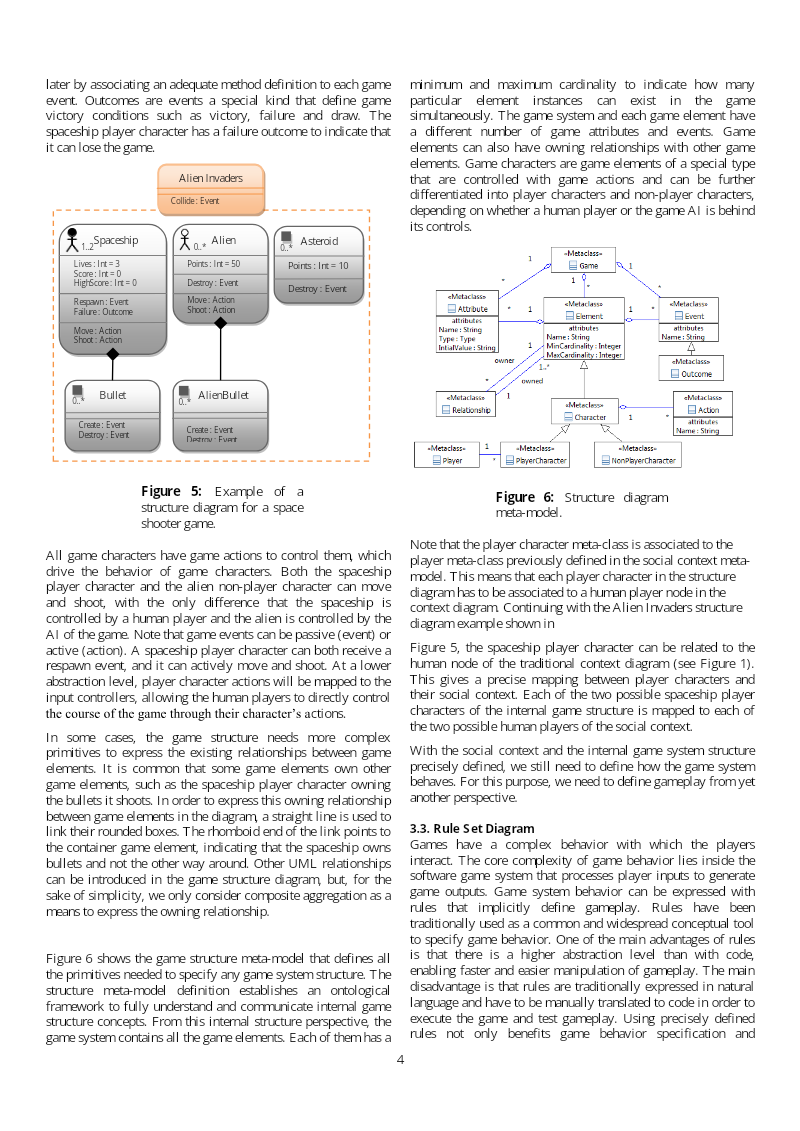
This paper proposes a platform-independent model for specifying videogame gameplay, aimed at giving game designers a precise alternative to natural language rule descriptions, which the authors argue are ambiguous and hinder the transition from design to implementation.
- The paper proposes a platform-independent, model-driven notation for videogame gameplay rules, aiming to replace ambiguous natural-language rule descriptions that hinder the transition from design to implementation.
- The model has three complementary views: a social context diagram (player and team cardinality, cooperative or competitive relationships), a structure diagram (attributes, events, actions, ownership, and player vs. non-player characters), and a rule set diagram (pre- and post-condition rules classified as action, internal, or goal rules).
- The framework builds on established ludology work, including Frasca's manipulation, goal, and meta-rule classification and Salen and Zimmerman's operational, constitutive, and implicit rules.
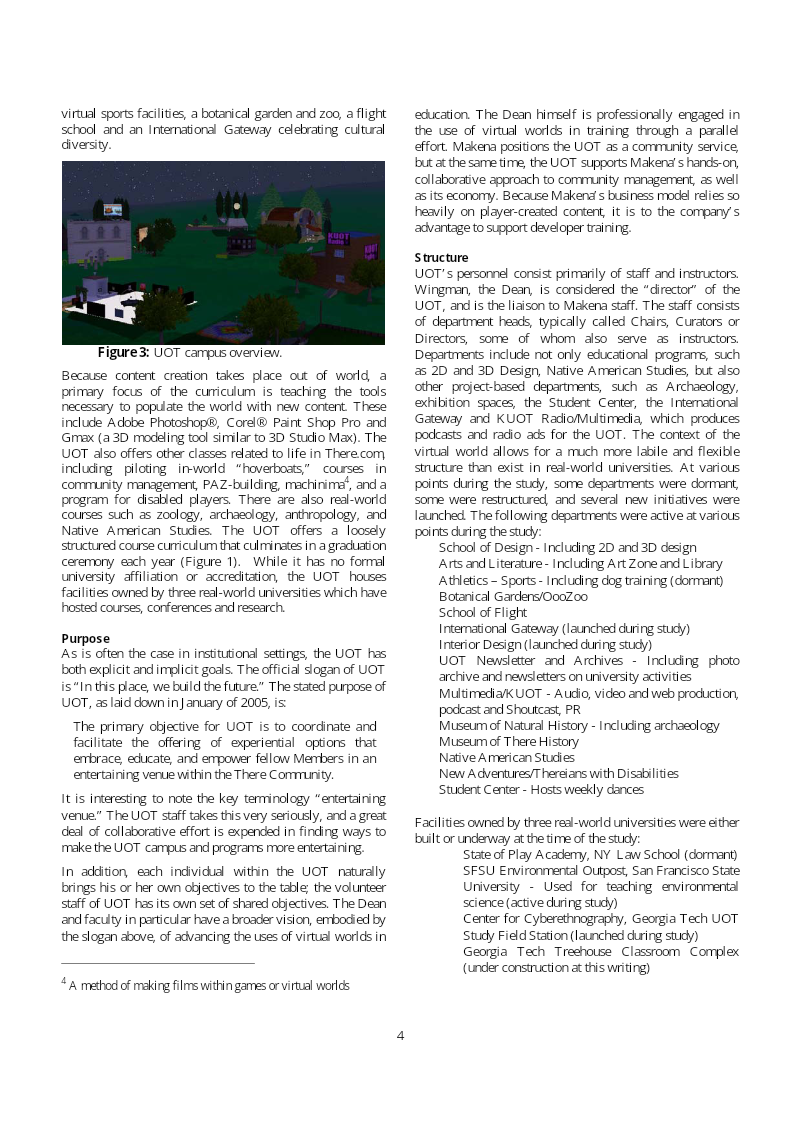
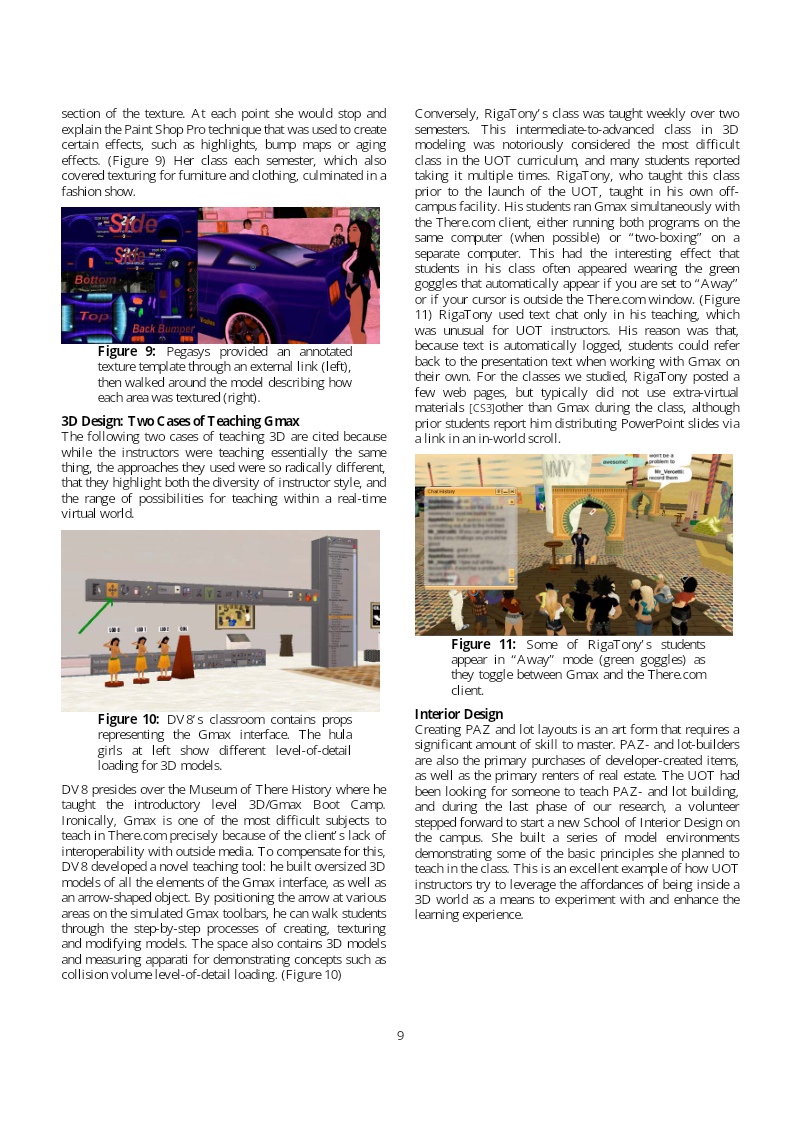
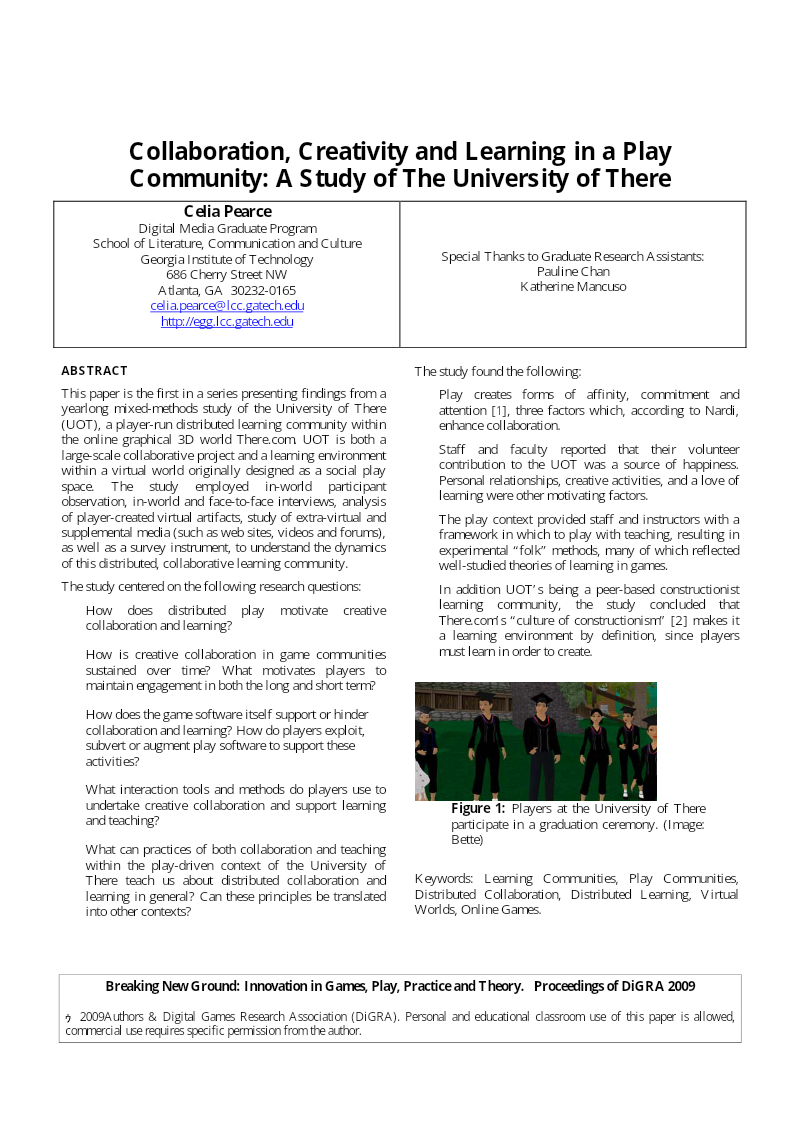
Collaboration, Creativity and Learning in a Play Community: A Study of The University of There
The University of There, a volunteer-run educational community within the 3D virtual world There.com, is examined in this study through a one-year mixed-methods investigation conducted between 2008 and 2009.
- The study identifies play-based affinity, commitment, and attention as the main drivers of collaboration in The University of There, a volunteer-run educational community within the 3D virtual world There.com (estimated 1.8 million players).
- Community approval is the main motivator for user content creation, and learning happens in situ within the three-dimensional world, with participants fluidly switching between teacher and learner roles.
- Staff reported a disability rate of over one-third, far above the national figure of 15 percent, a demographic detail the authors flag as significant to the community's character.