1 free read left. Create a free account for unlimited reading + AI research.
Create free accountWhitepaper DiGRA
1 free read left. Create a free account for unlimited reading + AI research.
Create free accountWhitepaperDiGRA
Distilling the key insights…
Bernard Perron's paper uses Resident Evil 5 (Capcom, 2009) as a case study to test and refine his gameplay-centric model of play, which he frames as an ongoing cognitive process rather than the static "magic circle" proposed by Huizinga. In his model, three interconnected spirals govern the player's engagement: the heuristic spiral of gameplay, considered the most important, the heuristic spiral of narrative, and the hermeneutic spiral of interpretation. Each cycle represents the iterative process by which a player answers questions about mechanics, story, and meaning, gaining skill and knowledge with every pass through the loop.
The study is a first-person, autoethnographic account. Perron documents his horizons of expectation, prior knowledge of the Resident Evil series, and pre-release information drawn from previews and the demo. He then traces his progression from first contact to first ending, recording how long it took to master controls, manage the extended inventory, develop strategies against enemies and bosses, and clear chapters on the first attempt. Particular attention is paid to the game's cooperative focus, which the developer presents as a revolution in how the series is played, and to how the narrative about the virus's origin is gradually revealed.
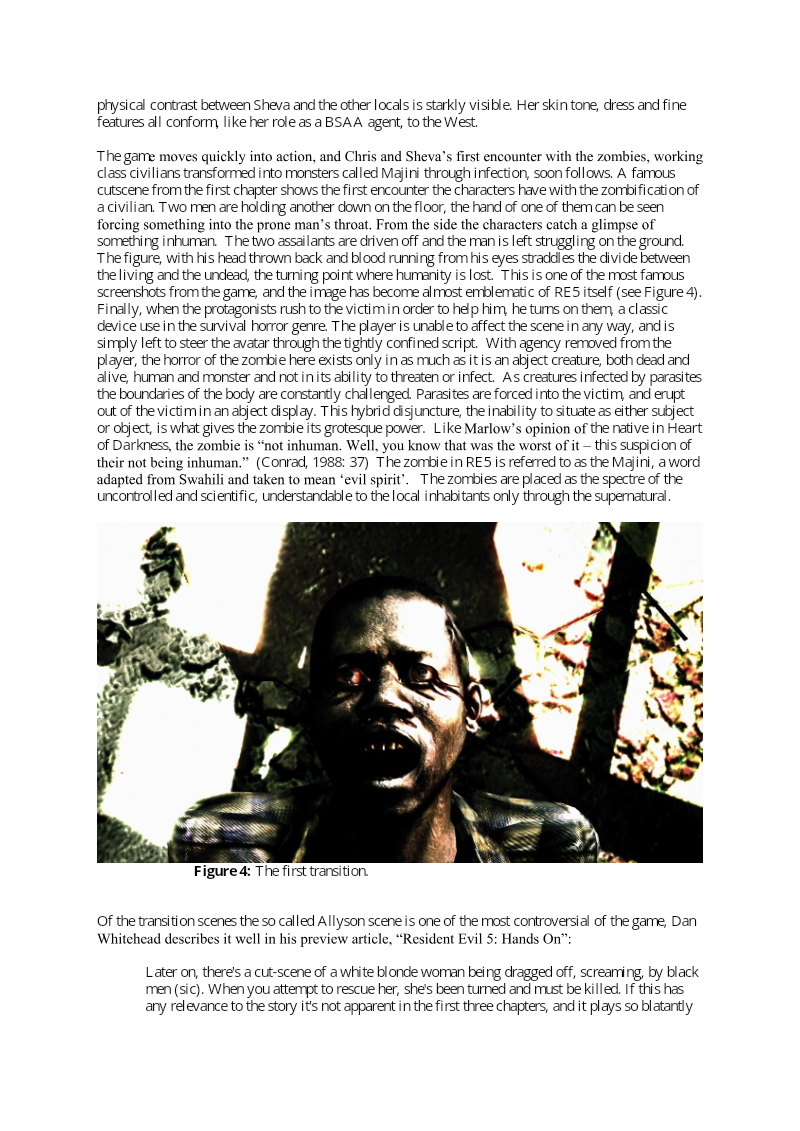
The paper also engages the controversy surrounding the game's African setting and the depiction of the Majini as Black characters, positioning this as an occasion for hermeneutic analysis of the game's meanings. Beyond this single title, Perron uses the analysis to advance his broader study of the video game horror genre. He asks what Resident Evil 5 contributes to survival horror, what gameplay patterns recur across the series, and whether fear and adrenaline change when players team up with an AI companion or another human against an overwhelming undead threat.