
DiGRA
The Digital Games Research Association: the international association of academics and professionals who study digital games. Its Digital Library holds the proceedings of the DiGRA conferences since 2002.
Documents
Online Video Games in Brazilian Public Health Communication
This paper, drawn from an ongoing doctoral dissertation, examines the potential of online video games, particularly massively multiplayer online role-playing games (MMORPGs), as a channel for public health communication in Brazil.
- Brazil's Unified Health System (SUS) relies heavily on centralized, prescriptive, and unidirectional communication, which tends to ignore local contexts and is less effective with young audiences.
- The authors propose online video games, particularly MMORPGs, as an interactive, dialogic channel that combines entertainment with health education.
- MMORPGs suit health messaging because players progress at their own pace, allowing content to be tailored to individual interests and limitations.
Why Gamers Don't Learn More: An Ecological Approach to Games as Learning Environments
Linderoth's paper challenges the widely held assumption that well-designed games are inherently good learning environments.
- Linderoth argues that well-designed games are not inherently good learning environments: players can perform complex tasks and perceive affordances without developing the corresponding skills, challenging James Paul Gee's claim that good games teach.
- Gee's claim is found by the author to rest mainly on anecdote rather than systematic evidence, so the relationship between game design and learning is treated as an open empirical question.
- The central evidence is an interaction analysis of two players, an eight-year-old and a 36-year-old, playing LEGO Indiana Jones 2, interpreted through the ecological approach to perception and Gibson's concept of tools.
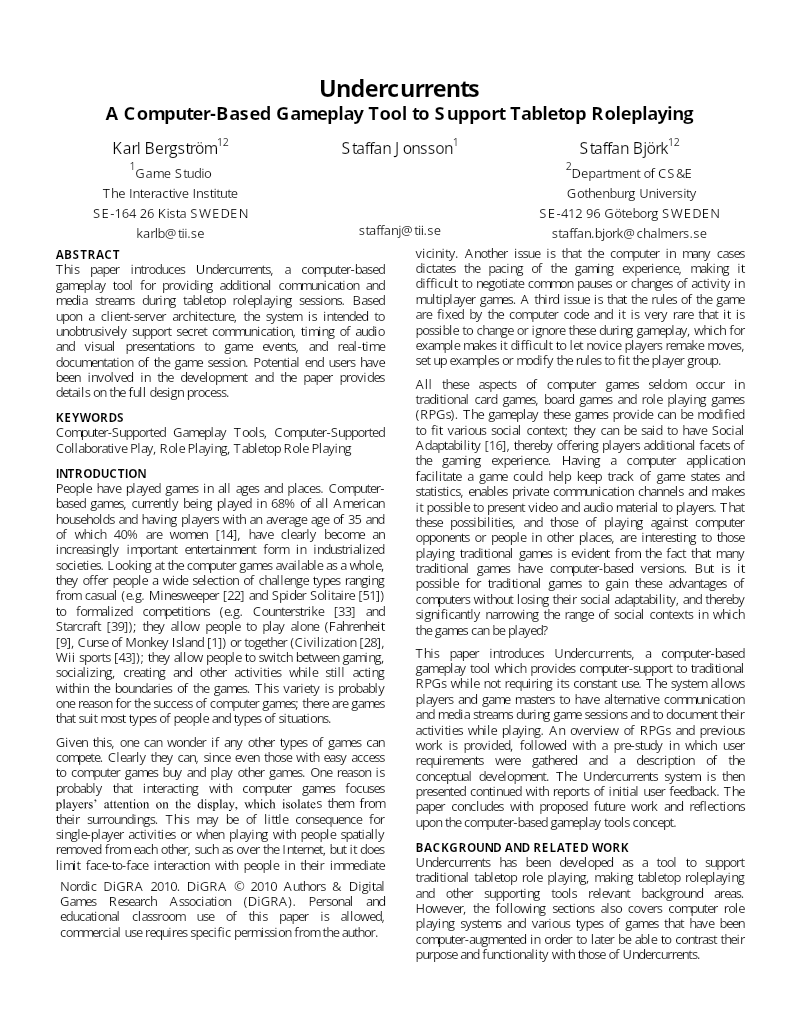
Undercurrents: A Computer-Based Gameplay Tool to Support Tabletop Roleplaying
Undercurrents is a computer-based tool designed to support tabletop roleplaying without dictating its rules, pacing, or social dynamics.
- Undercurrents is a computer-based tool that supports tabletop roleplaying without dictating its rules, pacing, or social dynamics, based on the thesis that computers add most value when they are under player control rather than acting as game authorities.
- The tool was designed to address limitations of traditional computer role-playing games, which impose fixed rules and rhythms, and offers features such as secret player-to-GM messaging, timed audio-visual presentations, and a real-time session wiki.
- Design requirements were gathered from three focus groups of tabletop game masters, all male and aged 16 to 45.
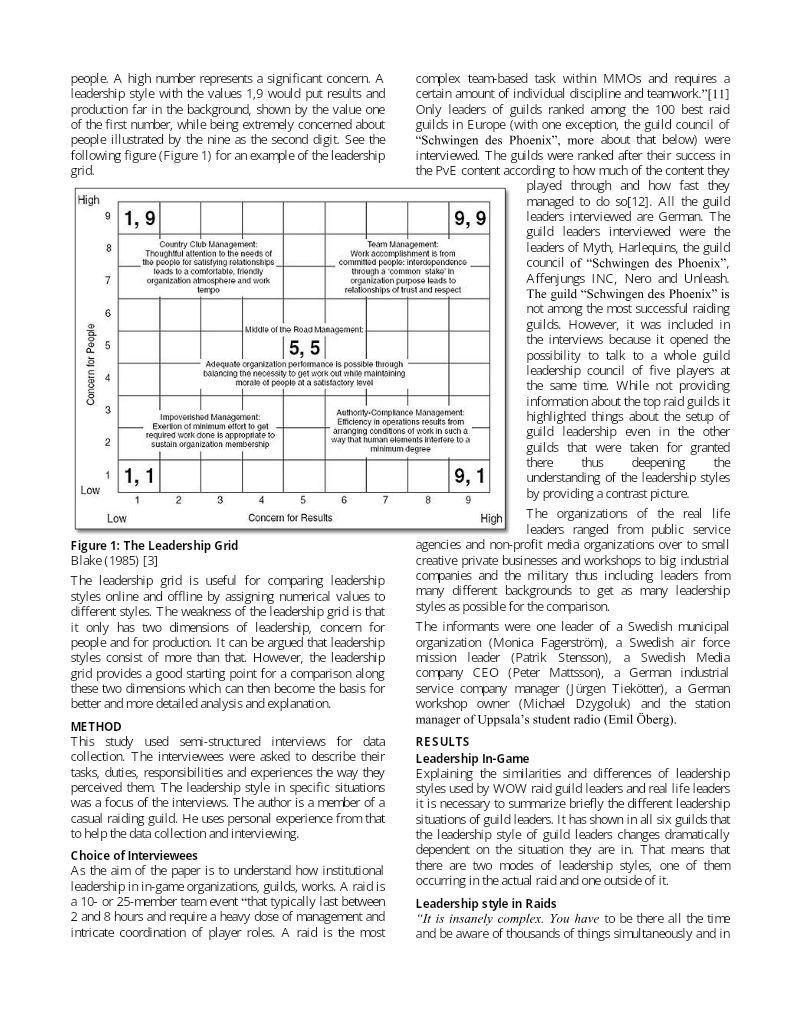
Leadership Style in World of Warcraft Raid Guilds
Patrick Prax's study examines how leaders of World of Warcraft raiding guilds manage their organizations, comparing their approaches with those found in real-life settings.
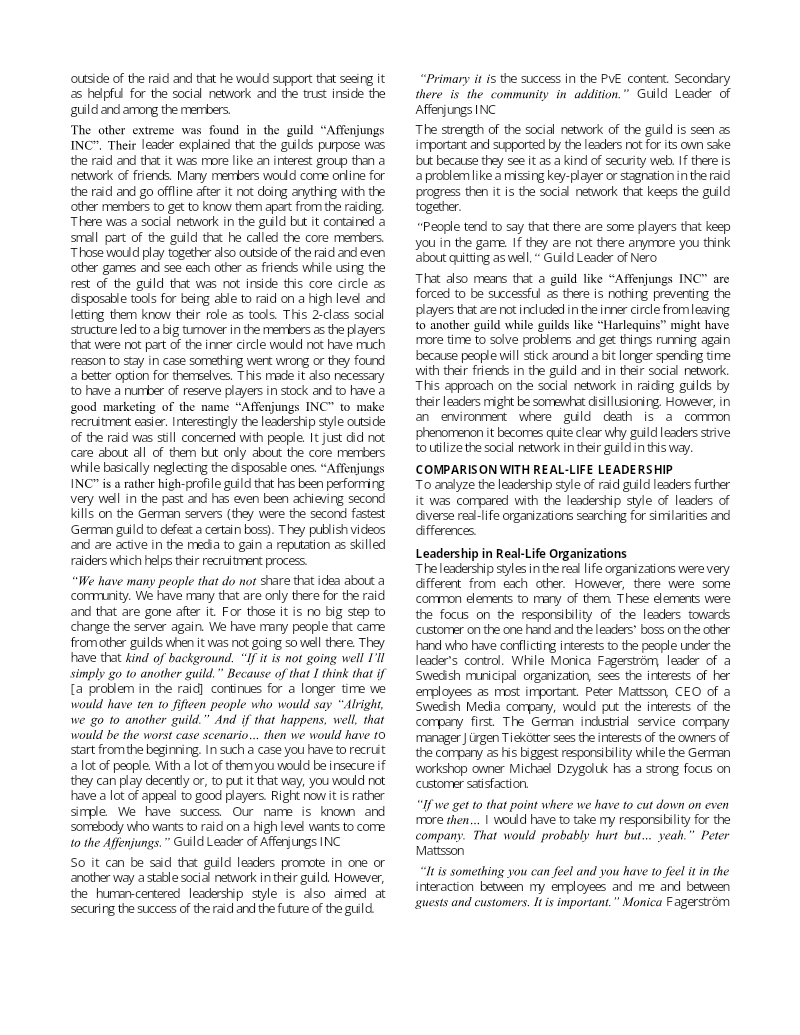
- Guild leaders behave in a 'Janus-faced' manner, switching between a results-focused, authority-compliance style during raids (scoring 9,1 on the Leadership Grid) and a people-focused, country-club style in everyday guild life that prioritizes members' social satisfaction, enjoyment, and sense of achievement.
- Raid stability is costly: a single absent player can force a raid cancellation, and that failure can cascade into the collapse of the guild, which is why leaders adopt a strict results orientation during raids.
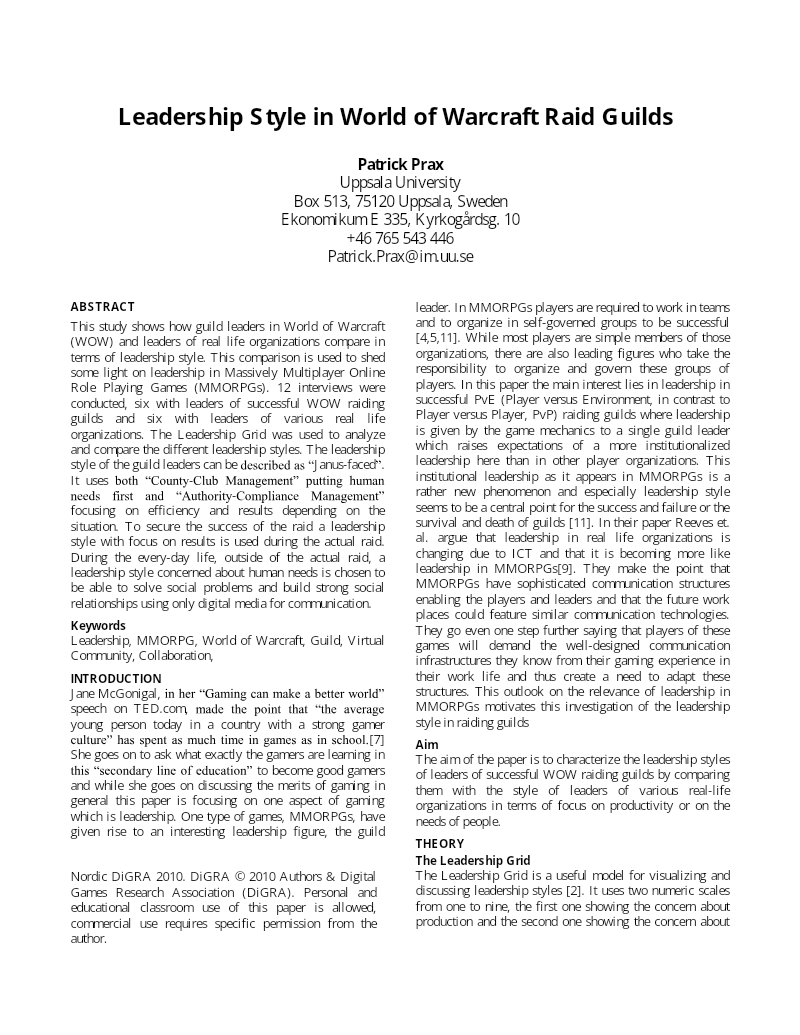
- The study compares two guilds at opposite ends of the spectrum: Harlequins never lost a member to another guild, while Affenjungs INC relied on a small core social circle, treated other members as 'disposable tools,' and suffered high turnover.
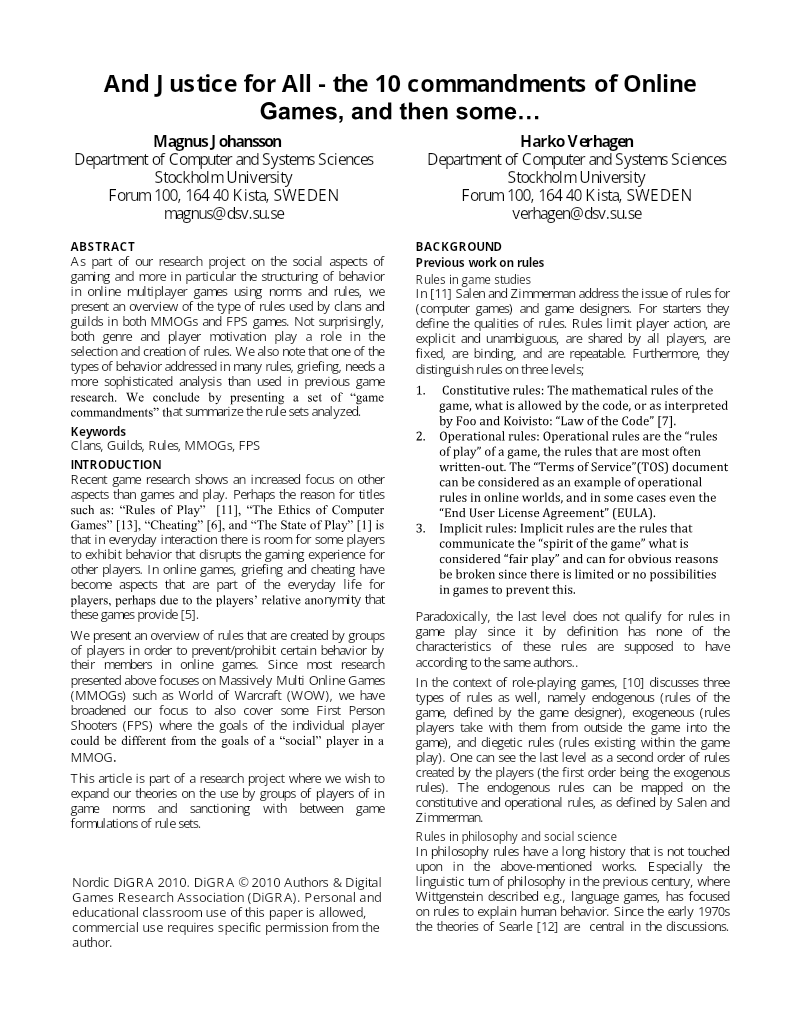
And Justice for All: The 10 Commandments of Online Games, and Then Some
This paper examines the rules that players themselves create to govern guilds in massively multiplayer online games (MMOGs) and clans in first-person shooter (FPS) games.
- The study analyzed 30 publicly posted player-authored rule sets (20 MMOG guilds and 10 FPS clans) from a convenience sample, framing them as a form of governance that fills gaps left by formal game rules, which the authors call "implicit rules."
- Both genres share a zero-tolerance stance toward racist and sexist remarks and common definitions of cheating, with variation mainly in how sanctions are applied and how strictly commitment is enforced.
- Raiding guilds and competitive clans use more instrumental, results-oriented structures, while MMOG guilds prioritize social cohesion and rely mainly on warnings as their principal sanction.
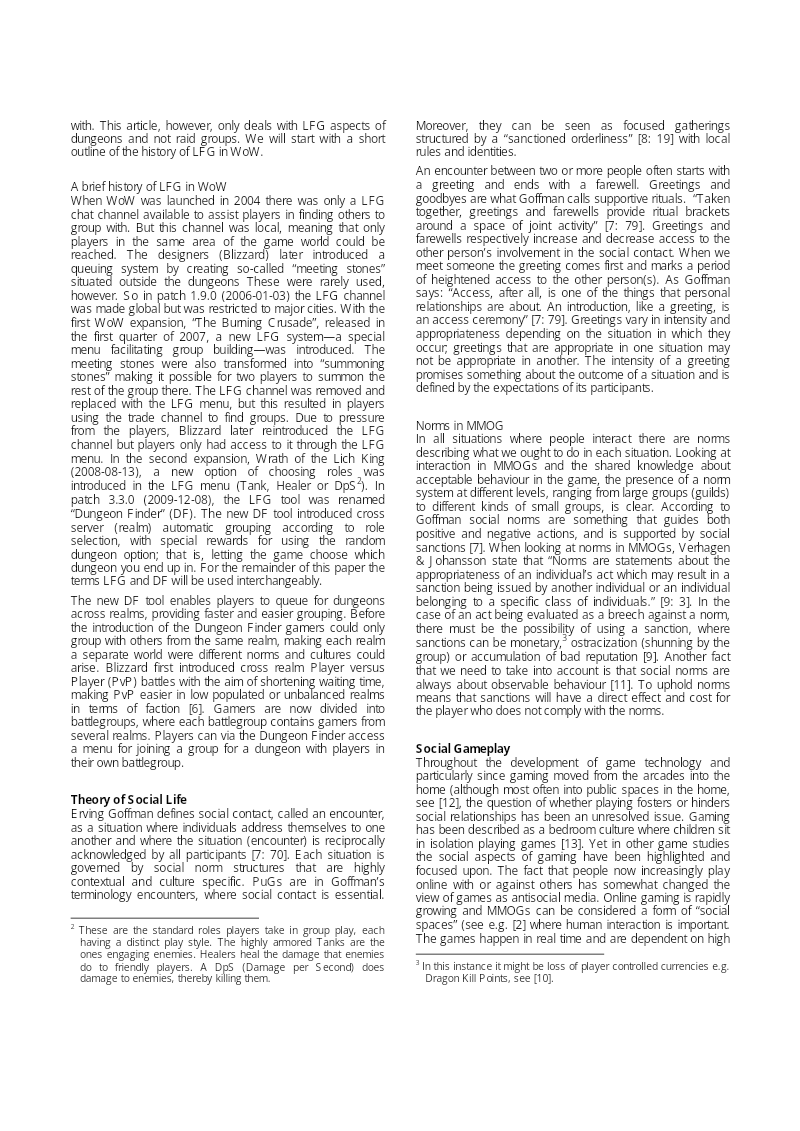
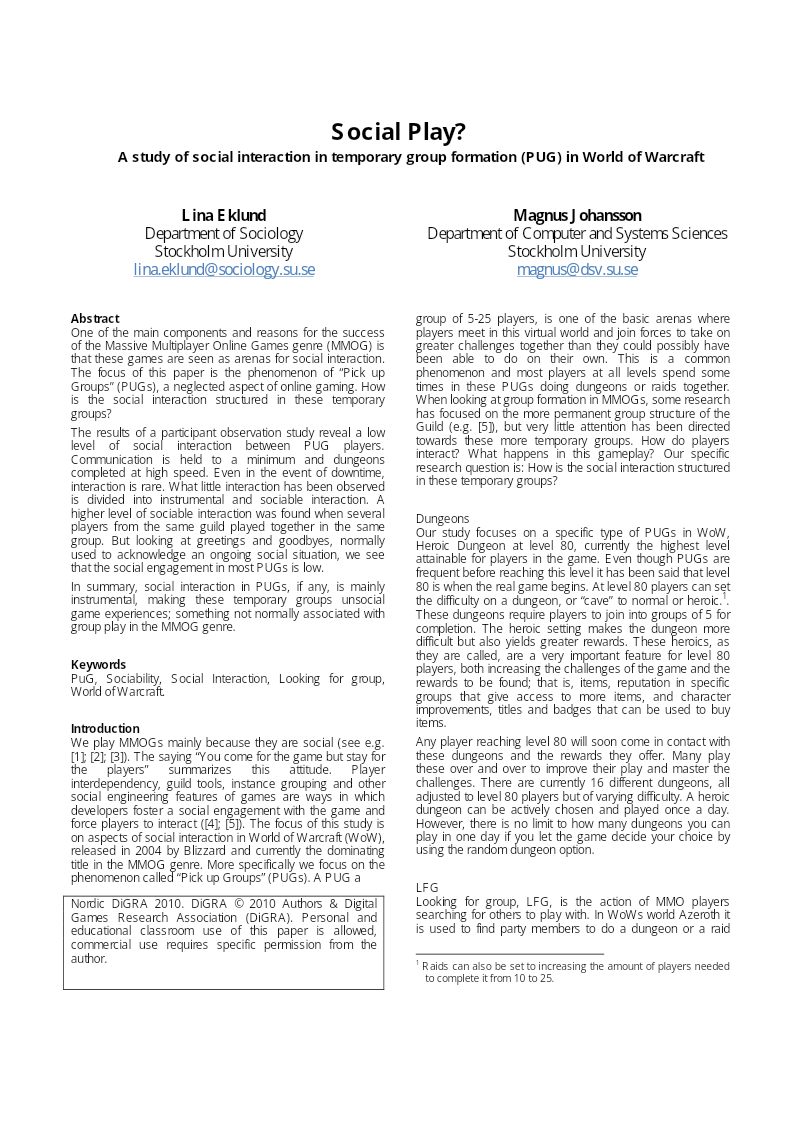
Social Play? A Study of Social Interaction in Temporary Group Formation (PUG) in World of Warcraft
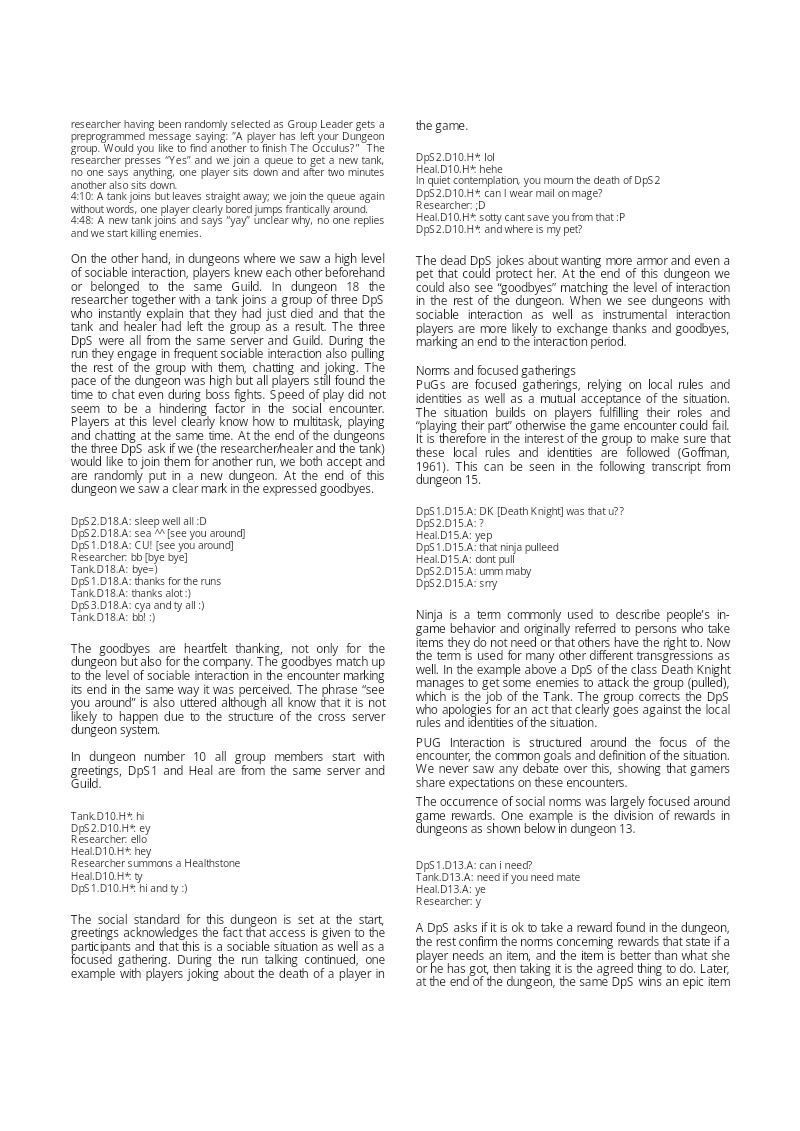
Drawing on 24 recorded random dungeon runs in World of Warcraft, this study examines social interaction in pick-up groups (PUGs), the temporary teams players form to complete dungeons with strangers.
- Pick-up group interaction in World of Warcraft dungeons is predominantly instrumental, focused on tactics, rewards, and task completion, with greetings, farewells, and rapport-building rare.
- The study, based on 24 recorded random dungeon runs, characterizes PUGs as largely "unsocial" when measured against the social expectations commonly associated with massively multiplayer online games.
- Sociable exchanges occur mainly when group members already share a guild or prior acquaintance, indicating that social engagement depends on existing ties rather than arising spontaneously in temporary groups.
Designing for Player Experience: How Professional Game Developers Communicate Design Visions
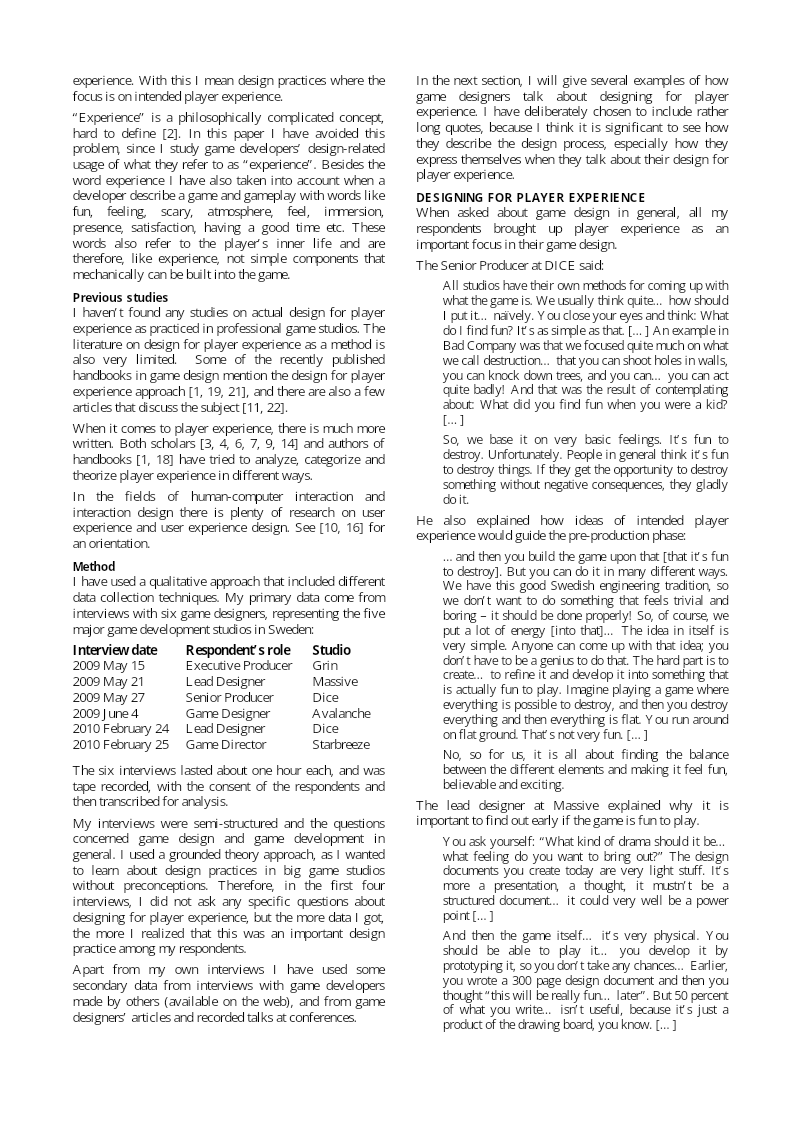
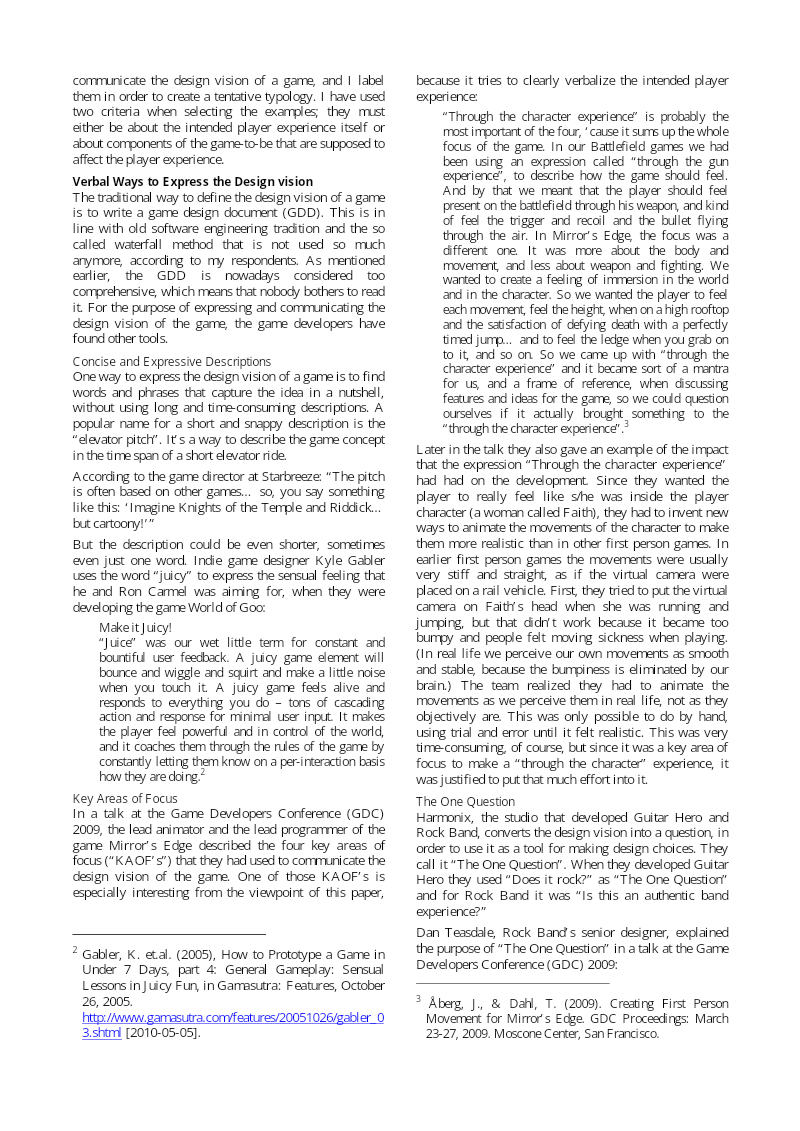
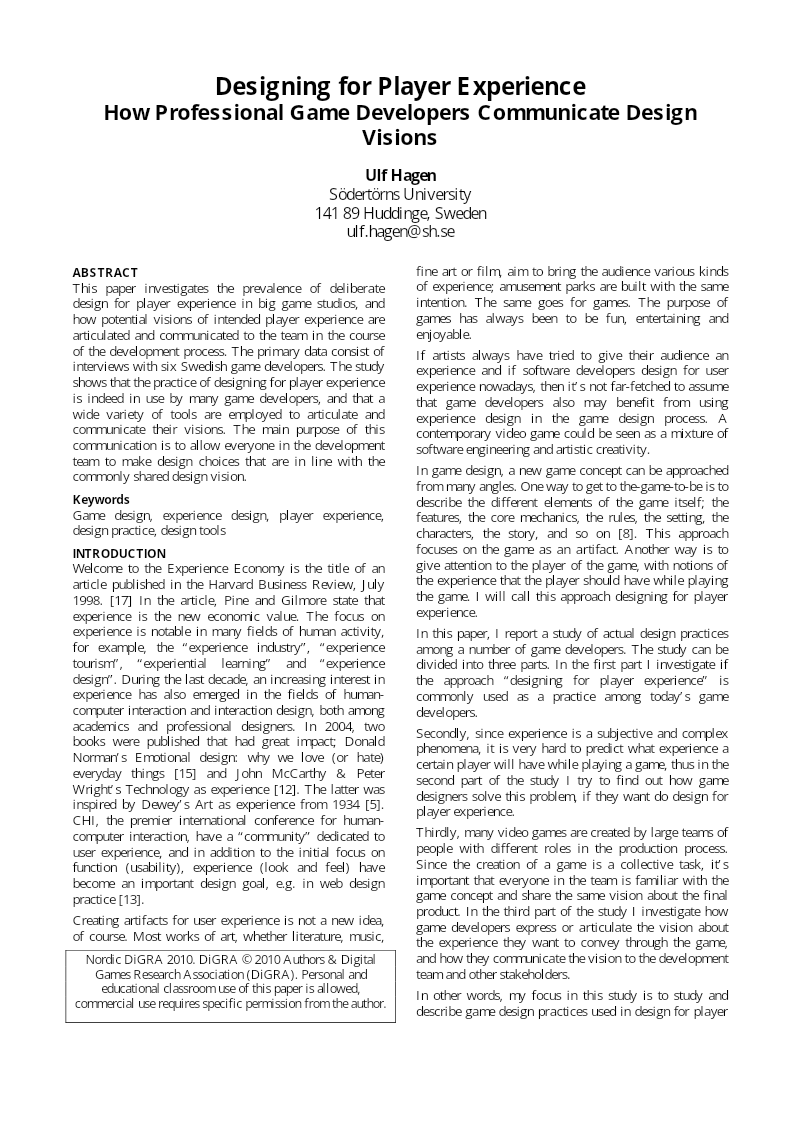
Hagen's study examines how professional game developers articulate and communicate the intended player experience of their games, focusing on Swedish studios.
- Designing for player experience, meaning the feelings a player should have rather than mechanics alone, is a widely practiced approach among professional developers, according to Hagen's study of six interviews with developers from five major Swedish studios.
- Strong game development depends on communicating a shared design vision so that team members can be creative within a common framework across large, multidisciplinary groups.
- Studios such as Dice, Harmonix, Avalanche, and Starbreeze communicate their visions through concise descriptors, similes, anti-exemplars, concept art, animation, and music rather than lengthy documents.
Review on Psychophysiological Methods in Game Research
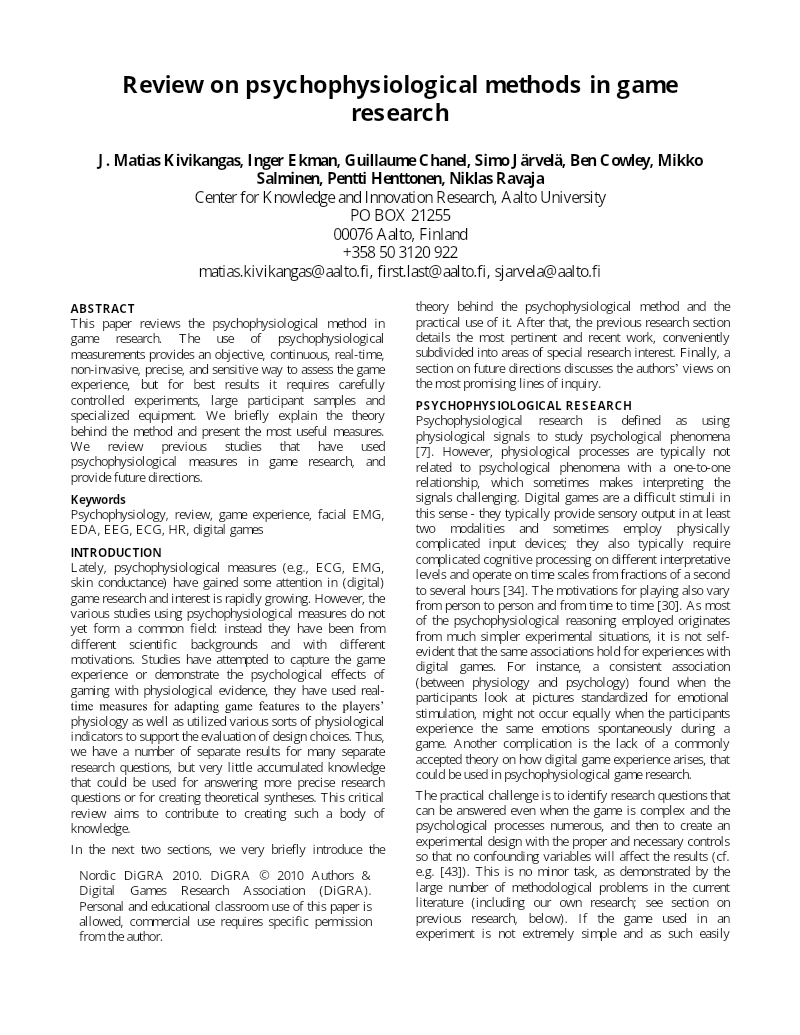
Kivikangas and colleagues' review examines how psychophysiological methods, which record bodily signals such as facial muscle activity, skin conductance, cardiac activity, and brain oscillations, can be applied to the study of games and play.
- Psychophysiological measures such as facial EMG (linked to emotional valence), electrodermal activity (linked to arousal), cardiac activity, and brain oscillations offer objectivity, continuous recording, and sensitivity to moment-to-moment experience, but face challenges in signal interpretation, a lack of shared theory, and the need for large samples and tightly controlled designs.
- In the FUGA project, electrodermal activity and facial EMG recorded during play predicted actual play behavior one week later, suggesting physiological responses can carry meaningful predictive value.
- Studies of social play report higher arousal and more positive valence when people compete against a friend or human opponent than against a computer, showing that social context shapes game experience.
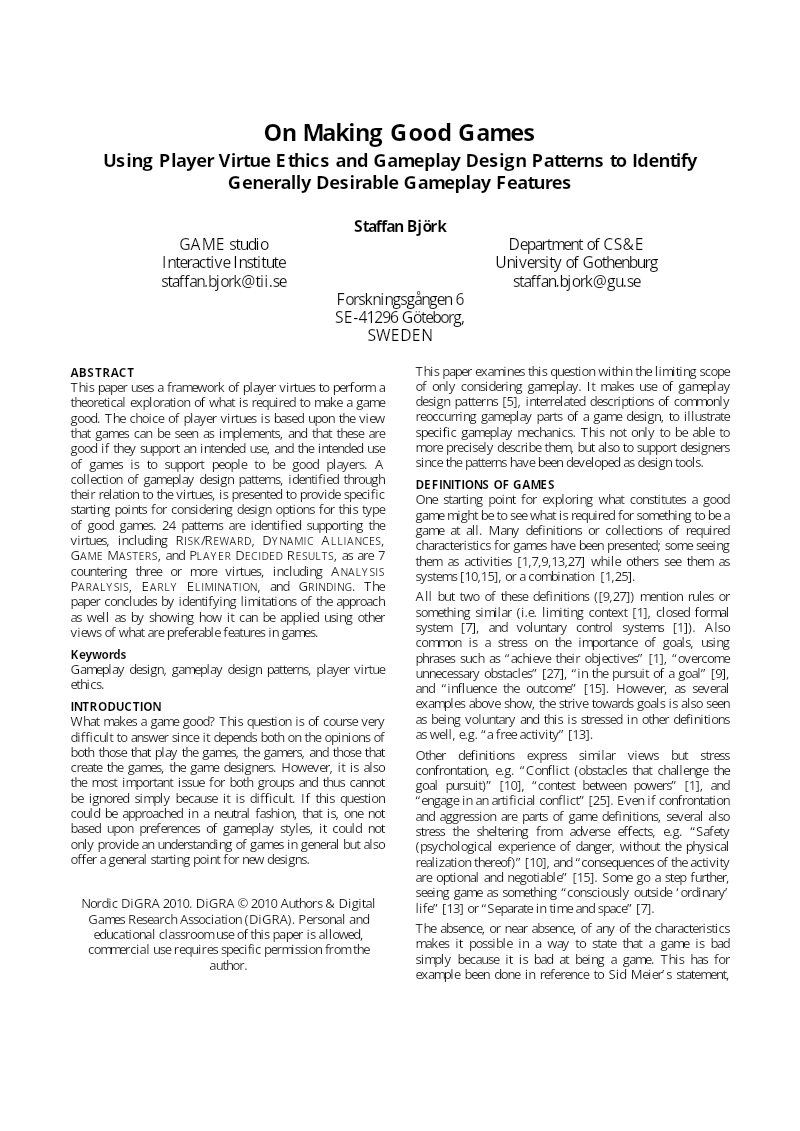
On Making Good Games: Using Player Virtue Ethics and Gameplay Design Patterns to Identify Generally Desirable Gameplay Features
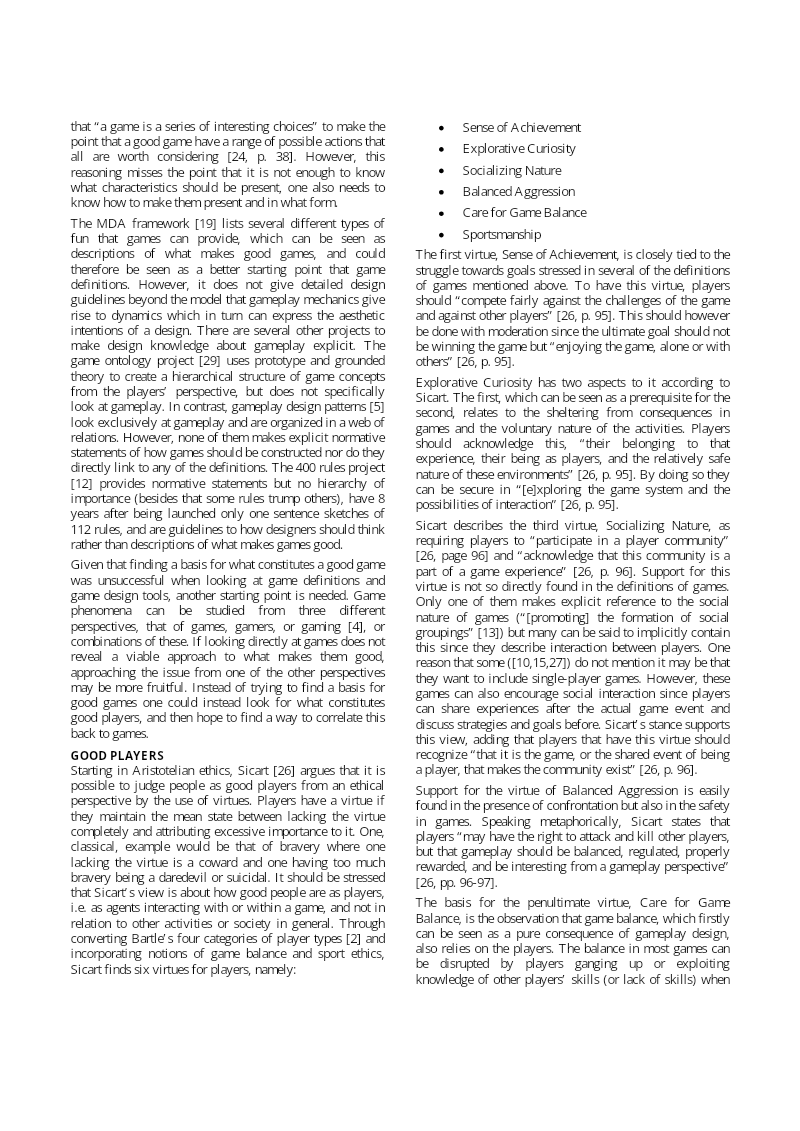
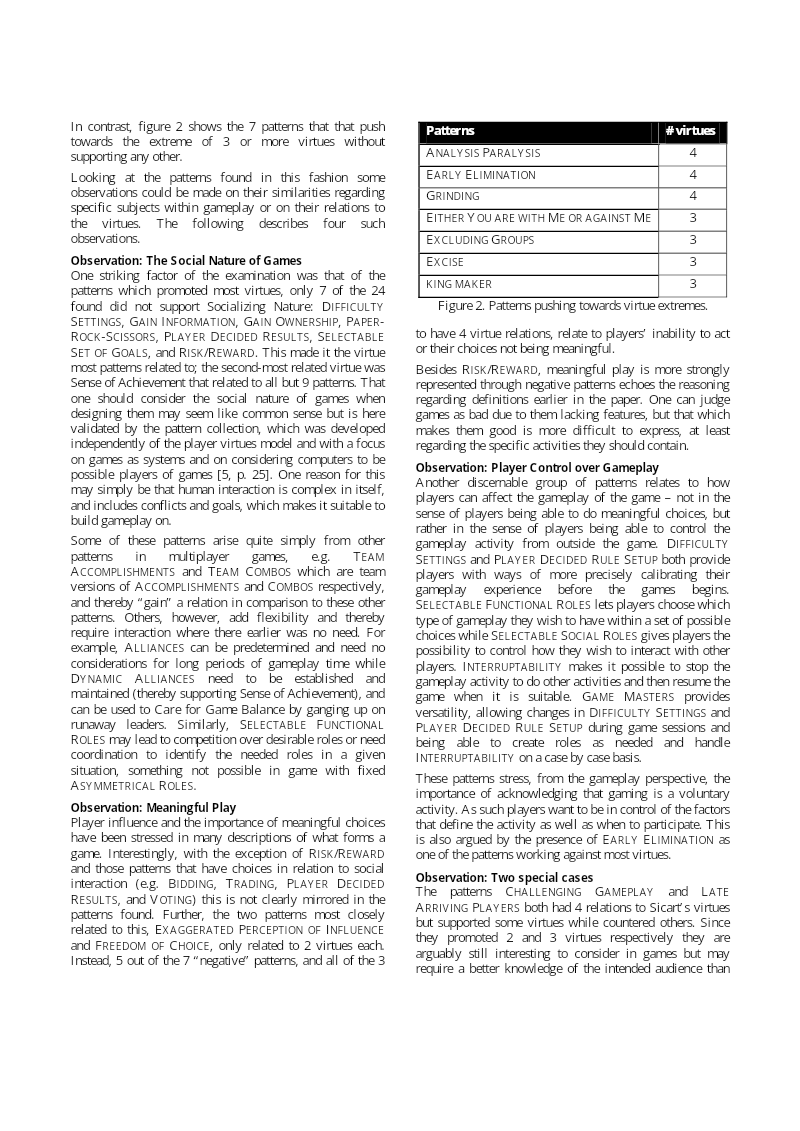
Björk's paper argues that a good game is one that supports its intended use, which is to cultivate good players, and it adopts Sicart's six player virtues (Sense of Achievement, Explorative Curiosity, Socializing Nature, Balanced Aggression, Care for Game Balance, and Sportsmanship) as the framework for judging that goodness.
- The paper argues a good game is one that supports its intended use of cultivating good players, judged by Sicart's six player virtues: Sense of Achievement, Explorative Curiosity, Socializing Nature, Balanced Aggression, Care for Game Balance, and Sportsmanship.
- Prominent design frameworks such as MDA, the Game Ontology Project, and the 400 rules project do not explicitly connect design guidance to what makes games good, a gap the paper aims to fill by mapping design patterns onto the virtues.
- An initial scan identified 24 gameplay design patterns relating to three or more virtues, with a further 161, 131, and 50 patterns relating to one, two, and three virtues respectively.
The Positive Negative Experience in Extreme Role-Playing
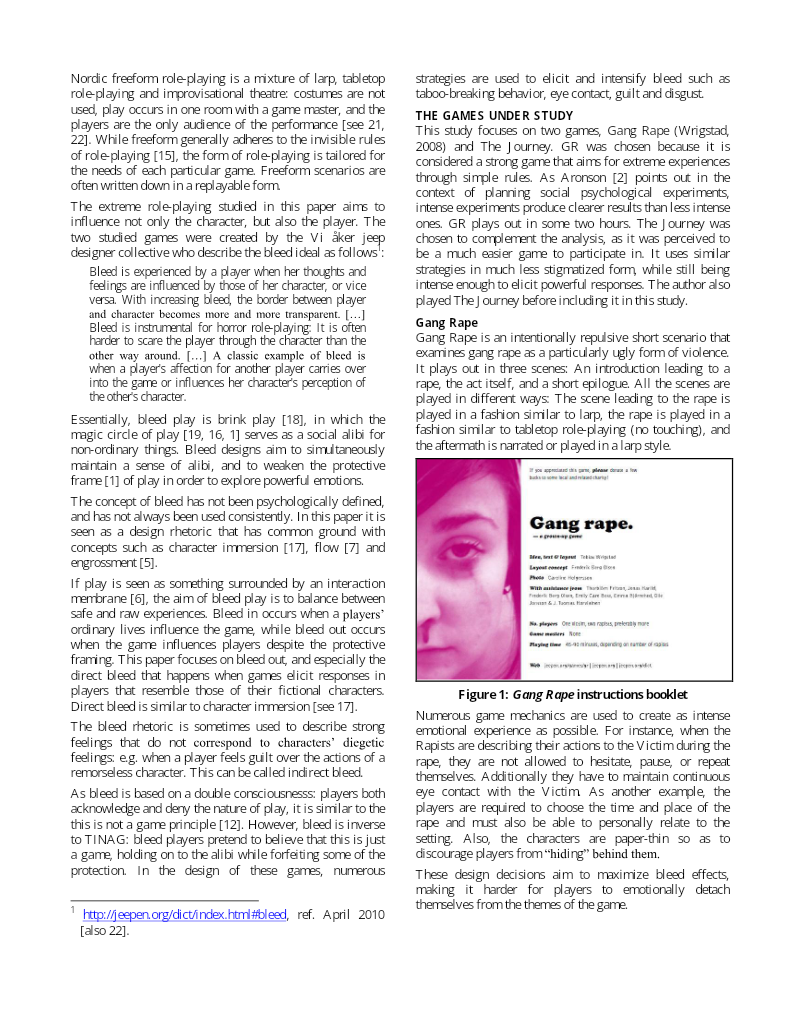
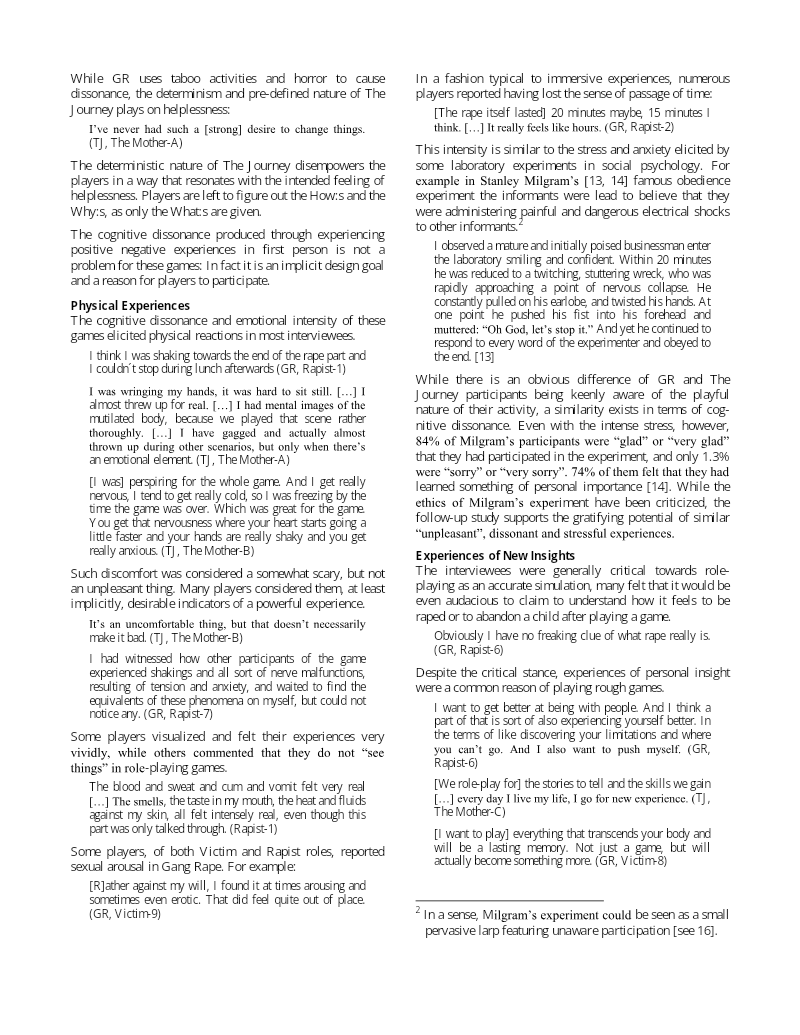
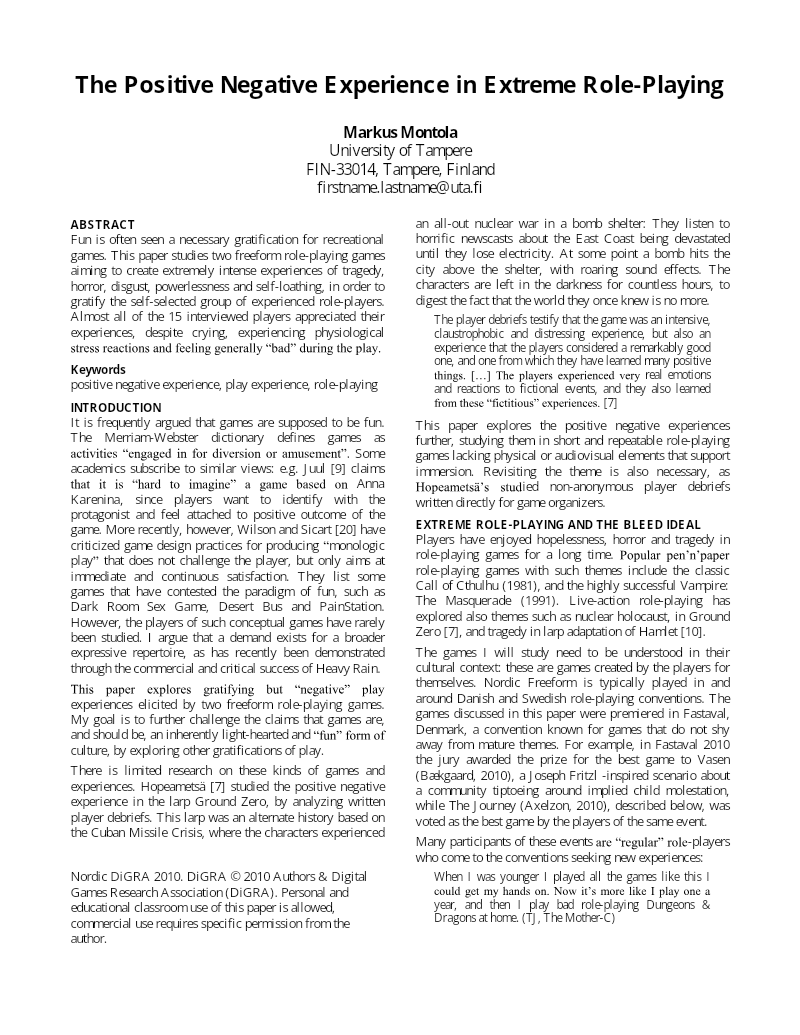
Markus Montola's study examines two Nordic freeform role-playing games, Gang Rape and The Journey, which are deliberately engineered to provoke horror, disgust, powerlessness, and discomfort.
- The study by Markus Montola examines two Nordic freeform role-playing games, Gang Rape and The Journey, engineered to provoke horror, disgust, powerlessness, and discomfort, and argues they produce a "positive negative" experience in which players find sessions gratifying and powerful rather than enjoyable.
- Based on interviews with fifteen experienced players, the work finds a consistent pattern of distress alongside appreciation: many reported crying, physiological stress, and lingering discomfort, yet none regretted playing Gang Rape and most reported positive takeaways.
- The "bleed" designs, which blur the boundary between player and character, make it difficult for participants to disengage from the fiction once a session begins, and they foster intense bonding and reliance on mutual support among players.
I'm in Love with Someone That Doesn't Exist!!: Bleed in the Context of a Computer Game
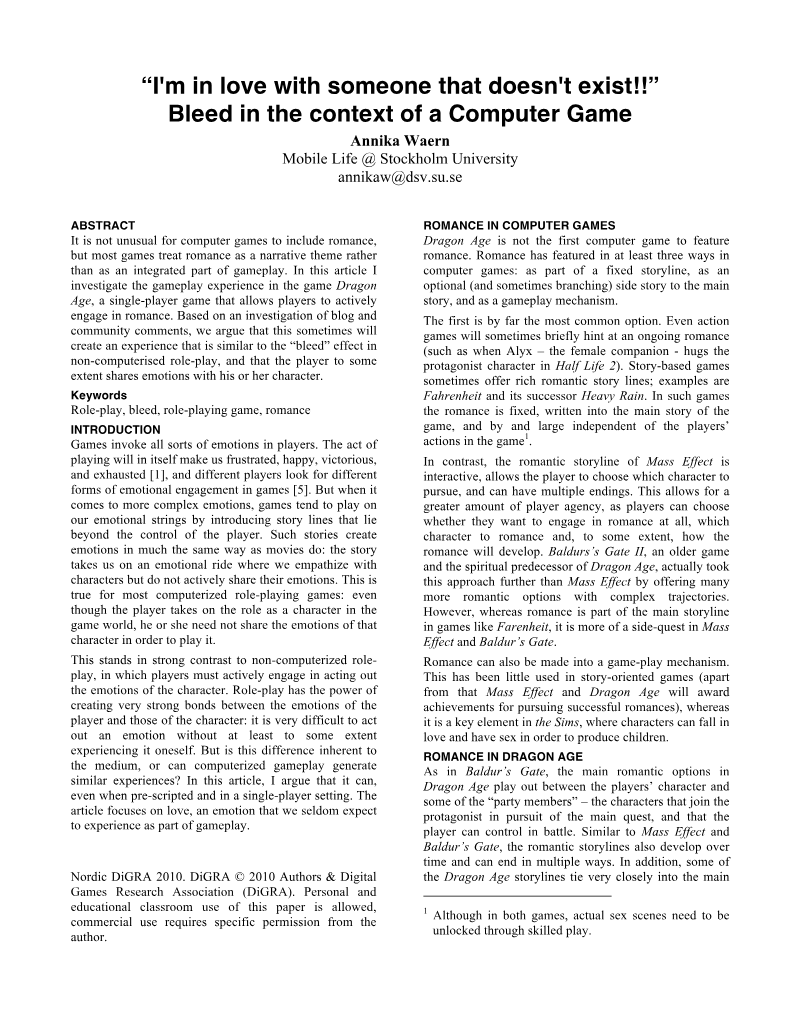
This paper examines how romance functions as a gameplay experience in Dragon Age: Origins, a single-player role-playing game, and argues that its romance options can produce an emotional "bleed" effect similar to that found in non-computerized role-play, in which players partly share the emotions of their characters.
- The paper argues that Dragon Age: Origins' romance options can produce an emotional "bleed" effect, in which players partly share the emotions of their characters, comparable to non-computerized role-play.
- Dragon Age integrates romance into both its storyline and its approval system, which strengthens party members' combat abilities, rather than treating it as a standalone theme or mechanic.
- The author contrasts three romance approaches: romance as a fixed narrative theme (Fahrenheit, Heavy Rain), as interactive romance (Mass Effect, Baldur's Gate II), and as an explicit mechanic (The Sims).
A Public Place of Their Own: A Fieldstudy of a Game Café as a Third Place
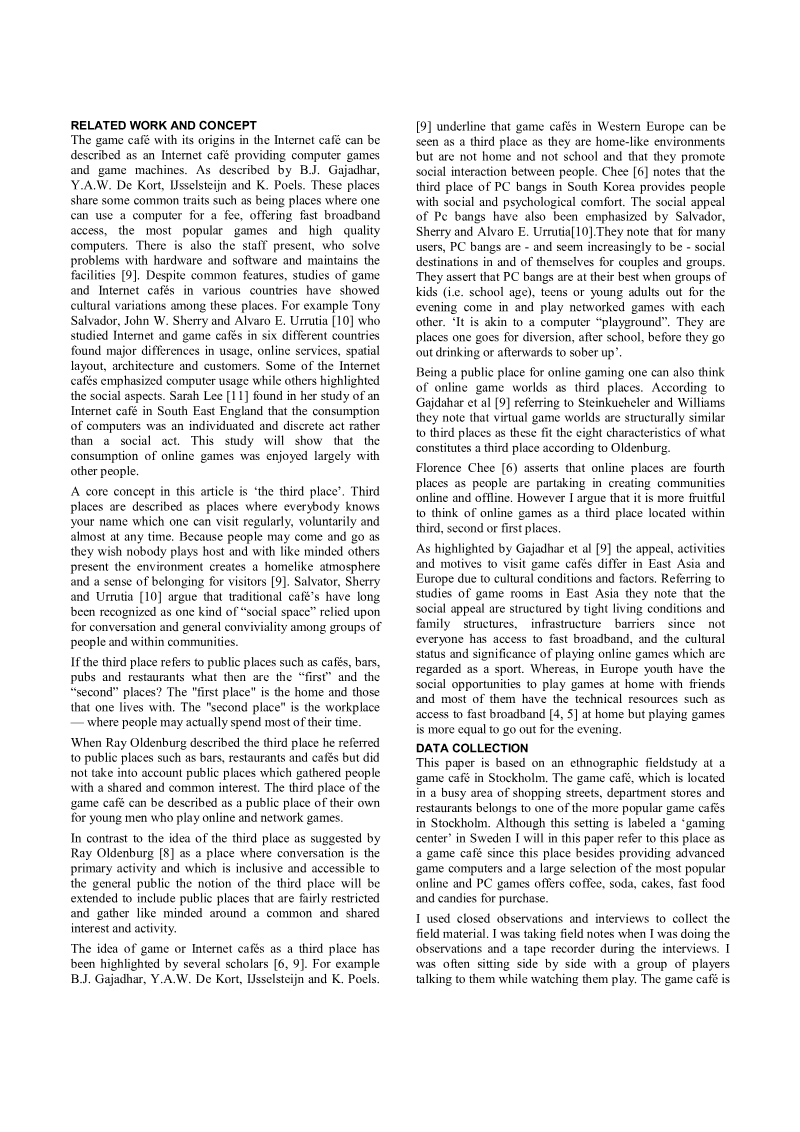
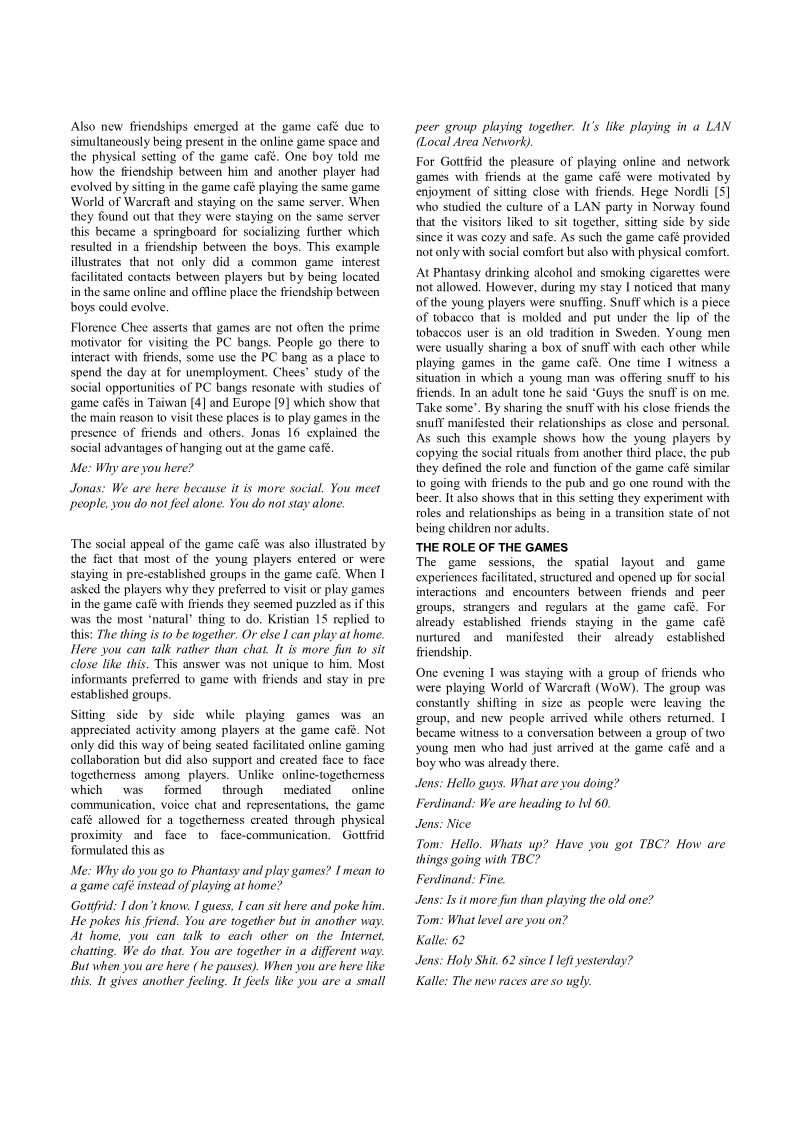
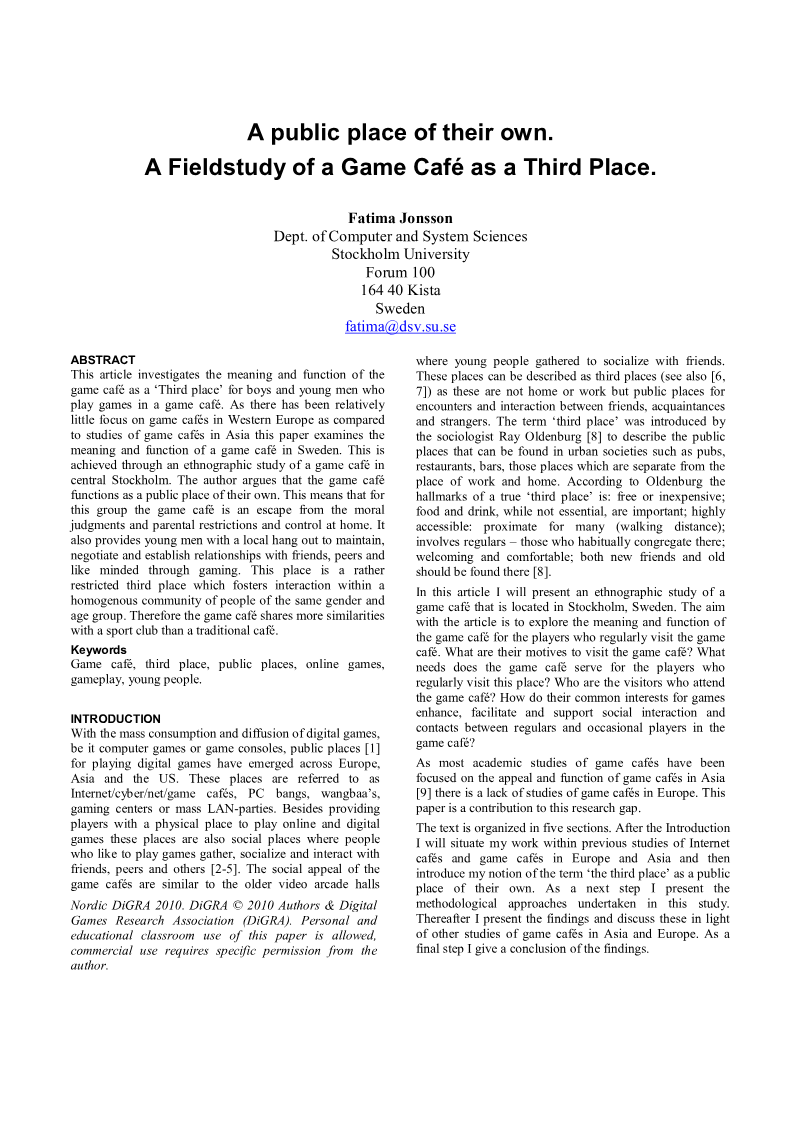
Jonsson's study examines Phantasy, a game café in Stockholm, as a "third place" in Ray Oldenburg's sense: a social setting distinct from home and work where people gather informally.
- The study examines Phantasy, a game café in Stockholm, through field observations and interviews conducted in 2005 and 2007, applying Ray Oldenburg's 'third place' concept to young male online and network gamers aged roughly 14 to 25.
- The café functions as a space of autonomy for regulars, offering an escape from parental restrictions and moral judgment in a home-like, homogeneous environment where players socialize, form fleeting relationships, and play together in person.
- Swedish parents in the study viewed game cafés favorably, a marked contrast to the more contested parental attitudes reported in Asian contexts, suggesting cultural framing shapes how these venues are perceived.