
DiGRA
The Digital Games Research Association: the international association of academics and professionals who study digital games. Its Digital Library holds the proceedings of the DiGRA conferences since 2002.
Documents
The Player Engagement Process: An Exploration of Continuation Desire in Digital Games
This study argues that player engagement is a distinct construct from motivation and enjoyment, defined by "continuation desire," the drive that keeps players returning to a game over time.
- The study defines engagement as a distinct construct from motivation and enjoyment, centered on 'continuation desire,' the drive that keeps players returning to a game over time.
- Its OA3 framework (Objectives, Activities, Accomplishments, Affect) models engagement as a cyclical process in which positive affect sustains continued play.
- In a coded sample of 310 statements from 131 participants, accomplishment was the most cited engagement driver at 36%, followed by experiencing the story (18%), socializing (10%), sensing (9%), positive affect (8%), and exploration (7%).
Video Games: Walking the Fine Line Between Art and Entertainment
Folkerts's central contention is that the long-running debate over whether video games qualify as art is better settled by examining the cognitive experience a work produces rather than the properties of the artifact itself.
- The author argues the art-versus-entertainment debate should be settled by the cognitive experience a work produces rather than by the properties of the artifact itself, since the distinction lies in how a work is apprehended.
- Common expert criteria such as emotion, fantasy, unusual appearance, and interpretability fail to separate art from entertainment, because popular television and Hollywood films exhibit them just as readily as acclaimed artworks.
- Imagination, emotion, challenge, and novelty are shared by both art and entertainment, so enjoyment alone reveals little about whether an experience is artistic.
The Map as Playground: Location-Based Games as Cartographical Practices
Sybille Lammes's paper examines how maps in location-based mobile games function as playing surfaces on which players inscribe their movements and local information while on the move.
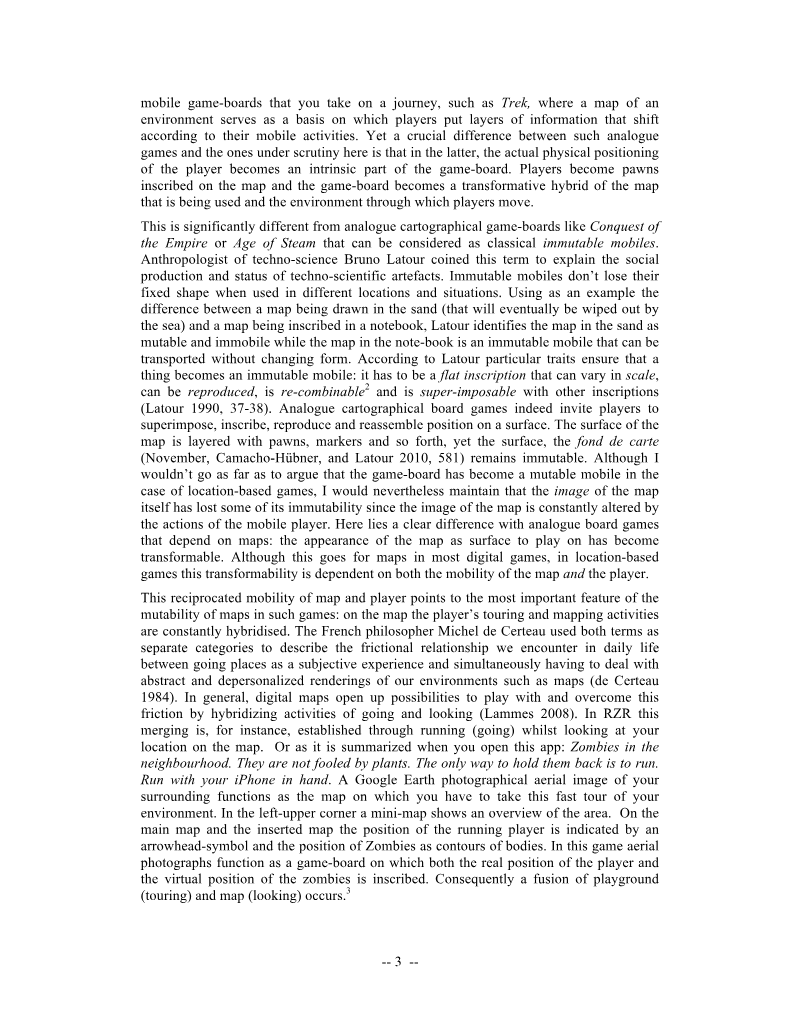
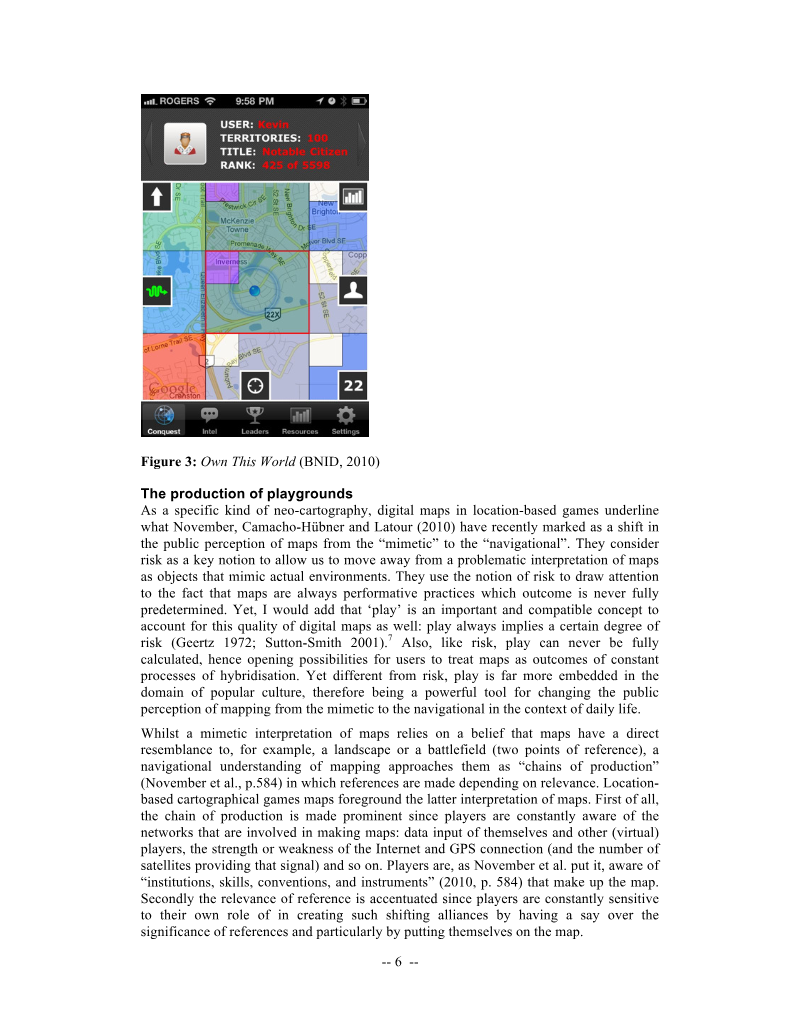
- Location-based mobile games such as RunZombieRun, Paranormal Activity Sanctuary, and Own This World use real-world maps (typically Google maps or aerial imagery) as game boards, with the player's physical position marked on them.
- The paper argues that maps in these games function as navigational interfaces and mediators that produce new social spaces, rather than as passive representations consulted by players, building on Latour's concept of mediators and Lefebvre's account of social space.
- Unlike analogue board games, which rely on Latour's immutable mobiles with fixed map surfaces, location-based games continually alter the map image as the player moves, blurring the line between touring and mapping and between the physical and game worlds.
A Procedural Critique of Deontological Reasoning
Togelius's prototype, presented at DiGRA 2011, is both a procedural implementation and a critique of Kant's categorical imperative.
- A player's underlying maxim can only be inferred imperfectly from observed behavior, because of the problem of induction, so outside observers will often misidentify it; the game is built to make this difficulty visible.
- The prototype is a mixed-initiative authoring tool in which rules are learned from player commands (reward, punish, kill, teleport, reverse, split, attract, repel) rather than predefined by designers, with a basic routine converting commands into persistent if-then rules.
- Operational rules start absent, so collisions and breaches have no consequences until the player issues rule-changing commands, and unplanned play quickly produces unbalanced, degenerate rulesets such as runaway scores and chain-reaction splitting that freezes the engine.

Schematically Disruptive Game Design
Peter Howell's DiGRA 2011 paper introduces "Schematically Disruptive Game Design," a framework for games that intentionally defy players' learned gameplay expectations instead of conforming to them.
- Howell's DiGRA 2011 paper proposes 'Schematically Disruptive Game Design,' a framework for games that deliberately defy players' learned gameplay expectations rather than conforming to them.
- The central open question is whether deliberately disorienting designs can remain commercially viable and engaging, positioned against industry trends toward hand-holding and accessibility, with Prince of Persia's guidance systems cited as criticized design.
- The paper argues schematically disruptive design should sustain constant cognitive effort rather than aim for pure flow, while warning that disruption must be carefully calibrated since players abandon games that become either frustrating or boring.
Exploring Anonymity in Cooperative Board Games
Linderoth's study explores whether anonymous actions can serve as a game mechanic in cooperative board games, with the aim of informing inclusive educational design.
- Many games marketed as cooperative blend in competitive or suspicion-based dynamics, and cooperative one-sided team games such as Pandemic suffer from "gameplay directing," where a single player effectively dictates decisions for the group.
- Tragedy-of-the-commons and traitor mechanics mitigate gameplay directing but do so only by sacrificing genuine cooperation, which motivated the study's goal of a purely cooperative game with anonymous player actions.
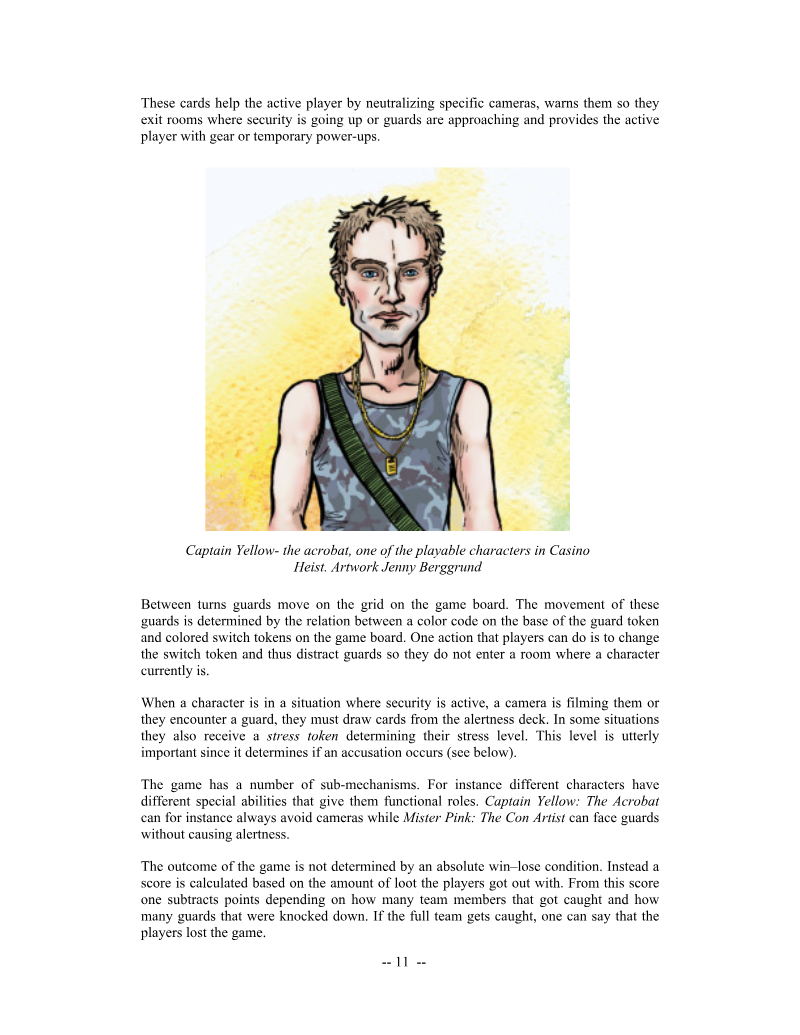
- The researchers prototyped "Casino Heist," a heist-themed cooperative game inspired by Battlestar Galactica's facedown card-play rule, in which players hold secret characters and concealed actions so the group knows what was done but not by whom.
How to Say Things with Actions I: A Theory of Discourse for Video Games
Rao's paper, "How to Say Things with Actions I: A Theory of Discourse for Video Games," argues that video games can be understood as discourse in the linguistic sense: structured flows of actions and events capable of conveying complex, argument-based meaning comparable to verbal communication.
- Rao's paper argues video games can be analyzed as discourse in the linguistic sense, conveying argument-based meaning comparable to verbal communication, and aims to build a procedural rhetoric framework that sits outside the ludology–narratology debate.
- The paper draws on argumentation theory, informal logic, and speech act theory, and adopts a rhetoric-derived definition of discourse (following Kinneavy's four aims: to inform, to be beautiful, to persuade, and to express) rather than the broader social-practice definition associated with Gee and Foucault.
- Its central finding is that games can currently produce only non-propositional, single-setting arguments (enthymemes), and they underuse the medium's capacity for temporal articulation of argument.
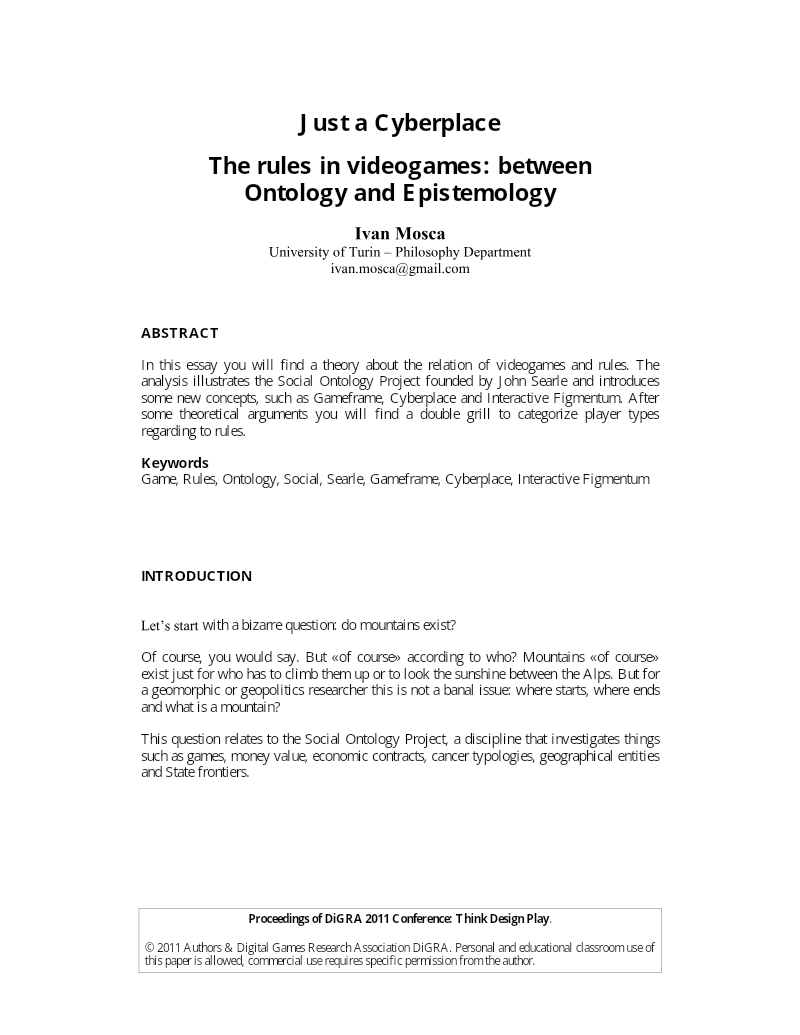
The Rules in Videogames: Between Ontology and Epistemology
Ivan Mosca's paper "The Rules in Videogames: Between Ontology and Epistemology" argues that "game" and "rule" are epistemological rather than ontological categories.
- Mosca argues that 'game' and 'rule' are epistemological rather than ontological categories: whether a device counts as a game depends on the player's interpretation, sustained by a 'gameframe,' a fiat boundary maintained through suspension of belief, drawing on John Searle's social ontology.
- The paper claims videogames contain no prescriptive rules in Bernard Suits' sense, since rules that can be obeyed or broken require a choosing subject; instead videogames have descriptive system functions enforced by hardware and software, comparable to recipes or the laws of physics.
- Mosca agrees with Chris De Leon that videogames lack rules but rejects the inference that they are therefore not games, and critiques Jesper Juul's view that videogames combine rules with fiction.
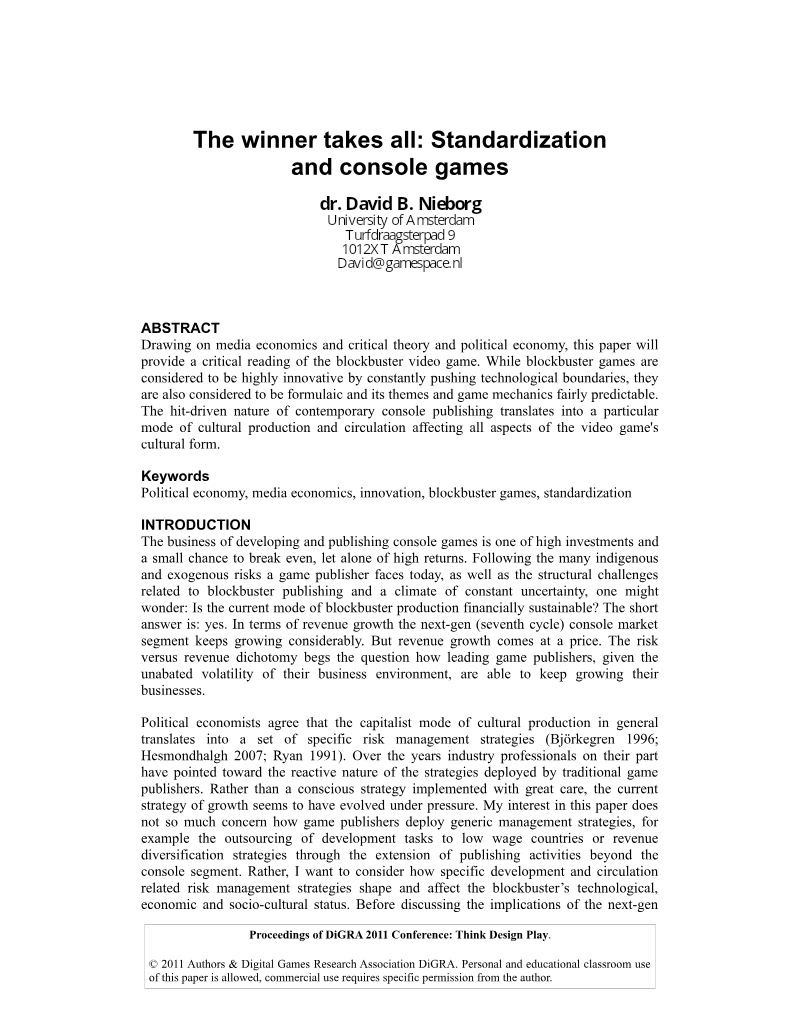
The Winner Takes All: Standardization and Console Games
Nieborg's analysis argues that blockbuster console games operate as a hit-driven, winner-take-all market shaped by network effects, serialization, and escalating development costs.
- Blockbuster console game development budgets have risen sharply, from roughly $2.5–4 million for sixth-generation titles to reported figures of $30–100 million for next-generation releases.
- Publishers have responded with a "fewer, bigger, better" strategy built on standardized, rationalized production, including reuse of proprietary engines such as the IW engine behind Call of Duty.
- Activision Blizzard's dependence on proven franchises is stark: Call of Duty, Guitar Hero, and World of Warcraft together accounted for about 68 percent of its 2009 net revenues, while original intellectual property rarely succeeds.
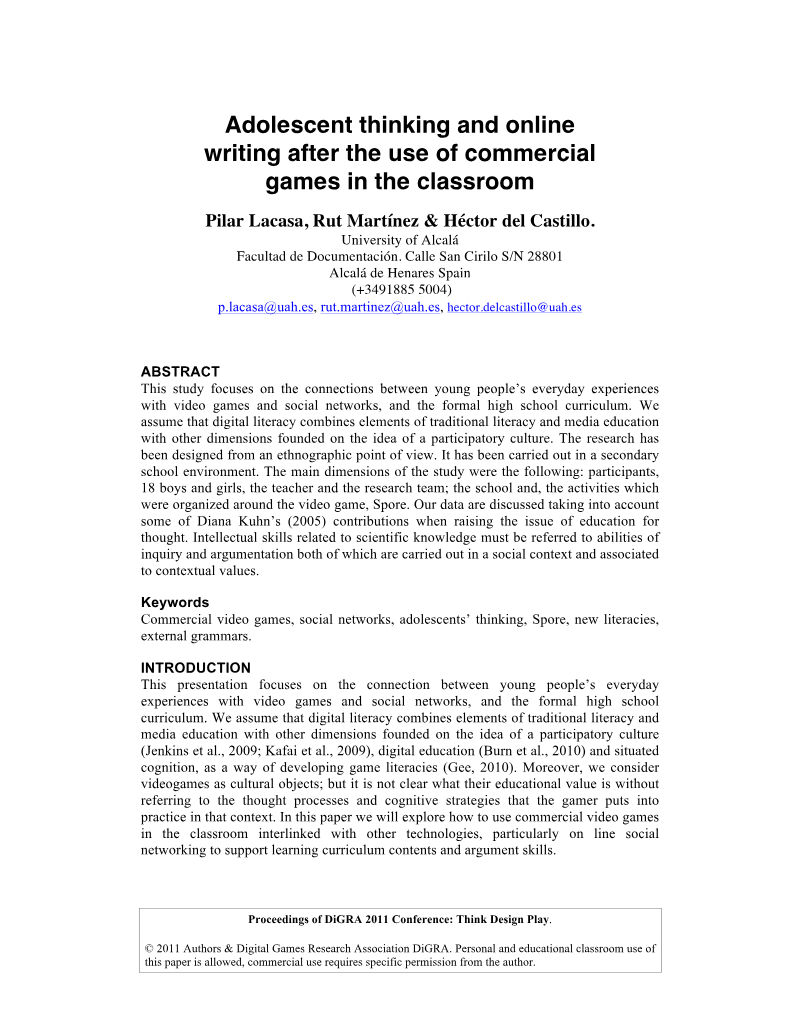
Adolescent Thinking and Online Writing After the Use of Commercial Games in the Classroom
This study examines whether the commercial video game Spore can support adolescent reasoning when integrated into a high school curriculum.
- A single-case ethnographic study of 18 students across 10 sessions in a bilingual Madrid secondary school class (2009/2010) used the commercial game Spore to teach evolutionary theory, so its findings rest on small-scale qualitative evidence.
- Students initially held superficial understandings of theories associated with Darwin, Lamarck, Kimura, and Gould, and classroom discussion alone did little to deepen them.
- An online forum generating 33 contributions prompted more substantive reasoning than oral discussion, with written, forum-based exchange producing more questions, reasoning, and well-developed arguments.
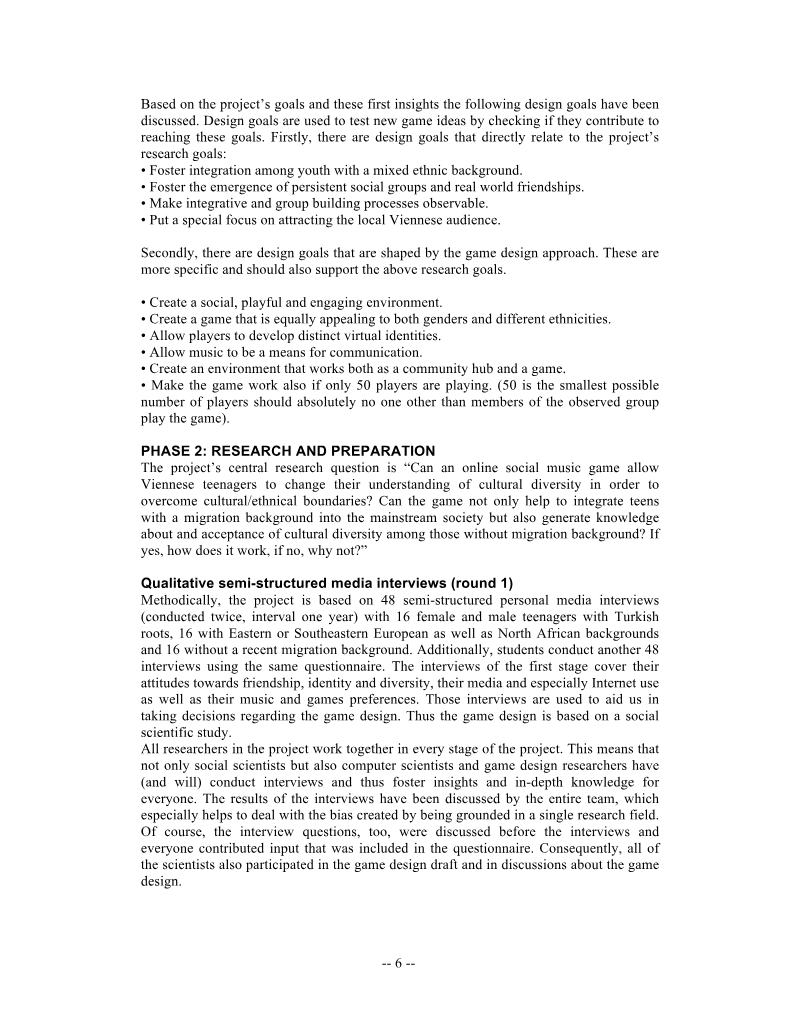
Serious Beats: Transdisciplinary Research Methodologies for Designing and Evaluating a Socially Integrative Serious Music-Based Online Game
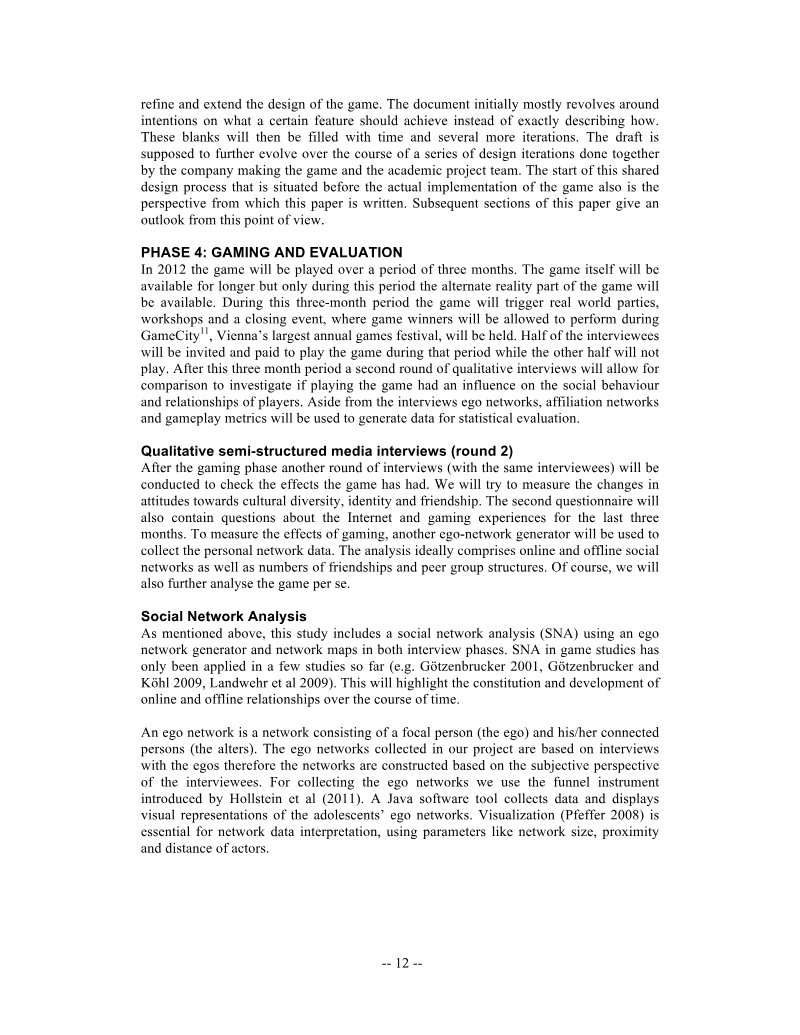
Serious Beats is a transdisciplinary project from Vienna University of Technology and the University of Vienna that aims to design a music-based online social game fostering intercultural friendships among Viennese teenagers aged 14 to 17, many of whom have Turkish or Balkan migration backgrounds.
- Serious Beats is a transdisciplinary project from Vienna University of Technology and the University of Vienna to design a music-based online social game that fosters intercultural friendships among Viennese teenagers aged 14 to 17, many with Turkish or Balkan migration backgrounds.
- The design foundation rests on 48 semi-structured interviews, which found a strong preference for rap and hip hop, heavy reliance on YouTube as the primary music source, and hybrid migrant and Austrian identities, with many reporting intergroup tensions over jobs and housing.
- Early music-game prototypes were judged to carry a high risk of losing both male and female audiences, prompting a shift toward a social music service built on Facebook and YouTube and integrated with real-world events in youth centers and vocational schools.
The Professional Identity of Gameworkers Revisited: A Qualitative Inquiry on the Case Study of German Professionals
This pilot qualitative study examines the professional identity of German gameworkers, using nine semi-structured interviews with designers, artists, programmers, producers, and freelancers working across studios of varying sizes.
- Germany was chosen as the case study because it is the second-largest European game market, and the study is set against industry surveys describing a male-dominated, high-stress environment marked by crunch and high turnover.
- Respondents identify strongly with both their profession and their teams, a bond driven chiefly by their interest in making and playing games.
- Most respondents entered the industry through amateur or hobbyist involvement and often moved across roles as they gained experience, with several studio heads having begun as programmers.