
DiGRA
The Digital Games Research Association: the international association of academics and professionals who study digital games. Its Digital Library holds the proceedings of the DiGRA conferences since 2002.
Documents
Formalizing Casual Games: A Study Based on Game Designers' Professional Knowledge
This study, presented at DiGRA 2013 by Laureline Chiapello, examines the persistent definitional confusion surrounding casual games.
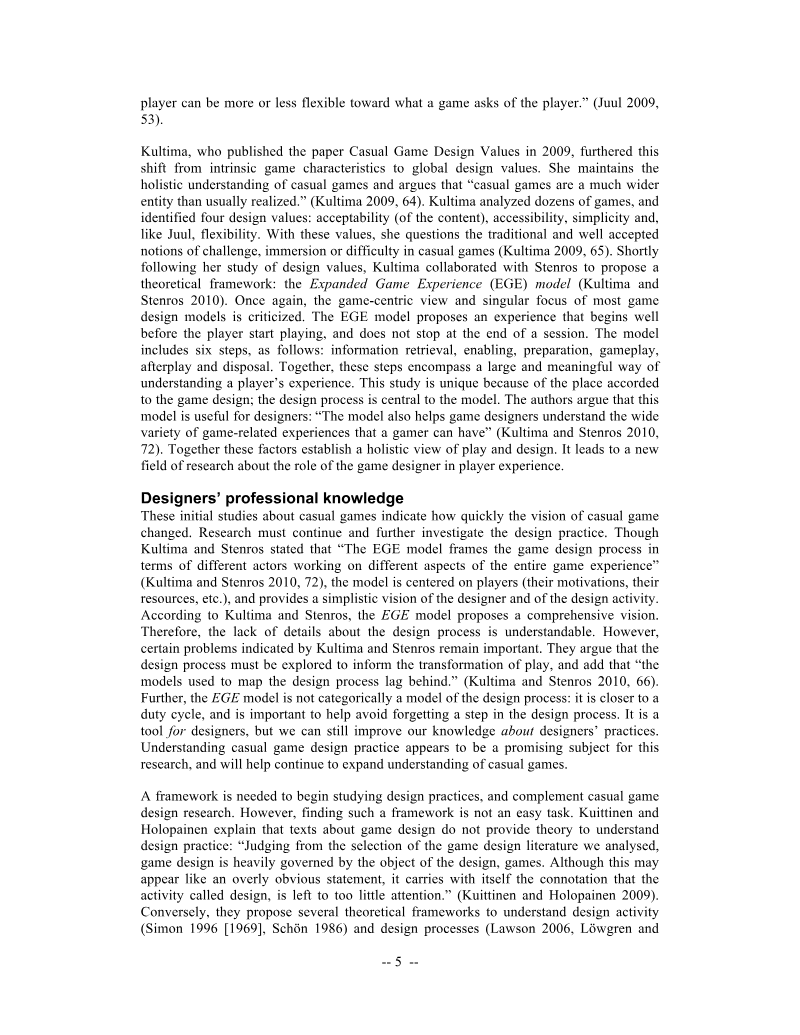
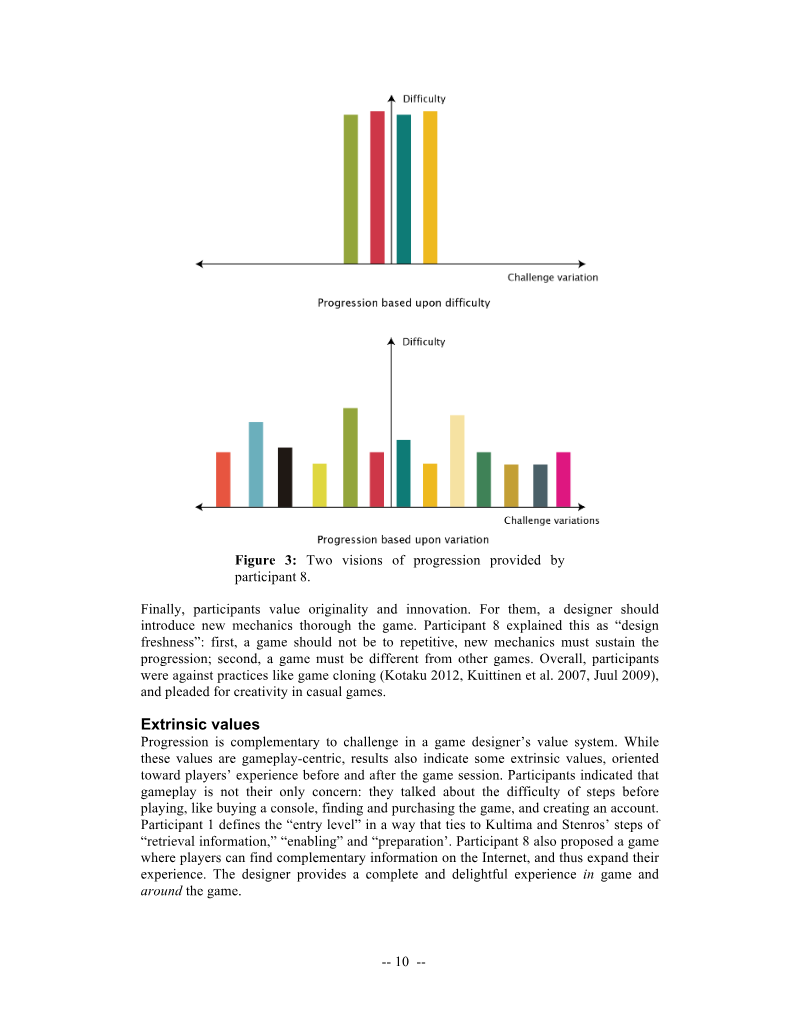
- Casual game definitions remain contested across five points: the genre's place in game culture, the role of challenge, the nature of difficulty, typical session length, and the function of fiction.
- Rather than proposing another top-down definition, the study argues the field should move toward holistic models grounded in design values, player experience, and the professional knowledge of designers, which has remained largely unexplored.
- Using a phenomenology-inspired qualitative method based on Schön's reflective-practitioner framework, the author interviewed eight casual game designers via sensitization booklets and semi-structured post-mortem interviews.
Everyone's a Winner at Warhammer 40K (or, at Least Not a Loser)
This study examines how players of Warhammer 40,000 reframe defeat as success.
- The study draws on ethnographic fieldwork and 36 player interviews at tournaments in Victoria, Australia, arguing that Warhammer 40,000 functions less as a purely competitive contest than as a framework for enjoyable experiences in which losing can still count as winning.
- Players routinely reframe losses as "moral wins" by shifting attention to strategic decision-making, narrative backstory ("fluff"), miniature painting and crafting, sportsmanship, and the role of luck or the metagame in determining matchups.
- The authors partly attribute this orientation to the game's own rulebook and tournament messaging, which states that winning at any cost is less important than enjoyment and encourages a relaxed, social view of competition.
Constructing the Ideal EVE Online Player
"Constructing the Ideal EVE Online Player" argues that the widely held view of EVE Online's players as exceptional is best explained by deliberate design choices made by CCP Games, which are then reinforced by a homogeneous player community, rather than by any inherent difference in the players themselves.
- The paper argues EVE Online's reputation for exceptional players stems mainly from deliberate CCP Games design choices, reinforced by a homogeneous community, rather than from inherent differences in the players themselves.
- EVE's atypical features, including ship-as-avatar capsule avatars, no level cap, and skill points that accrue over time regardless of activity, depart from mainstream MMOG conventions and are used to expose taken-for-granted assumptions about game design.
- Non-humanoid capsule avatars and the absence of conventional trading hubs remove the choke points and social gathering spaces common in other MMOGs, while a steep tutorial and harsh death penalties in low-security space push newcomers toward social support networks.
Regulating Virtual Worlds: Considering Participant-Driven Approaches
Woodford's DiGRA 2013 paper, "Regulating Virtual Worlds: Considering Participant-Driven Approaches," contends that virtual worlds are facing a growing number of disputes that will likely invite external regulation, and that the available governance options each fall short.
- Woodford's DiGRA 2013 paper argues that virtual world disputes are growing and will likely invite external regulation, but that industry self-governance, top-down state regulation, and emergent community models each have significant weaknesses.
- The paper proposes participant-driven self-regulation as a viable intermediate model, drawing on offshore gambling, where forums and third-party raters like Sportsbook Review enforced norms after formal arbitration failed and community mediation resolved disputes within a week versus years in courts.
- The author identifies four conditions favoring successful emergent governance: participant demand for remedy, concentration of the participant base, ambiguity in rules (e.g., around automation), and the capacity to deliver faster outcomes than alternatives.
Puzzle Is Not a Game! Basic Structures of Challenge
Karhulahti's paper argues that puzzles, unlike strategic and kinesthetic challenges, cannot constitute games in the full sense, because they lack the dynamic, opponent-driven structure that prominent definitions of play and games treat as essential.
- Karhulahti argues that puzzles, unlike strategic and kinesthetic challenges, cannot constitute games in the full sense because they lack the dynamic, opponent-driven structure that prominent definitions of play treat as essential.
- The paper proposes a tripartite framework of challenge structures: puzzles (static, determinate), strategic challenges (dynamic, indeterminate), and kinesthetic challenges (bound to bodily execution), presented as the basic building blocks of videogame challenge.
- The static/dynamic divide is framed as a structural property of the challenge itself rather than a matter of player perception, directly countering claims made by some critics.
The Role of Micronarrative in the Design and Experience of Digital Games
Micronarrative, the authors argue, is a useful design tool for understanding how digital games structure story and play.
- Micronarrative is proposed as a design tool: game narrative nests hierarchically in layers, from small arcs (a single hockey possession or stealth encounter) to medium units (periods or missions) to meta-arcs (a hockey season or franchise).
- The authors ground their analysis in close readings of two commercial titles released around 2011 to 2012, NHL 12 and Deus Ex: Human Revolution, spanning the sports and action-RPG segments of the console and PC market.
- NHL 12 relies largely on emergent, player-generated micronarratives with limited connection to the ongoing season, so its smaller units emphasize winning, losing, and moment-to-moment competitive drama.
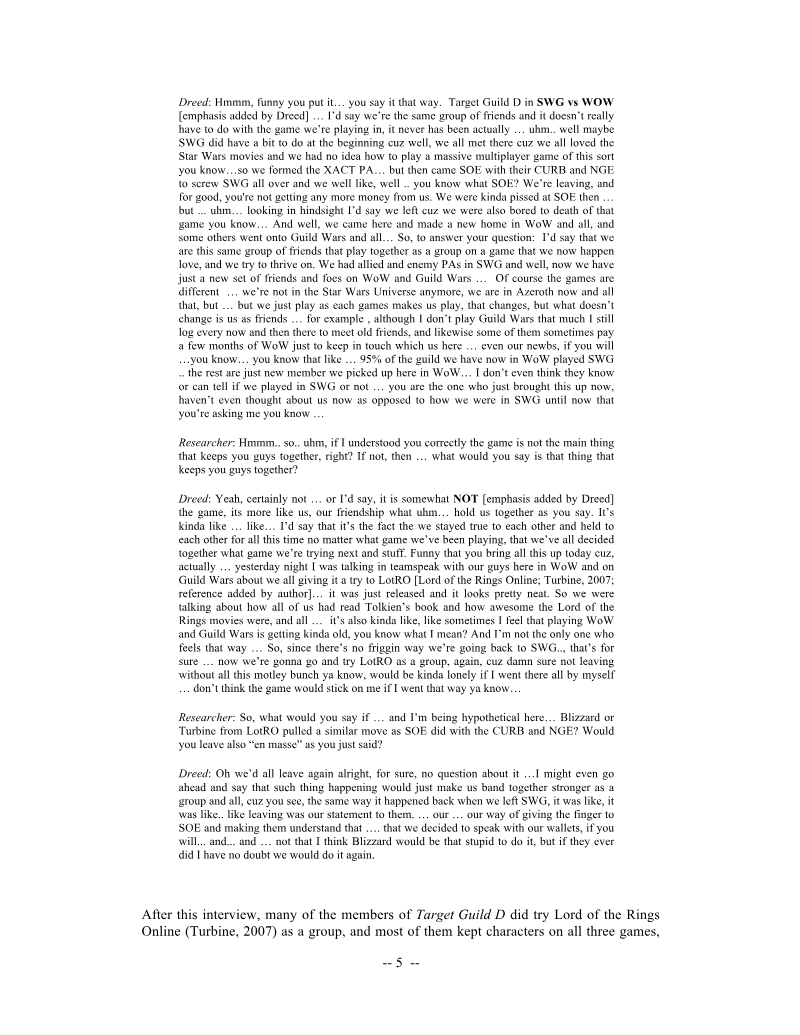
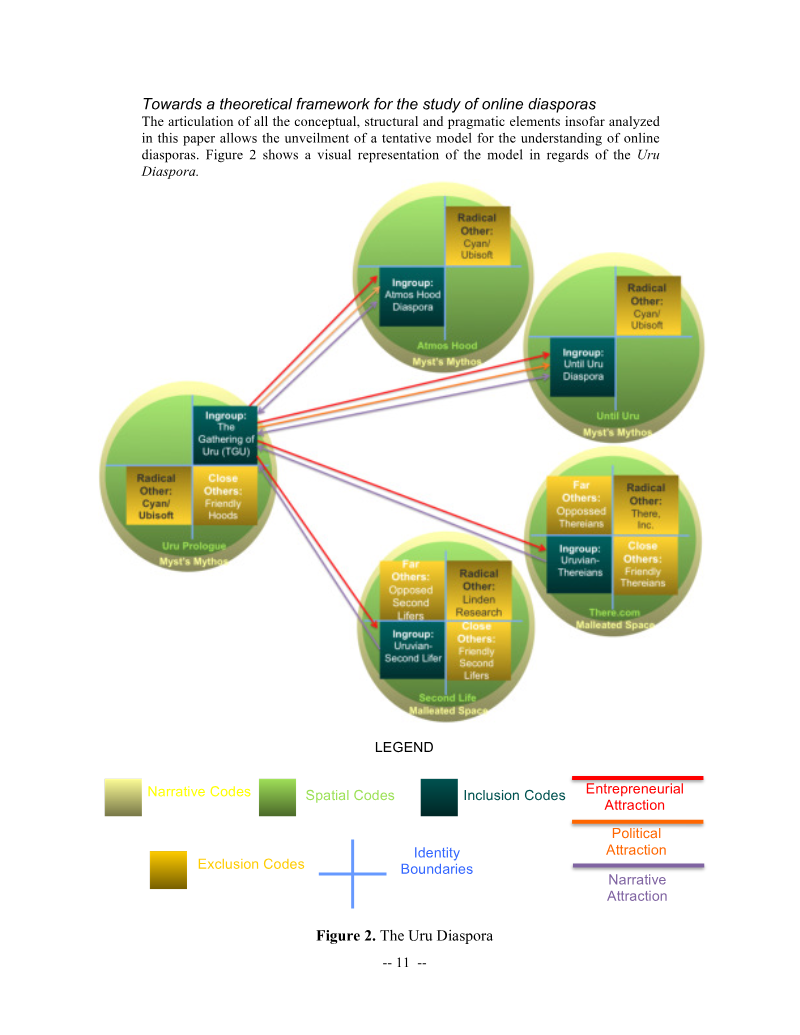
Online Diasporas: Theoretical Considerations on the Study of Diasporic Behavior in MMORPGs
Salazar's study examines whether the concept of diaspora, long applied to forced dispersions of physical peoples, can meaningfully describe groups of players who become displaced within massively multiplayer online role-playing games (MMORPGs).
- Salazar argues that the concept of diaspora, classically defined by forced dispersion, nostalgia for a lost homeland, and tension with host communities, can be extended to online groups in MMORPGs, but only once they develop a diasporic consciousness.
- The paper proposes reconciling classical and postmodern diaspora models by treating online diasporas as one possible outcome of MMORPG social configurations, in which groups may show either or both patterns.
- The first case, the Gathering of Uru, displayed classical traits after a server shutdown displaced its members, including idealized attachment to their virtual homeland and friction with new environments.
Stanislavski's System as a Game Design Method: A Case Study
This paper examines how Konstantin Stanislavski's acting method can serve as a game design framework, using the adaptation of Lope de Vega's seventeenth-century Spanish comedy La Dama Boba into an educational point-and-click adventure built on the eAdventure platform.
- Stanislavski's acting concepts (objectives, conflicts, units, events, and the superobjective) were used to segment Lope de Vega's seventeenth-century comedy La Dama Boba into discrete game events for an educational point-and-click adventure built on the eAdventure platform.
- The adaptation converted the play's scenes into five milestone-driven stages via a conversion table that mapped dramatic scenes to game tasks.
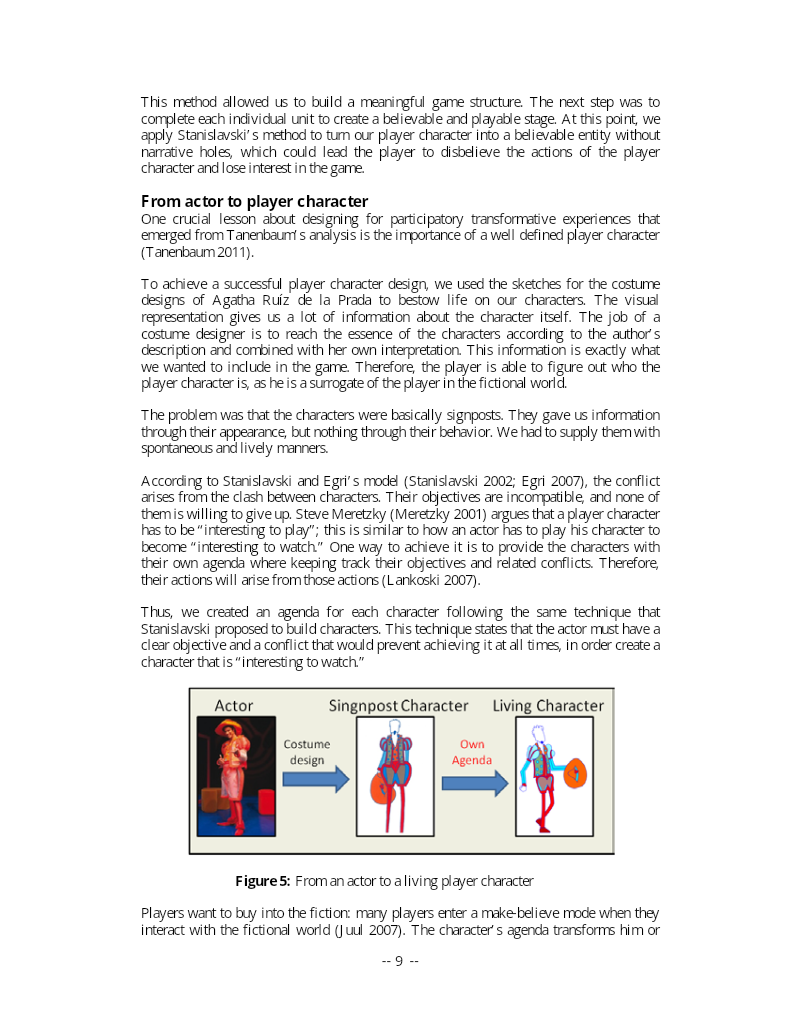
- Applying Stanislavski's agenda technique gave the protagonist Laurencio a coherent player character, with his superobjective defined as "to become rich."
Viewpoints AI: Procedurally Representing and Reasoning About Gestures
Viewpoints AI is a prototype co-creative system that pairs a human performer with an artificial co-performer in gesture-based, open-ended interaction.
- Viewpoints AI is a prototype co-creative system pairing a human performer with an AI co-performer in open-ended, gesture-based interaction, using the Viewpoints theatrical movement method as its procedural basis instead of pre-authored motion libraries.
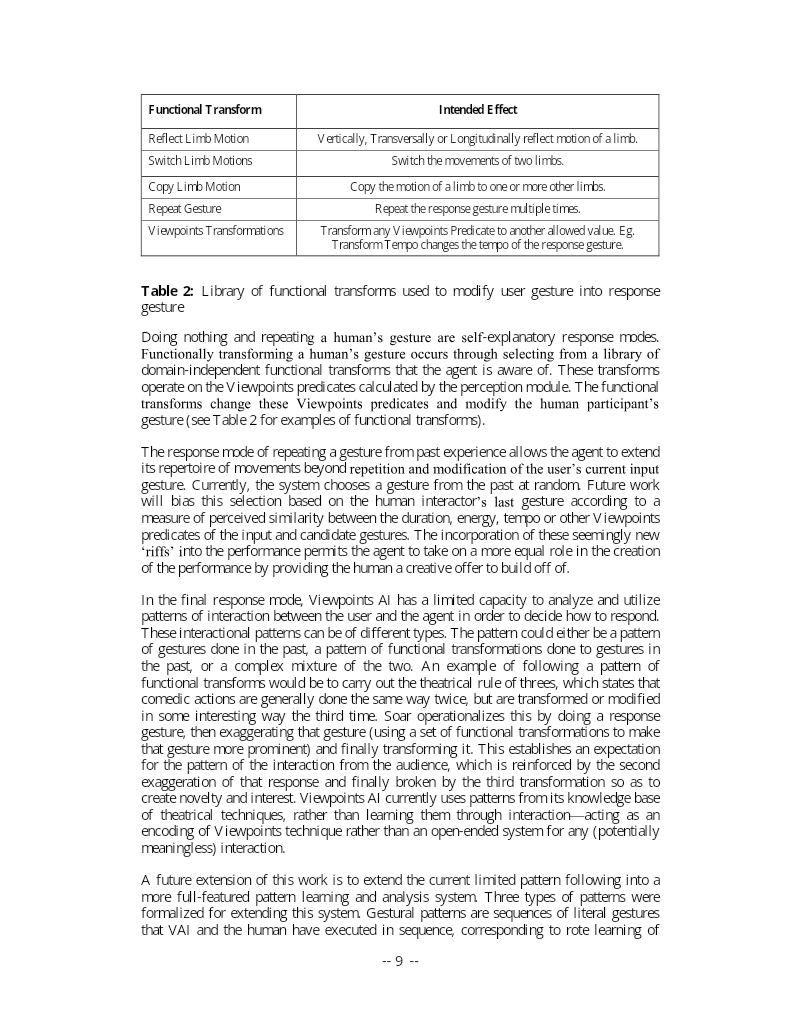
- The pipeline uses a Kinect sensor to convert human gestures into symbolic aesthetic predicates (tempo, duration, shape, energy, facing, spatial relationship), a Soar-based rule system to select a response mode such as longitudinal reflection, and domain-independent functional transforms to modify the response.
- The AI's response is rendered as a firefly-swarm human silhouette, with predicates mapped to visual parameters like color and speed, and projected onto a semi-opaque muslin screen alongside the human's rear-projected shadow to co-create movement-based proto-narratives.

Transforming Game Narrative through Social Media: Studying the Mass Effect Universe of Twitter
This study examines how fans of the Mass Effect video game series used Twitter as a participatory narrative medium, treating character accounts for figures such as Garrus, Tali, Joker, and Saren as a collaborative storytelling space.
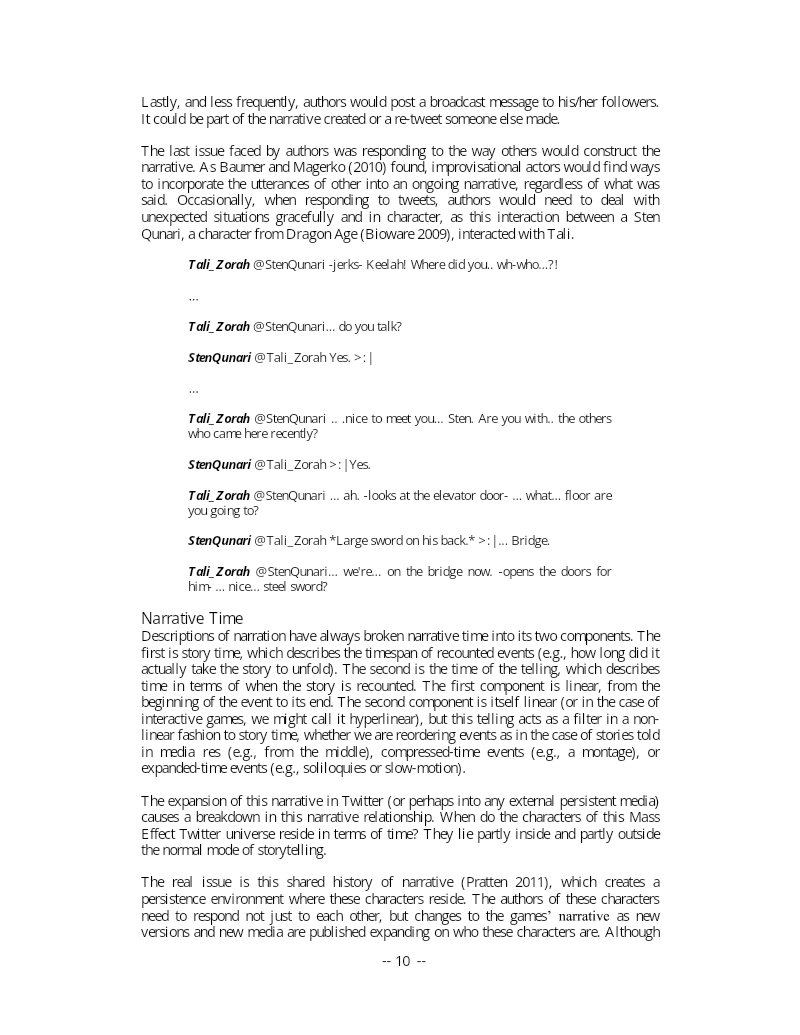
- Fans of the Mass Effect series used Twitter as a participatory storytelling space, with character accounts for figures like Garrus, Tali, Joker, and Saren acting as a collaborative narrative medium.
- A textual analysis of 215 tweets from eight character accounts found about 89% were first-person and 69% present-tense, with the accounts adopting a consistent character voice.
- Roughly 82% of tweets addressed other Mass Effect accounts versus only 6% engaging non-Mass Effect accounts, showing the narrative was aimed at fellow players rather than spectators.
From Generative to Conventional Play: MOBA and League of Legends
Simon Ferrari's 2013 DiGRA paper examines the multiplayer online battle arena (MOBA) genre through League of Legends, arguing that the genre emerged from player-modders working within Warcraft III, most notably the DotA mod, whose generative, exocentric design choices, including removing base-building, standardizing 5v5 play…
- The MOBA genre emerged from player-modders working in Warcraft III, most notably the DotA mod, whose design choices (removing base-building, standardizing 5v5 play, and using a single symmetrical map) were later commercialized.
- Ferrari positions League of Legends as the central MOBA case, citing it as the most played game by hours, supported by a professional competitive scene and a free-to-play model sustained by ongoing champion releases and data-driven balancing.
- Ferrari argues League of Legends constitutes conventional, exocentric play, with its team-based competition shaped by layered hidden and complex information.
Feminist Art Game Praxis
"Feminist Art Game Praxis" presents PsXXYborg, an experimental arts-led game in development, as a case study in how feminist theory can be enacted through the design of interactive art.
- PsXXYborg is an experimental, arts-led feminist game in development that uses irony, parody, and glitch aesthetics to critique exclusion in game culture, grounded in theory from Haraway, cyberfeminism, Braidotti, and Grosz.
- The report argues feminist texts must expose the patriarchal norms of their context and resist essentialist definitions of feminine authorship, with the project built through bricolage, collaboration, and multi-screen, FMV-based design.
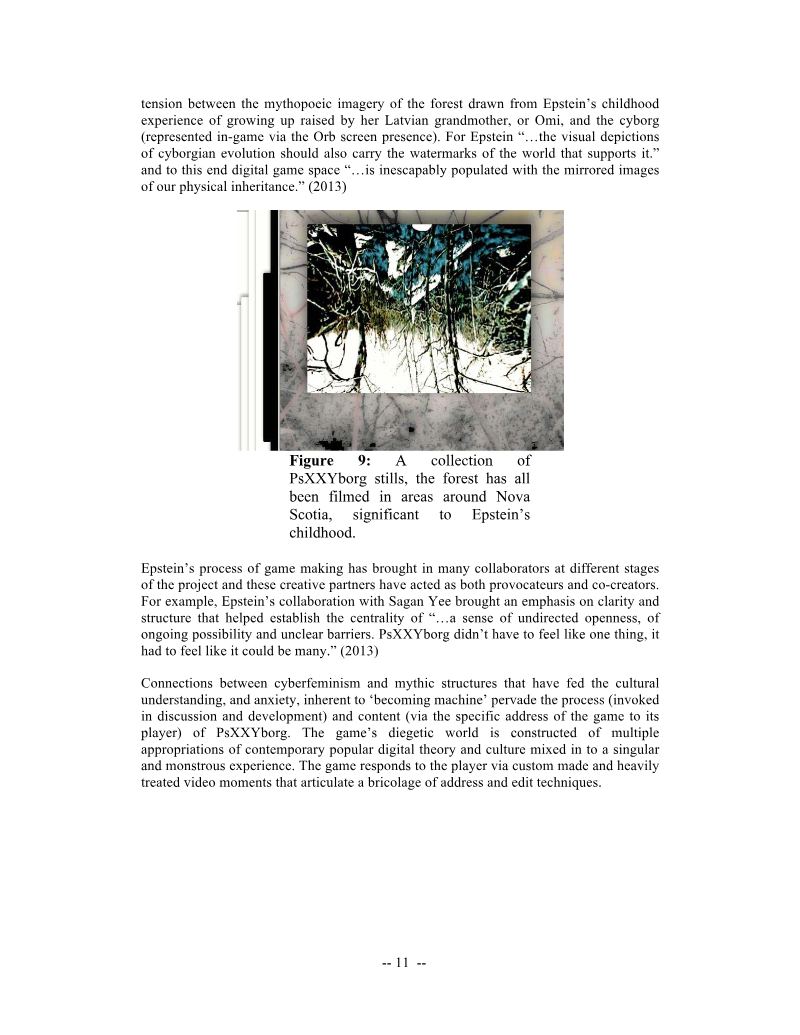
- The project deliberately removes the player avatar and disrupts first-person conventions through removed player agency, a fragmented gaze produced by multi-screen play, and mirror imagery.