
DiGRA
The Digital Games Research Association: the international association of academics and professionals who study digital games. Its Digital Library holds the proceedings of the DiGRA conferences since 2002.
Documents
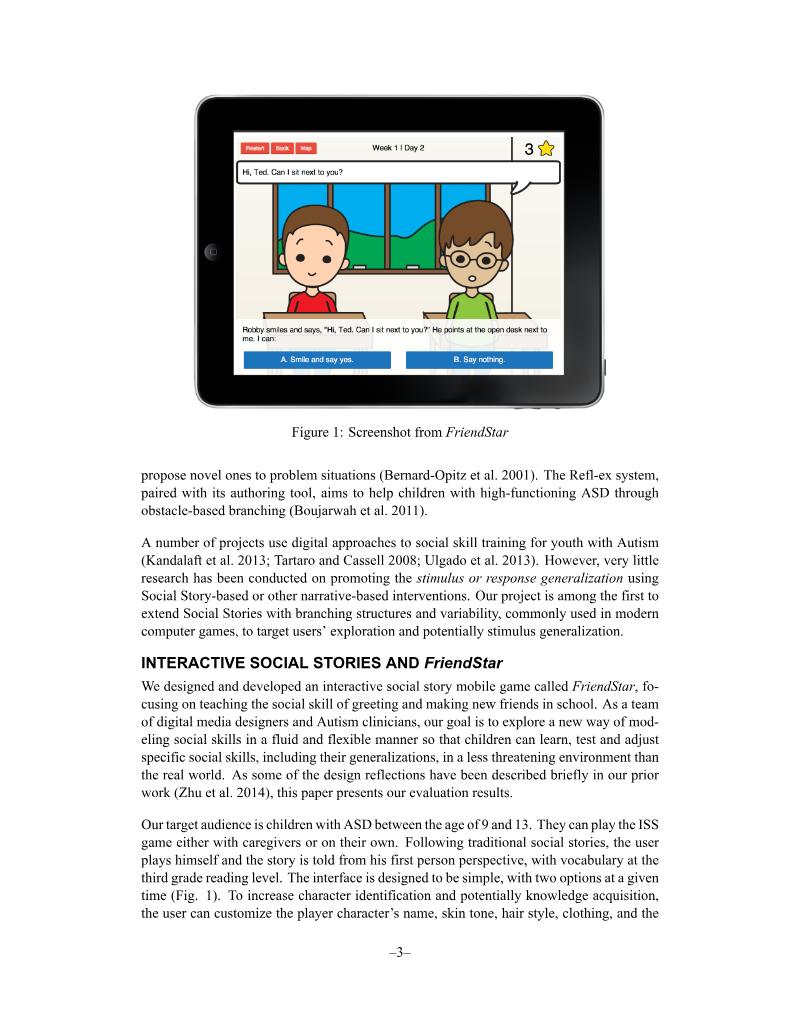

Using Interactive Social Story Games to Teach Social Skills to Children with Autism
This paper introduces Interactive Social Stories (ISS), an approach that extends the traditional Social Stories intervention for children with autism spectrum disorder (ASD) by adding branching narrative structures and meaningful variability drawn from interactive storytelling.
- The paper introduces Interactive Social Stories (ISS), extending traditional paper-based Social Stories for children with autism with branching narratives and variability, with the aim of improving stimulus generalization, the transfer of learned social responses to varied situations.
- FriendStar, a tablet game for children aged 9 to 13 teaching greeting and friend-making skills at school, was evaluated in a preliminary usability study with five high-functioning children with ASD (ages 12 to 13) and their caregivers, plus four health professionals.
- Children and caregivers rated the game very favorably, with mean IRP-15 item ratings in the 'agree' range and unanimous willingness to recommend it, while professionals were markedly more skeptical, with several item means between 'slightly agree' and 'slightly disagree', mainly over effectiveness beyond greeting and the lack of efficacy data.

Rapidly-Exploring Random Tree Approach for Geometry Friends
The paper presents a two-stage agent design for Geometry Friends, a physics-based cooperative platform game, using a Rapidly-exploring Random Tree (RRT) for high-level planning and a PID controller for real-time execution.
- The paper proposes a two-stage Geometry Friends agent: a Rapidly-exploring Random Tree (RRT) handles high-level planning and a PID controller handles real-time execution, with the aim of a generic, map-feature-independent method that generalizes to unseen levels.
- The circle agent placed first on the circle track of the 2015 IEEE Computational Intelligence and Games competition with a score of 2096, while the rectangle agent placed third on the rectangle track with 1487.
- Success rates were 0.32 on public circle levels and 0.38 on private levels, which the authors cite as evidence that performance does not collapse on unseen maps.

Design Lessons From Binary Fission: A Crowd Sourced Game for Precondition Discovery
Binary Fission is a crowdsourced formal verification game developed at UC Santa Cruz to address a fundamental scalability problem: there are far too few human formal-methods experts to verify the millions of programs that could benefit from it.
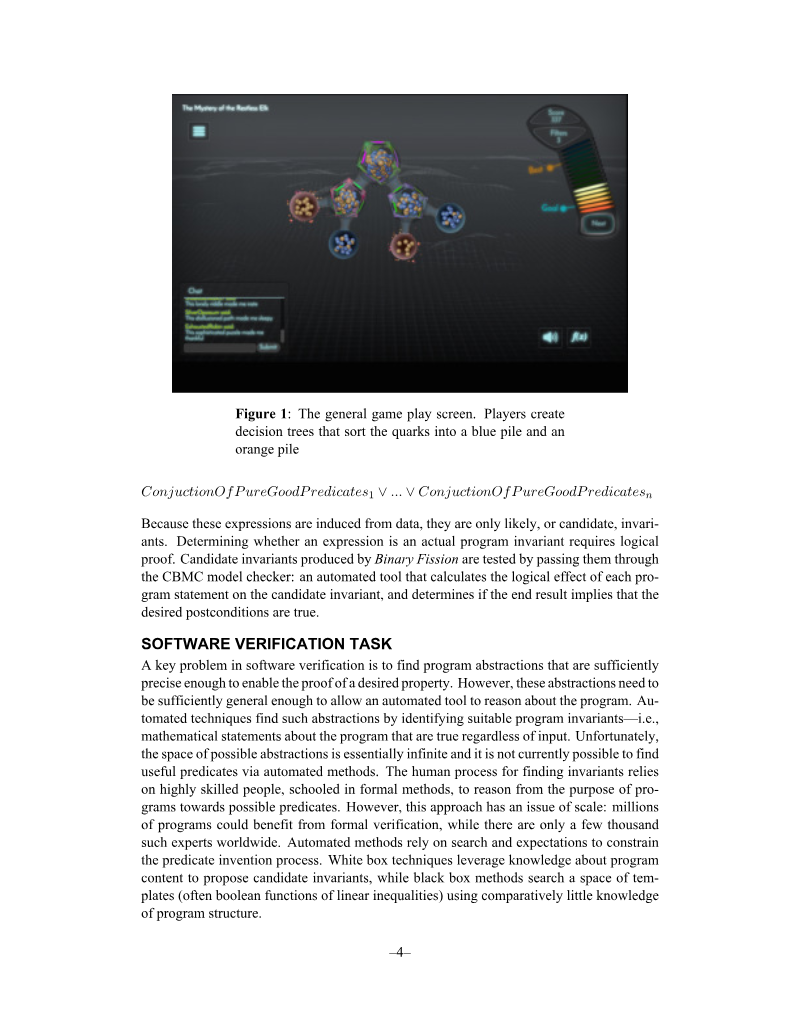
- Binary Fission is a crowdsourced formal verification game from UC Santa Cruz that addresses the shortage of human formal-methods experts by having players discover program preconditions through point-and-click sorting of colored "quarks" with logical filters.
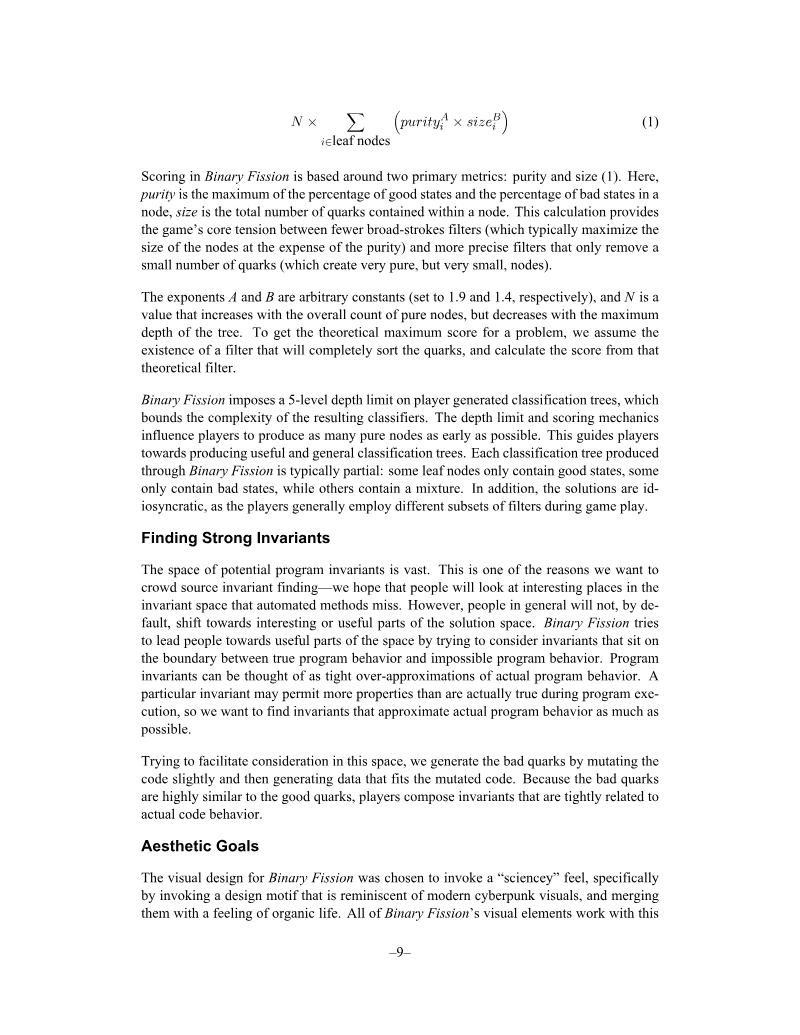
- Among 972 players who produced 2,963 solutions, only 191 of 3,108 player-created clauses qualified as usable function preconditions, about 6%.
- For seven TCAS functions, the player-discovered preconditions accepted between 0% and 53.7% of good test states, showing considerable variation in how general the resulting conditions were.
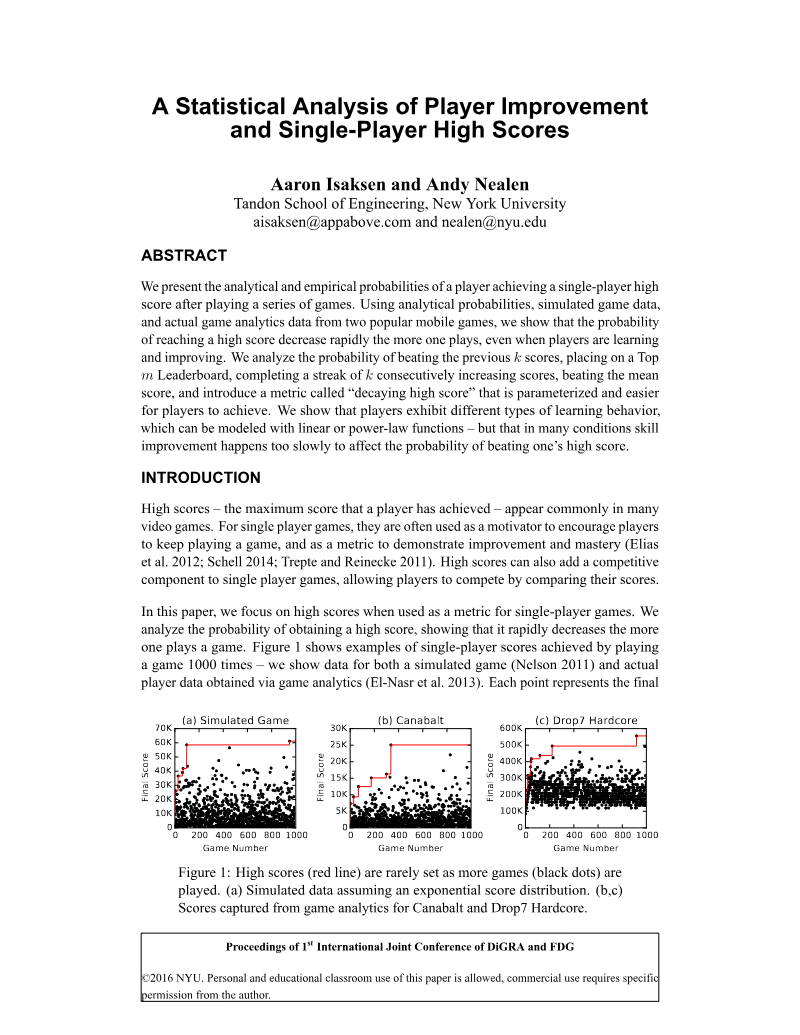
A Statistical Analysis of Player Improvement and Single-Player High Scores
Player learning in single-player games creates a tension for high-score systems: even when players steadily improve, the probability of setting a new personal or all-time high drops rapidly as play continues.
- Improvement in player skill is often too slow to offset the declining odds of beating past scores, so high-score rewards become progressively harder to earn as play continues.
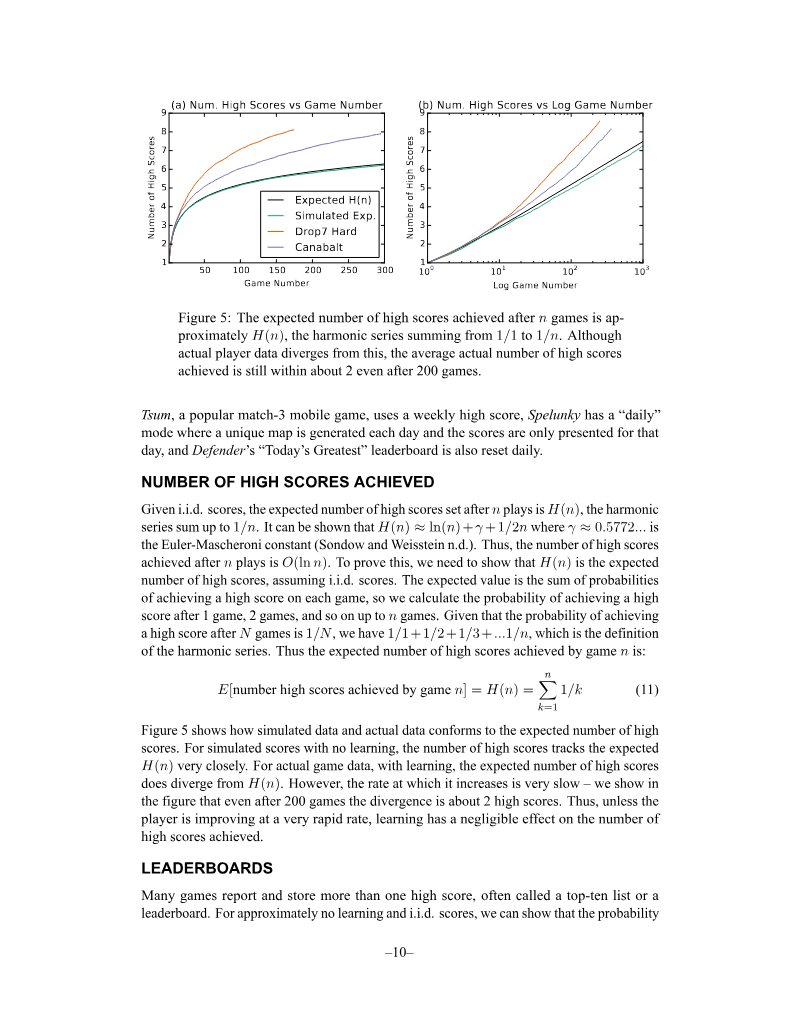
- Under an i.i.d. baseline with no learning, the chance of beating the previous score is 1/2 and the chance of a new all-time high on game n is 1/n, so expected high scores follow the harmonic series (approximately ln(n) plus the Euler-Mascheroni constant).
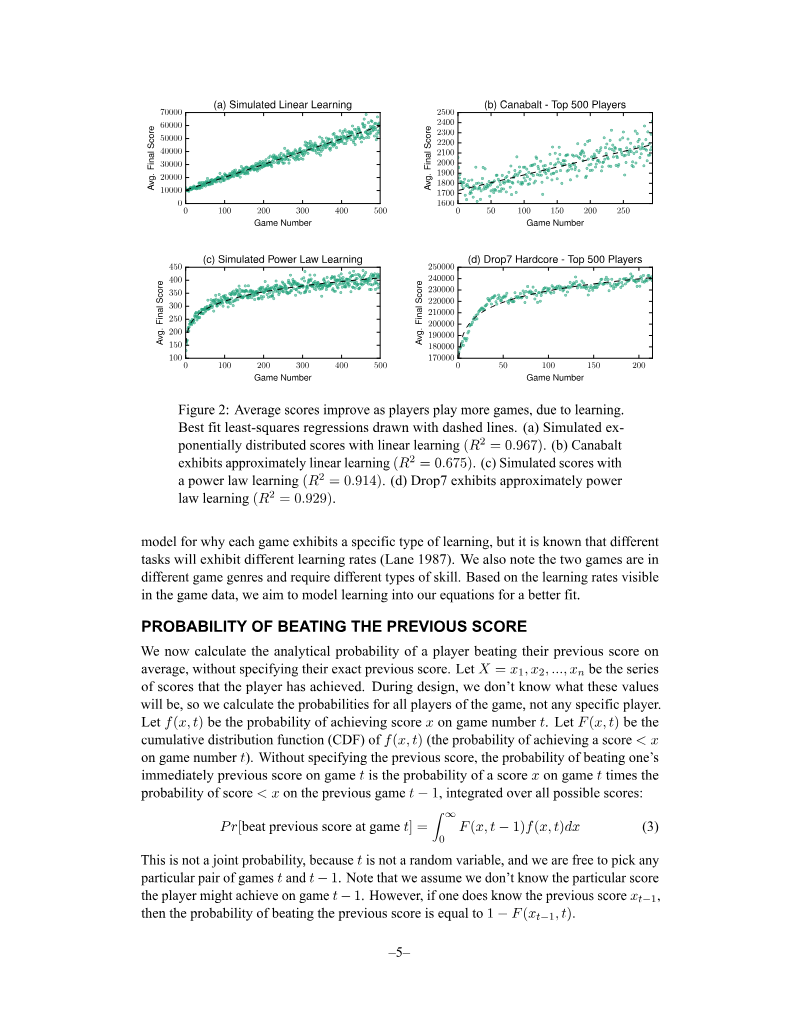
- Real data from Canabalt (roughly linear skill improvement) and Drop7 Hardcore (power-law learning curve) closely track these no-learning predictions, with fitted correction factors of only about 1.01 to 1.11 attributable to learning, whose influence diminishes as games accumulate.
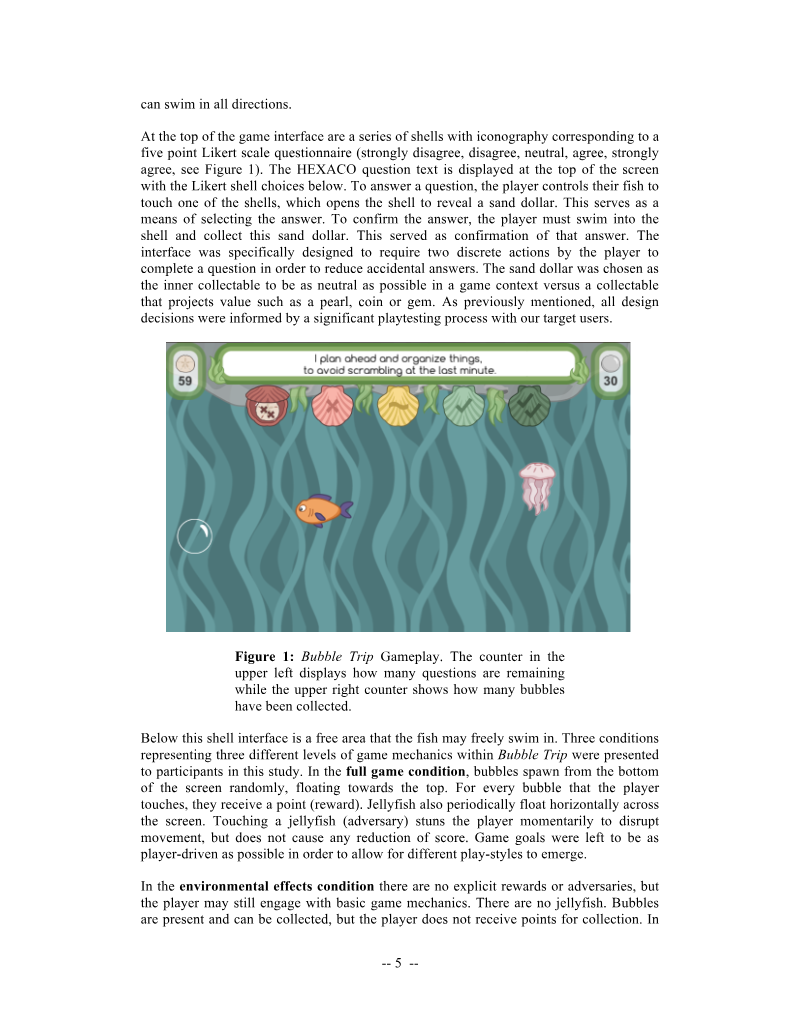
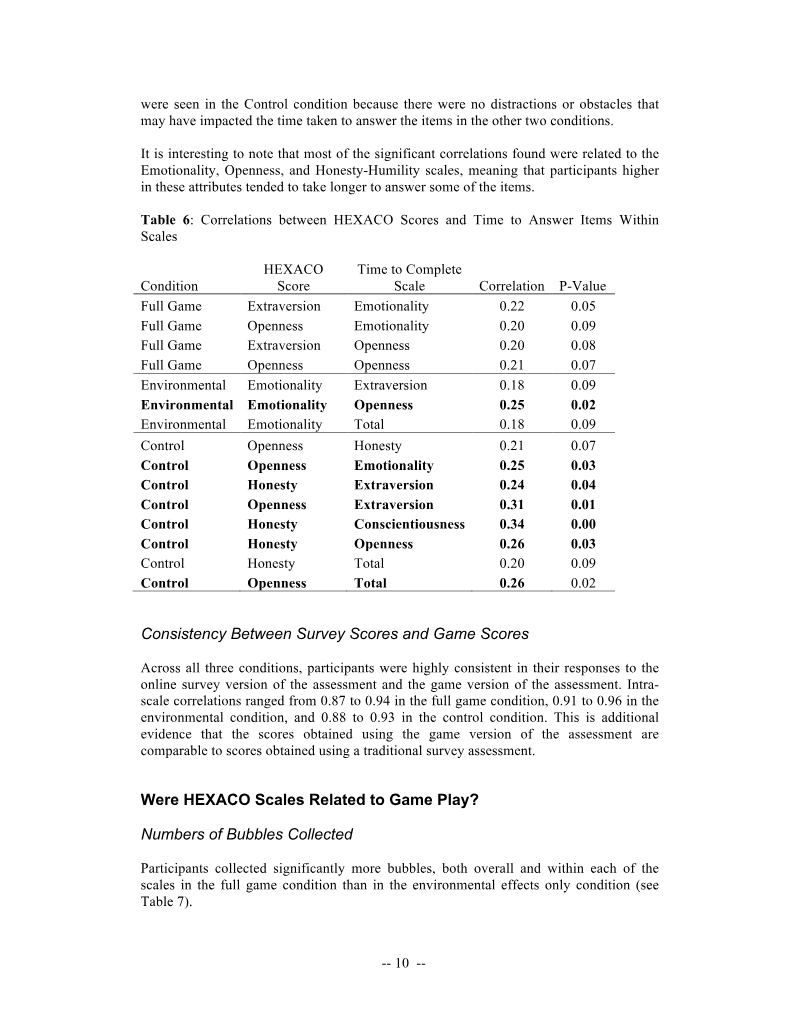

Grouches, Extraverts, and Jellyfish: Assessment Validity and Game Mechanics in a Gamified Assessment
This study examines whether a personality inventory can be gamified without compromising its psychometric integrity.
- Gamified administration of the 60-item HEXACO personality inventory produced personality scores and internal reliability (Cronbach's alphas) comparable to a traditional online survey, with no significant mean differences across conditions.
- Careless responding was low in both formats, with 17 respondents flagged in the game condition and 10 in the traditional survey.
- The full game condition, featuring enemies and point collection, significantly increased engagement: more bubbles collected, more changes to item responses, and an average play time of 5.5 minutes versus 4.9 to 5.1 minutes in the other conditions.

Three Shadowed Dimensions of Feminine Presence in Video Games
The paper "Three Shadowed Dimensions of Feminine Presence in Video Games" argues that scholarly and critical attention to women in games has concentrated narrowly on sexist portrayals and the action-heroine archetype, exemplified by Lara Croft, leaving other forms of feminine presence underexplored.
- The paper argues that scholarship on women in games has focused narrowly on sexist portrayals and the action-heroine archetype (exemplified by Lara Croft), leaving other forms of feminine presence underexplored.
- It proposes three neglected analytical axes: aging (including the 'Adventurous Alice' trope of child and older women characters), the contrast between protagonist-focused and world-focused perception, and feminine sociability.
- The sociability lens, adapted from the Bechdel-Wallace test, asks whether women interact meaningfully with one another rather than only in relation to men.

First-Person Walkers: Understanding the Walker Experience through Four Design Themes
First-Person Walker games, a genre exemplified by titles such as Dear Esther, Proteus, Gone Home, and The Stanley Parable, are defined by constrained interaction, deliberately slow movement, and ambiguous goals.
- The report defines First-Person Walker games (e.g., Dear Esther, Proteus, Gone Home, The Stanley Parable) by constrained interaction, deliberately slow movement, and ambiguous goals, distinguishing them from combat-oriented shooters like Half-Life 2.
- Its central finding is that limited controls, the absence of obstacles, and contextual "use" actions lengthen the time players spend in each environment and shift them from active challengers into attentive observers.
- The study identifies four design themes (player interactivity, temporal space, player focus, and ambiguity), derived from a qualitative method combining interaction mapping, interface study, object inventory, and gameplay logging across four representative games.
The Diversity of Attitudes Towards Play at the Workplace: A Case of an Academic Community
This study examines how members of an academic community perceive play and playfulness in the workplace, using the School of Information Sciences at a Finnish university as its case.
- Attitudes toward workplace play are varied and often ambiguous, so a community's existing views must be understood before any playful initiative is introduced.
- Many respondents see work and play as mutually exclusive, even while recognizing benefits such as improved well-being, creativity, and collaboration.
- Key obstacles to workplace playfulness include limited time, rigid organizational culture, pressure for concrete results, and the difficulty of shifting into a playful mindset.
Enacting Aporia: Roger Caillois' Game Typology as Formalist Methodology
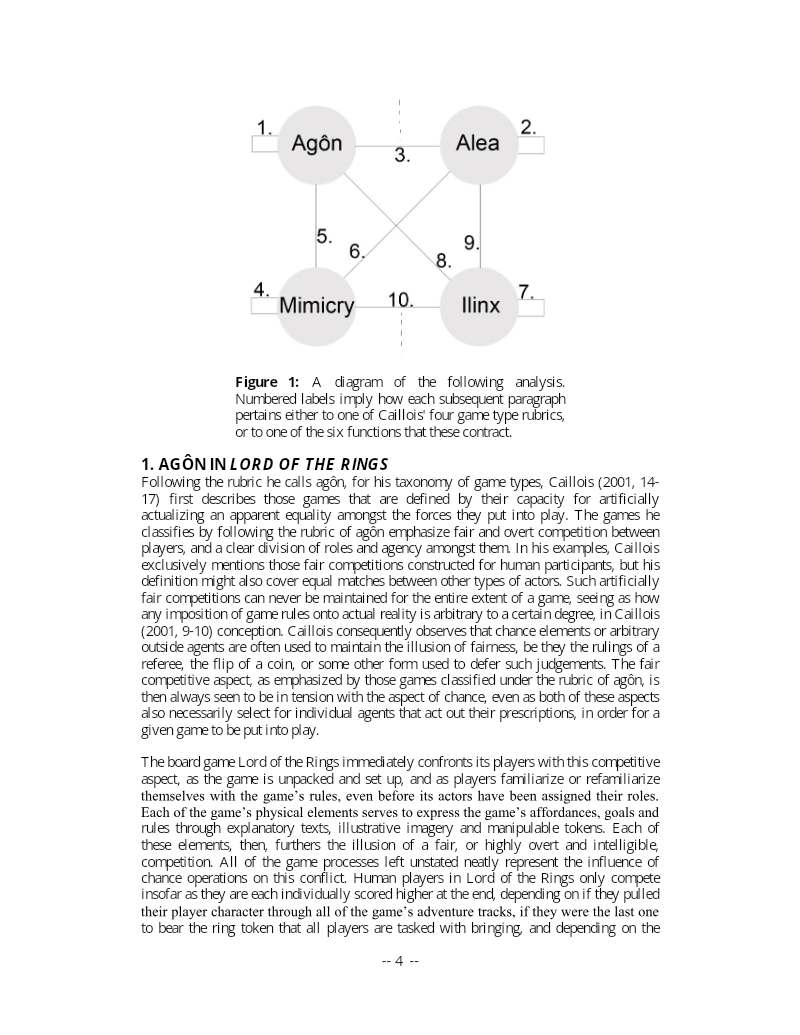
This article advances a formalist method for game analysis by adapting Louis Hjelmslev's glossematics to Roger Caillois' four-part game typology of agôn (competition), alea (chance), mimicry (role-playing), and ilinx (vertigo).
- The article proposes a formalist method that adapts Louis Hjelmslev's glossematics to Roger Caillois' four-part game typology (agôn, alea, mimicry, ilinx) as a foundation for analysing games.
- Its central thesis is that game dynamics emerge from tensions among Caillois' categories rather than from the dominance of any single category.
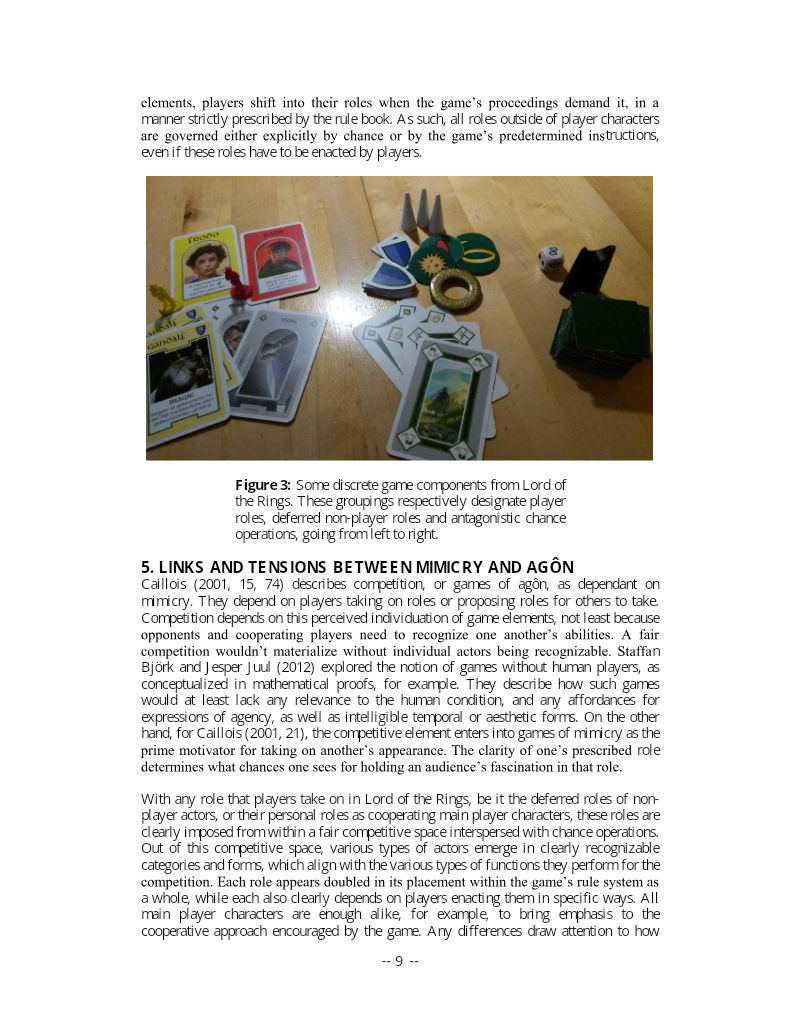
- The case study is a Dutch edition of the board game Lord of the Rings (2000), which the author reads as a title where no single category prevails.

Making the Familiar Unfamiliar: Techniques for Creating Poetic Gameplay
Alex Mitchell's paper argues that games can achieve "poetic gameplay" by applying Shklovsky's concept of defamiliarization, deliberately making familiar game structures strange so that players attend to the game's form and are prompted to reflect.
- The paper argues games can achieve "poetic gameplay" by applying Shklovsky's concept of defamiliarization: deliberately making familiar game structures strange so players attend to the game's form and reflect on it.
- Three core techniques are identified: undermining player control, disrupting the chronological flow of game time, and blurring the boundaries between game, film, and art.
- The findings rest on a close reading of Thirty Flights of Loving and the author's repeated play and analysis, making them qualitative rather than based on quantitative measurement.
Paratextual Play: Unlocking the Nature of Making-of Material of Games
Glas's "Paratextual Play" examines making-of material for digital games, including behind-the-scenes documentaries, concept art, and audio commentaries, and argues that such material has moved from peripheral marketing extra to an integral component of the play experience.
- Making-of material for digital games, such as documentaries, concept art, and audio commentaries, has shifted from a peripheral marketing extra to an integral part of the play experience, and it is never a neutral account of development but a curated, celebratory one.
- Game paratexts are woven into gameplay, with access tied to playing and succeeding: Star Wars: Episode I – Battle for Naboo hid material behind cheat codes, and Rare Replay locked its "Rare Revealed" section, unlike film DVD extras that are typically reached through menus.
- Achievement systems such as Xbox Gamerscore and PlayStation Trophies, along with medal points and in-game currency, gate bonus content like the "Tech Dive" video in Uncharted 2, which costs $120,000 in-game to unlock, turning collecting this material into a goal in itself.

Conventions Within eSports: Exploring Similarities in Design
"Conventions Within eSports: Exploring Similarities in Design" investigates whether successful competitive electronic sports share recognizable design characteristics, using League of Legends and CS:GO as its primary case studies.
- The study identifies five shared structural characteristics across successful competitive eSports, using League of Legends and CS:GO as case studies: a Match Based Structure, a Player Evaluation System, Explicit User Interfaces, Player Performance Feedback, and the Game Client.
- Both games use head-to-head matches with automated matchmaking that places players only in new matches, though their rules differ, such as base destruction in League of Legends versus thirty three-minute rounds in CS:GO, where draws are possible only in the latter.
- Both titles rank players by skill, with rank changes driven by win and loss records, and present gameplay information clearly through their interfaces.