
DiGRA
The Digital Games Research Association: the international association of academics and professionals who study digital games. Its Digital Library holds the proceedings of the DiGRA conferences since 2002.
Documents
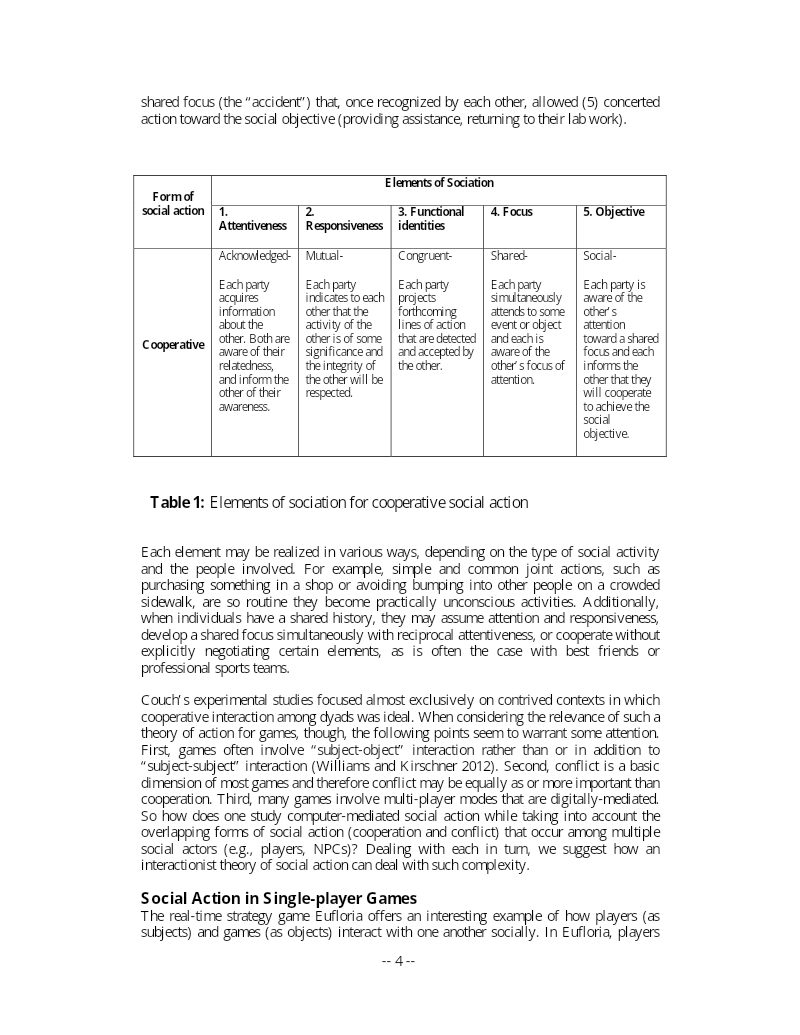
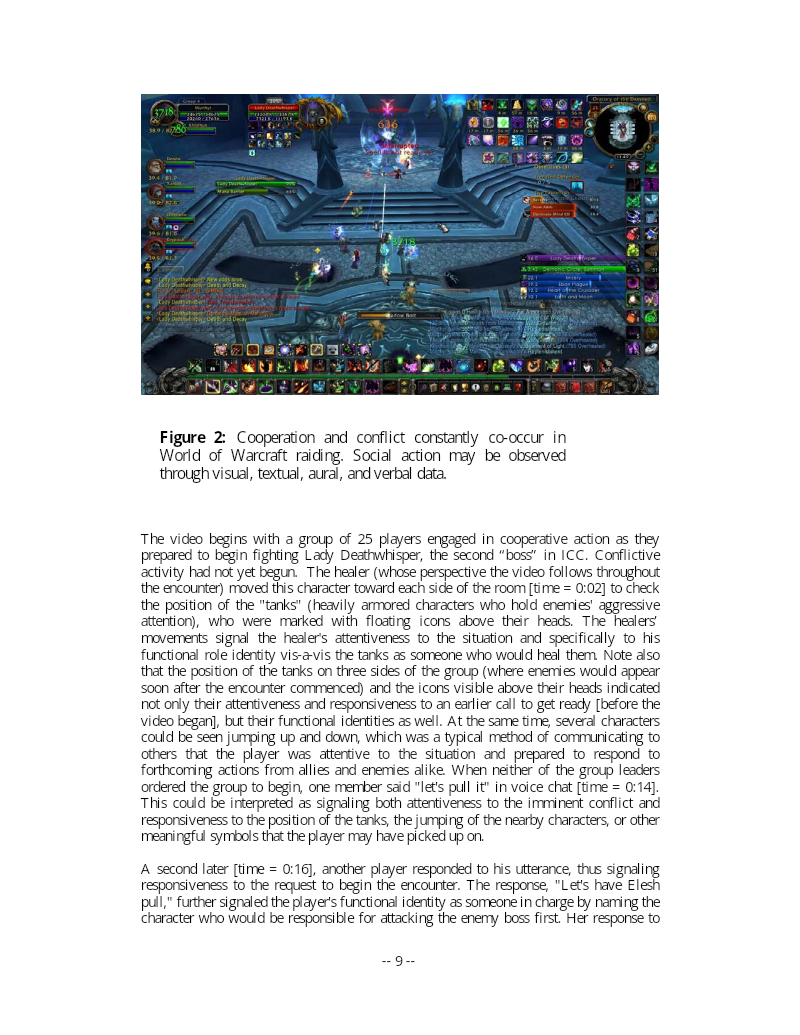
Elements of Social Action: A Micro-Analytic Approach to the Study of Collaborative Behavior in Digital Games
This paper proposes a micro-analytic framework for studying social action in digital games, extending Carl Couch's five elements of sociation (acknowledged attentiveness, mutual responsiveness, congruent functional identities, shared focus, and social objective) to cover both cooperative and conflictual interaction.
- The paper proposes a micro-analytic framework extending Carl Couch's five elements of sociation to cover both cooperative and conflictual interaction in digital games, arguing that conflict and cooperation draw on the same generic elements but serve different functions.
- The authors contend that understanding collaborative play requires moment-by-moment analysis of observable interaction from audio-visual recordings, rather than relying on players' retrospective accounts of what they did.
- In the single-player real-time strategy game Eufloria, game AI and narrative structure largely fix coordinated action in advance, leaving players limited room to redirect objectives.
Playability and Its Absence: A Post-Ludological Critique
Leino's "Playability and Its Absence: A Post-Ludological Critique" argues that single-player computer games and interactive art occupy distinct territory, and that the defining feature separating them is playability: a "gameplay condition" that makes players responsible for their freedom through constraints on interpretation…
- Leino defines playability as a 'gameplay condition' in which constraints on interpretation and clear right/wrong feedback make players responsible for their freedom, and he argues this is what distinguishes single-player games from interactive art.
- He traces a historical lineage from Allan Kaprow's 1960s Happenings through reactive environments and interactive installations to single-player games such as Tetris, framing games as the latest stage of machine-mediated audience participation.
- Leino contends that 'non-playable' art games like Proteus keep game-like features such as failure and significance while removing goals and winning conditions, and that this absence can be a deliberate artistic strategy shifting meaning toward aesthetic and existential reflection.


Cosplay: Material and Transmedial Culture in Play
Nicolle Lamerichs's study treats cosplay as a material and transmedial practice that sits at the intersection of fan community, play, and commerce.
- Lamerichs argues cosplay is a material and transmedial practice at the intersection of fan community, play, and commerce, and that its hybrid mix of play, production, and consumption resists existing definitions of play, making it a useful test case for play and fandom theory.
- Costumes circulate as liminal objects shaped by both fandom gift culture and commercial or non-commercial creative labor, blurring the boundary between labor and play.
- Preliminary April 2013 searches found eBay listings dominated by China-sourced outfits and wigs, with gendered categorization favoring women's accessories and vendors policing feedback to protect their reputations.
Assassin's Creed III and the Aesthetics of Disappointment
This paper examines how video game players construct a "culture of history" around Assassin's Creed III through prerelease, release, and post-release commentary, drawing mainly on user reviews and forum discussions on gaming enthusiast press websites such as Giantbomb.com, IGN.com, Destructoid.com, and Polygon.com.
- The paper argues that an "aesthetics of disappointment" lets players measure Assassin's Creed III against the series' past and against expectations for gaming's future, with disappointment depending on prior expectations shaped by paratexts such as leaked box art, previews, and developer interviews.
- Based on qualitative close reading of user reviews and forum threads from June 2012 through January 2013 on sites like Giantbomb, IGN, Destructoid, and Polygon, rather than a formal survey or sample.
- Critics targeted the game's level design, controls, technical glitches, narrative, and ending, often comparing it with Revelations, Dishonored, Far Cry 3, and Mass Effect 3, while others defended its naval combat and story.
What Happens When a Cyberworld Ends: The Case of There.com
The closure of There.com, a 3D social cyberworld that shut down on March 9, 2010, after its CEO cited insufficient revenue amid the economic crisis, serves as the focus of this analysis of how virtual communities respond to the loss of their digital homes.
- There.com, a 3D social cyberworld, shut down on March 9, 2010, after its CEO cited insufficient revenue amid the economic crisis, and the analysis treats this as the loss of a real community rather than a mere product.
- Displaced users responded with the language of death and mourning, grieving their avatars and searching for a new home across social networks and rival platforms.
- The community dispersed to Facebook groups, Thumdar, and YouTube, while rival cyberworlds such as Second Life and Kaneva offered free accounts and currency exchanges to attract the displaced population.
Understanding Videogame Cities
"Understanding Videogame Cities" argues that fictional game cities can be analyzed with the same rigor applied to physical cities, using Saints Row: The Third's Steelport as its central case.
- The report argues that fictional videogame cities can be analyzed with the same rigor as physical cities, using a three-part framework of constitutional, representational, and experiential orders that blends Lefebvre's spatial triad with Douglas Allen's criteria.
- Its central thesis is that a city's character emerges from the interplay between its built structure, its visual and symbolic representation, and the embodied experience of moving through it.
- Using Saints Row: The Third's Steelport (2011) as the central case, the analysis finds that territory control and monuments, such as the Magarac Island statue destroyed late in the game, visibly express the city's power dynamics.

A Study of Team Cohesion and Player Satisfaction in Two Face-to-Face Games
A study of two face-to-face educational farming games, The Green Revolution Game and Africulture, examines whether game rules shape team cohesion and player satisfaction.
- The Green Revolution Game produced significantly higher ratings than Africulture for team cohesion, communication, and fairness (each at p<.05), in a between-subjects study of 36 participants (16 vs. 20).
- The study grounded its hypothesis in Social Identity Theory, predicting that fixed team membership and collective judgment would foster stronger cohesion than individualized roles and changeable teams.
- Mixed-motive conflict was somewhat lower in the Green Revolution Game, but this difference did not reach statistical significance.


Fusing Quantitative and Qualitative Methods in Virtual Worlds Behavioral Research
A mixed-methods study conducted by SAIC and Georgia Tech examines whether real-world characteristics of players can be inferred from how they behave and appear as avatars in massively multiplayer online role-playing games.
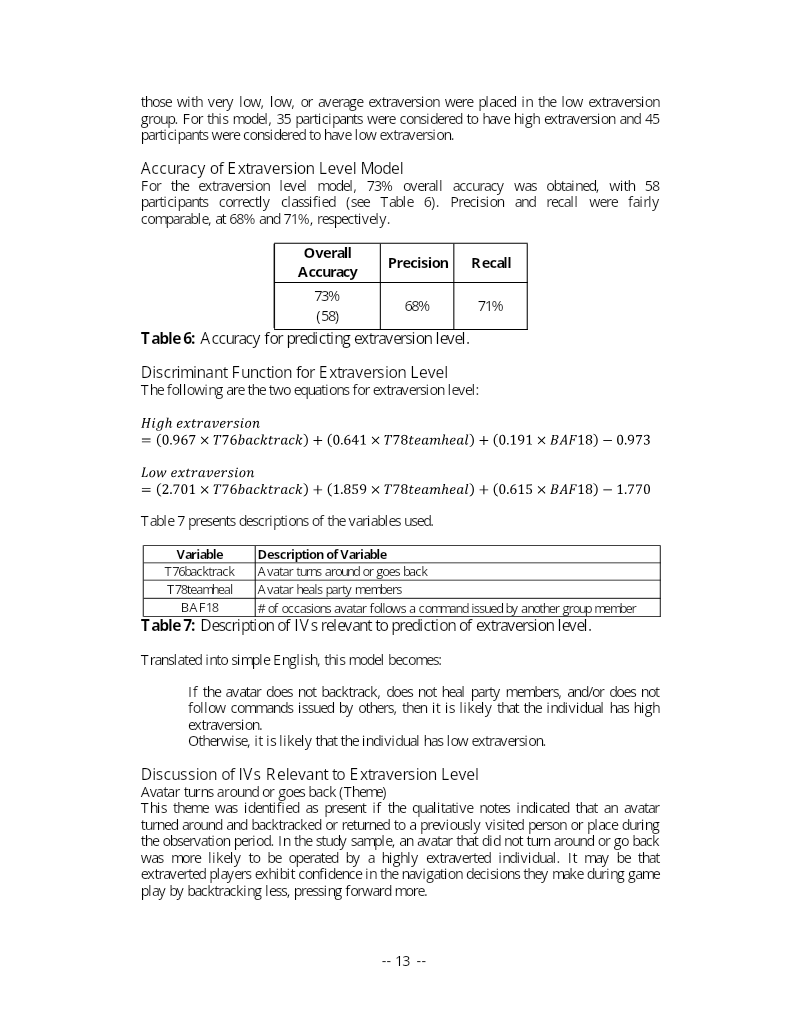
- Gender was predicted from virtual-world observation with 84% overall accuracy, the strongest result in the study of 80 Guild Wars and Aion participants, followed by extraversion (73%), aggressive ideology (73%), submissive ideology (71%), and approximate age (66%).
- The study fused standardized avatar ratings with 'thick description' field notes converted into quantitative predictors via automated text analysis, then analyzed them with discriminant analysis and leave-one-out cross-validation.
- Key predictors included male avatar appearance, movement patterns, and avatar class; aggressive ideology was associated with non-strategic play, melee combat, and frequent quest log checking, though its 53% precision indicates many false positives.
Teaching Serious Game App Design Through Client-Based Projects
This paper reports on a mobile game design course at George Mason University during 2012–2013, in which student teams of five built serious game prototypes for real clients, including The Century Council and ACE.
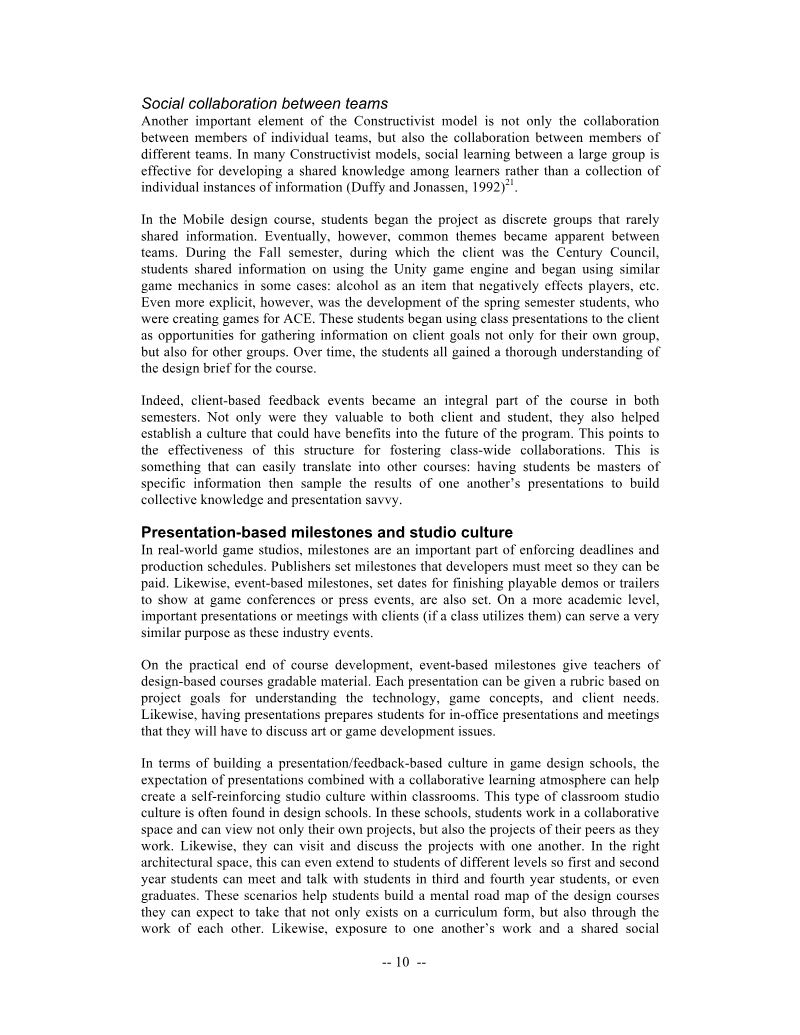
- The authors argue that client-based, studio-style projects are an effective way to teach serious game design, and that course structure significantly affects outcomes.
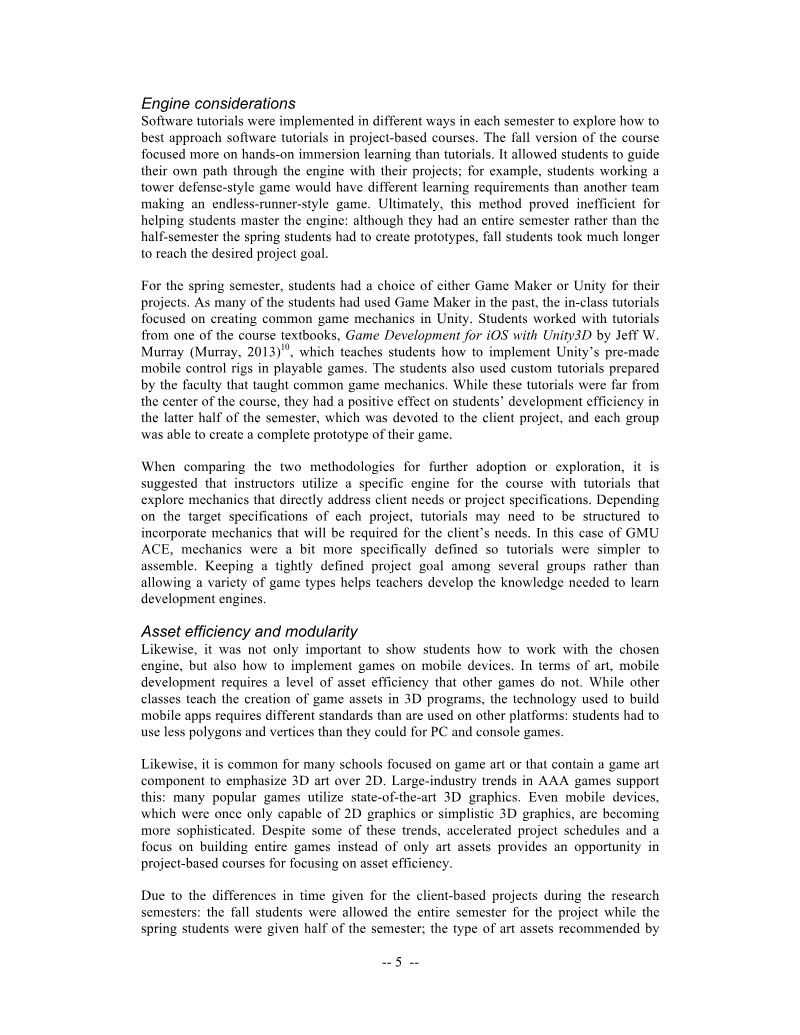
- A spring offering that began with tightly defined project goals and a half-semester project window produced faster progress toward complete prototypes than a fall offering that used an immersive, learn-by-building approach.
- Students with more formal game design study, delivered through parallel lectures and play sessions, analyzed client problems better and built systemic mechanics rather than emulating popular apps.
Nostalgia in Retro Game Design
Nostalgia in Retro Game Design examines how contemporary games draw on the aesthetics and conventions of earlier videogame eras, arguing that the category of "retro" games is far from uniform.
- Retro game design is not a uniform category: Maria Garda's distinction between restorative nostalgia (faithful preservation via emulation, re-releases, and retrogaming) and reflective nostalgia (creative recombination of the medium's historical styles) implies very different design goals.
- The report argues that perfect historical accuracy in restorative nostalgia is inherently unattainable, whereas reflective nostalgia openly embraces the gap between past and present.
- Hotline Miami is cited as reflective nostalgia that remediates the look of 1980s neo-noir cinema rather than specific gaming practices, producing a deliberately unfaithful analog feel.
Understanding the Videogame Medium: Perspectives of Participation
"Understanding the Videogame Medium: Perspectives of Participation" proposes a conceptual framework for designing and evaluating videogames by focusing on how players take part in gameplay rather than on abstract experiential concepts such as fun, flow, or immersion, which the authors argue are difficult to operationalize for…
- The report proposes a theoretical framework that analyzes videogames through six perspectives of participation (Playfulness, Challenge, Embodiment, Sociability, Sensemaking, and Sensoriality) rather than abstract experiential concepts like fun, flow, or immersion, which the authors view as hard to operationalize for design.
- The framework draws on Activity Theory's notion of multi-mediation and examines each perspective through three focuses: Intention, Artifact, and Participation, with mediators such as avatars, rules, resources, and social structures shaping player experience.
- The model is primarily theoretical rather than empirical, and each perspective is grounded in established play theory and player-motivation research.

DESIGN(er) META Game
The paper presents a serious game developed by design educators at the University of Tennessee to address a persistent gap in their course: students could analyze design history competently through compare-and-contrast essays, yet failed to transfer that analysis into their own conceptual reasoning and visual work.
- The META game was created by design educators at the University of Tennessee to close a gap where students could analyze design history in essays but failed to transfer that analysis into their own conceptual reasoning and visual work.
- The game uses directed, open-ended questioning to foster divergent thinking about concept, composition, materials, and technology, and aims to channel students' gaming curiosity into design education.
- Students read decade-based material drawn from a 1989 Print magazine issue covering design from the 1940s through the 1980s, then produce at least five question cards with visual examples and compete in team bouts where judges and opponents argue from question prompts.