1 free read left. Create a free account for unlimited reading + AI research.
Create free accountWhitepaper DiGRA
1 free read left. Create a free account for unlimited reading + AI research.
Create free accountWhitepaperDiGRA
Student teams of five built serious game prototypes for real clients, including The Century Council and ACE.
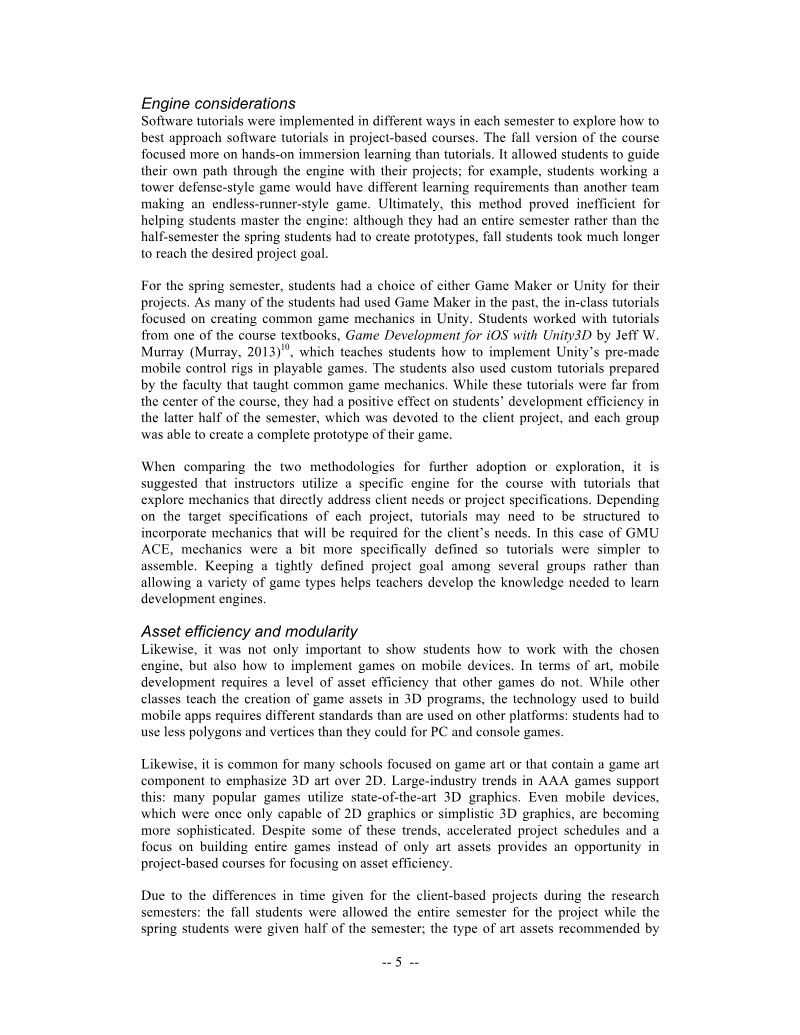
This paper reports on a mobile game design course at George Mason University during 2012–2013, in which student teams of five built serious game prototypes for real clients, including The Century Council and ACE. The authors' central argument is that client-based, studio-style projects are an effective way to teach serious game design, and that course structure matters considerably. Comparing a fall offering that used an immersive, learn-by-building approach with a spring offering that began with tutorials and design theory, they found that the spring model, with tightly defined project goals and a half-semester project window, produced faster progress toward complete prototypes.
Several findings shape the authors' recommendations. The shorter spring timeline pushed faculty to steer students toward 2D art for efficiency, while students who had completed more formal game design study, delivered through parallel lectures and play sessions, better analyzed client problems and built systemic mechanics rather than emulating popular apps. Students also valued frequent client engagement, which supports iterative, Constructivist project models. Survey data showed over 60% of students enthusiastic about the format, with 70% in the fall and 86.4% in the spring reporting a positive outlook on their projects.
The study is situated within the rapid growth of mobile gaming, which NPD Group data cited as reaching 22% of the overall video game market in 2012, up nine points from the previous year. Its scope is a single institution over two semesters, drawing on course-level observation, student surveys, and client presentations rather than a broad multi-institution sample.
The authors conclude that the spring structure was more successful and recommend splitting the course into two semesters, placing it at upper undergraduate or graduate levels, and treating mobile as one platform among many rather than as a standalone specialty.



DiGRA · 2018

DiGRA · 2018



DiGRA · 2018



DiGRA · 2018

DiGRA · 2018

DiGRA · 2018



DiGRA · 2018



DiGRA · 2018



DiGRA · 2018



DiGRA · 2018

DiGRA · 2018



DiGRA · 2018