
DiGRA
The Digital Games Research Association: the international association of academics and professionals who study digital games. Its Digital Library holds the proceedings of the DiGRA conferences since 2002.
Documents
Who Am 'I' in the Game?: A Typology of the Modes of Ludic Subjectivity
Daniel Vella's paper proposes a typology of "ludic subject-positions," the modes through which digital games establish an "I-in-the-gameworld" for the player.
- Vella proposes a typology of 'ludic subject-positions' grounded in phenomenology (Sartre, Merleau-Ponty), arguing the player's sense of self in a game is an experiential Gestalt built from interacting formal mechanisms rather than a single existing framework like point of view or Wilhelmsson's 'Game Ego'.
- The embodied subject-position is structured by four linked aspects: spatial standpoint, capabilities, goal-orientation, and passion.
- The typology identifies five variants: singular embodied (e.g., Tomb Raider, Pac-Man), multiple embodied (e.g., Valkyria Chronicles), distributed (e.g., Baldur's Gate), semi-transcendent (e.g., FTL, Warcraft II), and pure transcendent (e.g., SimCity, Black & White).


Selling Out the Magic Circle: Free-to-Play Games and Developer Ethics
This study examines how ongoing rule changes and monetization tactics in KingsRoad, a browser-based free-to-play MMORPG, affect player agency and perceptions of fairness.
- The study argues that KingsRoad's developer repeatedly broke an implicit contract with players by making unannounced or vaguely announced changes to economy, rules, and difficulty, disrupting the 'magic circle' that separates play from commerce.
- The central case, the 'Doomsayer belt fiasco' of October and November 2014, placed a tournament-exclusive belt in the in-game shop for premium currency only hours before the competition ended.
- Five purposively sampled cases of community upheaval were analysed, including a gold-income nerf, a hidden attack speed cap, a doubled lockbox price, and a secret raid 'bot' system suspected of levying a hidden tax.


Source Code and Formal Analysis: A Hermeneutic Reading of Passage
This analysis argues that the source code of video games can yield interpretive insight into their meaning without depending on the creator's stated intentions.
- The analysis argues that a video game's source code can yield interpretive meaning independently of the creator's stated intentions, using Jason Rohrer's 2007 game Passage as its case study.
- The author contends that prior hermeneutic readings of Passage by Parker, Harrer, and Robinson and colleagues rely too heavily on Rohrer's public statements, whereas the code offers an independent route to interpretation.
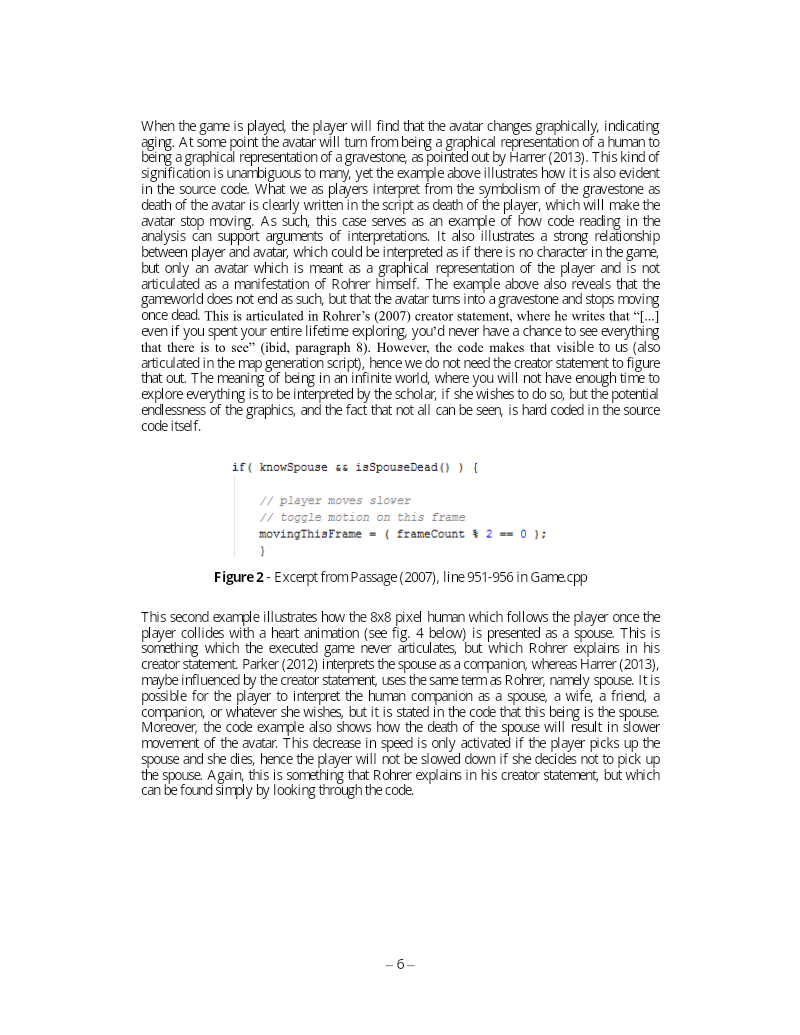
- Hardcoded symbolism identified in Game.cpp includes mapping the avatar's death onto the player's death and a rule permitting only one spouse per playthrough, which the analysis reads as monogamous and heteronormative.
Critical Acclaim and Commercial Success in Mobile Free-to-Play Games
Critical acclaim does not reliably predict commercial success among mobile free-to-play games, according to an analysis of 3,360 iOS titles that merges Metacritic Metascores with Sensor Tower grossing data.
- Critical acclaim does not reliably predict commercial success in mobile free-to-play games: across 3,360 iOS titles merging Metacritic Metascores with Sensor Tower grossing data, the Metascore-to-grossing-rank correlation is weak and negative (r = -0.169, p = 0.009).
- Business model matters far more than review quality: 73.6 percent of top-grossing games are free-to-play, and top grossers are much less likely to be reviewed by critics (18.2 percent versus 41.5 percent for the broader set).
- Top-grossing games average a Metascore of 71.8, compared with 79.8 for the comparison group, indicating that higher critical reception is slightly associated with lower revenue.
The Emancipated Player
"The Emancipated Player" argues that a distinct mode of player involvement, which the author terms "emancipated involvement," extends video game engagement beyond entertainment and immersion into critical reflection and the pursuit of significance.
- Gerald Farca proposes the 'emancipated player': a critical, open-minded player type who willingly engages in play and primarily seeks to experience play's aesthetic effect, rather than only basic entertainment or plot-level thrills.
- The emancipated player's involvement requires an interplay of inhabiting the gameworld and critically reflecting on it, and this engagement can occur both during play (micro and macro phases) and outside play as the player continues to reflect on the experience.
- Farca draws on Jacques Rancière's emancipated spectator, Wolfgang Iser's active reader and implied reader, Kendall Walton's make-believe framework, and Britta Neitzel's notion of play as a balance of proximity and distance to ground the concept.

Designing a Serious Game for General Practice Management
This work presents RIDEVA, a three-phase framework for designing serious games in general practice management education, motivated by widespread dissatisfaction among Dutch GP students and alumni with textbook-driven learning of practice management.
- The authors propose RIDEVA, a three-phase framework (requirements identification, game design, evaluation) for designing serious games in general practice management education, motivated by Dutch GP students' and alumni's dissatisfaction with textbook-driven learning.
- The resulting game is built on flow theory, player typologies, and a dramatic arc, with eight intended learning outcomes derived from Dutch and international curricula, literature, and expert interviews, aligned with the Netherlands' three-segment GP funding model.
- The game uses four progressively complex mini-games in which players manage actions, staffing, and resources, receiving algorithmic feedback based on five key performance indicators.

GameNet and GameSage: Videogame Discovery as Design Insight
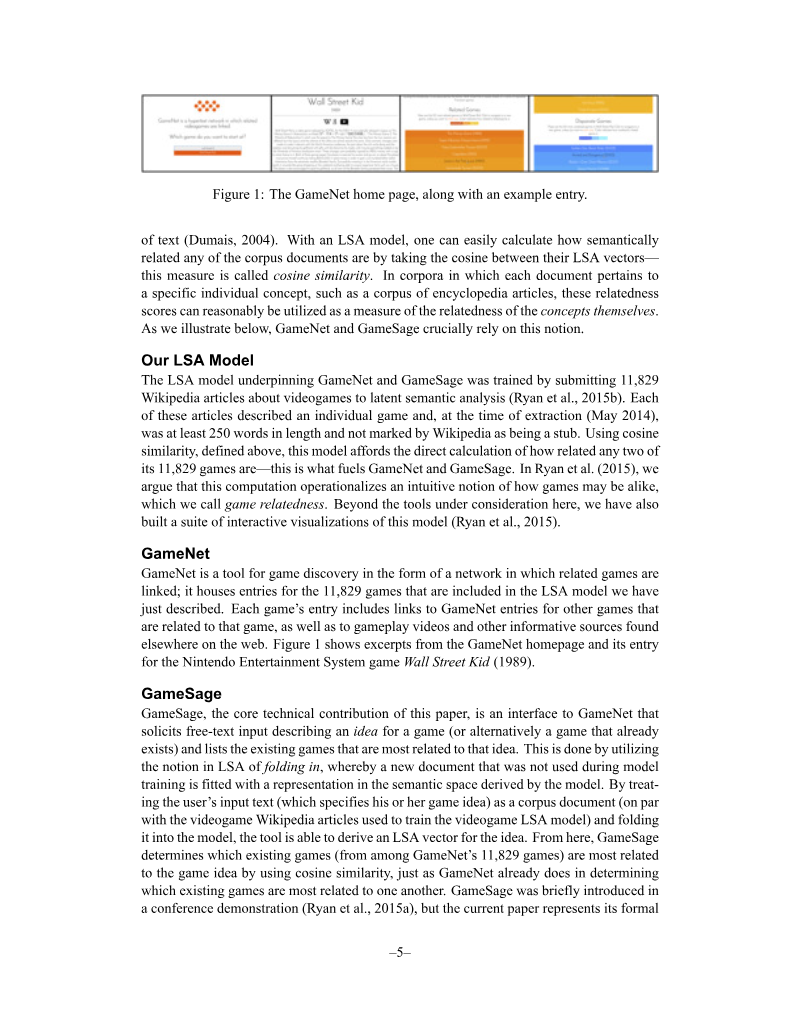
GameNet and GameSage present a videogame discovery system designed to help game designers locate related prior work in an industry where the volume of new releases has outpaced any individual's ability to survey existing games.
- GameNet and GameSage target a discoverability problem in game design: the volume of new releases has outpaced any individual's ability to survey existing games, which the authors link to blockbuster-driven, bandwagon-style development.
- In a controlled study of 182 undergraduate game-design students over 15-minute sessions, participants using GameSage and GameNet discovered an average of 14.16 games versus 6.49 with general web search.
- The tools surfaced far more unfamiliar titles: 80.3% of games discovered were new to participants, compared with 47.0% for the baseline.


Discovering Social and Aesthetic Categories of Avatars: A Bottom-Up Artificial Intelligence Approach Using Image Clustering
This study applies unsupervised image clustering to 191 player-created avatars from a custom RPG avatar creator, asking whether machine learning can uncover meaningful aesthetic and social categories without relying on predefined labels.
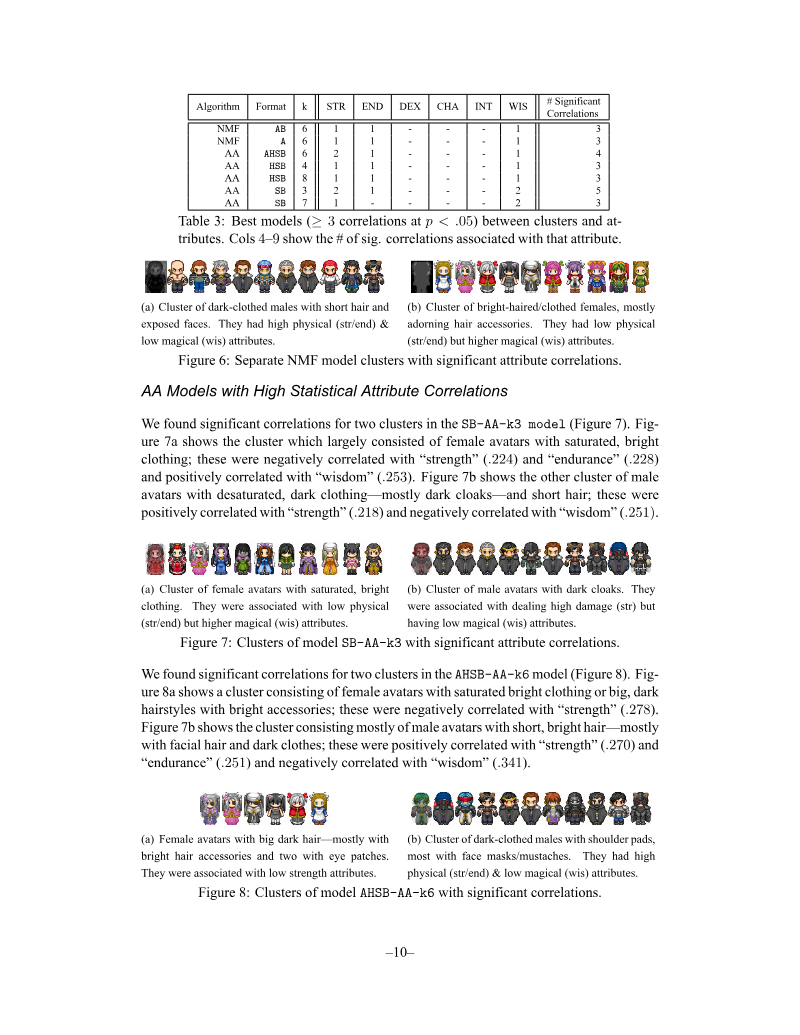
- The study uses unsupervised image clustering (NMF and archetypal analysis) on 191 player-created avatars from a custom RPG avatar creator to find aesthetic and social categories without predefined labels.
- Six clusters were identified as the optimal balance between interpretability and correlation strength across the best-performing models.
- The top-performing models (AB-NMF-k6, A-NMF-k6, SB-AA-k3, and AHSB-AA-k6) showed statistically meaningful associations (p < .05) with strength, endurance, and wisdom attributes.


Combining Speech Intervention and Cooperative Game Design for Children with ASD
Feeling Factory is a two-player cooperative iPad game designed to train prosodic speech, meaning the emotional and grammatical intonation of language, in children with autism spectrum disorder.
- Feeling Factory is a two-player cooperative iPad game training prosodic speech (emotional and grammatical intonation) in children with autism spectrum disorder, grounded in ABA and DIR-Floortime principles, addressing a notable scarcity of prosody interventions and a gap in speech games that lack conversational context.
- The game progresses from explicit semantic cues toward neutral sentences, so children gradually rely on their own prosodic control rather than contextual support, with role-switching built into the two-player design.
- The evaluation was a feasibility study, not an efficacy trial: seven speech pathology experts responded very positively, especially to the two-player structure, which they judged likely to raise engagement and encourage practice with real interlocutors.


Behaviour Change Wheel Driven Normative Feedback in a Serious Game for Energy Conservation
This paper proposes that normative feedback, grounded in Social Normative Theory and social comparison theory, is a promising and underexplored basis for serious games that promote household energy conservation.
- The paper argues normative feedback grounded in Social Normative Theory and social comparison theory is a promising but underexplored basis for serious games promoting household energy conservation.
- Three priority home behaviours were selected for their impact, likelihood of change, spillover potential, and measurability: turning off lights when leaving rooms, adjusting air conditioner use, and reducing standby electricity.
- Prior serious games such as the Kukui Cup produced short-term reductions of up to 16% without sustained effect, and points-, badge-, and leaderboard-based designs are judged to have failed to motivate lasting change.
Interactive Biotechnology: Design Rules for Integrating Biological Matter into Digital Games
This document argues that integrating live biological matter into digital games opens a design space far richer than conventional human-computer interaction, with the authors counting 64 possible interaction schemas compared with four for standard setups.
- The authors count 64 possible interaction schemas for integrating biology into games, compared with four for standard setups, and enumerate 21 arrangements of biology, digital systems, and human players.
- The report proposes the "biotic processing unit," treating biological components as abstracted hardware analogous to a GPU or physics engine.
- Design rules address the mismatch between biological and human time scales, using on-screen magnification, analog controls, and virtual overlays that compensate for biological variability.

Four Lenses for Designing Morally Engaging Games
"Four Lenses for Designing Morally Engaging Games" argues that games can cultivate genuine moral engagement in players by attending to four distinct dimensions adapted from Rest's Four Component Model of moral psychology: moral focus, sensitivity, judgement, and action.
- Games often teach players to treat morality instrumentally, as a means to rewards, rather than as a concern worth prioritising for its own sake; the authors therefore recommend abandoning morality meters in favour of familiar moral roles and sympathetic non-player characters.
- The framework adapts Rest's Four Component Model of moral psychology into four lenses for game design: moral focus, sensitivity, judgement, and action, positioned as a complement to existing ethics-in-games frameworks.
- Overt signalling of moral content can diminish players' own capacity to perceive moral stakes, while unsignposted choices risk alienating them, so designers must balance signposting against subtlety.