
DiGRA
The Digital Games Research Association: the international association of academics and professionals who study digital games. Its Digital Library holds the proceedings of the DiGRA conferences since 2002.
Documents

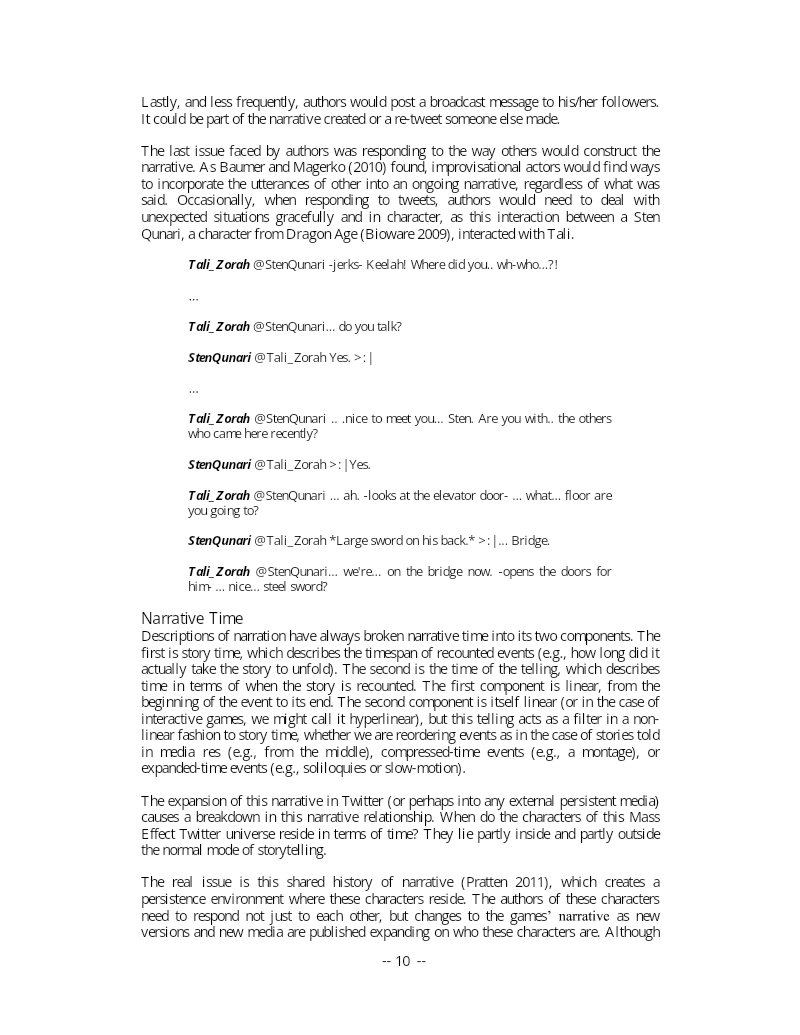
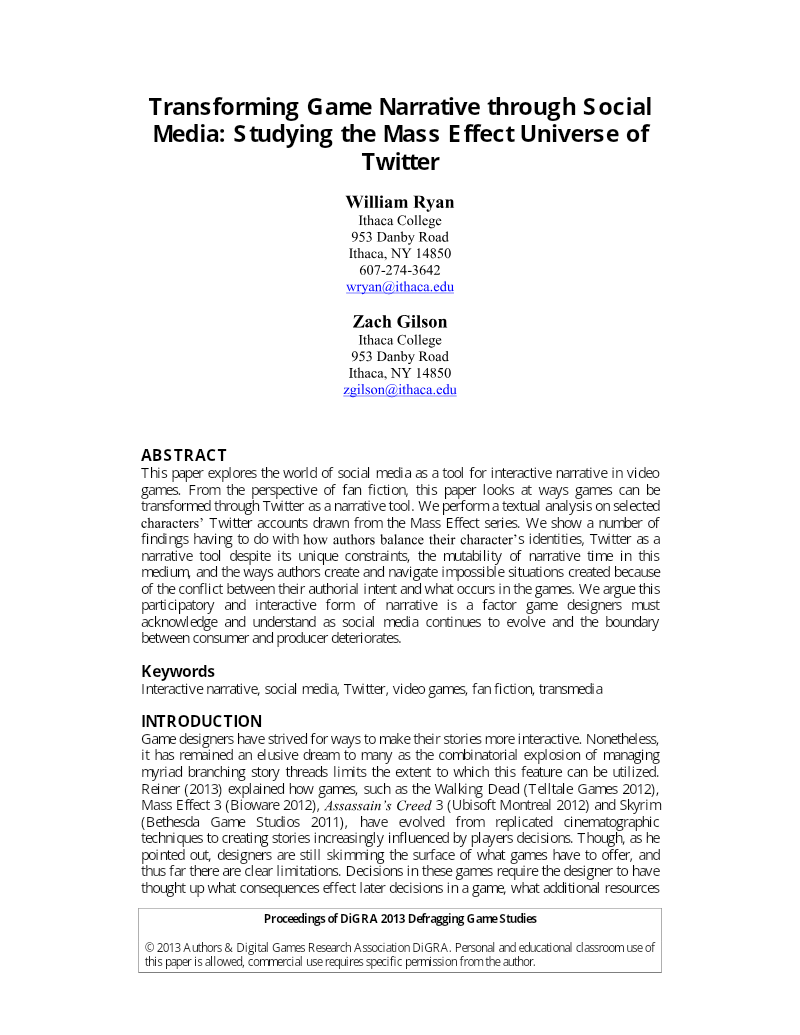
Transforming Game Narrative through Social Media: Studying the Mass Effect Universe of Twitter
This study examines how fans of the Mass Effect video game series used Twitter as a participatory narrative medium, treating character accounts for figures such as Garrus, Tali, Joker, and Saren as a collaborative storytelling space.
- Fans of the Mass Effect series used Twitter as a participatory storytelling space, with character accounts for figures like Garrus, Tali, Joker, and Saren acting as a collaborative narrative medium.
- A textual analysis of 215 tweets from eight character accounts found about 89% were first-person and 69% present-tense, with the accounts adopting a consistent character voice.
- Roughly 82% of tweets addressed other Mass Effect accounts versus only 6% engaging non-Mass Effect accounts, showing the narrative was aimed at fellow players rather than spectators.
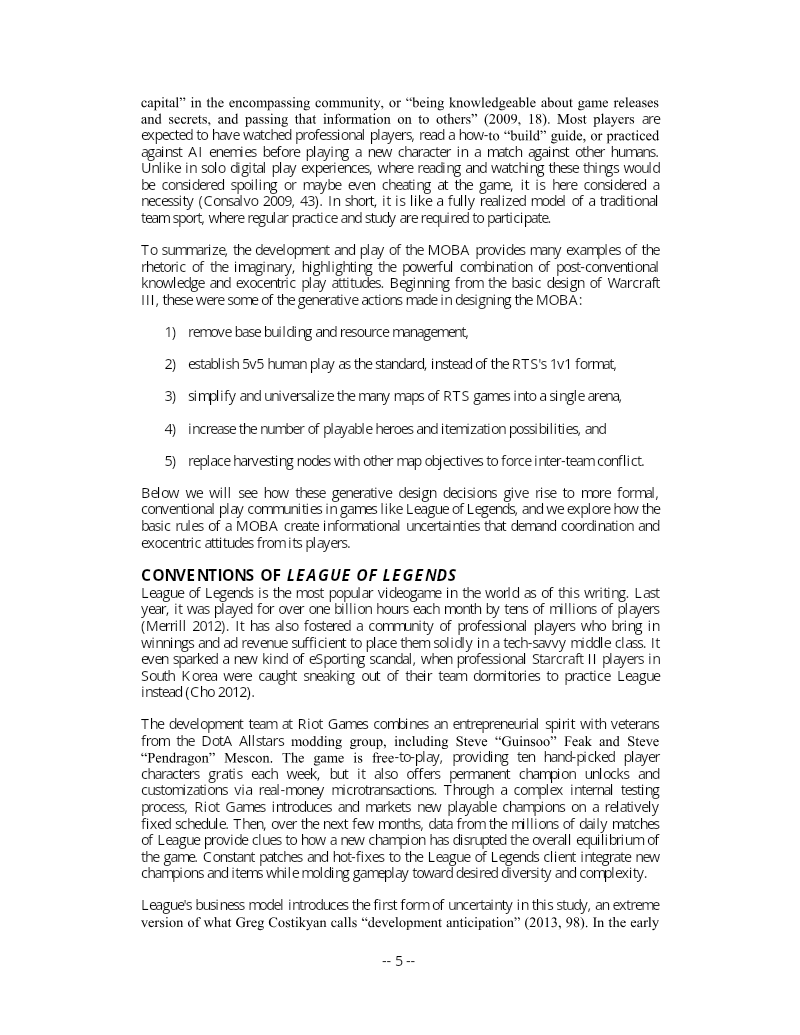
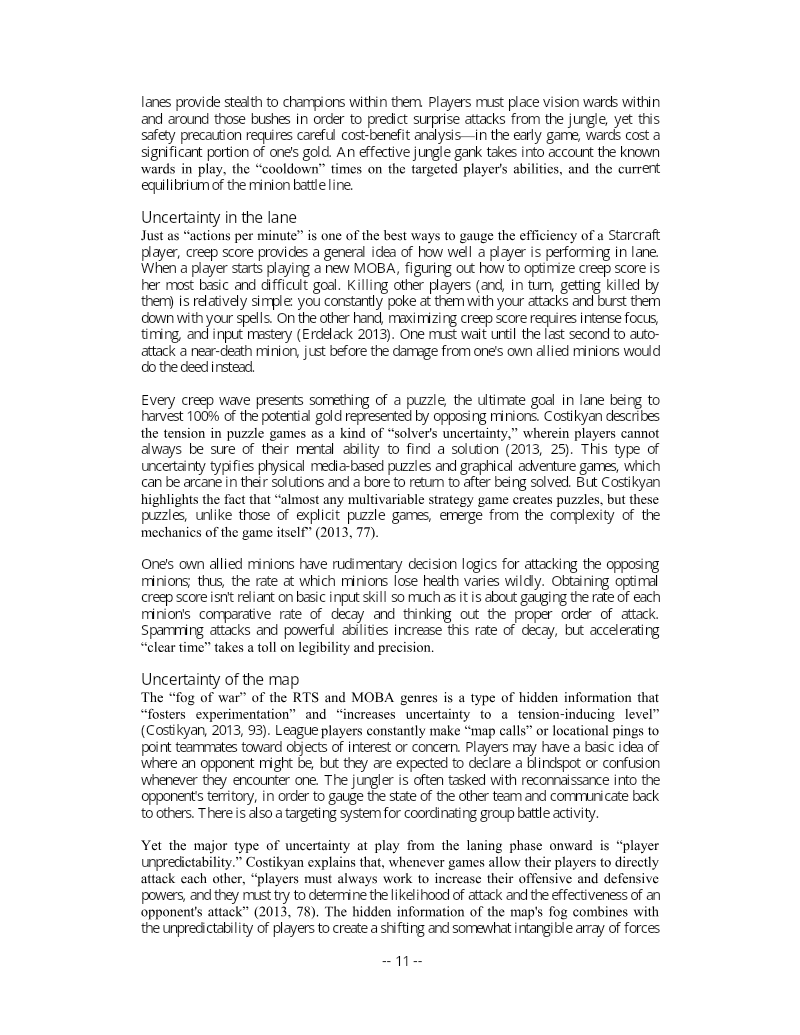
From Generative to Conventional Play: MOBA and League of Legends
Simon Ferrari's 2013 DiGRA paper examines the multiplayer online battle arena (MOBA) genre through League of Legends, arguing that the genre emerged from player-modders working within Warcraft III, most notably the DotA mod, whose generative, exocentric design choices, including removing base-building, standardizing 5v5 play…
- The MOBA genre emerged from player-modders working in Warcraft III, most notably the DotA mod, whose design choices (removing base-building, standardizing 5v5 play, and using a single symmetrical map) were later commercialized.
- Ferrari positions League of Legends as the central MOBA case, citing it as the most played game by hours, supported by a professional competitive scene and a free-to-play model sustained by ongoing champion releases and data-driven balancing.
- Ferrari argues League of Legends constitutes conventional, exocentric play, with its team-based competition shaped by layered hidden and complex information.

Feminist Art Game Praxis
"Feminist Art Game Praxis" presents PsXXYborg, an experimental arts-led game in development, as a case study in how feminist theory can be enacted through the design of interactive art.
- PsXXYborg is an experimental, arts-led feminist game in development that uses irony, parody, and glitch aesthetics to critique exclusion in game culture, grounded in theory from Haraway, cyberfeminism, Braidotti, and Grosz.
- The report argues feminist texts must expose the patriarchal norms of their context and resist essentialist definitions of feminine authorship, with the project built through bricolage, collaboration, and multi-screen, FMV-based design.
- The project deliberately removes the player avatar and disrupts first-person conventions through removed player agency, a fragmented gaze produced by multi-screen play, and mirror imagery.
From Euclidean Space to Albertian Gaze: Traditions of Visual Representation in Games Beyond the Surface
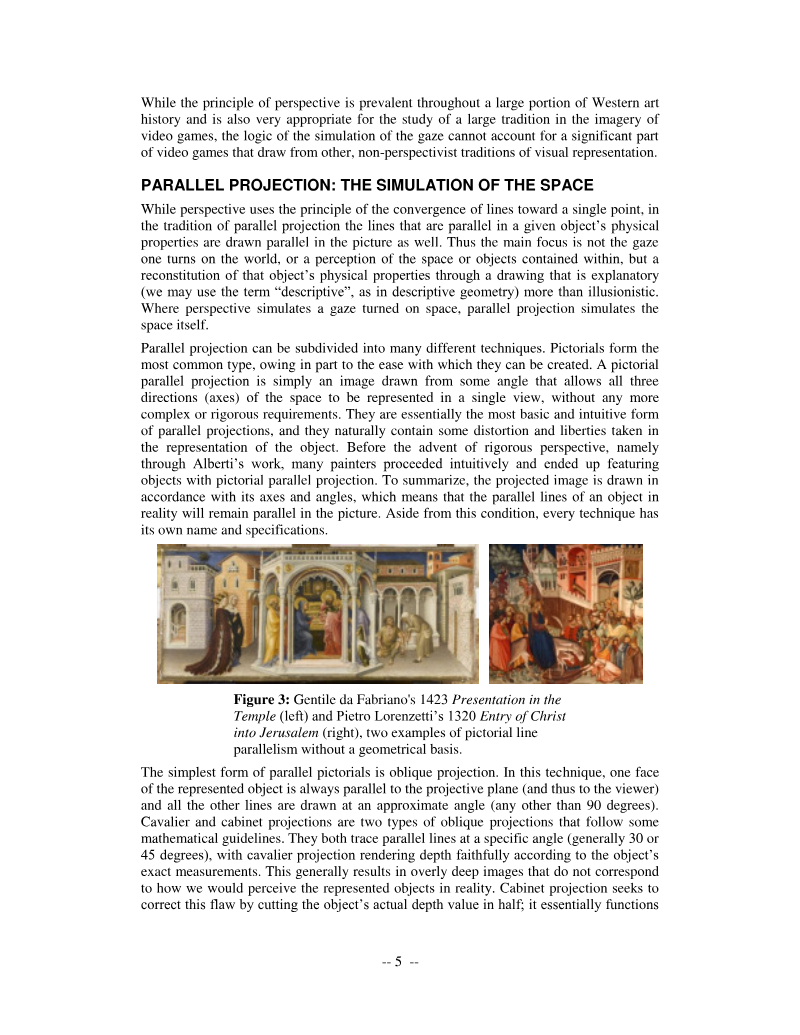
This paper argues that the visual analysis of video games has been dominated by perspective, the mathematical "simulation of the gaze" descended from Alberti, and that this emphasis obscures the wider repertoire of representational traditions games actually draw on.
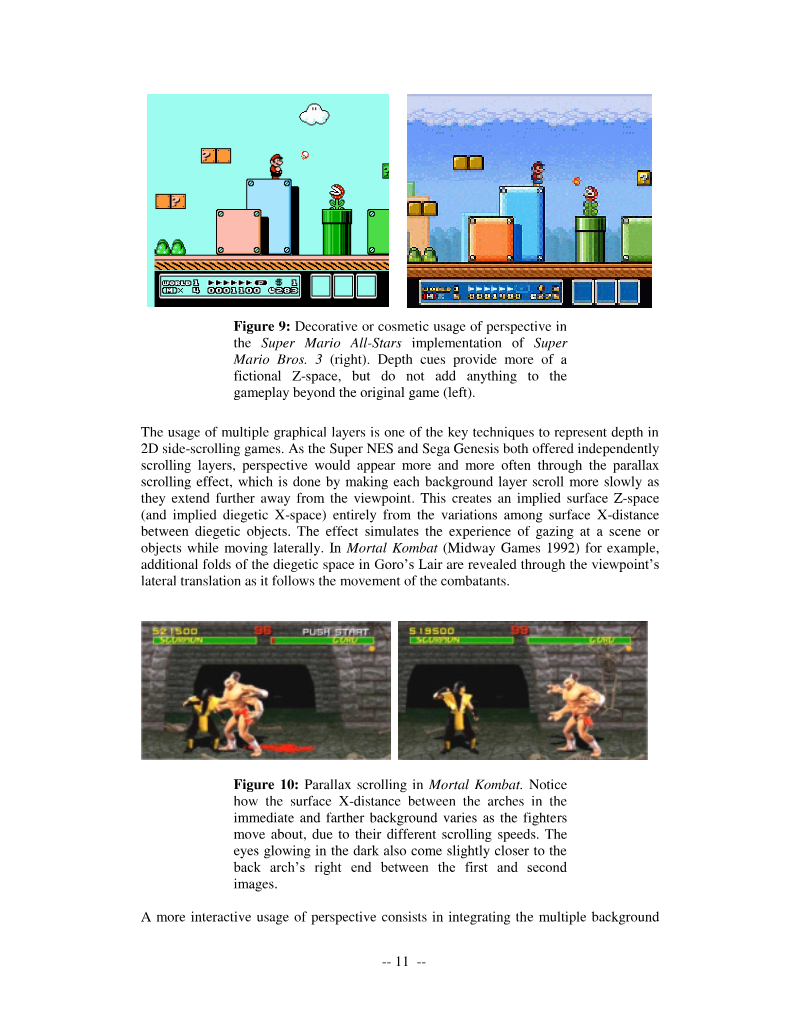
- The visual analysis of games has been dominated by Albertian perspective, which obscures the wider repertoire of representational systems games actually use, including oblique, axonometric, and parallel projections.
- The paper argues that the choice among projection systems is governed by functional and gameplay demands rather than artistic lineage, illustrated by SimCity 4 (parallel projection) versus Red Dead Redemption (perspective) as genre-driven decisions.
- The 26.6-degree dimetric angle yields a clean 1:2 pixel ratio, which explains why isometric and dimetric projections persisted in pixel-art games.

A Reality Game to Cross Disciplines: Fostering Networks and Collaboration
This paper examines "Reality Ends Here," a semester-long, deliberately hidden game introduced to incoming freshmen at the USC School of Cinematic Arts in fall 2011 and 2012.
- Reality Ends Here, a semester-long hidden game for incoming USC School of Cinematic Arts freshmen in fall 2011 and 2012, rewarded student teams for collaborative media projects through card-use points, serving as a testbed for how game mechanics shape student social networks.
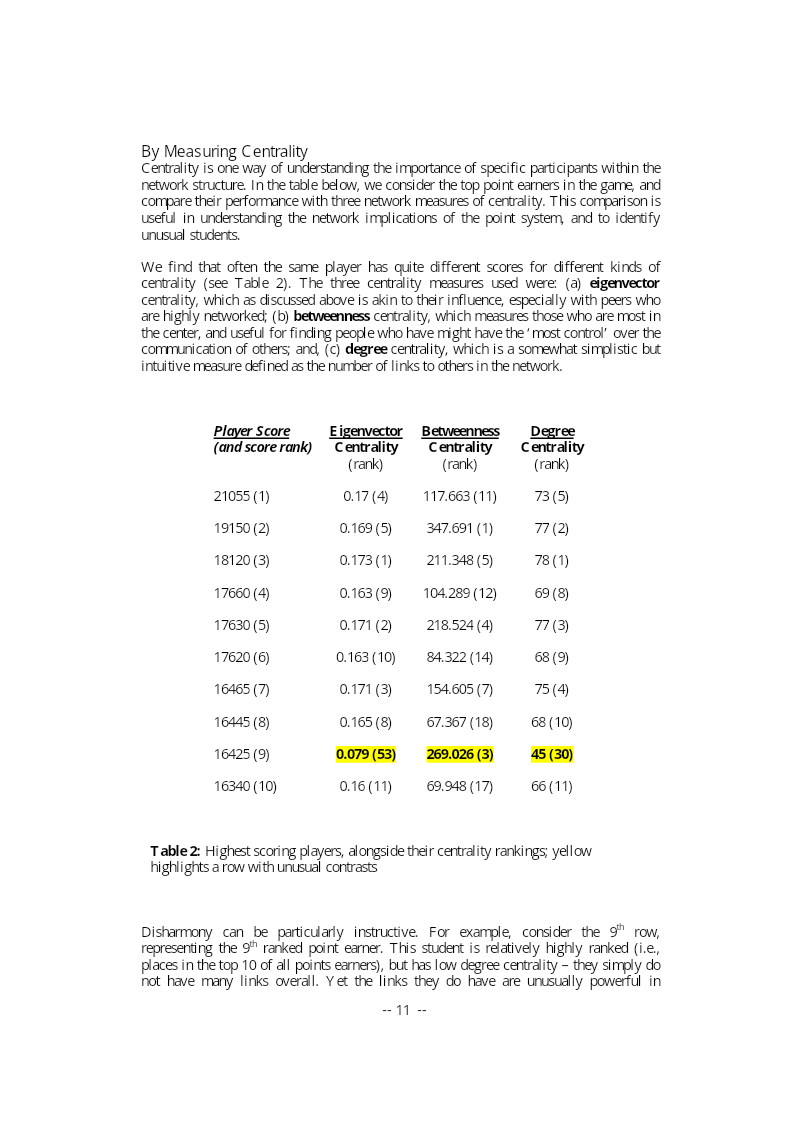
- Players' eigenvector centrality was strongly associated with game scores, explaining a substantial share of score variation (R² = 0.522) across two years of data covering 119 first-year projects.
- Overall participation was 47% across both cohorts, varying from 33% to 67% across five academic divisions, and the authors warn that non-participants may feel alienated and attrition may skew the networking results.
Elements of Social Action: A Micro-Analytic Approach to the Study of Collaborative Behavior in Digital Games
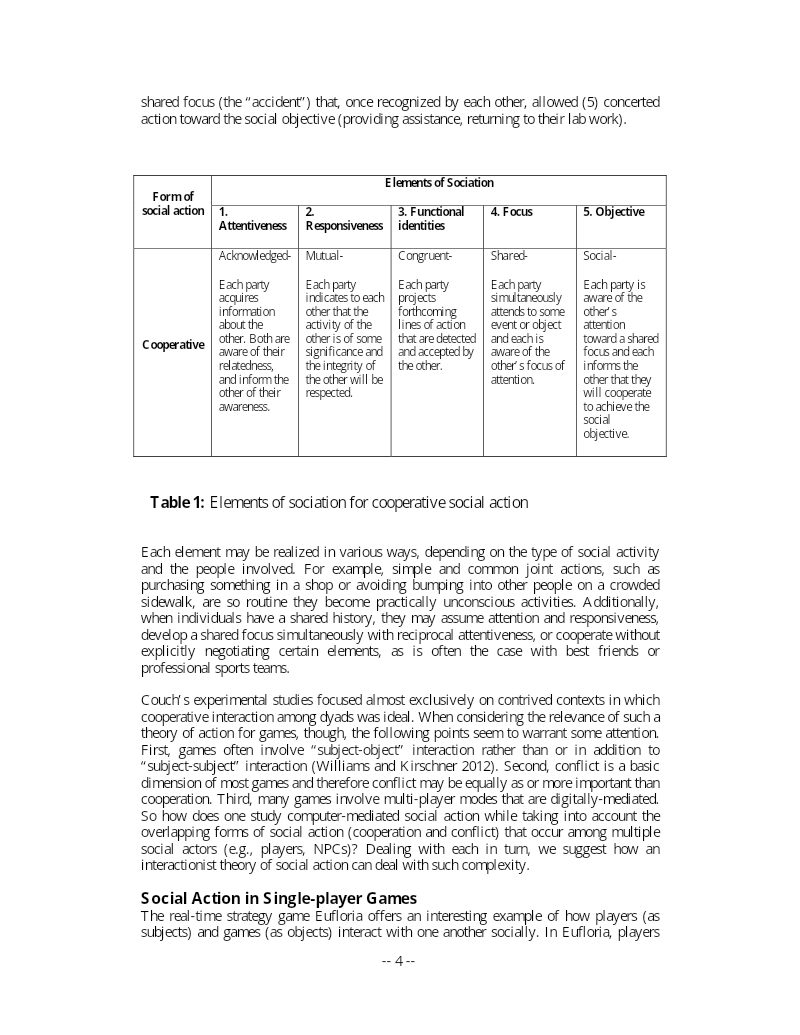
This paper proposes a micro-analytic framework for studying social action in digital games, extending Carl Couch's five elements of sociation (acknowledged attentiveness, mutual responsiveness, congruent functional identities, shared focus, and social objective) to cover both cooperative and conflictual interaction.
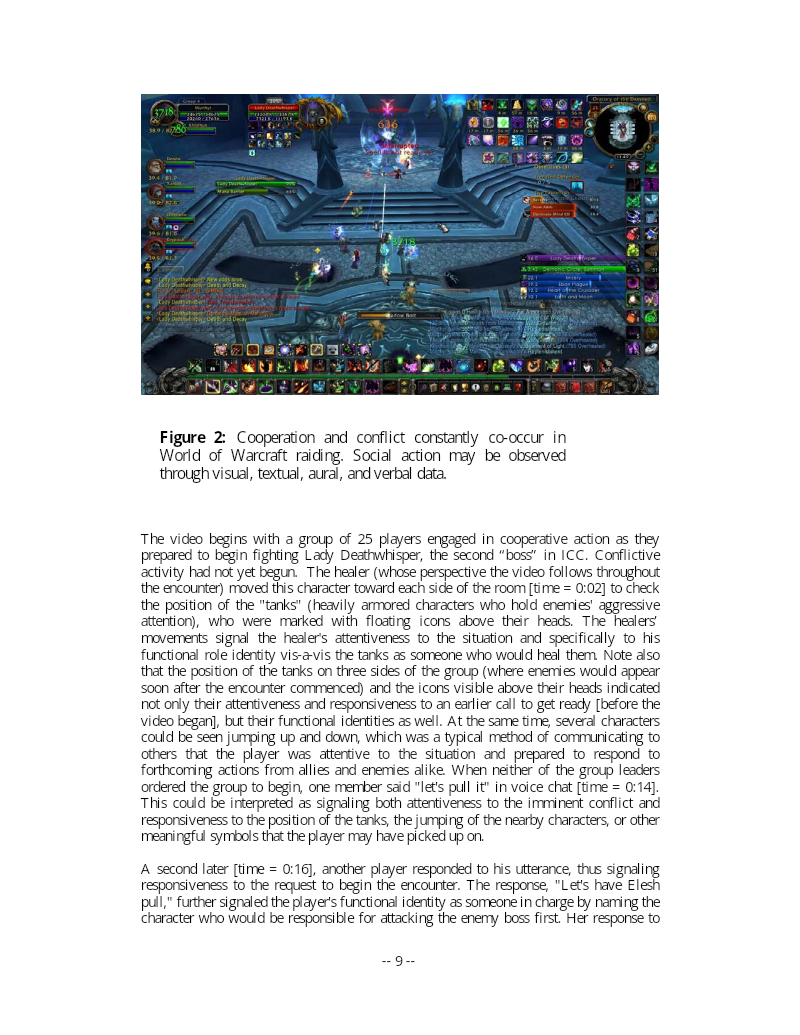
- The paper proposes a micro-analytic framework extending Carl Couch's five elements of sociation to cover both cooperative and conflictual interaction in digital games, arguing that conflict and cooperation draw on the same generic elements but serve different functions.
- The authors contend that understanding collaborative play requires moment-by-moment analysis of observable interaction from audio-visual recordings, rather than relying on players' retrospective accounts of what they did.
- In the single-player real-time strategy game Eufloria, game AI and narrative structure largely fix coordinated action in advance, leaving players limited room to redirect objectives.
Playability and Its Absence: A Post-Ludological Critique
Leino's "Playability and Its Absence: A Post-Ludological Critique" argues that single-player computer games and interactive art occupy distinct territory, and that the defining feature separating them is playability: a "gameplay condition" that makes players responsible for their freedom through constraints on interpretation…
- Leino defines playability as a 'gameplay condition' in which constraints on interpretation and clear right/wrong feedback make players responsible for their freedom, and he argues this is what distinguishes single-player games from interactive art.
- He traces a historical lineage from Allan Kaprow's 1960s Happenings through reactive environments and interactive installations to single-player games such as Tetris, framing games as the latest stage of machine-mediated audience participation.
- Leino contends that 'non-playable' art games like Proteus keep game-like features such as failure and significance while removing goals and winning conditions, and that this absence can be a deliberate artistic strategy shifting meaning toward aesthetic and existential reflection.

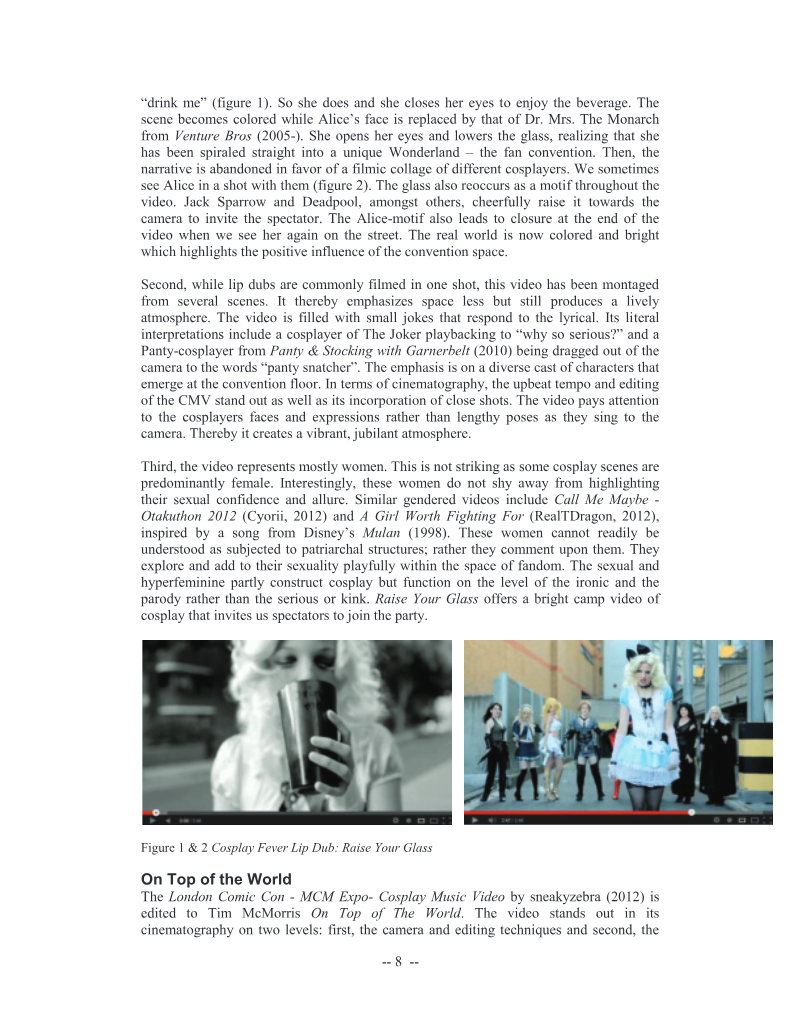
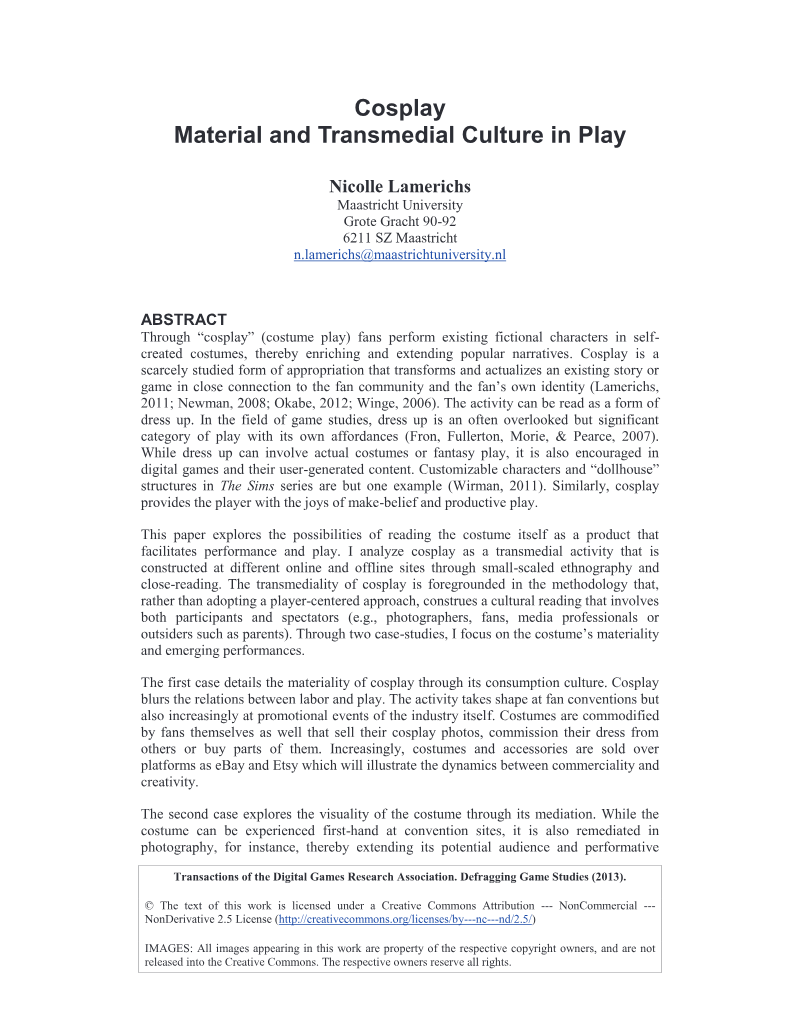
Cosplay: Material and Transmedial Culture in Play
Nicolle Lamerichs's study treats cosplay as a material and transmedial practice that sits at the intersection of fan community, play, and commerce.
- Lamerichs argues cosplay is a material and transmedial practice at the intersection of fan community, play, and commerce, and that its hybrid mix of play, production, and consumption resists existing definitions of play, making it a useful test case for play and fandom theory.
- Costumes circulate as liminal objects shaped by both fandom gift culture and commercial or non-commercial creative labor, blurring the boundary between labor and play.
- Preliminary April 2013 searches found eBay listings dominated by China-sourced outfits and wigs, with gendered categorization favoring women's accessories and vendors policing feedback to protect their reputations.
Assassin's Creed III and the Aesthetics of Disappointment
This paper examines how video game players construct a "culture of history" around Assassin's Creed III through prerelease, release, and post-release commentary, drawing mainly on user reviews and forum discussions on gaming enthusiast press websites such as Giantbomb.com, IGN.com, Destructoid.com, and Polygon.com.
- The paper argues that an "aesthetics of disappointment" lets players measure Assassin's Creed III against the series' past and against expectations for gaming's future, with disappointment depending on prior expectations shaped by paratexts such as leaked box art, previews, and developer interviews.
- Based on qualitative close reading of user reviews and forum threads from June 2012 through January 2013 on sites like Giantbomb, IGN, Destructoid, and Polygon, rather than a formal survey or sample.
- Critics targeted the game's level design, controls, technical glitches, narrative, and ending, often comparing it with Revelations, Dishonored, Far Cry 3, and Mass Effect 3, while others defended its naval combat and story.
What Happens When a Cyberworld Ends: The Case of There.com
The closure of There.com, a 3D social cyberworld that shut down on March 9, 2010, after its CEO cited insufficient revenue amid the economic crisis, serves as the focus of this analysis of how virtual communities respond to the loss of their digital homes.
- There.com, a 3D social cyberworld, shut down on March 9, 2010, after its CEO cited insufficient revenue amid the economic crisis, and the analysis treats this as the loss of a real community rather than a mere product.
- Displaced users responded with the language of death and mourning, grieving their avatars and searching for a new home across social networks and rival platforms.
- The community dispersed to Facebook groups, Thumdar, and YouTube, while rival cyberworlds such as Second Life and Kaneva offered free accounts and currency exchanges to attract the displaced population.
Understanding Videogame Cities
"Understanding Videogame Cities" argues that fictional game cities can be analyzed with the same rigor applied to physical cities, using Saints Row: The Third's Steelport as its central case.
- The report argues that fictional videogame cities can be analyzed with the same rigor as physical cities, using a three-part framework of constitutional, representational, and experiential orders that blends Lefebvre's spatial triad with Douglas Allen's criteria.
- Its central thesis is that a city's character emerges from the interplay between its built structure, its visual and symbolic representation, and the embodied experience of moving through it.
- Using Saints Row: The Third's Steelport (2011) as the central case, the analysis finds that territory control and monuments, such as the Magarac Island statue destroyed late in the game, visibly express the city's power dynamics.

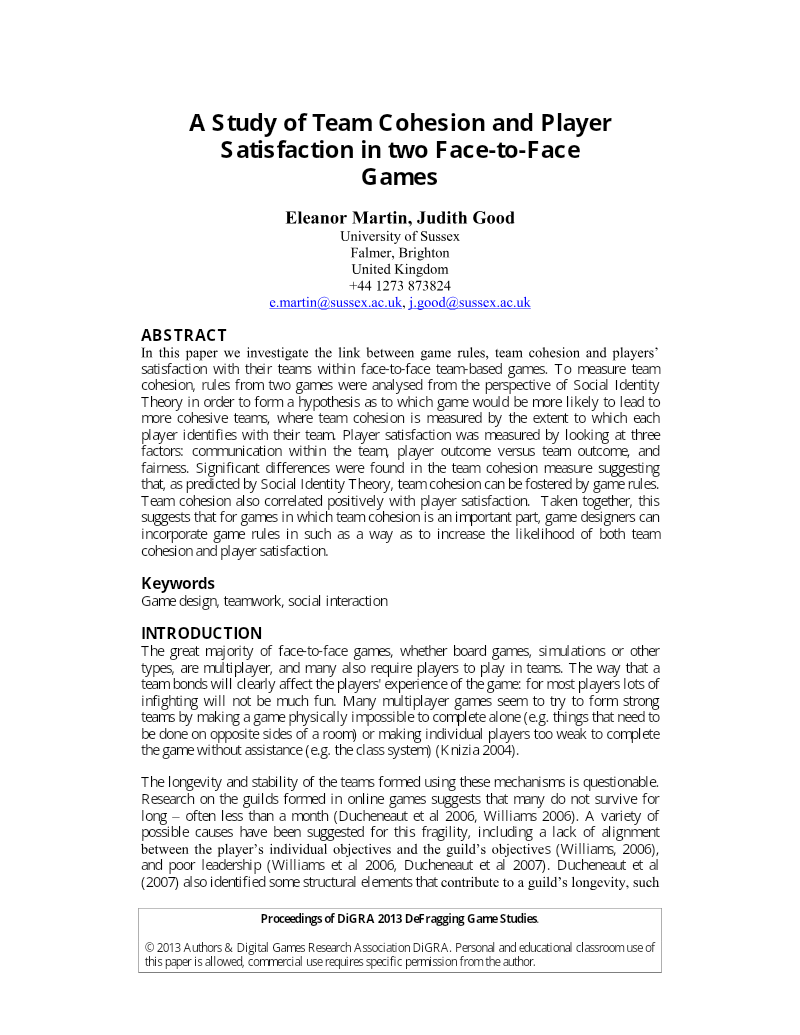
A Study of Team Cohesion and Player Satisfaction in Two Face-to-Face Games
A study of two face-to-face educational farming games, The Green Revolution Game and Africulture, examines whether game rules shape team cohesion and player satisfaction.
- The Green Revolution Game produced significantly higher ratings than Africulture for team cohesion, communication, and fairness (each at p<.05), in a between-subjects study of 36 participants (16 vs. 20).
- The study grounded its hypothesis in Social Identity Theory, predicting that fixed team membership and collective judgment would foster stronger cohesion than individualized roles and changeable teams.
- Mixed-motive conflict was somewhat lower in the Green Revolution Game, but this difference did not reach statistical significance.