
DiGRA
The Digital Games Research Association: the international association of academics and professionals who study digital games. Its Digital Library holds the proceedings of the DiGRA conferences since 2002.
Documents
Shadowplay: Simulated Illumination in Game Worlds
The document, "Shadowplay: Simulated Illumination in Game Worlds," argues for the development of a comprehensive vocabulary to discuss simulated illumination in game environments.
- Light in games is argued to be far more than decoration: illumination shapes narrative meaning, directs player attention, modulates mood and risk, and can directly drive gameplay and NPC behavior.
- Silent Hill 2 and Thief serve as the paper's primary case studies, with Silent Hill 2 examined through its pre-rendered cut scenes and low-key horror lighting, and Thief through its tuned sensory system governing AI visibility.
- The author builds a lighting vocabulary by adapting Sharon Callahan's five objectives of digital animation lighting, while noting that free navigation in games exceeds the fixed-frame assumptions of film.
Cognitive Callisthenics: Do FPS Computer Games Enhance the Player's Cognitive Abilities?
This study investigates whether playing First-Person Shooter (FPS) computer games enhances players' cognitive abilities, specifically multitasking.
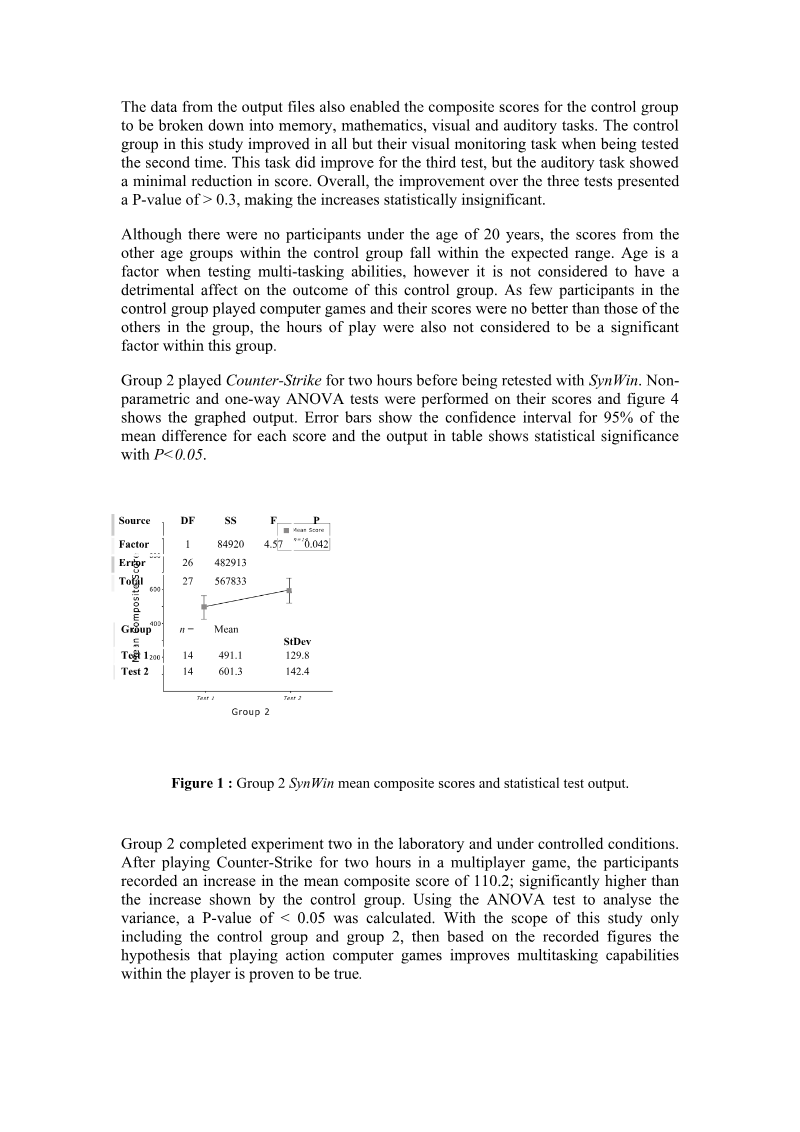
- A 2005 DiGRA study by Paul Kearney (Unitec New Zealand) found that two hours of multiplayer Counter-Strike play raised the mean composite multitasking score of 14 participants by 110.2 points, a statistically significant gain (P < 0.05) measured with the SynWin synthetic work-environment software.
- The control group of eight largely non-gaming participants, tested three times without any intervention, showed only modest gains that were not statistically significant (P > 0.3), consistent with ordinary practice effects.
- The author attributes the gains to immersion, collaborative play, and realism, but the study had no control condition in which participants played a non-game activity, so the game itself cannot be isolated as the cause.


OceanQuest: A University-Based Serious Game Project
The document presents a case study of "OceanQuest," a serious game project developed at the University of Calgary's Digital Media Laboratory, aiming to integrate traditional game goals with educational objectives.
- OceanQuest is a university-developed serious game teaching Grade 8 science about hydrothermal vent ecosystems at the Endeavour field west of Vancouver Island, built under a small budget and a four-month schedule to deliver by February 2004.
- The authors argue that a serious game can satisfy both traditional game goals and educational goals, and treat the difficulty of combining instructional and entertainment design as the central challenge.
- Rather than direct instruction, the design aimed for players to absorb science implicitly through a submarine scavenger hunt narrative in which they search for organisms that may contain a plague cure, mirroring how commercial games teach through play.
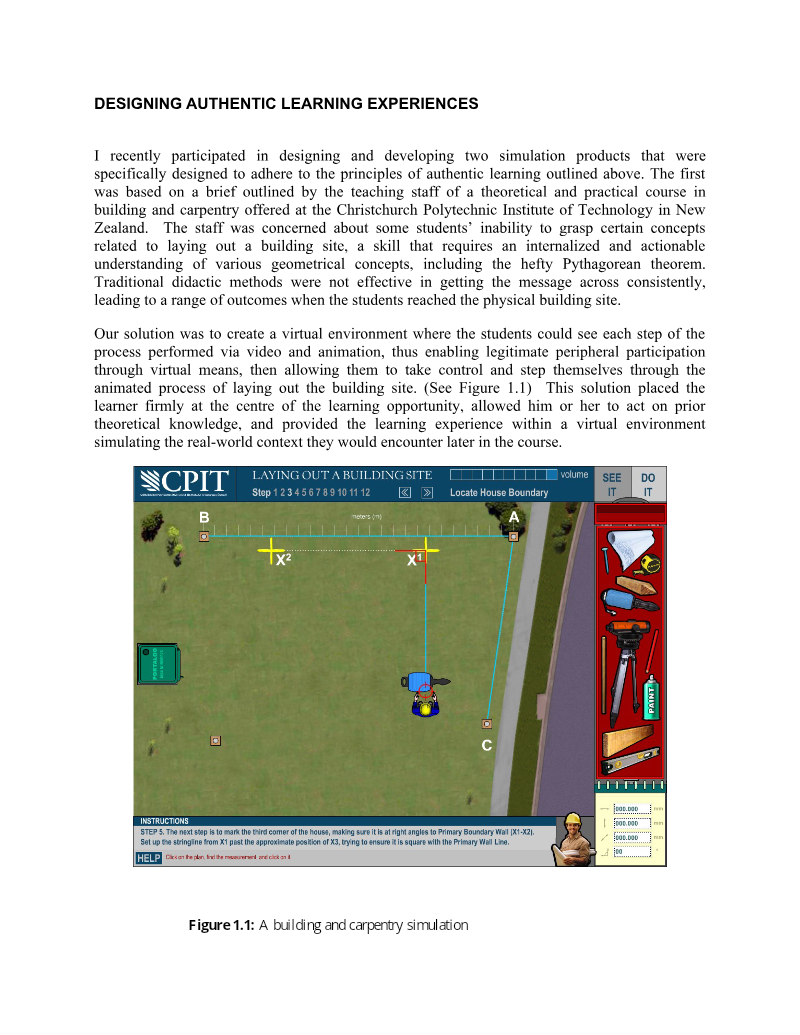
Authentic Learning Experiences Through Play: Games, Simulations and the Construction of Knowledge
The document "Authentic Learning Experiences Through Play: Games, Simulations and the Construction of Knowledge" examines the role of games and simulations in facilitating authentic learning experiences, particularly within vocational training and educational settings.
- Games and simulations are most valuable when designed around authentic learning experiences, not used as generic motivational wrappers; many 1990s 'edutainment' titles merely repackaged didactic content.
- The paper's core thesis is that learning is the formation of connections through experience, so the key design question is how to let learners experiment with knowledge in context and encounter a range of outcomes, including failure.
- The author proposes balancing three elements identified by Clark Aldrich (pedagogical structure, simulation mechanics, and game features), with the simulation element treated as central to providing realistic practice.
A Game Architecture for Emergent Story-Puzzles in a Persistent World
An architecture is proposed for narrative games built around story-puzzles in the tradition of classic graphic adventures.
- The paper proposes a double-layer architecture that splits a game into a narrative layer (case-based reasoning plus a narrative ontology) and an agent layer (autonomous characters running a sense-think-act cycle), aiming to reconcile tight plot control with genuine emergent behavior.
- The narrative layer generates a crime by matching a randomly generated case against a case base using ontology-based semantic distance, then adapts the retrieved world state with heuristic rules inspired by the Minstrel system's transform-recall-adapt methods.
- Character relationships are encoded as three-component emotional vectors (attraction/disgust, trust/distrust, love/hate) with values from -10 to 10, categorized as balanced, weak, moderated, or strong, and these evolve with player performance and character interaction.
The GameCreator: Self-Created Mobile Games on the Internet
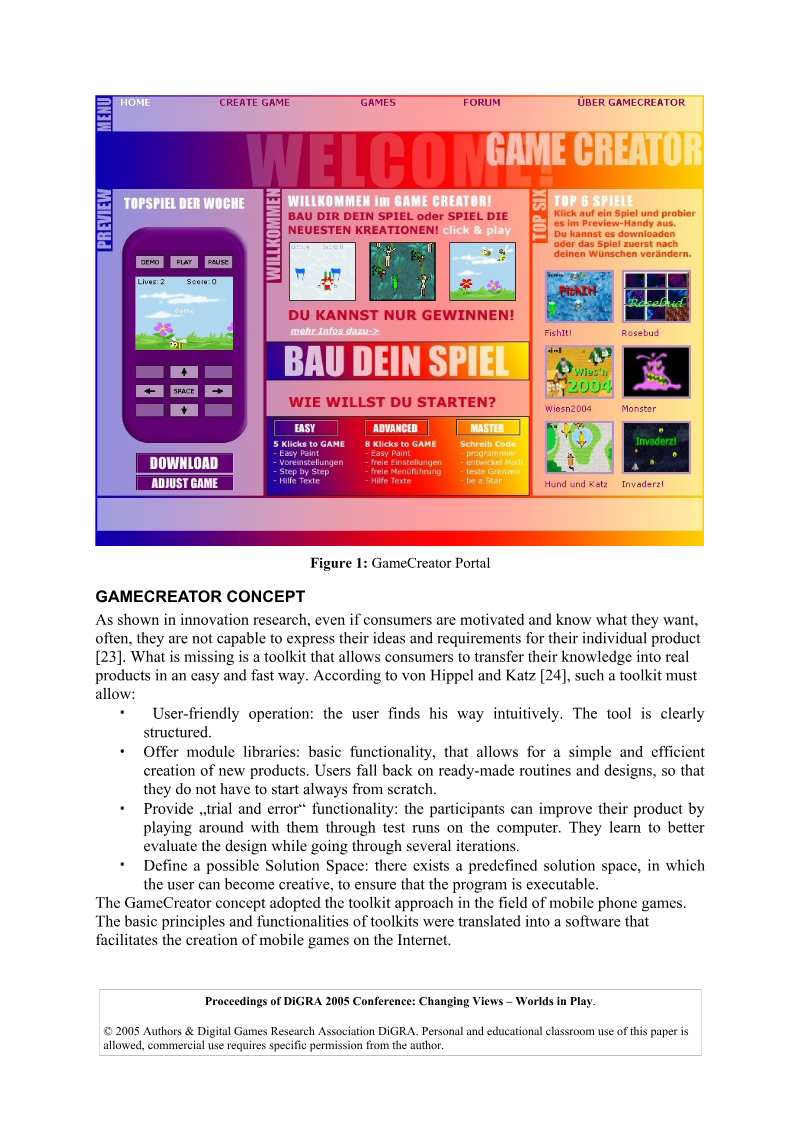
This paper introduces the GameCreator, an Internet platform designed to enable consumers to create and download their own mobile Java games without requiring programming skills.
- The GameCreator is a 2005 DiGRA-presented web platform that lets users with no programming skills build and download their own Java mobile games, either from scratch or by modifying templates, using a graphical wizard, live preview, server-side compilation into JAR files, and an embedded community for sharing and co-developing games.
- The paper argues that self-created games offer value beyond ready-made titles because the effort of creation is rewarded through hedonic enjoyment, personal utility, social recognition, and symbolic meaning, such as use as personalized gifts or messages.
- The platform targets three segments through easy, advanced, and master modes: Mobile Internet crossover users who have never downloaded mobile games, regular gamers aged roughly 9 to 18, and programming-literate users seeking top-tier games.
A Realistic Reaction System for Modern Video Games
The document introduces a Realistic Reaction System (RRS) designed to enhance player immersion and believability in modern video games by modeling dynamic, societal-like relationships between in-game characters and objects.
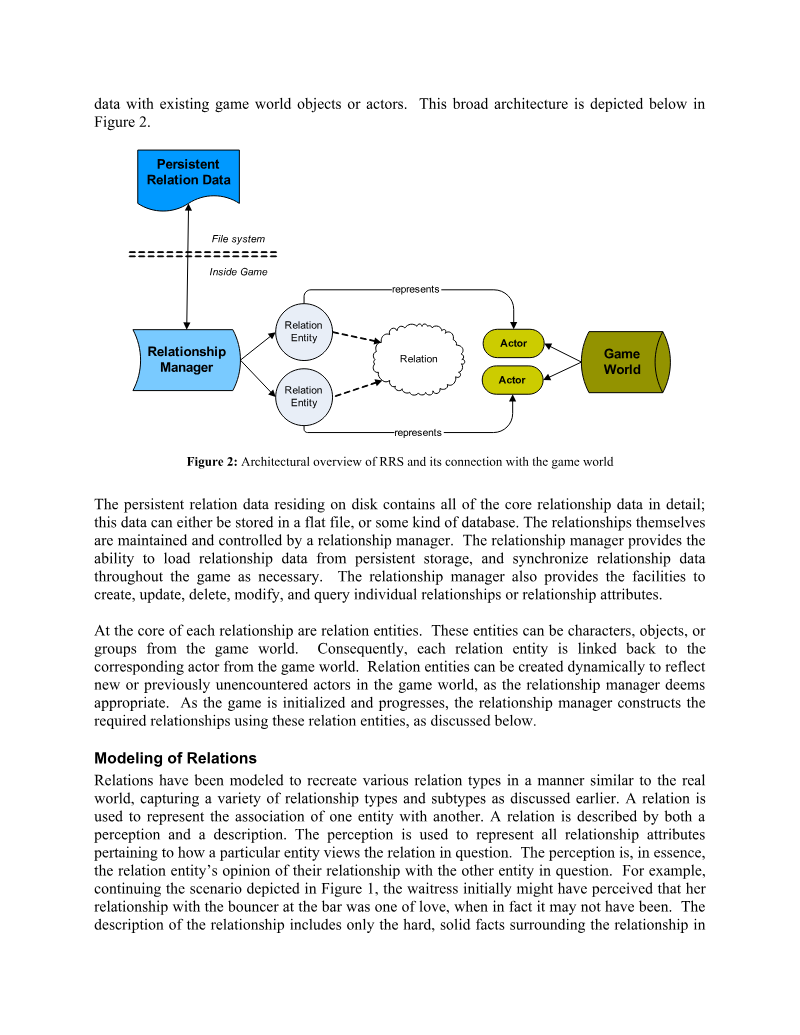
- The Realistic Reaction System (RRS) replaces scripted, event-driven reactions with a persistent relationship network in which characters, groups, and objects are nodes connected by typed, attributed edges that characters can query to shape behaviour and dialogue.
- Relationships are organized in a hierarchical taxonomy (emotional, familial, business, membership) and carry attributes such as origin, history, strength, polarity, and validity, and they decay toward neutrality over time unless reinforced.
- Game events affect the network directly, and their effects propagate indirectly through related entities, similar to reputation spreading through a community.
The Design of Narrative as an Immersive Simulation
The document proposes a novel concept of narrative in video games, defining it as the design of an immersive simulation experienced by the interactor.
- Narrative in video games is increasingly framed as the design of an immersive simulation, arising from the tension between character-oriented games (immersion through embodied presence in navigable 3D worlds) and simulation games (modeling complex systems over time).
- The paper treats agency, the satisfying power to take meaningful action and witness its consequences, as the foundational premise for games as a narrative form.
- Drawing on Gibson's affordances and the Umwelt concept of Jakob and Thure von Uexküll, the author argues that presence and agency depend on how well a player's virtual body can perform meaningful tasks, and that embodiment can enable alternative perceptions of reality.


Playing and Learning Without Borders: A Real-Time Online Play Environment
The ENJEUX-S project, funded by CANARIE Inc., developed a real-time communication interface to enhance online educational games and simulations, building upon the existing SAGE project.
- The ENJEUX-S project, funded by CANARIE Inc., adds real-time telepresence to browser-based educational games in the SAGE network by integrating video, voice, chat, whiteboard, and access management directly into game environments.
- The system uses a service-oriented architecture built on Web services (XML/SOAP, WSDL, UDDI), a Flash client layer, a network layer over the CAnet4 high-speed fiber backbone with IPv6 support, and a server layer combining a Flash Communication server, data server, and database.
- Users need only a webcam, headphones, and a high-speed connection, with no special software downloads required.
Games, Montage, and the First Person Point of View
This document explores the concept of "interactive montage" in video games, specifically focusing on its application within a first-person point of view (POV).
- Montage in video games differs from film because the player initiates each cut, and cuts succeed when they reinforce the player's spatial positioning and control within the virtual environment.
- Player-triggered cuts remain comprehensible when spatial continuity is preserved, even when they break conventions such as the axis of action.
- Siren's 'sight-jacking' feature is presented as a counterexample: complex, changing visualizations weaken player positioning, making the game harder to read and play.

Towards an Ontological Language for Game Analysis
The "Towards an Ontological Language for Game Analysis" document introduces the Game Ontology Project (GOP), an initiative to develop a hierarchical framework for the systematic analysis of games.
- The Game Ontology Project (GOP) is a hierarchical framework that aims to give game studies and design a shared analytical vocabulary, built inductively from many specific games using prototype theory and grounded theory.
- Rather than classifying games by genre or cataloguing design patterns, the framework takes a black-box, player-perceived perspective that deliberately sets aside representational features such as setting and theme.
- At the top level, games are described through five elements: interface, rules, goals, entities, and entity manipulation, which are then elaborated into finer distinctions such as gameplay, gameworld, and rule-synergy rules.

Place Space & Monkey Brains: Cognitive Mapping in Games & Other Media
The document explores the relationship between architectural design, game space, and cognitive mapping, proposing that embodied interaction in three-dimensional games enhances sequential spatial memory more effectively than traditional non-ergodic media like film or literature.
- Erik Champion's paper is a conceptual, hypothesis-driven proposal rather than a completed empirical study, arguing that interactive 3D games engage spatial cognition differently from film and literature.
- The core hypothesis is that the embodied, ergodic experience of games produces a sequential spatial memory that passive episodic media like film and non-interactive books do not.
- Support for the hypothesis is anecdotal: a virtual heritage project on Mayan sites found task performance depended on which building cluster participants navigated and whether they could gain an overview of the site, and psychology students reported improved spatial memory after playing first-person shooters.