
DiGRA
The Digital Games Research Association: the international association of academics and professionals who study digital games. Its Digital Library holds the proceedings of the DiGRA conferences since 2002.
Documents
Learning Games as a Platform for Simulated Science Practice
Homicide, a forensic investigation game developed at Learning Lab Denmark, is presented as a "simulated situated learning space" that brings authentic science practice into the classroom.
- "Homicide," a forensic role-playing game developed at Learning Lab Denmark, runs over one school week, with students in investigative groups working four murder cases and concluding with written indictments.
- The game's design integrates the inquiry steps of problem definition, hypothesis formation, investigation, observation, data collection, and explanation, using forensic methods drawn from a handbook, with the teacher acting as police chief in meetings.
- Findings come from a small, qualitative, exploratory study based on video observations and a short focus-group interview with pupils from two eighth-grade classes across two schools, not a controlled experiment, so results are preliminary.
Troubling 'Games for Girls': Notes from the Edge of Game Design
This paper explores the complexities of designing games for middle school girls, challenging the universal categorization of female players and their preferences.
- Women make up only about 10 percent of US game industry workers and rarely shape design decisions, a gap the paper links to the design choices made for girls.
- Flanagan argues that 'girls' should not be treated as a uniform category with fixed preferences, since grouping them together risks reinforcing the stereotypes designers aim to challenge.
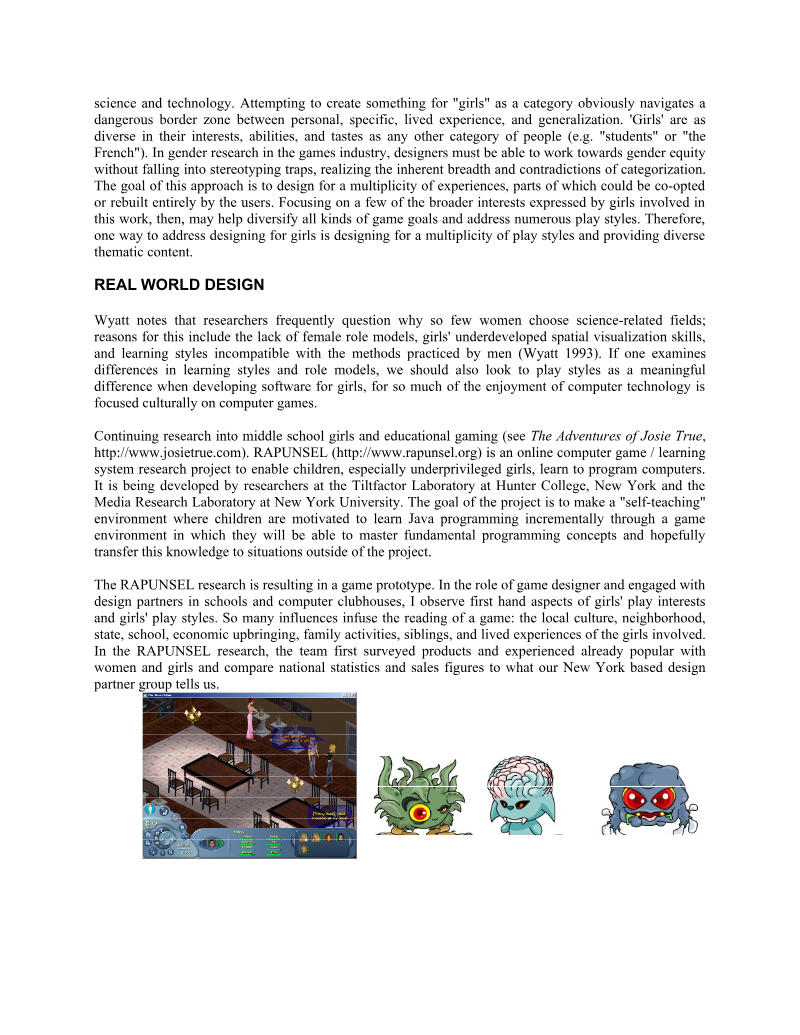
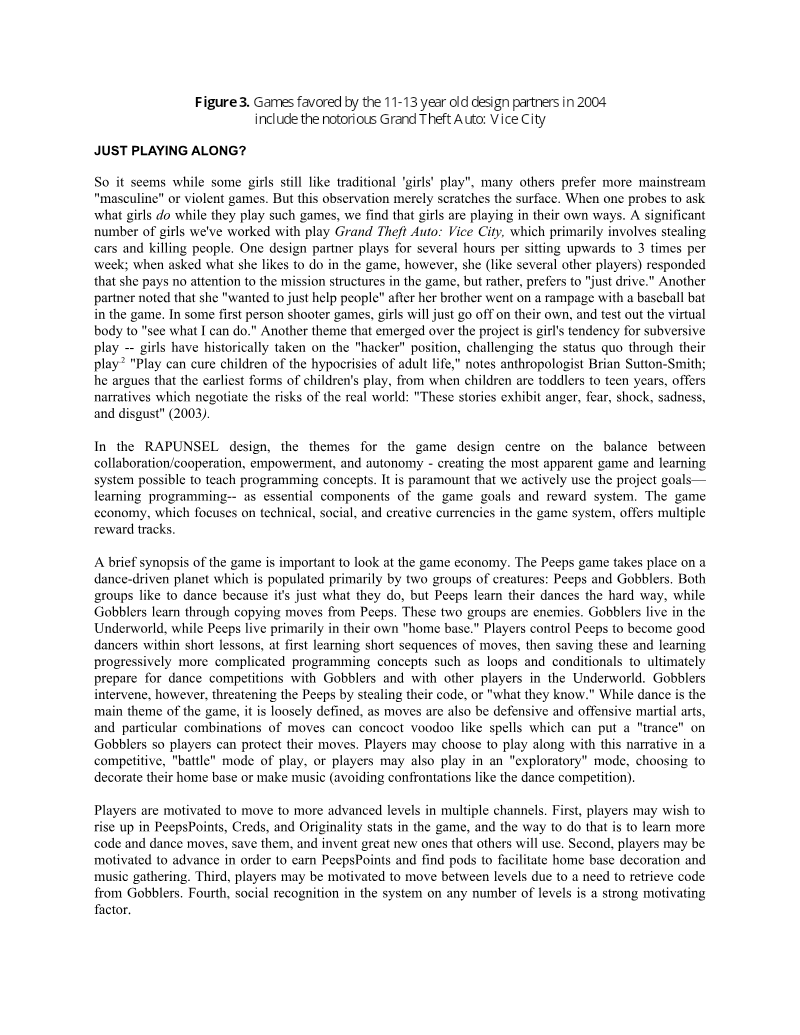
- Fieldwork with roughly 60 mostly African American girls aged 11 to 13 from New York housing projects found stated preferences leaning toward action, challenge, competition, and fear, with Grand Theft Auto and Mortal Kombat favored over traditional caregiving titles.
Research as Design-Design as Research
This paper introduces Research as Design-Design as Research (RADDAR), a methodology developed for inquiry into game design, particularly concerning its role in promoting conceptual learning in physics.
- RADDAR (Research as Design-Design as Research) is a methodology that emerged from a doctoral inquiry into designing a game to teach conceptual understanding of special relativity to undergraduate physics students.
- The paper argues that design and research share a synthesizing character and a cyclical, reflective structure, and that design can be treated as action research once emancipatory collaboration and systematic reflection are addressed.
- The author adopts Fourth Generation Evaluation, a constructivist, hermeneutic-dialectic methodology, and extends the notion of 'participant' to include design materials such as sketches, prototypes, code, and documents as collaborators alongside human respondents.
Game Graphics Beyond Realism: Then, Now, and Tomorrow
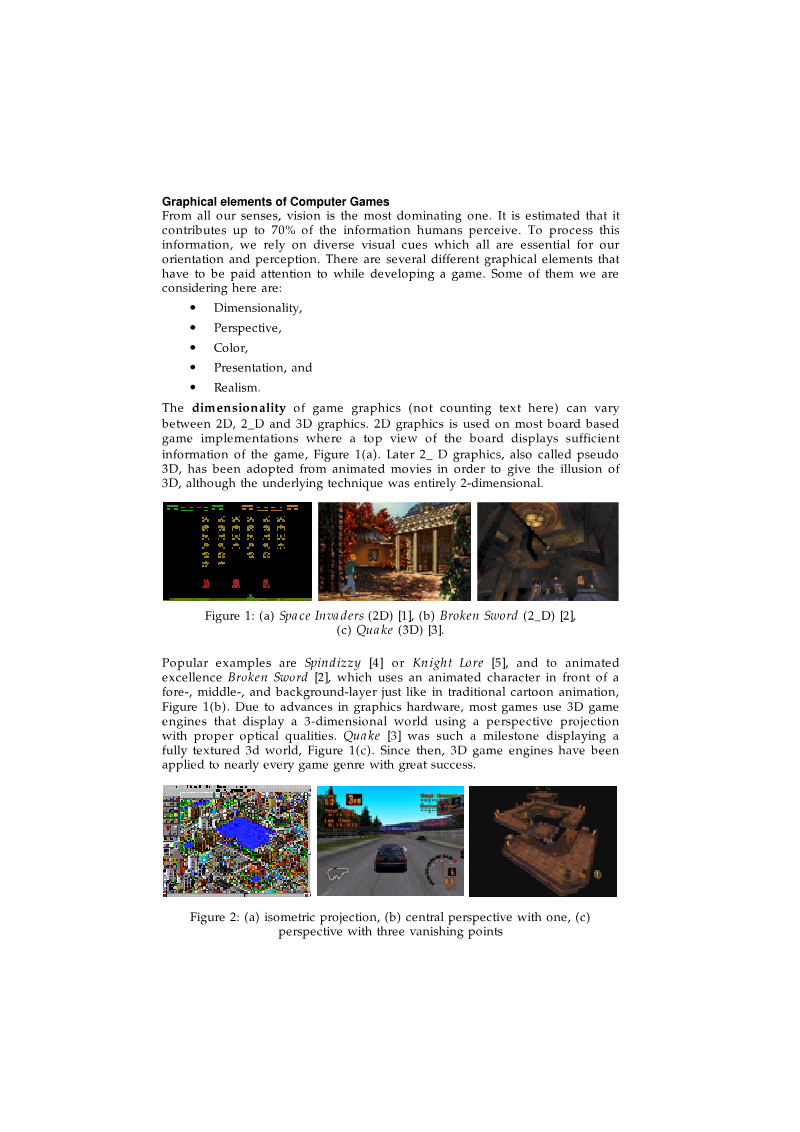
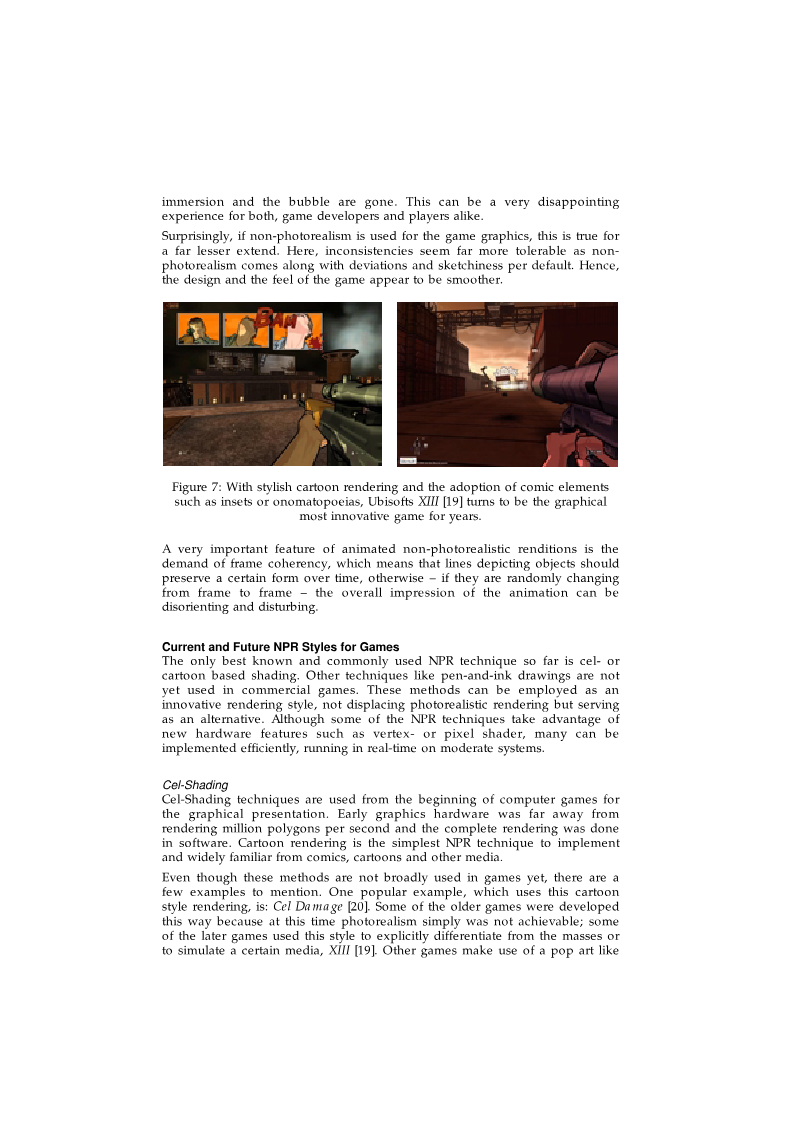
This paper surveys the evolution and application of graphical styles in computer games, advocating for the increased adoption of non-photorealistic rendering (NPR) techniques beyond the current emphasis on photorealism.
- The authors argue game graphics should not be limited to photorealism and that developers should explore non-photorealistic rendering (NPR) and other artistic styles.
- They contend that gameplay and story drive player enjoyment far more than graphical fidelity, and that as photorealism becomes costlier to achieve, graphics will lose effectiveness as a unique selling point.
- Immersion depends on believability and consistency rather than strict realism: small inconsistencies such as an incorrect shadow can break the illusion of a photorealistic game, while NPR styles tolerate such imperfections more readily.
Neomancer: An Exercise in Interdisciplinary Academic Game Development
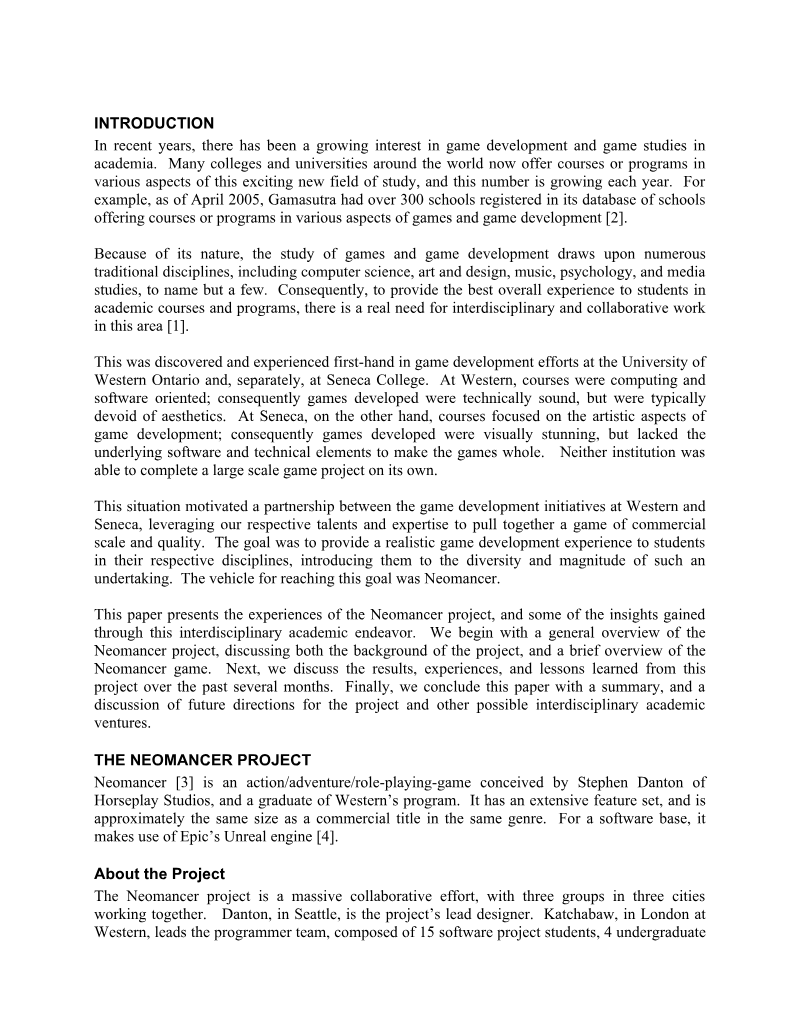
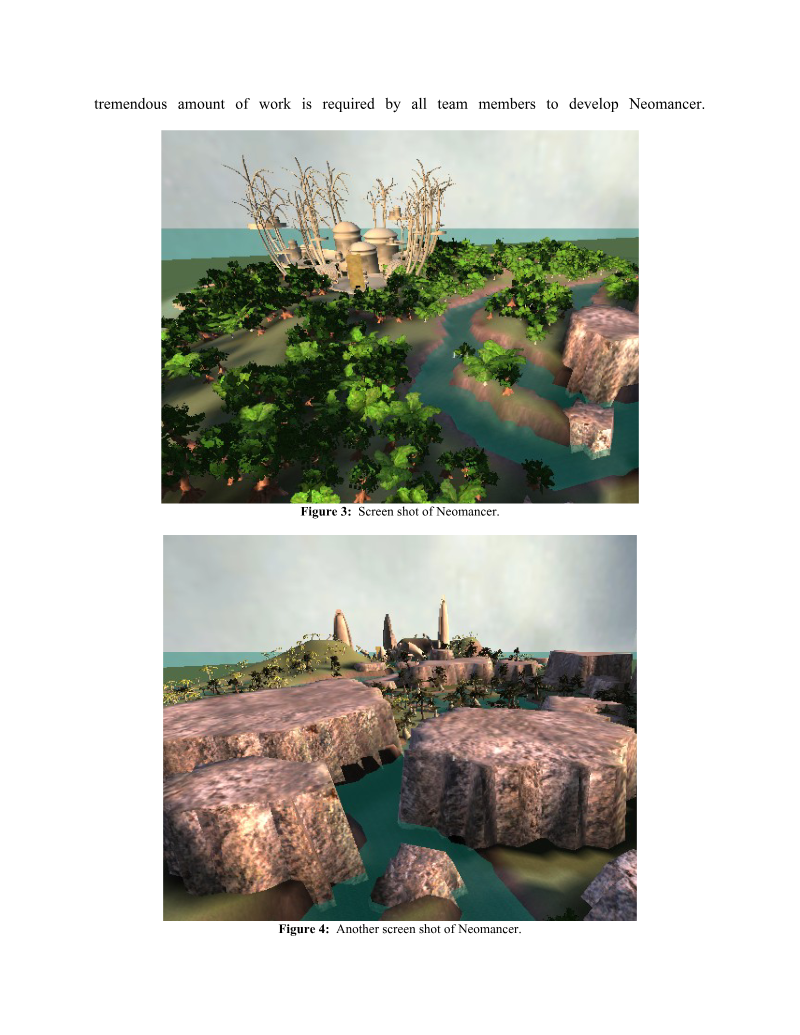
The document details the "Neomancer" project, an interdisciplinary academic game development initiative aimed at providing students with a realistic, collaborative experience.
- Neomancer is an interdisciplinary academic action-adventure RPG built on Epic's Unreal engine, set in the fantasy archipelago of Kintorr, and sized to be comparable to a commercial title in its genre.
- The project involves roughly 50 participants from the University of Western Ontario and Seneca College of Applied Arts and Technology, with a lead designer based in Seattle, pooling Western's programming strengths with Seneca's artistic and design capabilities.
- The project began in fall 2004 with a planned two to three year timeline, and its first two milestones were reported as met.
Bringing New HOPE to Networked Games: Using Optimistic Execution to Improve Quality of Service
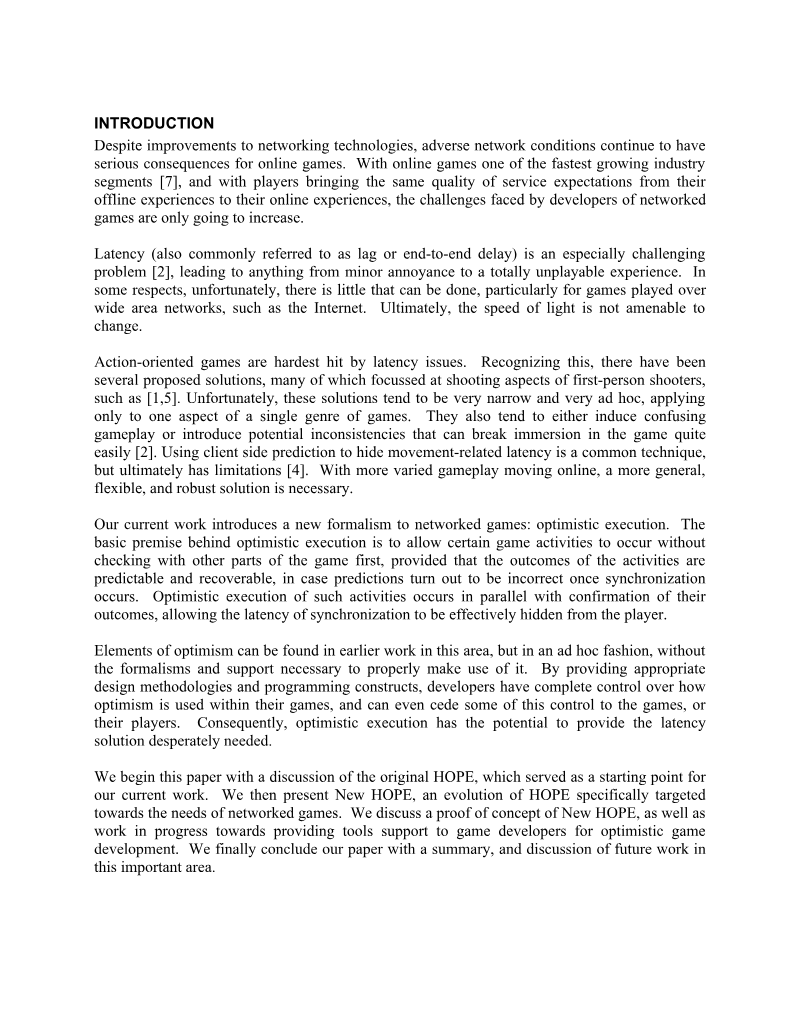
This paper introduces "New HOPE" (Hopefully Optimistic Programming Environment), a framework designed to mitigate the effects of latency in networked multiplayer games through optimistic execution.
- New HOPE adapts optimistic execution, a framework originally built for transaction-oriented systems, to let predictable game actions proceed without waiting for remote confirmation, hiding synchronization delay from players.
- Unlike original HOPE, which relied on full rollback when predictions failed, New HOPE substitutes controlled recovery procedures that restore a consistent state while keeping gameplay moving forward.
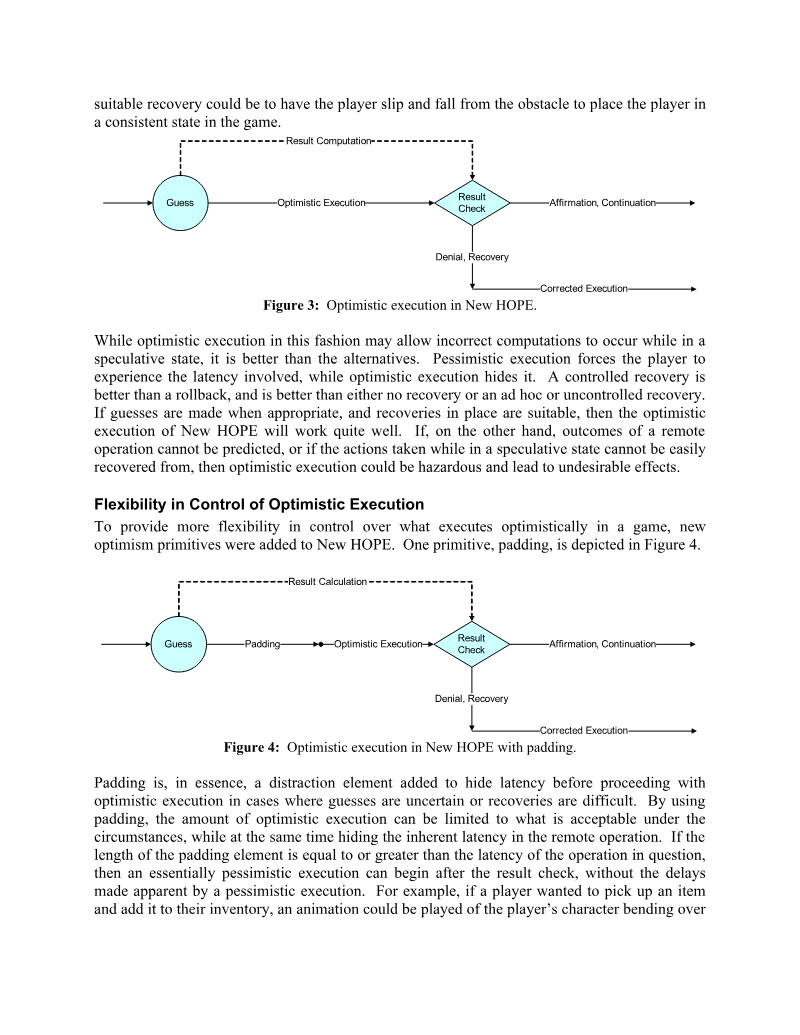
- New HOPE introduces padding (distracting animation that masks latency) and synchronization points (limits on how far speculative execution can proceed) as core primitives.
Frame and Metaphor in Political Games
This paper explores how political rhetoric, particularly ideological bias, is conveyed in videogames through the lens of cognitive linguist George Lakoff's concepts of metaphor and frame.
- Ian Bogost's 2005 DiGRA paper argues that videogames can carry ideological bias through procedural rhetoric, operating via rules and systems rather than verbal argument, drawing on George Lakoff's cognitive linguistics and Frank Luntz's message-development work for conservatives.
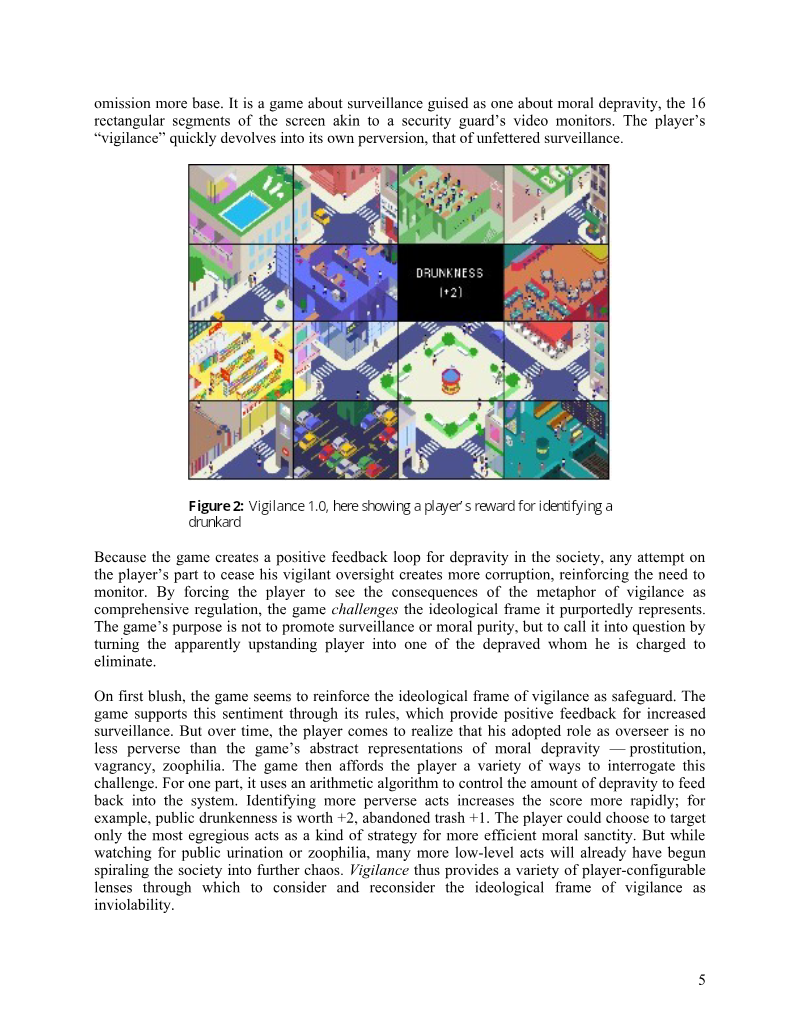
- Bogost classifies games' relation to ideological frames into three modes: reinforcing them, contesting them, or exposing them.
- The paper's reinforcement example is the Republican National Committee's Tax Invaders, a Space Invaders variant in which a Bush head fires at tax increases framed as invaders, turning the metaphor of taxation as theft into a playable form.
Interactive Story Writing in the Classroom: Using Computer Games
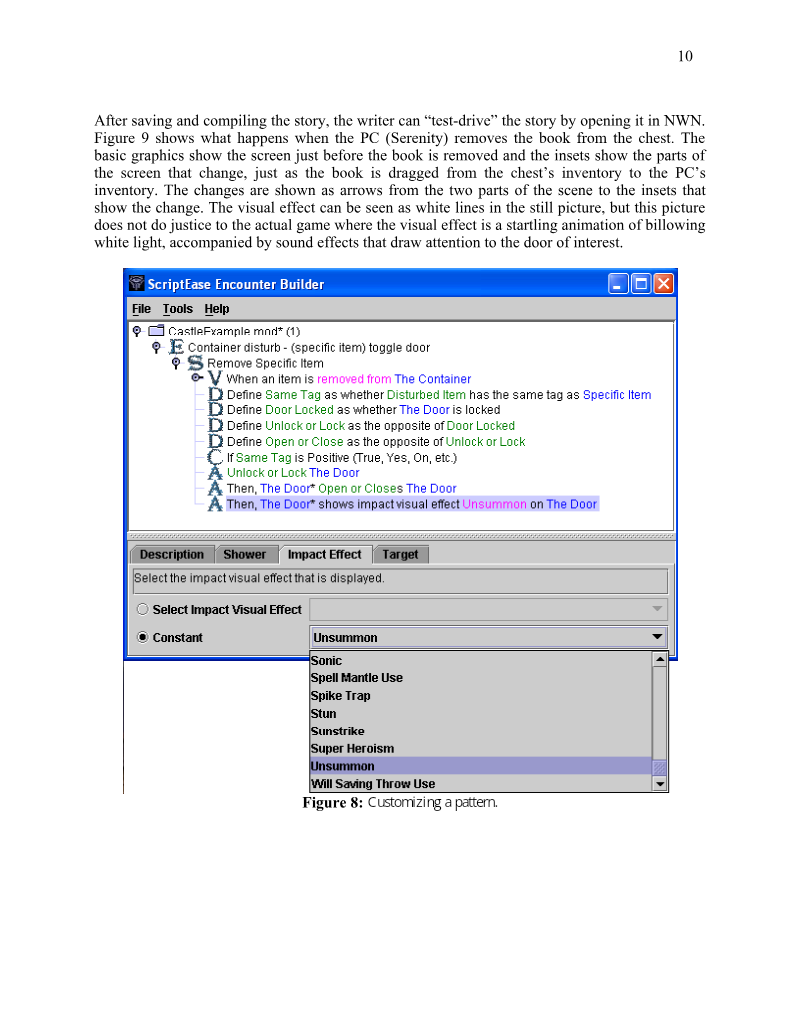
The document explores the pedagogical application of computer games for interactive story writing, focusing on ScriptEase, a tool designed to empower non-programmers to create narratives within role-playing game environments such as Neverwinter Nights.
- ScriptEase is a pattern-based authoring tool for Neverwinter Nights that lets non-programmers build interactive stories without writing NWScript, using menu-driven, customizable story patterns that generate the underlying script automatically.
- The authors motivate the tool with the volume of scripting-related help requests in the game's community forums, which reached nearly 150,000 posts, arguing that manual scripting is slow, error-prone, and a barrier to wider participation.
- A pilot with 21 Grade 10 English students in Alberta produced graded interactive stories; participants were highly motivated, spontaneously collaborated in ways resembling pair programming, and lower-achieving students became notably engaged.
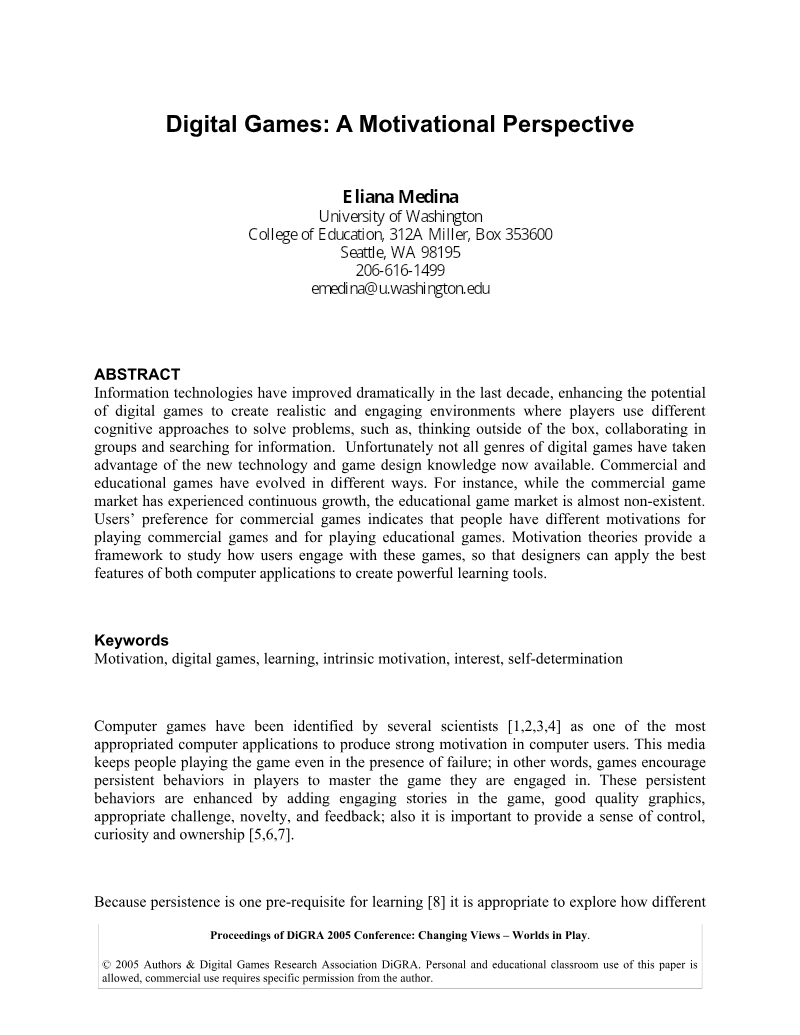
Digital Games: A Motivational Perspective
This literature review explores the motivational differences and similarities between commercial and educational digital games, aiming to inform the design of more effective learning tools.
- Commercial digital games have grown steadily while educational games remain marginal, and the review argues that understanding the motivational differences between the two can help designers combine their strengths to build more effective learning tools.
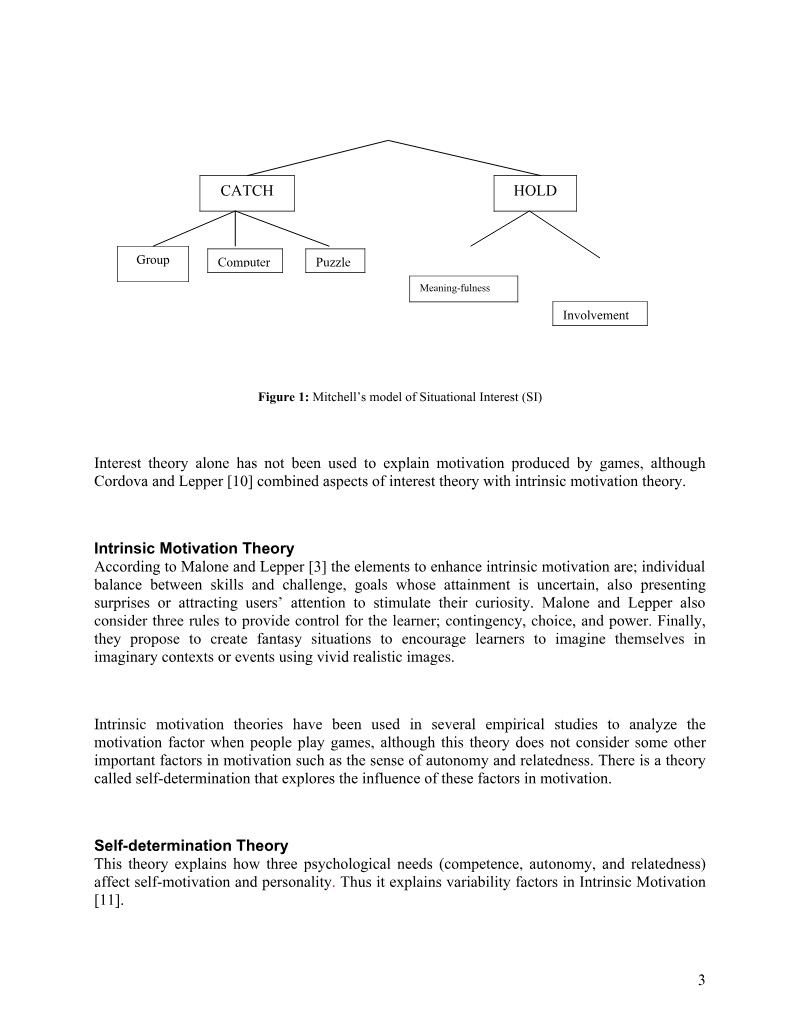
- The review grounds its analysis in three frameworks: Mitchell's situational interest model (CATCH versus HOLD), intrinsic motivation theory (challenge, fantasy, curiosity, control), and self-determination theory (competence, autonomy, relatedness).
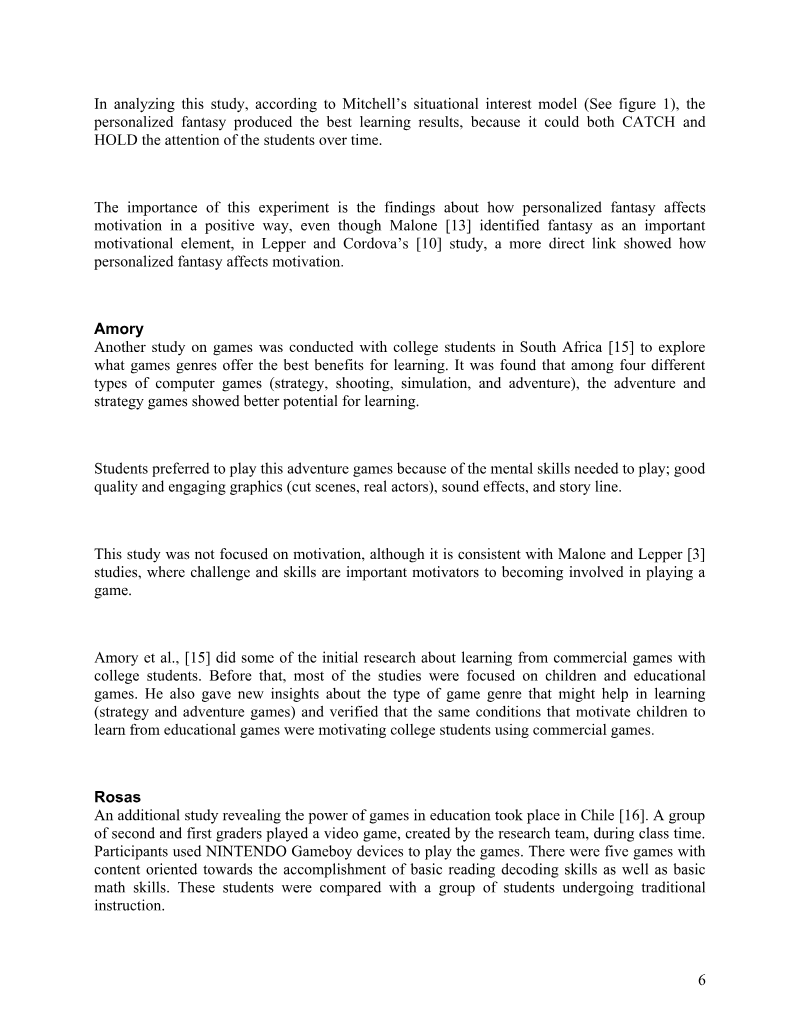
- Lepper and Cordova's arithmetic game experiments found that personalized fantasy and player choice improved intrinsic motivation, time on task, and learning, with personalized fantasy producing the strongest results.
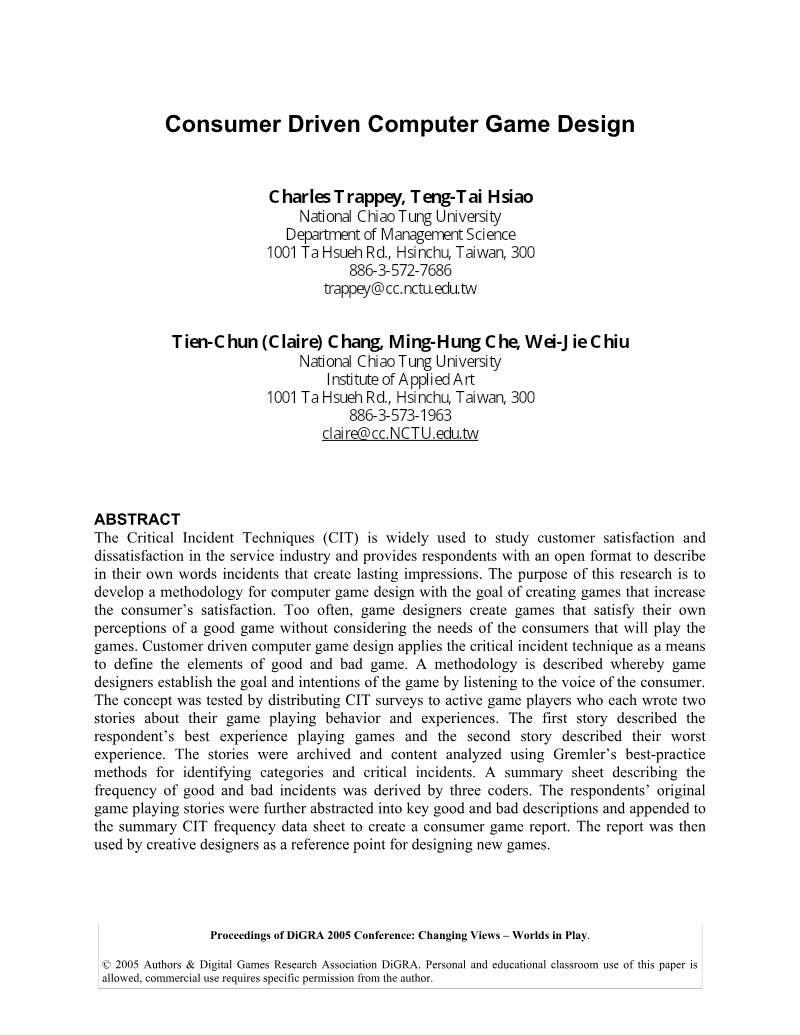
Consumer Driven Computer Game Design
This research outlines a methodology for consumer-driven computer game design, aiming to increase player satisfaction by integrating user feedback into the development process.
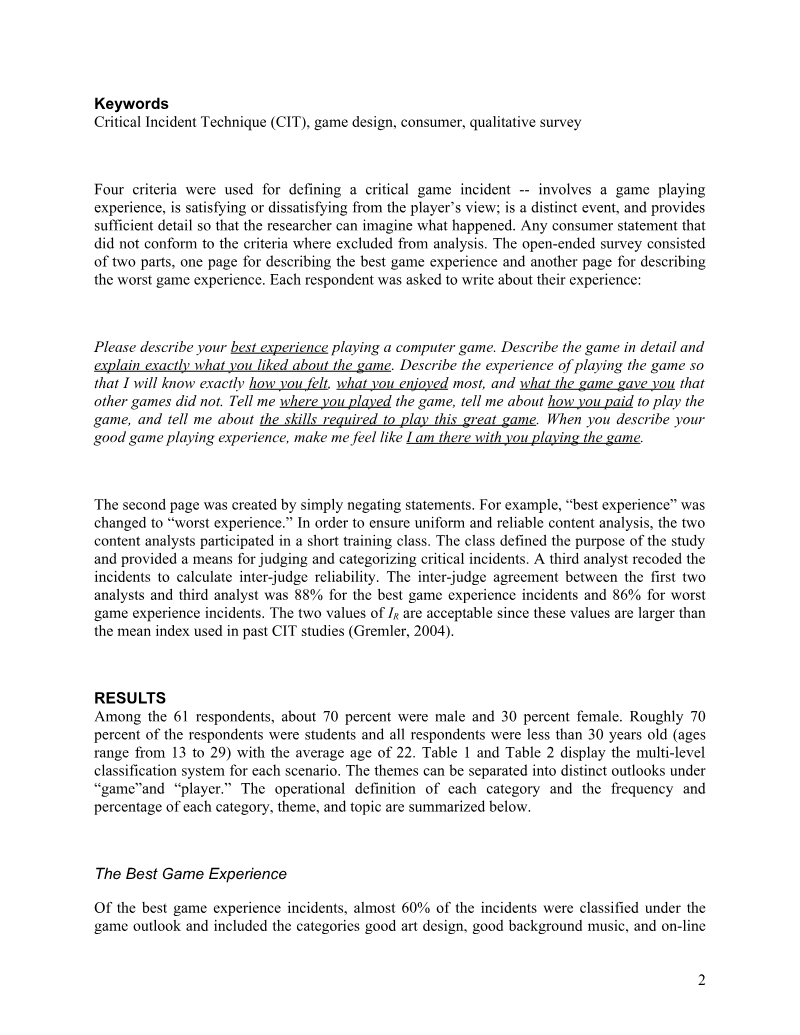
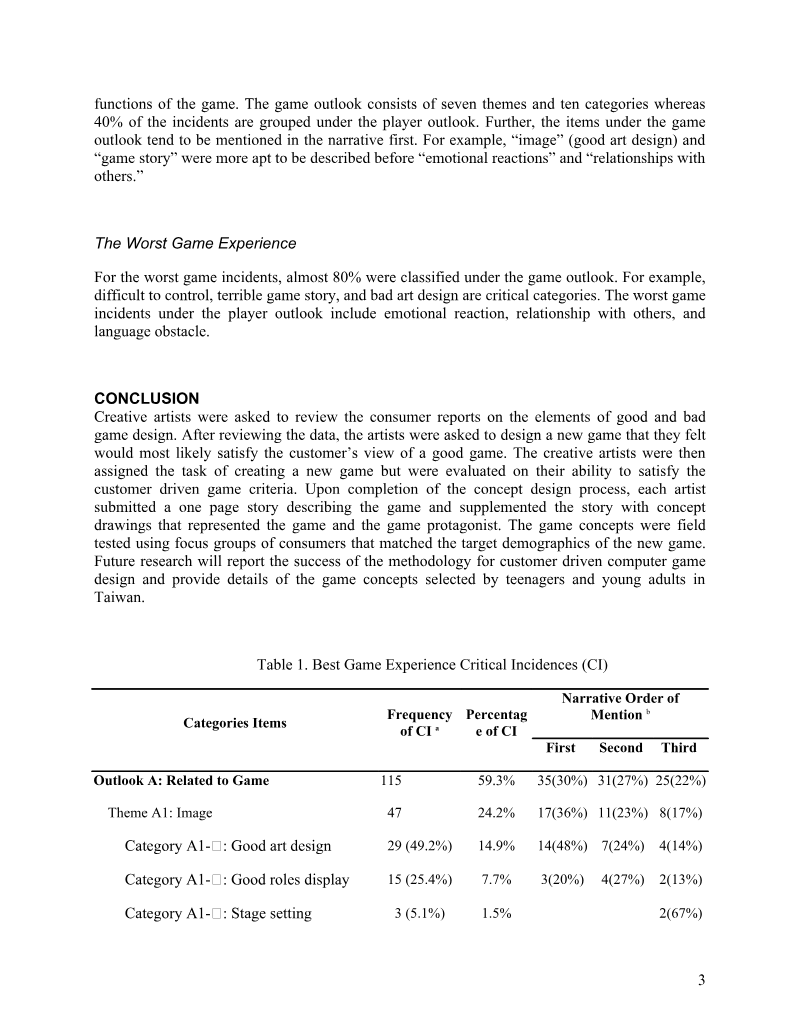
- The paper proposes consumer-driven game design using the Critical Incident Technique, grounding development in players' reported satisfying and dissatisfying experiences rather than designers' assumptions, with player narratives handed to creative designers as a reference for new games.
- The study drew on 61 active players (about 70% male, 30% female, roughly 70% students, ages 13 to 29, average 22), each writing one best and one worst game experience account.
- Two trained analysts coded the incidents with a third checking reliability, reaching 88% inter-judge agreement for positive incidents and 86% for negative ones.
Who Owns My Avatar? Rights in Virtual Property
This paper, a 2005 DiGRA conference contribution by Anders Eriksson and Kalle Grill of the Royal Institute of Technology in Stockholm, argues that the prevailing approach to virtual property, in which license agreements grant game developers exclusive rights to everything in a virtual world, is unsatisfactory.
- The paper argues that the prevailing practice of license agreements granting developers exclusive rights to everything in a virtual world is unsatisfactory, and proposes treating ownership as a divisible bundle of legal rights rather than a single fundamental relationship.
- Drawing on Sidgwick's and Honoré's analyses of property, the authors use a constructivist perspective to examine the legitimate interests of producers and players directly, without relying on a contested notion of full ownership.
- The analysis identifies two producer interests (a subscription interest in revenue and a control interest in shaping the game world) and two gamer interests (a fairness interest in playing under intended rules and a labor interest in the products of their effort), each grounded in established moral practices.
Configuring the Player: Subversive Behavior in Project Entropia
This paper analyzes "subversive behavior" in the Massively Multiplayer Online Game (MMOG) Project Entropia, focusing on how players attempt to circumvent the game's unique micro-payment business model.
- Project Entropia, developed by Swedish company MindArk, is free to download and earns revenue through a micro-payment model in which players buy its in-game currency, PED, at roughly 10 PED per US dollar, unlike most MMOs that rely on monthly subscriptions.
- The paper argues that the game's hidden rules make working as a hunter, miner, or crafter effectively costly, since tool upkeep and repairs often exceed earnings, which pushes players toward paying.
- Using the Science and Technology Studies concept of the 'black box,' the authors show how developers embed assumptions into the game to shape player behavior, and how players work to open that box and pursue roles the publisher did not intend.