
DiGRA
The Digital Games Research Association: the international association of academics and professionals who study digital games. Its Digital Library holds the proceedings of the DiGRA conferences since 2002.
Documents
/hide: The Aesthetics of Group and Solo Play
David Myers' essay examines the relationship between solo and group play in the massively multiplayer online game City of Heroes, arguing that these two modes of play are fundamentally antithetical rather than complementary.
- The essay argues that solo and group play in the MMO City of Heroes are fundamentally antithetical rather than complementary, with individual play persisting as a self-determined process of distinguishing self from other even in socially oriented designs.
- Group play is described as progressing from informal pickup groups to stable supergroups and then to large supragroups (such as those formed for Hamidon raids), with group values increasingly narrowing and substituting for individual play values as players advance.
- Supergroups are characterized as unstable because collective expectations distort the aesthetic pleasures of solo play, whereas supragroups allow greater individual expression, including 'grief play' that designers had initially encouraged during beta testing.
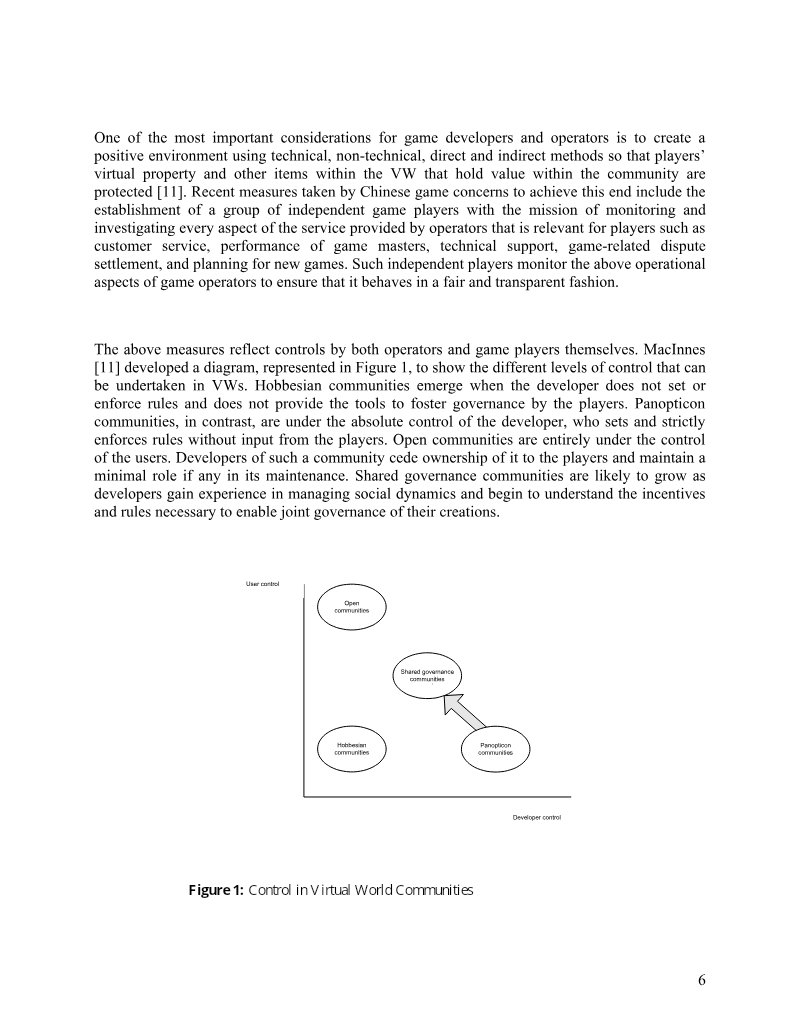
Virtual Worlds in Asia: Business Models and Legal Issues
This paper examines the evolving business models and legal challenges within the virtual worlds (VW) industry, focusing on case studies from Korea and China.
- The central argument is that early technical obstacles for virtual world businesses have largely been overcome, while new environmental, security, and governance challenges now demand a fundamental rethinking of the game industry's guiding assumptions.
- Korea's item trading market, where real-world currency is exchanged for digital items stored on company servers, exceeded $200 million in transactions in 2004 and supported more than 300 item trade companies.
- Korean developers sharply disagree on item trading: NCSoft opposes it, while smaller developers see it as a way to attract players, and a 2003 industry survey ranged from outright prohibition to unrestricted individual trade.
Machinima: Digital Performance and Emergent Authorship
The document explores machinima as an emergent online dramatic form, analyzing its production process, dramatic conventions, and relationship to traditional video production techniques and gameplay.
- Machinima repurposes video game engines and off-the-shelf software such as Halo and The Sims 2 to produce dramatic works, which the authors, John Carroll and David Cameron of Charles Sturt University, argue is an emergent form of digital performance and authorship.
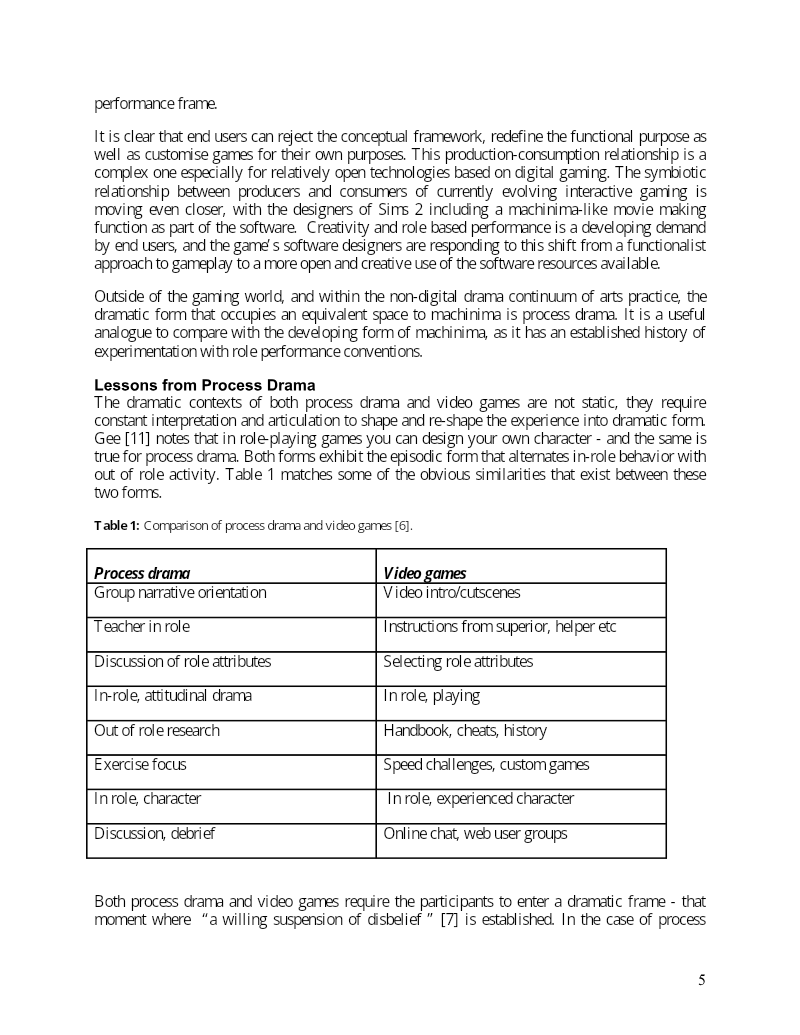
- The authors frame machinima through process drama conventions, particularly role distance and role protection, as a way to understand player agency in game-based performance.
- The history of machinima is traced to recording modes introduced in id Software's DOOM in 1994, which let players capture and share gameplay and later evolved into scripted parodies and episodic productions.
Sex in Games: Representing and Desiring the Virtual
"Sex in Games: Representing and Desiring the Virtual" examines the evolving landscape of sexual content within video games, tracing its progression from early, technologically limited insinuations to the current era of interactive, photorealistic 3D representations.
- The paper traces how sexual content in games moved from the margins to mainstream titles, citing early comedic adult games such as Leisure Suit Larry and Golgo 13 and later community-made nude patches for The Sims and celebrity-based adult skins.
- The author argues that virtual characters, celebrity culture, and pornography increasingly blur together, citing the topless Karen Walker cut-scene in Siberia and fan-made nude Lara Croft content as examples.
- Drawing on Baudrillard, Gaines, and Lacan, the paper contends that digital pornographic forms create a 'hyperreal' blend of looking and touching that intensifies voyeuristic desire.
Playing Audio-Only Games: A Compendium of Interacting with Virtual, Auditory Worlds
This paper presents an overview of audio-only computer games, games played and perceived entirely through sound and acoustics.
- Audio-only games were originally developed by and for visually impaired players, but the authors argue they offer advantages for gameplay experimentation, mobile gaming, and immersive storytelling that also appeal to hearing players.
- The central design challenge is balancing functional information for orientation and navigation against artistic aesthetics, avoiding both cluttered auditory displays and silent stretches that disorient players.
- Designers can tune difficulty through narration, monologues, the number of sound objects, and background music, which the paper presents as tools for managing this functionality-aesthetics balance.
History of Digital Games in Turkey
This study provides a historical overview and current status of digital games and the game industry in Turkey, covering the period from the late 1980s to 2005.
- Turkish players' habits and play durations parallel global averages, but domestic game development has been extremely limited and poorly documented.
- Digital games reached Turkey in the early 1980s via arcade-style "Atari Salonu" halls, which prompted a 1985 regulatory response requiring local permits.
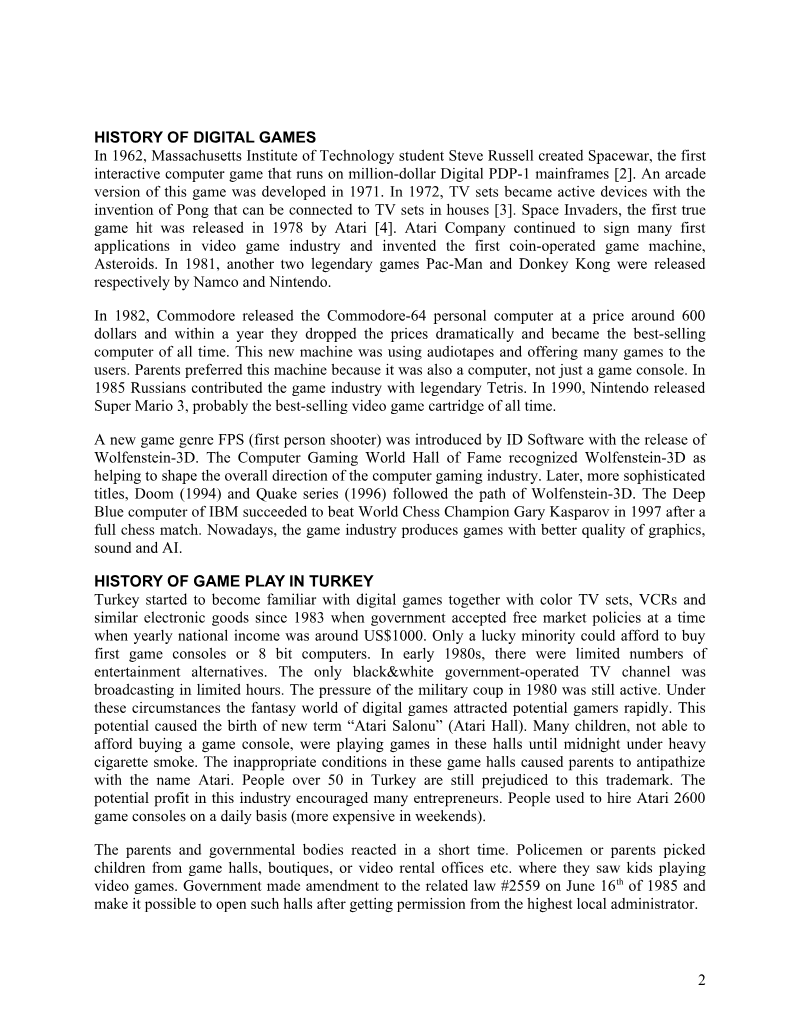
- Turkish home game development passed through three phases: an amateur 1980s period built on the Commodore 64 and magazine-published source code, a semi-professional 1990s period centered on Amiga and PC groups like Siliconworx and Compuphiliacs, and a professional stage from 2000 onward.
The Play's the Thing: Practicing Play as Community Foundation and Design Technique
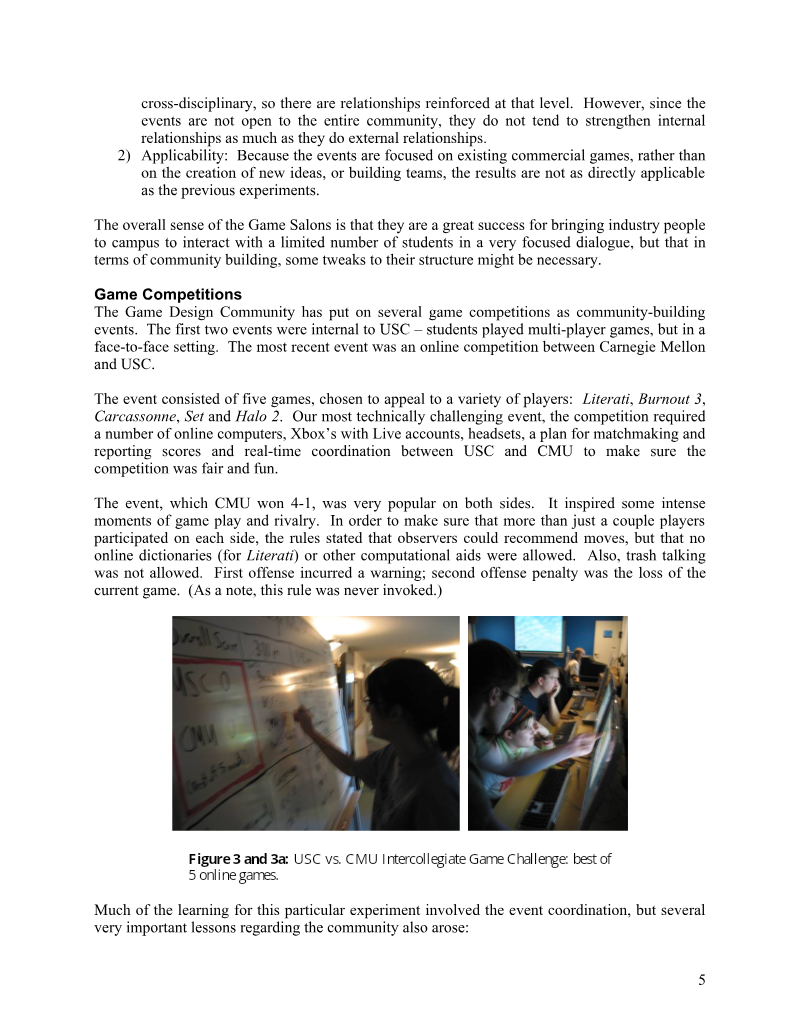
Tracy Fullerton's paper describes the USC Game Design Community, an extracurricular, cross-departmental initiative at the University of Southern California's School of Cinema-Television and Annenberg Center for Communication.
- Tracy Fullerton's paper argues that shared play experiences can give students and researchers from different disciplines a common vocabulary, social bonds, and collaboratively generated design concepts, complementing formal curricula that leave cross-disciplinary teamwork to chance.
- The USC Game Design Community is an extracurricular, cross-departmental initiative run through the School of Cinema-Television and the Annenberg Center for Communication at the University of Southern California.
- The Cooperative Game Play Experiment, drawing on the 1970s New Games Movement and led by Bernie DeKoven, was judged the community's most successful event, with its outdoor, technology-free format and the motto "play hard, play fair, nobody hurt" credited with sustaining discussion.
A Sociotechnical Conjecture About the Context and Development of Multiplayer Online Game Experiences
The document posits a sociotechnical framework for understanding multiplayer online games, asserting that their "development" is an ongoing process of "context engineering" that extends beyond initial design into active gameplay.
- Multiplayer online game experiences are framed as sociotechnical constructions whose meaning is continuously co-produced by designers and players rather than fixed at launch.
- The central thesis is that 'playing is authoring': designers inscribe rules, roles, and arenas, while players reinterpret and rewrite these conditions through their actions.
- Game design sets up conditions for emergent experience rather than predetermining outcomes, making social interaction the principal driver of what unfolds in a match or community.
Among Pasta-Loving Mafiosos, Drug-Selling Columbians and Noodle-Eating Triads: Race, Humour and Interactive Ethics in Grand Theft Auto III
Dymek and Lennerfors examine how Grand Theft Auto III (2001) portrays race and what that portrayal asks of players.
- The paper argues that video games are a meaningful medium through which cultural meanings and social issues such as race circulate and can be critiqued, while noting that games scholarship has paid comparatively little attention to race and humour.
- Using Critical Race Theory, the authors read Grand Theft Auto III's exaggerated gang caricatures (Italian mafiosos, Colombian drug sellers, triad members) as potentially perpetuating white supremacy and racial stereotyping.
- Drawing on Schopenhauer's incongruity theory of humour, the paper proposes that the game's caricatures may clash with players' prior assumptions, prompting reflection on their own racial beliefs rather than merely expressing superiority.
Liberal Sims?: Simulated Difference and the Commodity of Social Diversity
Curlew argues that the progressive representations praised in Electronic Arts' The Sims, including same-sex relationships, racial equality, and nonsexualized women, reflect shifts in marketing strategy under late capitalism rather than a genuine cultural turn toward liberalism.
- Curlew argues that The Sims' praised inclusiveness stems less from genuine ideological change than from late-capitalist marketing that targets marginalized consumers, drawing on Stuart Hall's concept of the commercial appropriation of difference.
- The paper contends that the 1990s expansion of gaming markets, combined with corporate embrace of diversity, led producers to incorporate marginalized groups for financial rather than principled reasons.
- On gender, the game gives male and female Sims equal capabilities and does not sexualize women, yet its emphasis on domesticity, shopping, child-rearing, and interior design is read as a strategy to attract women while reinforcing stereotyped feminine roles.
Challenge Balance and Diversity: Playing The Sims and The Sims 2
This analysis examines "The Sims" and "The Sims 2" through the lens of "challenge" to understand their appeal and differences, particularly given their status as "borderline games" lacking clear winning conditions.
- The paper treats The Sims (2000) and The Sims 2 (2004) as dynamic systems that motivate player activity through challenge, rather than as ideological or cultural artifacts as much prior scholarship has done.
- The author classes these people-simulation games as 'borderline' games under a classical definition because they lack clear overall goals or winning conditions, yet argues challenge is a productive framework for understanding them and could support a broader definition of games.
- Challenge is defined experientially as a situation of resistance that calls for transformative action and requires non-trivial effort or has an uncertain outcome.

Theory as Game: Designing the Gamegame
The document introduces "The Gamegame," a card game designed to facilitate game analysis and concept design by transforming theoretical game elements into a playable format.
- Järvinen's Gamegame is a card game that serves both as a tool for analysing games and as a method for generating design ideas, grounded in his doctoral theory of nine game elements grouped into systemic, behavioural, and compound classes.
- The paper argues that distinct game genres arise from particular configurations of the nine elements (goals, components, procedures, environments, players, contexts, rules, game mechanics, theme, and interface), and frames game design as a combinatorial task the Gamegame turns into play.
- The work is framed as research through design, producing a tangible artifact that embodies the theory, drawing on Frayling's distinction between research into, through, and for design.