User Acquisition reports and market data
Documents
Level Up: AI Powered Mobile Gaming Growth with Google's Katie Funk & Belinda Langner
Google’s product leadership highlights the integration of artificial intelligence across the mobile gaming lifecycle, positioning AI as a critical multiplier for user acquisition, creative optimization, and monetization.
- AI-driven value-based bidding, such as Target Return on Ad Spend (tROAS), has replaced manual campaign management to better align user acquisition with specific revenue goals like in-app purchases and advertising.
- Voodoo achieved a 58% increase in Return on Ad Spend (ROAS) by implementing AI-optimized bidding strategies tailored to their specific monetization structures.
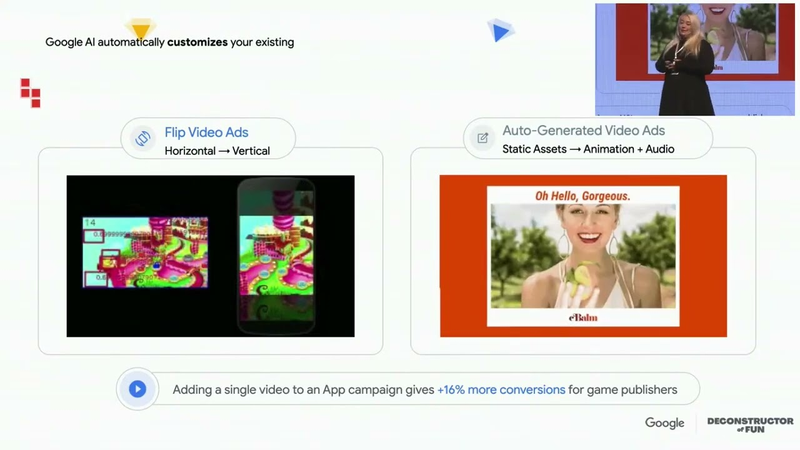
- Google’s AI-powered creative tools, which include automatic video reorientation and asset generation from static images, deliver a 16% performance uplift in campaign results.

4X (R)evolution part1. Top Heroes: Idle RPG or 4X strategy game? (#99)
Top Heroes represents a significant evolution in mobile gaming by successfully blending idle RPG mechanics with the high-stakes environment of 4X strategy.
- Top Heroes successfully blends idle RPG mechanics with 4X strategy, utilizing a deceptive onboarding process that starts as an accessible isometric action game to lower entry barriers for casual users.
- The game demonstrated rapid financial growth following its January 2024 launch, with monthly revenue increasing from $1.5 million in January to $6 million by February.
- Current daily performance metrics for the title are approximately $300,000 in revenue and 50,000 downloads.

The Measurement Crisis (in mobile UA) | #1 of 5 in State of Measurement Series
The mobile user acquisition landscape is currently undergoing a profound transformation, driven by the deprecation of device identifiers like IDFA and the implementation of stringent privacy regulations.
- The deprecation of device identifiers like IDFA and stricter privacy regulations have rendered legacy last-touch attribution models obsolete and unreliable.
- The industry is experiencing a measurement crisis marked by fragmented data, declining performance metrics, and longer payback periods for marketing investments.
- Incrementality testing using holdout groups is now the primary method for isolating causal installs and determining true return on investment.


Store Intelligence Data Digest: Q4 2023
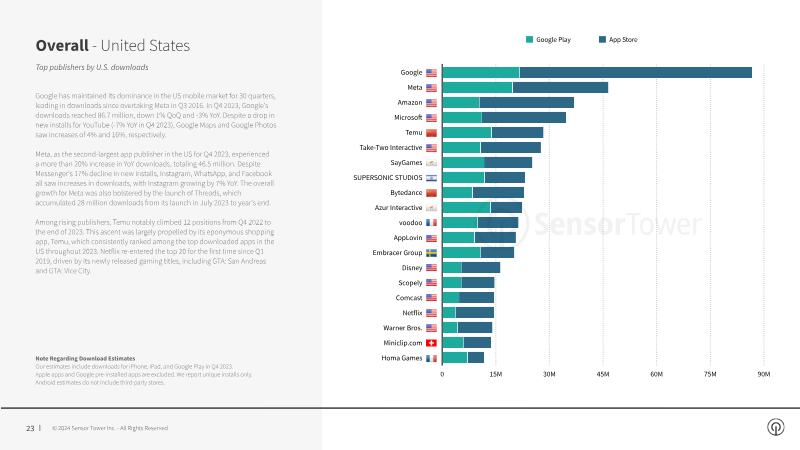
Global mobile app performance in the final quarter of 2023 reflected a complex landscape of shifting platform dynamics and regional market evolution.
- Global mobile app downloads fell 6% year-over-year in Q4 2023 to 33.4 billion, driven by an 8% decline in Google Play installs despite a 1.3% increase in iOS downloads.
- India remains the world's largest mobile market with 6.1 billion downloads, though Google Play installs in the region declined by 13% while iOS adoption grew.
- TikTok reclaimed the top spot for global downloads following an 80% surge in China, while Temu dominated Western markets but struggled with user stickiness, maintaining daily engagement rates below 20%.

The Gaming App Insights Report: Unlocking Growth Opportunities for Mobile Marketers
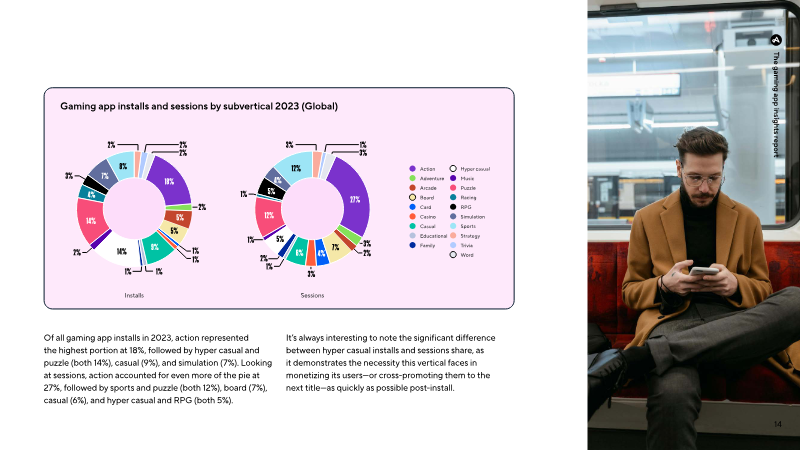
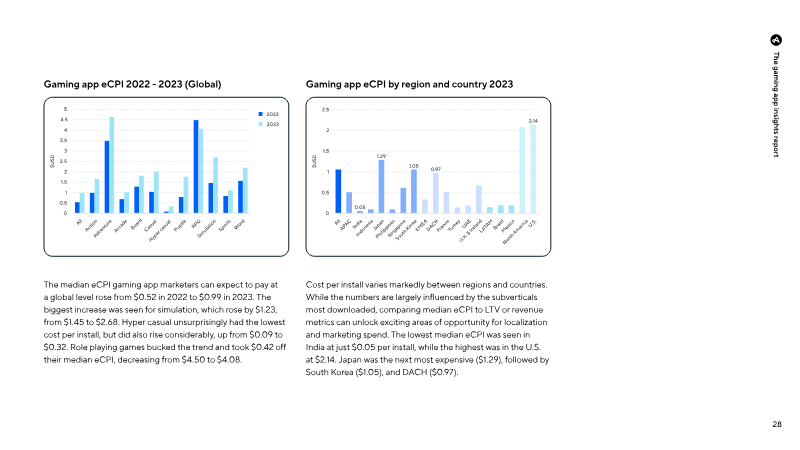
The mobile gaming industry is entering a period of stabilization and renewed growth following recent volatility, characterized by a 7% year-over-year increase in global installs during late 2023.
- Global mobile game installs increased by 7% year-over-year in late 2023, signaling a stabilization period following recent market volatility.
- Hybrid casual titles and AI-driven production are fueling a 2024 recovery, with Racing and Simulation subverticals seeing install surges of 61% and 53%, respectively.
- Monetization is shifting toward hybrid models combining in-app purchases and advertising, as in-app revenue grew 6% despite a marginal decline in overall consumer spending.



Turning Organic Success into Long-Term Revenue: A Framework for F2P Mobile Games
This industry guide provides a strategic framework for mobile game developers to transition from initial organic traction to sustainable, long-term revenue growth.
- Developers should treat monetization and user acquisition as iterative, scientific processes, using predictive modeling to forecast ROAS up to one year in advance to ensure profitability.
- Implementing a hybrid ad mediation setup that combines real-time bidding with manual waterfalls can yield an immediate 10% to 20% uplift in ARPDAU.
- Personalized, segmented in-app purchase offers can increase player spending by up to 23%, while regional pricing adjustments in lower-purchasing-power markets can boost ARPDAU by as much as 30%.

Mobile Gaming OG Eric Futoran: (Scopely) War stories, Algorithm Manipulation, Growth strategies, ANR
The mobile gaming industry has evolved from the early days of Facebook canvas development into a highly sophisticated ecosystem defined by aggressive user acquisition, data-driven monetization, and complex intellectual property management.
- Mobile game success requires treating technical performance and ad-tech integration as core business pillars rather than secondary development concerns.
- Developers must aggressively manage third-party ad SDKs to prevent App Not Responding (ANR) errors, as these technical failures directly degrade store rankings and long-term viability.
- Growth strategies rely on 'pegging' store algorithms by front-loading marketing spend and utilizing high-quality creative assets to trigger organic discovery.

Panel: The Mobile Marketing Survival Guide: How to Navigate new Industry Trends.
Mobile marketing success in the current landscape depends on a sophisticated synthesis of cultural localization, AI-driven automation, and rigorous creative testing.
- Creative strategy is the primary driver of user acquisition, requiring strong storytelling and compelling hooks within the first three seconds of an advertisement.
- Global scaling requires moving beyond generic assets to prioritize localized content, regional influencer partnerships, and high levels of linguistic and cultural accuracy.
- Developers must shift from short-term metrics to long-term retention by aligning product development directly with marketing efforts to create player-centric experiences.

Voodoo super growth w/ Alvaro Duarte: How to 10x IAP revenue in 2 years? Healthy margin! (#98)
The mobile gaming industry has undergone a fundamental shift as rising user acquisition costs and privacy changes have rendered the traditional hyper-casual model unsustainable.
- The industry is shifting from hyper-casual to a hybrid-casual model that targets a 150% return on ad spend (ROAS) within 120 days.
- Sustainable profitability now requires a balanced revenue mix where in-app purchases and advertisements contribute equally to the bottom line.
- Legacy game catalogs can be revitalized through data-driven live management, with iterative updates capable of quintupling retention rates.

We are Warriors live Review: Ad juggernaut, creative depth, balancing difficulty & progression, UA
We Are Warriors represents a highly successful hybrid-casual title that synthesizes auto-battler mechanics with idle RPG progression.
- We Are Warriors generates approximately $200,000 in daily revenue, with 75% to 80% of that income derived from rewarded ads.
- The game maintains an 81% rewarded ad viewer rate by capping placements to prevent user burnout, which supports high daily active user counts.
- The title has surpassed 10 million global downloads, with its primary market traction concentrated in the United States and South Korea.

The Inner Works of a Game Publisher with John Wright, Kwalee’s Publishing Head
The mobile gaming industry is undergoing a significant structural shift as privacy regulations and capital constraints render traditional hyper-casual models increasingly unsustainable.
- The mobile gaming industry is shifting away from hyper-casual models toward hybrid-casual titles that prioritize deeper player retention and extended lifetime value.
- Rising user acquisition costs and privacy regulation changes have rendered traditional, purely metric-driven testing models unsustainable for long-term growth.
- Kwalee is transitioning to a co-development partnership model that provides developers with technical coaching, advanced A/B testing tools, and long-term strategic guidance.
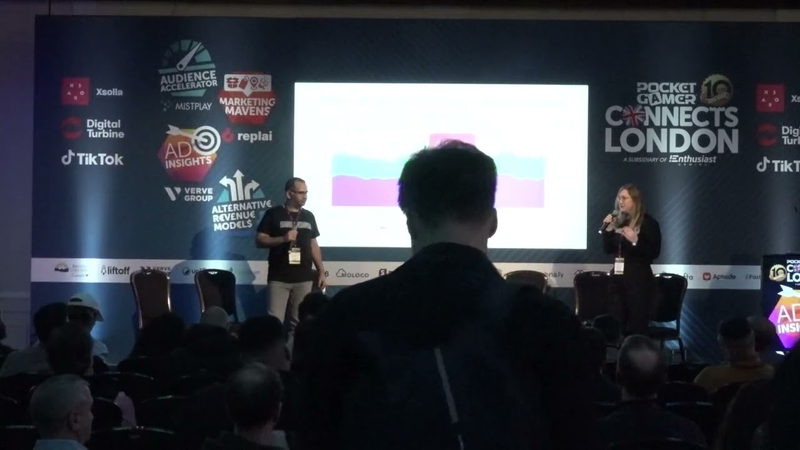
When you Said 'Attribution', did you Mean 'Contribution'? - Maor Sadra & Hadar Telem, INCRMNTAL.
The shift toward a privacy-centric digital landscape has rendered traditional user-level attribution increasingly unreliable, necessitating a transition in how gaming companies allocate marketing budgets.
- Marketers must shift from deterministic user-level attribution to incrementality-based contribution analysis to account for the erosion of data accuracy caused by Apple’s App Tracking Transparency and privacy manifests.
- Budget allocation should be determined by measuring the actual incremental value a channel provides to total market performance, rather than relying on potentially duplicated or skewed attribution data.
- Companies can identify cannibalization by comparing total conversions against paid traffic, revealing instances where increased ad spend fails to generate a net lift in overall installs.