Sports Games reports and market data
Documents

How FIFA Delivers Live Content to Users Fast
Transitioning to a Games-as-a-Service model requires decoupling live content delivery from core server and game updates.
- Decoupling live content delivery from core game updates allows developers to bypass lengthy certification processes and push continuous, high-volume updates to users.
- A centralized, browser-based portal enables a small team of producers to deploy localized content across 11 platforms in under an hour without requiring engineering intervention.
- The system is designed for rapid reaction to real-world sporting events, enabling the delivery of timely, value-driven promotions within minutes of an event occurring.

The Secret of Eternal (Product) Life: Lessons from J.R.R Tolkien and John Madden
Achieving long-term success in the video game industry requires a fundamental shift away from the pursuit of fleeting technical spectacle toward the cultivation of deep, iterative, and culturally resonant experiences.
- Long-term franchise success is achieved by prioritizing consistent gameplay refinement and accessibility over the pursuit of cutting-edge technical spectacle.
- Developers should avoid 'creeping featurism' by focusing on core mechanics, which allows products to endure beyond the lifecycle of a single console generation.
- Drawing from J.R.R. Tolkien’s methodology, developers must establish a coherent, well-defined cosmology before launching sequels to ensure narrative consistency.

Game Accessibility: Practical Visual Fixes from EA's Madden NFL Franchise
The integration of accessibility features into the Madden NFL franchise demonstrates that significant improvements for players with visual impairments can be achieved through cost-effective, software-based solutions.
- Accessibility features can be integrated into AAA titles with minimal resources, as demonstrated by a single developer implementing these changes for Madden NFL 17 within a one-month timeframe.
- High-impact visual improvements for low-vision players include enlarging pass icons, standardizing UI placement, and providing user-adjustable brightness and contrast controls.
- Modified color-shifting algorithms are superior to standard color-blind filters, which often compress color ranges and negatively impact gameplay clarity.
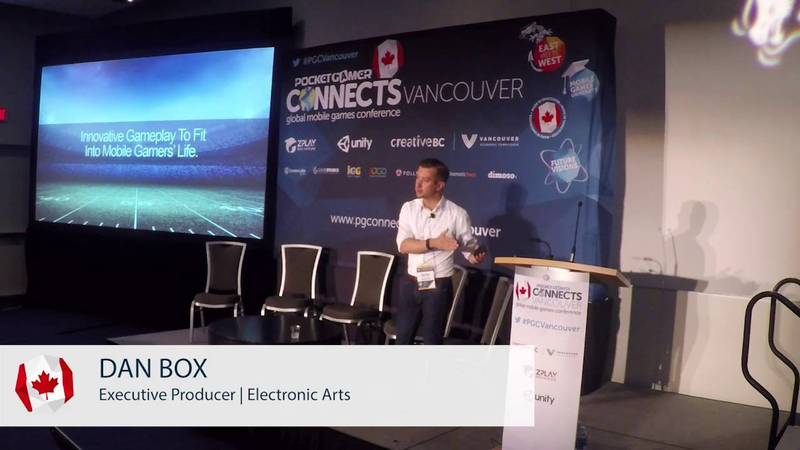
Bringing EA's big sports brands to mobile gaming
Electronic Arts (EA) aims to establish itself as the premier global brand for sports on mobile devices by leveraging its extensive portfolio of intellectual property and deep fan engagement.
- Mobile sports gaming represents a significant growth opportunity, currently accounting for only 3% to 5% of the total sports gaming market compared to 15% to 20% on consoles.
- EA’s mobile strategy, modeled after Madden Mobile’s tenfold growth over two years, focuses on bite-sized 30-second gameplay loops tailored for mobile user lifestyles.
- Social features are a primary driver of engagement, with social interaction rates in EA sports titles increasing by 600% over a two-year period.

Rewarded video ads in Pele Soccer Legend
Pele Soccer Legend utilizes rewarded video advertisements as a primary monetization strategy within its free-to-play mobile framework.
- Pele Soccer Legend monetizes its free-to-play model by integrating rewarded video ads into both macro-level energy management and micro-level mission mechanics.
- The game uses a heart-based energy system that allows players to replenish depleted energy by watching rewarded videos, providing a non-monetary alternative to waiting or spending currency.
- Rewarded ads are embedded directly into core gameplay, offering players additional kicks or level restarts after a failure to reduce friction and maintain session length.

How Madden NFL Mobile drove EA Mobile's FY16 Q3 financials
EA Mobile’s financial performance for the third quarter of fiscal year 2016, covering October through December 2015, demonstrates a significant disparity between GAAP and non-GAAP accounting metrics.
- EA Mobile reported non-GAAP revenue of $162 million for FY16 Q3, marking a 43% quarterly increase driven by deferred revenue recognition in its free-to-play model.
- GAAP revenue for the same period was $126 million, reflecting a more modest 3% quarter-over-quarter and 5% year-over-year growth compared to non-GAAP figures.
- Madden NFL Mobile served as the primary growth engine for the quarter, leveraging a mid-August update to align with the NFL season and improve engagement levels.

Biodroid's Ricardo Flores Santos on Billabong Surf Trip 2, MegaRamp and MegaRamp Championship
Biodroid, a Portuguese game developer specializing in action sports titles, is expanding its portfolio through strategic partnerships with major sports brands and athletes.
- Biodroid is launching 'MegaRamp Championship,' a new title that integrates directly with the X Games global tour to synchronize virtual gameplay with real-world professional athletic circuits.
- The studio employs a location-based strategy for the MegaRamp franchise, featuring in-game structures that mirror the specific cities hosting the real-world tour.
- Biodroid maintains a consistent mobile gaming presence by balancing seasonal releases, such as the Billabong Surf Trip series for summer and year-round extreme sports titles.
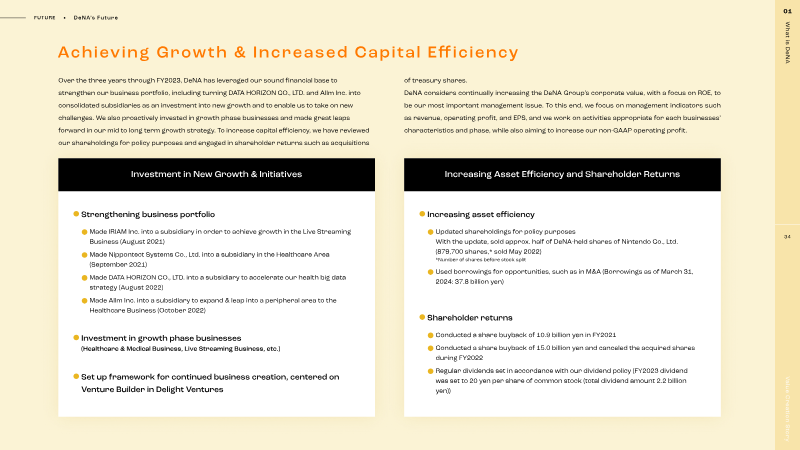


2024 Integrated Report: Value Creation Story
DeNA is currently executing a strategic pivot toward a diversified business model to mitigate the volatility inherent in the gaming industry.
- DeNA aims for a non-GAAP operating profit of 15.0 billion yen by FY2026, with additional goals of 5.0 billion yen for Healthcare & Medical and 3.0 billion yen for Sports & the Community over the next three years.
- DeNA has significantly shifted its business portfolio since FY2021, reducing reliance on the volatile Game Business and growing Live Streaming to over 40.0 billion yen (more than 30% of total revenue) and Sports to 20% of total revenue.
- The Live Streaming Business, driven by Pococha (5.77 million downloads as of March 31, 2024) and IRIAM, has grown to over 40.0 billion yen in revenue, with a segment profit of 5.2 billion yen in FY2023.