Sports Games reports and market data
32 game industry reports, presentations and talks about sports games from writers such as PocketGamer.biz, Game Developers Conference and We Are Social, newest from 2026. Every document has a summary and key insights with the page they come from, and 275 charts and tables are extracted as data.
Documents

Assassin’s Creed creator Patrice Désilets: “I have two or three games left”
The independent development landscape is currently undergoing a significant shift as veteran creators move away from the constraints of large-scale publishing toward self-determined, iterative production models.
- Patrice Désilets, creator of Assassin’s Creed, is shifting toward a self-determined production model at his 70-person studio, Panache, to maintain creative autonomy over projects like 1666: Amsterdam.
- Désilets estimates he has only two or three major titles left in his career, signaling a move toward high-impact, iterative development rather than large-scale corporate output.
- Independent developers are increasingly rejecting the volatile live-service model in favor of sustainable, player-focused projects that prioritize long-term viability over aggressive monetization.

One Player Ran 10,000 Games on This Skillz App
Touch Mechanics, a two-person independent studio founded by brothers Carl and Grant Crossley, specializes in developing competitive mobile sports games for the Skillz platform.
- Touch Mechanics utilizes a rapid iteration loop for their Skillz-based sports games, often producing a functional prototype in 2 weeks while spending up to 10 months refining the final product.
- The studio prioritizes analog control schemes over digital inputs to ensure players feel direct agency, allowing for high-skill mastery that rewards players with a sense of personal achievement.
- To maintain long-term engagement, the developers implement realistic variables like 'blind oil' conditions in bowling, which force players to adapt their playstyle during a warm-up period just as they would in a real-world setting.

2026 World Cup Effect on Games
The 2026 FIFA World Cup serves as a catalyst for significant shifts in the mobile football gaming landscape, highlighting a divergence between established market leaders and the governing body’s own interactive efforts.
- Konami’s eFootball has surpassed EA’s FC Mobile in cumulative revenue, reaching $1.9 billion compared to FC Mobile’s $1.6 billion.
- While eFootball leads in total revenue, FC Mobile maintains a larger daily active user (DAU) base, highlighting a divergence in monetization strategy versus user reach.
- Major football titles have abandoned traditional seasonal resets in favor of continuous progression and power inflation to reduce user churn.


PC & Console Year in Review: 2025
The 2025 PC and Console Year in Review provides a comprehensive analysis of the global gaming landscape, focusing on market performance, consumer behavior, and development trends.
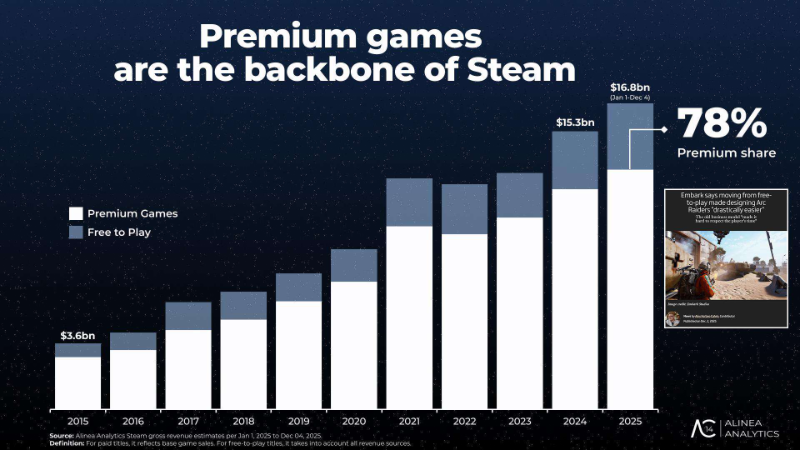
- Premium games dominate the market, accounting for 78% of Steam’s $16.8 billion total revenue in 2025.
- Cooperative gameplay is a primary driver of commercial success, with 11 of the top 20 highest-grossing titles featuring co-op mechanics.
- Indie developers contribute over 25% of Steam’s total revenue, with 'Triple-I' titles delivering exceptional return on investment.

Dream Sports and the Future of Cricket
Dream Sports operates as a mission-driven conglomerate designed to provide a comprehensive, 360-degree sports experience through a portfolio of specialized business units.
- Dream Sports leverages a corporate startup model to manage a 250-million-user ecosystem, aiming to capture a share of the $20 billion global sports video game market.
- Dream Game Studios is targeting the 2.5 billion global cricket fan base by filling the market gap for AAA-quality, realistic mobile experiences instead of traditional arcade-style titles.
- The flagship title, Dream Cricket, has achieved over 6 million organic downloads by focusing on hyper-realistic visuals, high-performance technology, and custom roster-building meta-games.

Building a Sustainable Web3 Game With Sorare
Sorare establishes a sustainable model for Web3 gaming by prioritizing consumer-first utility over the volatile, speculative tokenomics that characterize many blockchain projects.
- Sorare prioritizes long-term engagement by anchoring digital collectibles to real-world athlete performance data rather than speculative, volatile tokenomics.
- The platform avoids systemic financial risks by eschewing proprietary game tokens in favor of Ethereum as a transaction rail while supporting fiat payments for non-crypto users.
- To prevent pay-to-win dynamics and maintain competitive integrity, the game utilizes mechanics like point caps that prioritize analytical skill and sports knowledge over financial investment.

Think Forward: Sports Edition 2023
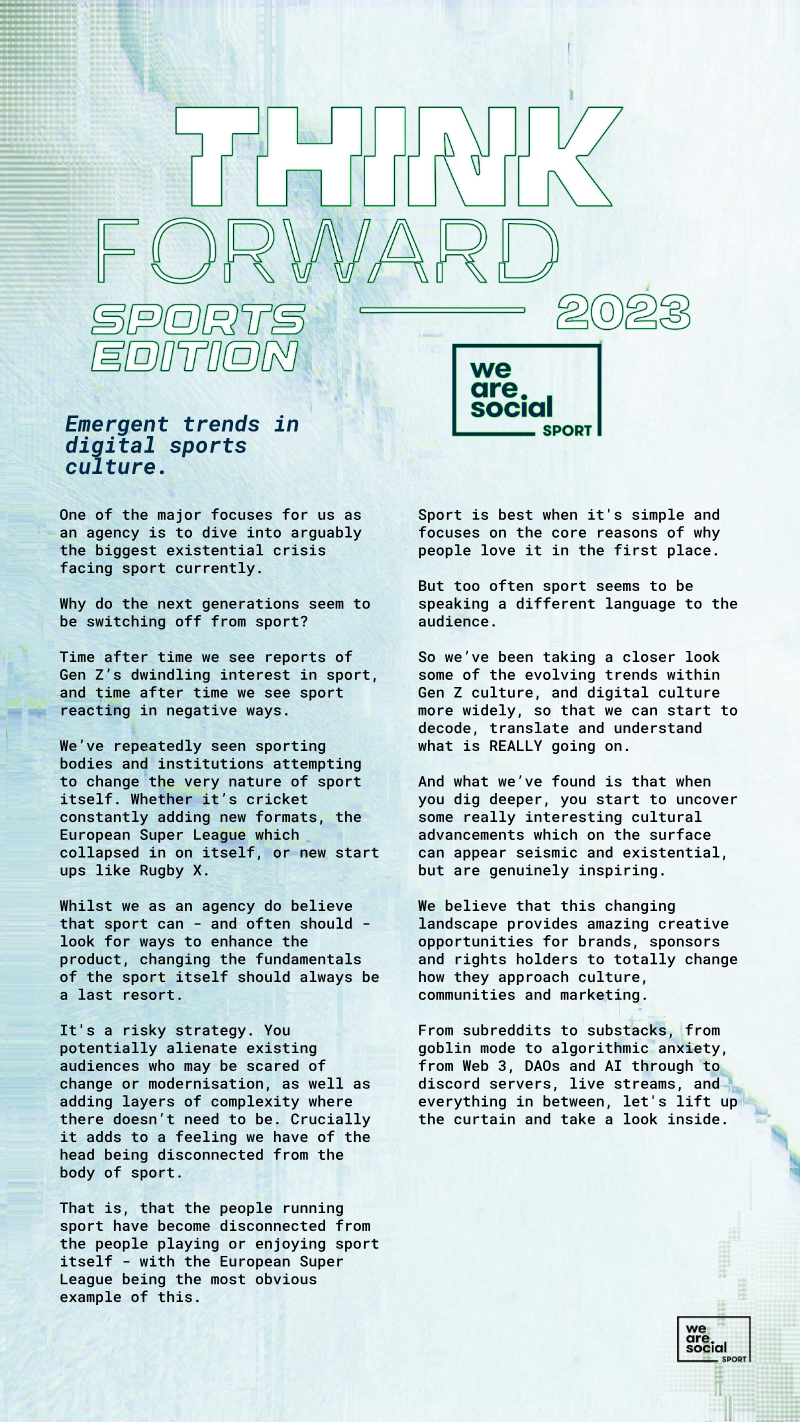
This analysis examines the evolving relationship between Gen Z and sports culture, identifying a significant disconnect between traditional sports institutions and younger audiences.
- Nearly 40% of Gen Z now use social platforms like TikTok and Instagram as their primary search engines for sports discovery rather than traditional search tools.
- Sports organizations should prioritize adapting to digital cultural behaviors over altering fundamental game rules, as rule changes often alienate core fanbases.
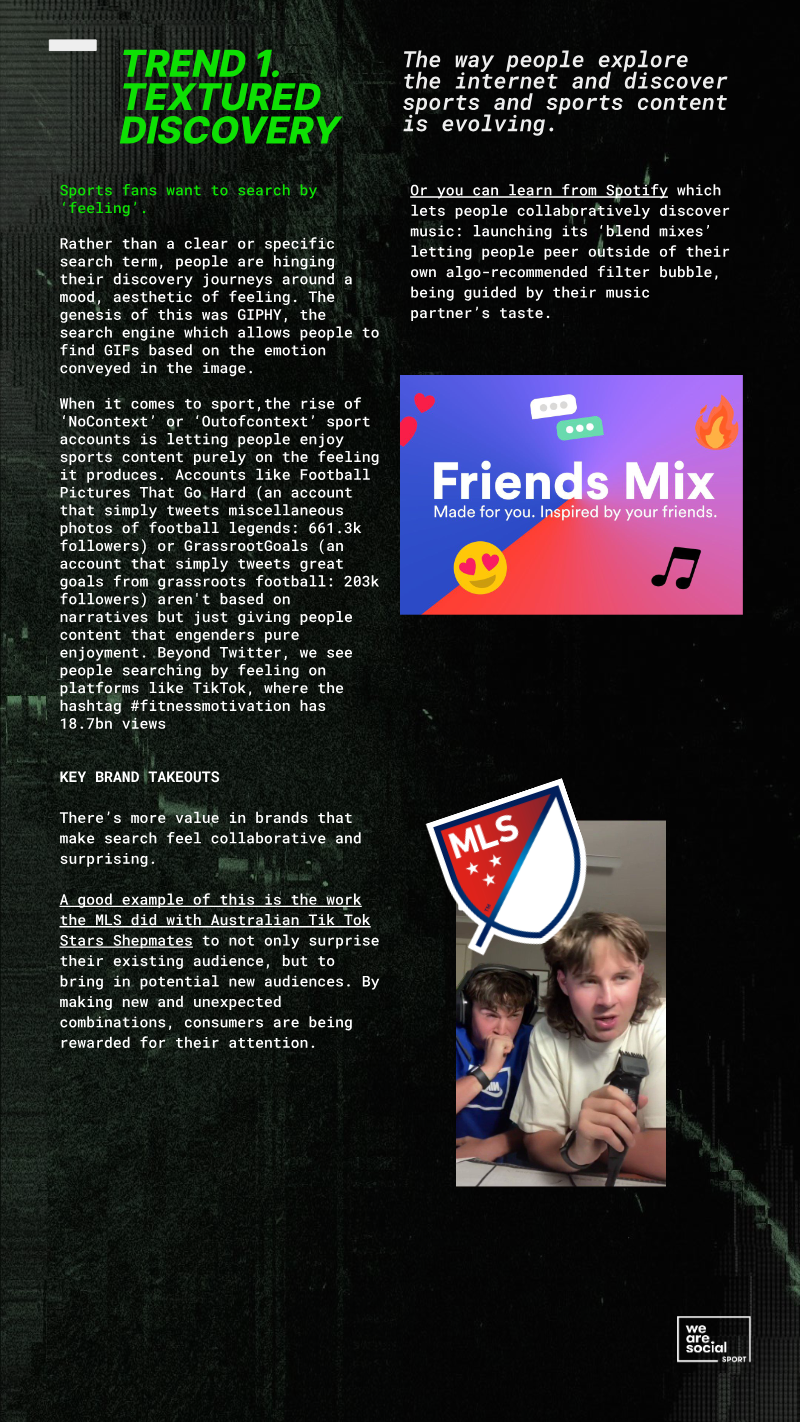
- Sports consumption is shifting toward 'textured discovery,' where fans search by emotion and feeling rather than specific keywords or traditional narrative structures.

'FIFA 22's' Hypermotion: Full-Match Mocap Driving Machine Learning Technology
Electronic Arts has fundamentally transformed the animation pipeline for the FIFA franchise by shifting from traditional studio-based motion capture to full-match data acquisition.
- EA captured 11-vs-11 professional football matches using Xsens motion capture suits to generate over 4,000 new gameplay animations for FIFA 22.
- To resolve player drift and provide spatial context, the team integrated Local Positioning System (LPS) data using Wemo Pro sensors, achieving tracking accuracy within five centimeters.
- The team reconstructed 3D ball data by triangulating coordinates from eight static 8K cameras (50 fps) and calibrating them using known field landmarks instead of traditional checkerboard patterns.
Environmental and Motion Matched Interactions; 'Madden', 'FIFA' and Beyond
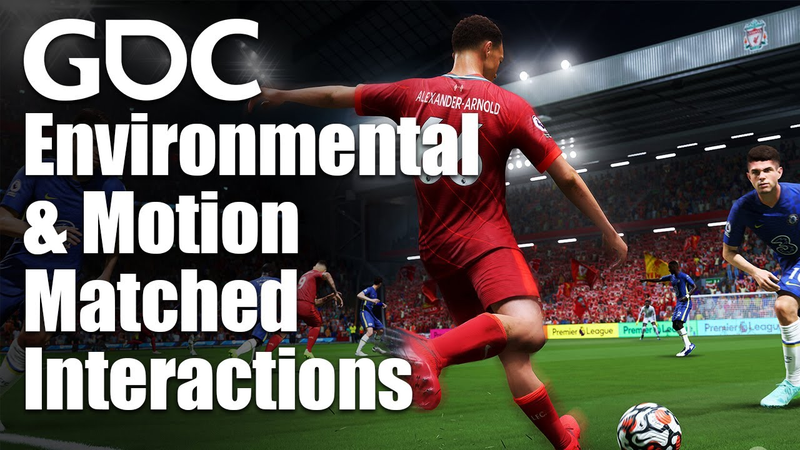
The integration of advanced animation systems within sports titles like Madden and FIFA represents a significant shift toward fluid, physically grounded character interactions.
- EA's multi-character interaction system (Interact) was extended to support environment and object interactions by using 'locators'—abstract points in the world—instead of relying solely on character-to-character matching.
- By using locators to represent predicted future positions of objects, such as a football in Madden, the system enables complex multi-character catches and interactions that anticipate movement.
- Integrating motion matching with the interaction system allows characters to navigate toward ideal interaction points, significantly reducing the need for visual warping or alignment during gameplay.

Sports & Racing Games Report: Q3 2021
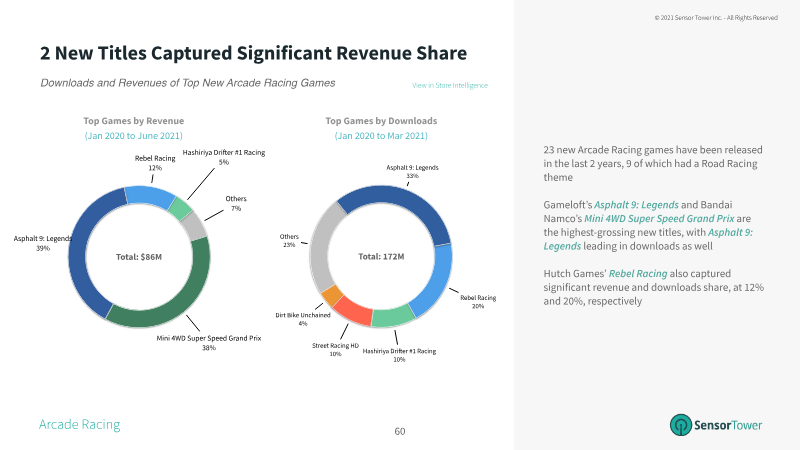
The sports and racing gaming sectors experienced a transformative period throughout 2020 and early 2021, characterized by a 40.2% year-over-year revenue increase to $2 billion.
- The sports and racing sectors saw a 40.2% year-over-year revenue increase to $2 billion between 2020 and early 2021.
- Market power is highly concentrated among major publishers like Electronic Arts, Konami, Tencent, and Zynga, who are driving growth through strategic acquisitions such as Glu Mobile and Codemasters.
- Realistic simulation titles consistently outperform arcade-style games in revenue, while arcade games continue to lead in total download volume.

TWIG 145: How FIFA Ultimate Team's new Preview Packs actually boosted loot box sales
The gaming industry is currently navigating a period of intense regulatory scrutiny regarding loot boxes, with legislative efforts in regions like the United Kingdom and Australia, alongside age-appropriate design codes, threatening the future of this monetization model.
- Electronic Arts reported that FIFA Ultimate Team 'Preview Packs' increased engagement and conversion rates, though analysts caution that these results may be skewed by seasonal revenue spikes.
- The gaming industry faces significant regulatory pressure in the UK and Australia regarding loot boxes, forcing developers to explore alternative monetization models to mitigate potential revenue losses.
- Developers are transitioning toward monetization strategies that emphasize skill, time, and direct cost, such as battle passes, ticket-based mission entry, and higher-priced direct asset purchases.
Throwing Down on Genre - A discussion on Fighting, Sports & Wrestling video games! - Extra Credits
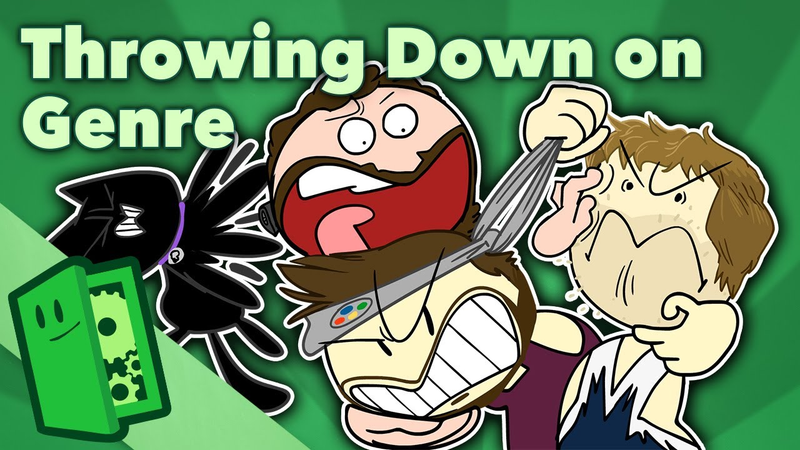
The classification of professional wrestling video games remains a subject of debate within the gaming industry, specifically regarding whether they function as sports simulations, fighting games, or a distinct hybrid genre.
- Professional wrestling video games occupy a unique hybrid genre that defies traditional classification as either pure sports simulations or fighting games.
- The sports simulation classification is supported by the industry's reliance on iterative, annual release cycles that prioritize roster updates and authentic athletic presentation.
- The fighting game classification is supported by core mechanical similarities, including two-player combat systems, health depletion mechanics, and the use of special move meters.