Market (PC & Console)·Updated Apr 8, 2026 by Newzoo
Report · January 1, 2025
Published by Newzoo
Global PC and console revenues are expected to grow modestly through 2027, with consoles driving the majority of expansion at an estimated +13 % CAGR while PC revenue rises only in single digits. 2024 saw a plateau for PCs, dominated by free‑to‑play and in‑game monetisation, whereas console sales are set to rebound from 2025 thanks to strong releases such as GTA VI and the launch of Nintendo Switch 2. Player growth remains incremental, with PC players increasing at +2.3 % annually and console players at +3.5 %, driven largely by established franchises rather than breakthrough innovation. Playtime data confirm that 2024 experienced a 6 % YoY increase, with Pay‑to‑Play titles (e.g., Call of Duty) and free‑to‑play hits (Fortnite, Roblox) accounting for most of the lift. New releases captured only about 9 % of total playtime, underscoring that long‑running series dominate the market. Console audiences remain heavily slate‑dependent: 67 % of new‑release hours come from annual franchises, while PC players show a higher share of non‑annual titles. In the US and Western Europe, non‑annual franchise games contribute a smaller slice of console revenue (≈8–22 %) compared to annual franchises, which drive the bulk of earnings. Engagement patterns reveal a sharp decline in title diversity on PC and Xbox, with the average number of titles played per player falling 27 % on Steam in the US and up to 34 % in Russia and Brazil. PlayStation, by contrast, shows modest growth in title engagement. Genre preferences are shifting away from Battle Royale toward Adventure and Role‑Playing, reflecting a broader industry trend toward narrative‑rich, long‑form gameplay. Nostalgia and free‑to‑play models continue to sustain short‑term spikes, but long‑term retention hinges on continuous content updates and robust live‑service strategies. New IPs must prioritize originality, polished gameplay loops, and community‑first discovery to overcome the legacy brand advantage and achieve lasting commercial success.
Copyright & redistribution notice The content of this report is created with due care by Newzoo and protected by copyrights. This report, or any portion thereof, may not be reproduced, distributed, or transmitted in any form or by any means, including photocopying, recording, or other electronic or mechanical methods, or used in any manner whatsoever, without the express written permission of Newzoo. Reproducing, distributing, and/or transmitting this report, or any portion thereof, for commercial purposes is explicitly not allowed.
Contents The PC and console market outlook 10 Playtime analysis 19 How many games do we really play? 43 Special topic: Recursive nostalgia 68 Special topic: Steam visibility 80 What's Next? 90
Meet the authors of this report Emmanuel Rosier Ben Porter Spyros Georgiou Director of Market Intelligence Director of Consulting Design Lead Michael Wagner Tyler Long Siyi Zhang Senior Market Analyst Director of Product Design Intern Brett Hunt Horatiu Mitu Lynn van den Hoven Market Analyst Director of Marketing Marketing Specialist Michiel Buijsman Principal Market Analyst
The state of PC and console gaming in 2025 Welcome to the third edition of Newzoo’s annual PC and console report. ) In a rapidly evolving market filled with speculation and opinion, it’s essential to cut through the noise with clear, data-driven insights. At Newzoo, we leverage rigorous analysis and industry-leading data science to deliver the most comprehensive and accurate snapshot of the PC and console gaming landscape, empowering you to navigate challenges and capture emerging opportunities. In this report, we first examine the market's performance in 2024. We then examine how upcoming game releases, changing consumer behaviors, and monetization strategies will shape the market toward 2027. Building on last year's groundbreaking Playtime Analysis, we present an updated, in-depth look at how player engagement has evolved across PC, PlayStation, and Xbox since the pandemic. We're particularly excited to introduce our new section, "How Many Games Do We Really Play?", which investigates the exact number of games players actively engage with and their willingness to invest at different price points across platforms. Additionally, our Special Focus Topics offer deeper insights into key market dynamics: ü Recursive Nostalgia: Explore how major live-service games leverage their histories to drive ongoing player engagement through nostalgic experiences. ü Steam Visibility: Gain actionable insights into discoverability, identifying best practices for standing out in Steam’s increasingly competitive marketplace.
ostalgia: Explore how major live-service games leverage their histories to drive ongoing player engagement through nostalgic experiences. ü Steam Visibility: Gain actionable insights into discoverability, identifying best practices for standing out in Steam’s increasingly competitive marketplace. By the end of this report, you'll be equipped with actionable insights into monetization strategies, player engagement trends, platform-specific nuances, and effective discoverability tactics. This free resource draws from the Newzoo Platform, focusing on the Game Performance Monitor, with supporting data and insights from all our tools. We also delve into our Games Market Reports and Forecasts for valuable market context. We hope you enjoy reading it as much as we loved writing it. Thanks for tuning in. Emmanuel Rosier Director of Market Intelligence
Key takeaways 1 PC 2Play 3 Hov PC & console Playtime analysis How many games market outlook do we really play? PC popu ü Overall play Number of ü PC popularity remains stable with muted Overall playtime hours are growing but ü Number of games played is down on Xbox and revenue growth, while console revenue growth concentrated in AAA and at times cannibalistic; Steam from COVID peak will be driven by GTA VI and Nintendo Switch 2 the battle for audience hours is fierce and near Play habits zero sum ü Play habits are calcifying into fewer games, ü All business models are viable, but not at the reducing addressable market for new launches same scale on every platform ü PC skews heavily towards older, F2P titles while console is slate dependent ü F2P drives significant interest, but players are ü Barring radical outliers, titles’ growth to come often very quick to churn from share shift ü Launching a successful F2P game requires a combination of strong IP, great gameplay, and ü Adventure and Role playing titles are on the favorable market conditions rise for those who enjoy playing more titles Recursive nostalgia 5 Steam visibility Recu Stea
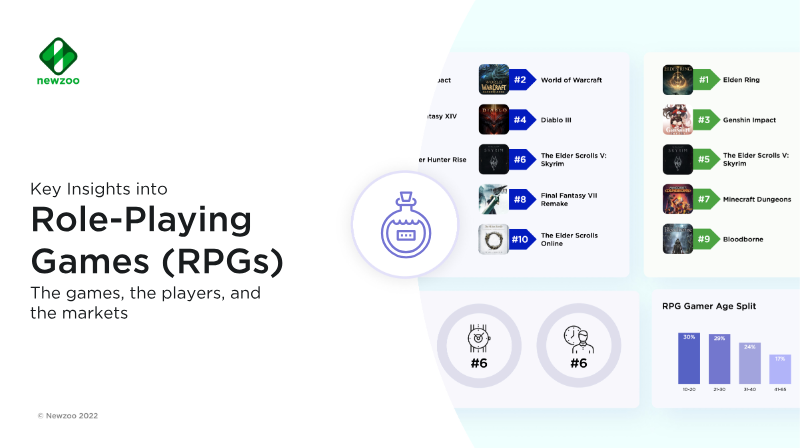
Role-Playing Games (RPGs) represent the highest-revenue genre in the global gaming market as of 2022. The genre is characterized by deep character development, party-based mechanics, and progression systems centered on quests and combat. While RPGs are played across all platforms, they maintain a strong presence on PC and console, where they consistently rank among the top genres for monthly active users. The demographic profile of the RPG audience is predominantly male, accounting for 58% of players, and skews toward younger age groups, with 59% of the player base falling between the ages of 10 and 30. Engagement patterns reveal that RPG players are highly active, averaging 18.8 sessions per month. The genre also demonstrates significant cross-genre appeal, with high player overlap in the adventure, shooter, and battle royale categories. High magical fantasy remains the most popular thematic element, utilized by 63% of the player base, while skill and talent trees serve as the most prevalent gameplay mechanic. Monetization within the RPG space is dominated by pay-to-play models, which reach 97% of the player base, followed closely by in-app purchases at 90%. Geographically, the United States and Japan lead in monthly active users on PC and console. The genre also maintains a robust live-streaming presence, generating 205 million hours watched across platforms like Twitch and Facebook Gaming in June 2022. These insights are derived from data covering 37 markets, excluding China and India, and utilize proprietary gamer segmentation to analyze player motivations, viewing habits, and engagement metrics across the broader gaming ecosystem.
The report examines how gaming engagement varies across generational cohorts, drawing on a representative online sample of 72,068 respondents from 33 global markets (North America, EMEA, APAC). Data were collected via Computer Assisted Web Interviewing between January and April 2021. Findings show that younger generations devote a larger share of leisure time to gaming, with Gen Z and Millennials spending 11–12% of their free time on games versus 18% for Baby Boomers. Weekly playtime averages 7 hours and 20 minutes for Gen Z, 6 hours and 30 minutes for Millennials, dropping to just over 2 hours for Baby Boomers. Gaming remains the dominant entertainment medium across all ages, though motivations shift: younger players cite competition, socializing and achievement, while older players prioritize relaxation. Platform preferences differ markedly; Gen Z spends 77% of gaming spend on mobile, whereas Baby Boomers allocate 73% to PC. Younger gamers also engage more with game‑related content, with 71–67% of Gen Z and Millennials both playing and watching games, compared to 44–51% for older cohorts. Persona segmentation reveals that “Ultimate Gamers” and “Community Gamers” dominate among Gen Z, whereas older groups are more likely to be “Time‑Fillers” or “Bargain Buyers.” The report highlights the metaverse as a growing trend, with 70% of Gen Z and 63% of Millennials expecting to spend more time in virtual worlds. Overall, the study underscores a generational shift toward immersive, social gaming experiences and signals expanding opportunities for brands to reach diverse gamer audiences.
Across more than twenty national markets, the majority of gamers report that playing video games reduces stress and enhances happiness, with 70‑90 % indicating lower stress levels and 57‑91 % feeling happier. Respondents also cite diminished anxiety and isolation, while parents observe a positive shift in relationships with their children, ranging from roughly one‑third in Sweden to nearly four‑fifths in Nigeria. Mobile devices dominate the landscape, accounting for 60‑96 % of play sessions, and online multiplayer emerges as the most prevalent social mode. In the United Arab Emirates, United Kingdom and United States, surveys of roughly three thousand gamers reveal consistent benefits: about 70‑80 % experience reduced stress and increased well‑being, and roughly two‑thirds of parents note improved parent‑child interaction. Genre preferences diverge, with UAE players favoring teamwork, collaboration and creativity, whereas UK and US gamers gravitate toward problem‑solving, critical‑thinking and cognitive‑skill development. Approximately half to sixty percent of participants perceive gaming as supportive of career‑related or hobby pursuits, and a similar share report enhancements in professional competencies. Research spanning multiple sectors demonstrates that video‑game‑based training yields measurable gains in cognition, decision‑making speed and technical performance. Gamers outperform non‑gamers in robotic‑surgery simulations, emergency‑response drills and retail‑seasonal‑sales scenarios, with meta‑analyses confirming statistically significant improvements in perception, attentional control and procedural accuracy. These outcomes translate into higher job performance, reduced error rates and stronger return on investment, prompting organizations such as NASA, the U.S. Air Force and elite sports teams to integrate game‑based platforms into their training pipelines.
This analysis examines global consumer engagement with video games, drawing on data from over 73,000 surveyed individuals across 36 markets. The findings reveal that gaming has become a dominant pillar of modern entertainment, with 80% of the total online population playing games and 85% engaging with the medium through playing, viewing content, or participating in social communities. Engagement is highest among younger demographics; over 90% of Gen Alpha and Gen Z consumers are game enthusiasts, with Gen Alpha notably spending more time on gaming (5.2 hours per week) than on social media. The data highlights a significant shift in how different generations and genders interact with the medium. While Adventure is the top genre for Gen Alpha, Gen Z, and Millennials, younger female players are increasingly likely to invest in pay-to-play titles, challenging traditional industry stereotypes. On PC and console platforms, players are motivated primarily by vast open worlds and deep storytelling. These platforms also attract higher-spending audiences compared to mobile; 22% of console players spend more than $25 per month, and over half are classified as medium-to-high spenders. Despite a market where a small number of established franchises capture the majority of playtime, a vital segment of "new game seekers" remains. Approximately 31% of PC and console players actively hunt for trending titles. This cohort is highly valuable, as 80% of them spend money on games monthly and they are 50% more engaged than the average player. Geographically, this appetite for new experiences is strongest in emerging markets like China, India, and Saudi Arabia, while more mature markets like Japan and Western Europe show more conservative play patterns. The findings suggest that success in a competitive landscape requires moving beyond playable experiences to engage consumers across multiple dimensions, including social media, creator content, and transmedia brands.