Monetization reports and market data
Documents

Fireside Chat: Content Creator Programs - The Hidden Secret for Mobile Growth & Monetization.
Content creator programs have emerged as a critical, high-impact strategy for mobile game growth and monetization.
- Formalized content creator programs shift influencer marketing from brand awareness to a measurable, performance-driven channel for mobile growth and monetization.
- These programs are most effective for live-service games featuring in-game purchases, high replayability, and an existing organic base of content creators.
- Successful integration requires providing creators with direct developer access, exclusive game updates, and financial incentives tied directly to sales performance.

Product Deep Dive: Whiteout Survival's $400M Loot (Century Games)
Whiteout Survival has emerged as a dominant force in the global mobile strategy market, generating approximately $235 million in in-app purchase revenue over a recent six-month period.
- Whiteout Survival generated approximately $235 million in in-app purchase revenue over a recent six-month period, establishing it as a dominant force in the global mobile strategy market.
- The game achieves broad market appeal by blending 4X strategy mechanics with RPG elements and idle resource management, lowering entry barriers through intuitive UI and visual signposting.
- Monetization is driven by a multi-layered economy that anchors value at a $5 price point while utilizing gacha hero collection, VIP systems, subscriptions, and time-skip mechanics.

Gamesforum Live Special w/ Adam & Gus: Rewarded play, AI in game development. Are UA managers lazy?
The rewarded gaming model has emerged as a dominant strategy for driving profitability, utilizing real-money incentives to encourage user engagement through ad interactions and data-sharing tasks.
- The rewarded gaming model achieves profitability within a three-day window by using real-money incentives to drive high-value user cohorts and rapid capital recycling.
- Modern game development is increasingly subservient to acquisition metrics, where marketing requirements dictate core design choices to function as high-performance affiliate platforms.
- A significant skill gap exists among user acquisition managers who rely too heavily on automated platform algorithms rather than integrating creative strategy with game mechanics.

From Waterfall to Bidding Everything you Need to Know - Alasdair Pressney, Chartboost.
The transition from waterfall to bidding represents a fundamental shift in mobile advertising monetization, driven by the need for greater efficiency and reduced latency.
- The transition from waterfall to bidding is driven by the need to eliminate the latency inherent in sequential server calls, which currently limits impressions per daily active user.
- Bidding improves monetization efficiency by allowing all demand partners to compete simultaneously for inventory in real-time, rather than relying on manual, bucketed waterfall structures.
- Publishers often adopt a hybrid model that integrates winning bids into existing waterfall structures to balance competitive pricing with the granular control and transparency they are accustomed to.
Unveiling the Future of In-App Payments in Europe: The Evolution of app Stores, Andrew Christodoulou
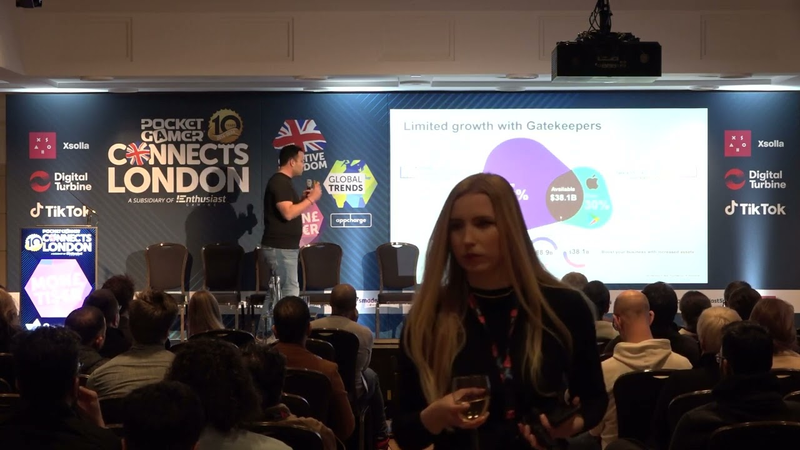
The European mobile gaming landscape is undergoing a significant transformation driven by the European Union’s Digital Markets Act (DMA).
- The European Union's Digital Markets Act (DMA), which became fully applicable on March 6, 2024, is mandating a shift in app store payment models by forcing gatekeeper platforms to allow alternative in-app payment methods.
- Mobile game revenue streams are currently dominated by in-app purchases (48.2%), followed by paid app downloads (37.8%) and ad-based revenue (14%).
- Google Play has already introduced 'User Choice Billing,' which allows developers to offer alternative payment options, a feature already utilized by companies like Spotify.

Monetising First Party Data for in app Advertising - Geeshan Willink, Nefta.io
The mobile gaming industry currently faces significant headwinds, including stringent privacy regulations, shifting market dynamics, and the erosion of ad revenue following Apple’s App Tracking Transparency (ATT) policy.
- Apple’s App Tracking Transparency (ATT) policy has caused a significant revenue decline of 18% to 50% within iOS opt-out cohorts.
- Developers are shifting toward first-party behavioral data—such as in-game progression and spending habits—to monetize traffic while maintaining privacy compliance by avoiding universal identifiers.
- Standardized data models now allow publishers to isolate and analyze user data in secure environments, enabling them to optimize ad bids and target high-value cohorts without building proprietary infrastructure.
Out of the Box Live Events Insights - Wilhelm Voutilainen, GameRefinery.
Live operations have evolved from simple content updates into the primary driver of player engagement and monetization in the free-to-play mobile gaming market.
- Live operations have shifted from simple content updates to the primary driver of engagement and monetization in free-to-play mobile games, making a robust event framework essential from launch.
- Top-performing titles like Royal Match and Monopoly Go demonstrate that success relies on integrating diverse event types, including task-based competitions, seasonal passes, and limited-time modes.
- Modern event design prioritizes mini-games that extend beyond the core loop—such as merge mechanics, exploration, and digging challenges—to create additional monetization opportunities through energy or currency consumption.

Panel: Direct to Consumer in 2024 - How to Create Powerful Web Store Experiences.
The transition toward direct-to-consumer web stores has become a strategic imperative for game developers seeking to mitigate the impact of high platform fees and regain control over their player relationships.
- Developers are shifting to direct-to-consumer web stores to bypass high platform fees and regain control over player data as organic discovery within major app stores declines.
- Successful web store strategies prioritize value-added bundles and loyalty programs over simple discounting to avoid destabilizing in-game economies.
- Core games are currently seeing significant revenue gains from direct web channels, whereas casual titles face higher friction in user acquisition.

In the Sandbox With Creative Success! AppsFlyer, ACE Games, Product Madness.
This discussion, held at Pocket Gamer Connects London 2024, explores the evolving role of creative assets in mobile game user acquisition.
- Creative assets have replaced granular user-level data as the primary lever for mobile user acquisition due to ongoing privacy restrictions on iOS and Android.
- Effective creative strategy requires a data-driven feedback loop that integrates attribution data with business intelligence tools like Looker or Tableau to move beyond vanity metrics.
- Marketers must shift from single-asset campaigns to creative sequences that build brand familiarity and hook users within the first three to five seconds.

State of Mobile Gaming 2024 - Karl Knights, Data.ai
The 2024 State of Mobile Gaming analysis provides a comprehensive overview of the global mobile app ecosystem, focusing on market performance, genre trends, and consumer behavior throughout 2023.
- Global mobile gaming consumer spend in 2023 increased by 4% year-over-year when excluding the China market, despite a 2% decline in total app downloads to 88 billion.
- Mobile ad spend remains a growth engine, reaching $362 billion in 2023 with a projected compound annual growth rate of 16.2% to exceed $400 billion in 2024.
- The 'Billion Dollar Club'—apps generating over $1 billion in annual consumer spend—added 13 new members in 2023, including Royal Match and Gardenscapes.

The Future of Web Stores: AI Personalisation & Gamified Sales - Miikka Luotio, Appcharge
The mobile gaming industry is experiencing a significant shift toward direct-to-consumer (D2C) web stores as publishers seek to mitigate rising user acquisition costs and navigate restrictive platform policies.
- Direct-to-consumer (D2C) web stores are generating 30% to 40% in incremental revenue growth for top-grossing mobile publishers.
- Publishers are adopting web stores as essential infrastructure to bypass platform policies and mitigate the impact of rising user acquisition costs.
- AI-driven conversational commerce is expected to shift web stores from static storefronts to concierge-like models that facilitate social mechanics and group discounts.

Mistplay’s Gabriel Lewis On Leveraging Loyalty To Keep Paying Players Coming Back
The mobile gaming industry is undergoing a significant shift in user acquisition and retention strategies, moving away from short-term tactics toward long-term loyalty and lifetime value (LTV) models.
- Mobile gaming strategy is shifting from short-term user acquisition tactics to long-term loyalty models focused on maximizing player lifetime value (LTV) and year-long retention.
- Rewarded play has evolved from a stigmatized, short-term incentive into a core, integrated component of game design that requires active player progression.
- Modern loyalty platforms utilize data-driven insights and predictive modeling to move beyond simple cashback, offering personalized perks tailored to individual gaming lifestyles.