Monetization reports and market data
Documents

New ways of monetization with Bright SDK
Game developers are increasingly adopting bandwidth-sharing as a viable alternative to traditional advertising models.
- Integrating bandwidth-sharing SDKs allows developers to generate consistent, non-intrusive revenue by utilizing idle user bandwidth for public web data collection.
- This monetization model can increase average revenue per daily active user (ARPDAU) by approximately 15%, with some partners reporting total revenue growth of up to ten times their previous baseline.
- Developers can generate approximately $21,600 in monthly revenue from an application with 50,000 daily active users, with earnings based on daily active devices regardless of app usage.
Levelling Up: State of India Interactive Media and Gaming Research FY24
The Indian interactive media and gaming sector has emerged as a significant economic force, reaching a market valuation of $12.5 billion in fiscal year 2024.
- The Indian gaming sector reached a $3.8 billion valuation in FY24 and is projected to grow at a 20% CAGR to reach $9.2 billion by FY29.
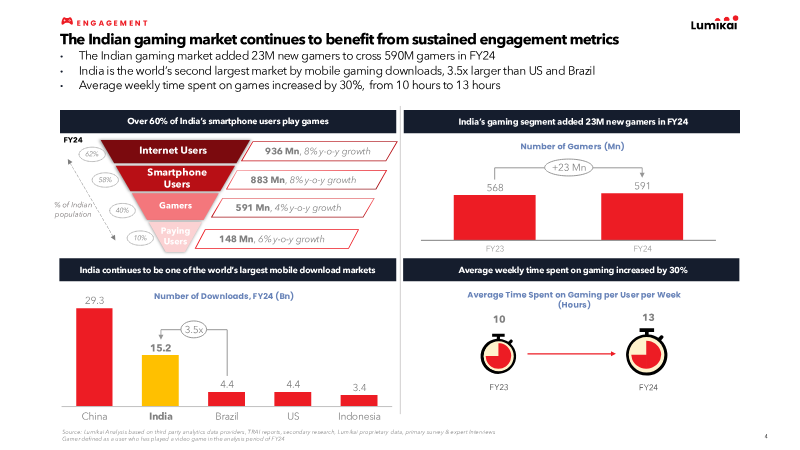
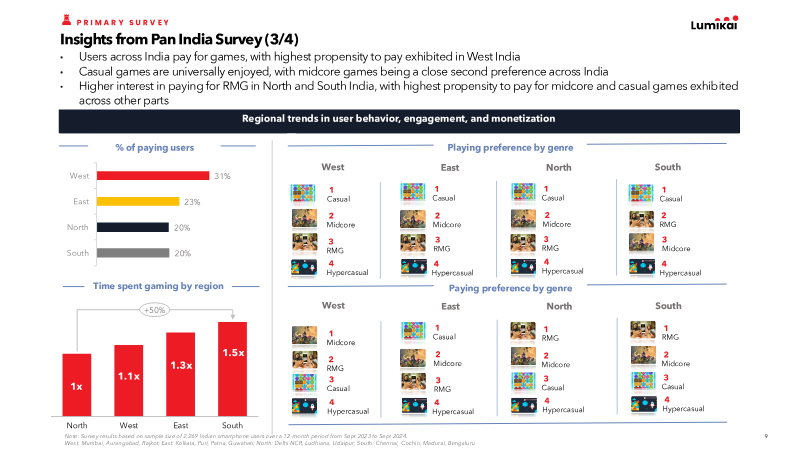
- India’s gaming ecosystem now includes 590 million users, with average weekly engagement increasing by 30% to 13 hours per user.
- Midcore gaming is a primary growth engine, recording a 53% year-on-year revenue increase, while average revenue per paying user rose 15% to $22.
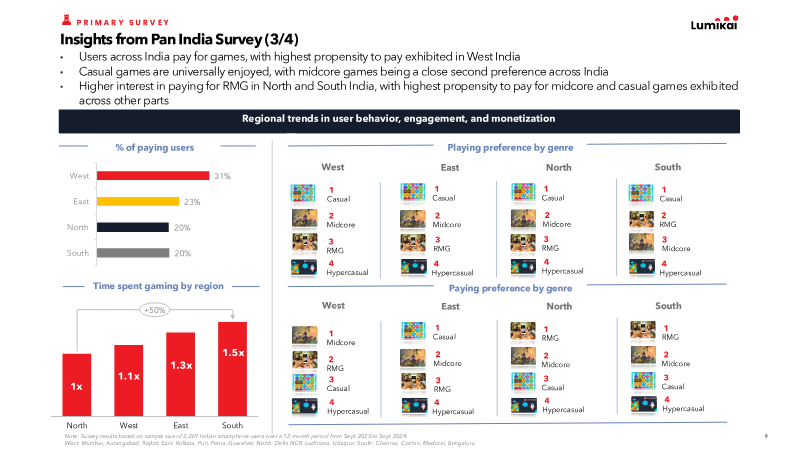
Levelling Up: State of India Interactive Media & Gaming Research FY'24
The Indian interactive media and gaming market reached a valuation of $3.8 billion in FY24, representing a significant 30% share of the country’s broader $12.5 billion new media sector.
- The Indian interactive media and gaming market reached a $3.8 billion valuation in FY24 and is projected to grow at a 20% CAGR to exceed $9.2 billion by FY29.
- In-app purchase revenue grew 41% year-on-year, with the midcore segment serving as a primary growth driver after experiencing a 53% increase.
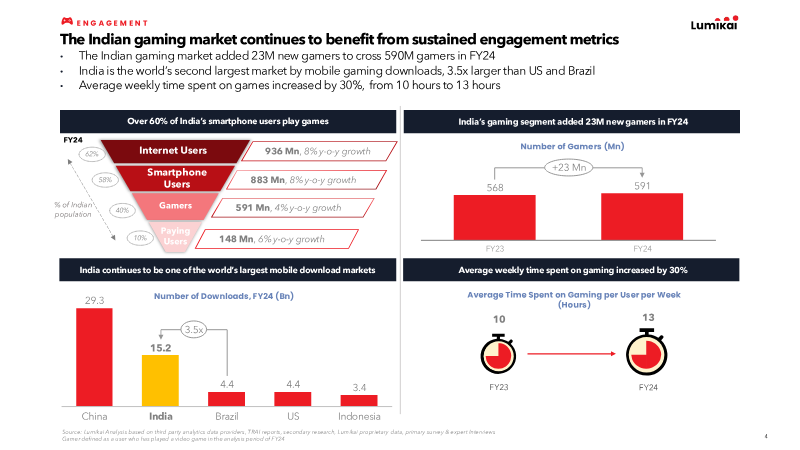
- India’s gaming population has reached 590 million, including 148 million paying users who now spend an average of 13 hours per week gaming, a 30% increase from previous metrics.

All in Hole: A Stolen Voodoo's lunch. A new (hybrid) casual game on the horizon
All in Hole, developed by Homa Games, represents a strategic evolution in mobile gaming by successfully merging the accessible, satisfying core mechanics of hyper-casual titles like Hole.io with the sophisticated, long-term engagement loops characteristic of casual puzzle games such as Royal Match.
- Homa Games' 'All in Hole' is a hybrid-casual title that has generated $3 million in in-app purchase (IAP) revenue since its soft launch on July 13, 2023.
- The game utilizes a 'hole' mechanic similar to 'Attack Hole' but features significantly higher production values, incorporating meta-game elements like star chests, level chests, and player-driven events such as Star Tournaments.
- Monetization is heavily weighted toward IAPs, with interstitial ads appearing only after level 35 and a notable absence of aggressive ad placements, likely to avoid cannibalizing IAP revenue.

What's the last thing developers think of? | Chris Meredith from Xsolla
The Middle East and North Africa (MENA) region is emerging as a pivotal growth market for the global games industry, characterized by a lack of historical market baggage and a high influx of both established publishers and emerging developers.
- Developers must shift from a user-acquisition-only model to sustainable, direct-to-consumer monetization strategies to ensure long-term business viability.
- The MENA region is a primary growth market for the global games industry, driven by a lack of historical market baggage and a high influx of new publishers and developers.
- Data privacy regulations are increasingly limiting traditional tracking methods, making the establishment of direct relationships with end users essential for player retention.

Social Sweeps, the $6B Gaming Category Hiding in Plain Sight
Social sweepstakes gaming has evolved from a niche concept into a significant $6 billion industry as of 2023, with projections indicating a doubling in value to $12 billion by 2025.
- The social sweepstakes gaming market reached a $6 billion valuation in 2023 and is projected to double to $12 billion by 2025.
- Operators bypass traditional real-money gambling regulations by bundling free-to-play currency with sweepstakes entries and providing alternative, non-purchase methods of entry.
- The industry is currently mobile-web-first, with 75% of total traffic originating from mobile browsers due to restrictive and uncertain app store policies.

Ad Revenue in Mobile Games: Key Insights and Trends
Mobile gaming monetization is undergoing a structural shift as ad revenue growth, currently expanding at an annual rate of 10% to 15%, outpaces traditional in-app purchase models.
- Mobile game ad revenue is growing at an annual rate of 10% to 15%, outpacing traditional in-app purchase models within a total market exceeding $100 billion.
- The industry is shifting from volume-based user acquisition toward strategies that prioritize long-term retention and high-value user engagement.
- Developers are increasingly adopting hybrid monetization models and AI-driven content to remain competitive as Western markets reach saturation.

Week in Mobile Games E34 - Subscription without upsell is death! And IDFA changes are good now?
The mobile gaming industry is currently undergoing a period of structural recalibration, marked by a shift away from unsustainable growth models toward long-term value creation.
- Netflix has closed its internal 'Team Blue' triple-A studio and terminated contracts with senior hires, signaling a shift in its high-end gaming strategy.
- Apple's IDFA (Identifier for Advertisers) privacy changes, while criticized for their implementation, are increasingly viewed by some industry developers as a catalyst for greater creativity and more sustainable player engagement models.
- Subscription-based gaming models risk failure without robust upsell mechanisms, as the lack of new content incentives can lead to player churn and diminished perceived value compared to games-as-a-service.

Hexasort: Unpacking the $500k/day revenue success. A new era of casual & puzzle games!
Hexasort represents a pivotal shift in the hybrid-casual mobile gaming landscape, establishing a new benchmark for combining addictive puzzle mechanics with sophisticated monetization.
- Hexasort by Lion Studios has achieved significant financial growth, doubling its daily in-app purchase (IAP) revenue from approximately $70,000 in September 2024 to $140,000 per day within a single month.
- The game maintains high user engagement, achieving an average of six sessions per day, which is considered exceptionally high for the puzzle genre.
- Hexasort utilizes an aggressive ad monetization strategy that allows for a maximum load of nine interstitial ads and 16 rewarded ads per 40-minute daily session.

Duke Vu - Digital Markets Act and Its Implications for the Mobile Gaming Industry
The Digital Markets Act represents a transformative shift in the mobile gaming landscape by dismantling the long-standing monopolistic control held by platform gatekeepers such as Apple and Google.
- The Digital Markets Act (DMA), effective as of March 2024 in the European Economic Area, mandates that gatekeepers like Apple and Google reduce control over marketplaces, allowing developers to implement alternative payment methods and bypass traditional 30% platform commissions.
- Major mobile gaming companies, including Playtika, Rovio, Supercell, and Huuuge Games, are increasingly adopting Direct-To-Consumer (D2C) web stores to capture higher margins, with Playtika reporting that over 25% of its revenue is now generated through these alternative distribution channels.
- While the DMA enables alternative payments, Apple has introduced a new fee structure for larger businesses in the EU consisting of a 17% commission plus a 3% fee and a 50-cent core technology fee per install over one million, which developers must weigh against the cost of maintaining their own infrastructure.

The Fingerprinting Problem Destroying Mobile Growth
The mobile performance marketing landscape has undergone a fundamental transformation, moving away from manual campaign optimization toward a model defined by advanced algorithms, high-volume creative production, and sophisticated data science.
- The mobile marketing industry is shifting away from probabilistic fingerprinting toward models built on consented first-party data to counter the decline of traditional deterministic measurement.
- Successful growth strategies now require internalizing data science capabilities rather than relying on external demand-side platforms, focusing instead on primary social platforms and rewarded video networks.
- Studios should adopt a two-stage growth model that validates retention and lifetime value metrics before investing in full-scale marketing organizations.

Exploring Alternatives: Mobile Gaming’s Megatrend for 2025
Alternative distribution channels and app stores are emerging as a critical growth frontier for the mobile gaming industry heading into 2025.
- Nearly 70% of mobile users report they would utilize new discoverability features if they were available, highlighting a significant market demand for alternatives to traditional app stores.
- Alternative distribution channels, including preloads and on-device opportunities, are positioned as a primary growth driver for mobile gaming in 2025.
- Industry leaders are increasingly diversifying user acquisition strategies by treating web-based platforms, manufacturer-integrated stores, and non-traditional partnerships as essential components of a balanced marketing mix.