Mobile reports and market data
Documents

Top Girl meets Last War! Last Z: Survival Shooter review
Last Z: Survival Shooter represents a significant evolution in the mobile 4X strategy genre, functioning as a hybrid model that merges the established mechanics of titles like Last War: Survival with highly suggestive, character-driven engagement loops.
- Last Z: Survival Shooter is a new 4X mobile title from the developers of Last War: Survival, currently scaling to approximately $300,000 in daily revenue with 50% of earnings originating from the U.S. market.
- The game utilizes a proven 4X template established by Last War: Survival and Dark War, focusing on optimized onboarding sequences and high-retention mechanics to lower User Acquisition (UA) costs.
- Developers are aggressively integrating 'waifu' and AI-generated character tropes, including an 'OnlyFans-style' chat and image system that monetizes user interaction through energy consumption and per-message fees.
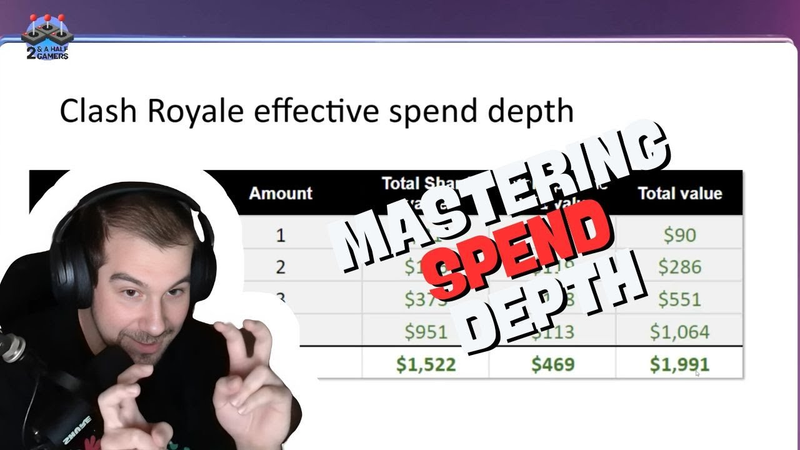
Mastering Effective Spend Depth in Gaming by Jakub Remiar
Effective spend depth is a critical metric for game designers and developers to understand, as it represents the specific resources required for a player to access and complete end-game content.
- Spend depth is the total monetary value required to acquire every upgradeable asset in a game, while effective spend depth represents the specific resources needed to access and complete end-game content.
- To calculate spend depth, anchor the game's economy to real-world currency by analyzing the cost of hard currency bundles and the total shard or resource requirements to max out all items.
- Effective spend depth is often lower than total spend depth because players typically focus on optimizing a specific loadout, such as the eight cards used in a Clash Royale deck, rather than maxing every available asset.

How This Small Game Studio 10x Their Revenue in an Industry Downturn
Fumb Games achieved a tenfold increase in revenue during a challenging 2024 industry downturn by focusing on a strategy of iterative testing, transparent monetization, and operational efficiency.
- Fumb Games achieved a 10x revenue increase in 2024 by focusing on iterative testing and operational efficiency rather than relying on a single breakthrough.
- The studio’s revenue model is anchored by a hybrid approach, with approximately 70% of total income generated through advertising.
- Fumb Games tested roughly 100 game concepts over a two-year period to identify high-performing mechanics and scale successful titles like Bitcoin Miner and Idol Miner.

Summarizing Sensor Tower's Latest State of Mobile Gaming Report
The 2025 State of Mobile Gaming report provides a comprehensive analysis of the global mobile gaming landscape, focusing on performance trends throughout 2024.
- While mobile gaming download volumes declined in 2024, primarily driven by a slump in the casual games sector, total consumer spending increased, signaling that monetization remains robust for successful titles.
- Rising cost-per-install (CPI) metrics, exacerbated by Apple’s 2021 App Tracking Transparency changes, have forced developers to shift focus from launching new titles to optimizing legacy games through improved live ops and in-game events.
- Strategic use of intellectual property (IP) and transmedia integration, such as the synergy between the 'Arcane' Netflix series and 'League of Legends' mobile titles or 'Fallout' media and 'Fallout Shelter,' significantly boosted revenue and downloads.

Beyond User Acquisition: How to Win with Influencer Marketing
Influencer marketing has transitioned from a brand-awareness tactic into a sophisticated performance channel essential for the mobile gaming industry.
- Deep influencer integrations, such as custom in-game characters or branded events, can drive up to a 400% increase in conversion rates and a 279% boost in ROI.
- Influencer marketing should be treated as a performance channel with a primary goal of achieving at least a 25% organic uplift over baseline installs.
- Performance analysis should be conducted at the vertical level rather than by individual creator, requiring a minimum threshold of 500,000 views and a 30% profitability rate before scaling.

Supercell's Mo.co: Exciting new global launch. Is this the next billion-dollar game?
Supercell’s latest action RPG, Mo.co, represents a strategic attempt to capture the mobile market through a streamlined, fast-paced experience that mirrors the core loops of titles like Diablo.
- Supercell has launched Mo.co as an invite-only title, prioritizing a long-term community-building approach over immediate mass-market scaling.
- The game features a grind-heavy, quest-based progression system reminiscent of early World of Warcraft, focusing on PVE mechanics rather than traditional gacha-based power progression.
- Monetization is currently limited to cosmetic items and an Elite pass, with a notable absence of aggressive pay-to-win mechanics or standard RPG power-progression monetization.

A Human-Centric Approach to Mobile gaming industry by Ömer Yakabagi
The mobile gaming industry is currently experiencing a crisis of identity, characterized by an aggressive, revenue-obsessed startup culture that prioritizes key performance indicators (KPIs) over the core values of creativity, joy, and human connection.
- The mobile gaming industry's current 'peak culture'—a startup-driven focus on rapid growth and aggressive revenue targets—is stifling creativity and creating unsustainable pressure on developers, artists, and marketers.
- To restore the industry's core value of providing joy and connection, companies must shift from a purely revenue-centric model to a human-centric approach that prioritizes employee well-being and mental health.
- Creative professionals, including designers and developers, are often forced to prioritize high-volume content production over innovation, which diminishes the quality of the player experience and the long-term health of the industry.

Tools and Tactics That Help Small Game Studios Nail Big Results
Small game studios can achieve significant results by integrating monetization mechanics directly into core gameplay and leveraging artificial intelligence to overcome resource constraints.
- Small studios should prioritize integrating monetization directly into core game mechanics rather than attempting to back-engineer revenue models after development.
- Testing should focus on early-stage metrics like CPI and retention before introducing monetization, allowing studios to pivot based on player engagement with specific items or features.
- Live ops, such as limited-time events with unique progression paths, provide a scalable way to introduce new content and revenue opportunities without overwhelming small teams.

"If You Aren't Curious, Your Bottom Line Will Show It": A CMO's Warning for Game Marketers in 2025
In the evolving landscape of 2025, game marketing success is increasingly defined by a commitment to deep curiosity and data-driven decision-making.
- Financial performance in 2025 is directly tied to a marketer's ability to rigorously analyze player behavior and treat marketing as a calculated, iterative risk rather than a static process.
- The industry has moved past post-IDFA uncertainty by adopting probabilistic attribution and sophisticated modeling, which have restored stability to user acquisition efforts.
- Small, agile studios are achieving significant profitability by targeting niche audiences and maintaining high-quality performance metrics, proving that scale is not the sole determinant of success.

Softlaunch Sonar #8 - Exploring the Latest Game Releases & Innovations
The mobile gaming industry is currently defined by a strategic shift toward aggressive iteration on proven mechanics and the widespread adoption of hybrid genre models.
- The mobile market is shifting toward hybrid genre models that blend successful core loops, such as combining arcade idle progression with base-building or integrating board-game mechanics into puzzle frameworks.
- Developers are aggressively iterating on proven 4X strategy mechanics popularized by high-performing titles like Last War and Whiteout Survival to mitigate risks in a saturated market.
- Rising user acquisition costs and market saturation have made IAP-driven monetization models essential for sustaining growth in new mobile releases.

The Studio Shaping the African Gaming Sector and What To Expect from the Region in 2025
The African gaming sector is undergoing a pivotal transformation, shifting from a passive consumer market toward a robust hub of original content creation.
- The African gaming sector is projected to exceed $1 billion in revenue this year, driven by a young, tech-savvy population and widespread mobile accessibility.
- Local studios are shifting from outsourced work-for-hire models to the development of original intellectual property that emphasizes local folklore and culturally resonant storytelling.
- Nigeria, Kenya, South Africa, and Egypt are currently the primary engines of growth for the regional gaming industry.

GOAT: GUY YOGEV aka Game Design Powerhouse
Guy Yogev, a game designer at SuperSonic and academic lecturer, emphasizes the integration of psychology and behavioral economics into game design to create successful, player-centric experiences.
- Modern mobile game design requires a multidisciplinary approach, blending psychology for user experience with product-oriented thinking to balance creative vision with business KPIs.
- Game design is not purely artistic; it involves rigorous research, wireframing, and behavior mapping, with approximately 70% of the role dedicated to thorough market research and trend analysis.
- In the current hybrid-casual market, success relies on creating games that are easy to pick up while implementing multiple monetization units, such as season passes and subscription models.