VideoTwo & a Half Gamers
Mastering Effective Spend Depth in Gaming by Jakub Remiar
26 Mar 202522 min video
Transcript
Everybody upgrading everything is nice, but it literally won't happen for like 90% of the players. Payers, not players, payers. Okay. Um, as I said, this is very genre specific. Some games like uh again, Survivor IO, they have pretty straightforward upgrade inventories based on based on HP damage scaling. So that's that's of course normal uh and pretty straightforward. Then we have stuff like candy crash or puzzlers where we don't have inventories or HP damage scaling or like gold money upgrading. We have levels [Music] crew talking and design. The feeling shak bringing the insight. We're rocking those vibes till the early daylight. Master eyes on the prize.
Tracking data through the cyerspace. Feeling stacks like a wizard in disguise. Jack lift us to the high and smack slows are beautiful. Like the way click it fast, don't delay. [Music] Ah, hello. Hello. Uh, this is two and a half gamers podcast. Uh again, this is one of those solo episodes where we focus on one topic and go through it through kind of a more detail in this kind of a learning fashion. So yeah, this time it's my turn. And today I'm going to talk about economies, game economies and spendept like a favorite topic of mine and I guess a lot of people in the industry. It's kind of a little bit of a I would say a mirage
that everybody keeps talking about but nobody actually you know shows how to do. So yeah today I want to go through some kind of practical example and pretty much dive deep into like how these things work get some terms out there and like how to kind of approach some things and yeah let's hope we learn something together. Okay so let's roll the presentation. So as said the focus will be the economies and their spend depth. So what is spend depth? Uh by sense sometimes you can hear these kind of giant numbers associated with certain games and yeah like this game you can spend that much there and so on so forth. So this is what spend basically means is that it's a money value representing the total amount of money user can spend in the game until there's nothing else to buy. That's how you would define spend depth. This can be a little bit of uh clunky because you know
games especially free-to-play games are content driven. So their game is service. So they add more and more content. Therefore this number keeps increasing. But for now let's kind of stick with this one. The more more important term is effective spend because effective spendant means a specific set of resources needed to get to the end game access all the endame content and those are two different terms and yeah before we start you know adding anything into the game let's first try to understand which of these means what on some kind of a practical example. So yeah, what is effective spend up? You can think of effective spend up as your pretty much fully upgraded deck on last league in Clash Royale or fully upgraded deck of characters in Empires and Puzzles or fully upgraded inventory in Survivor io which is pretty much like the set of things that kind of were able to carry you to the end game. That's like because
you didn't really need to upgrade everything like all the characters, all the heroes, all the equipment. It's just that like kind of one set. So how do we actually calculate this thing and get to the actual numbers the dollars of this? Um so let's continue uh and stick with Clash Royale for now. So what you do is you go to the anchor prices of the shop. Every game economy has this kind of a hard currency if they have a hard currency or could be just soft currency kind of the basic anchoring meaning the base prices for those like small and high price points where you have the amount of hard currency that you can buy for real world money. This is the connector. That's why it's called anchoring because it's anchoring the economy to the real world value. What you do is you know you check and you see how much it actually cost based on these gems in these values. Usually there's a discount. So always like the smallest bag has the worst price kind of hard
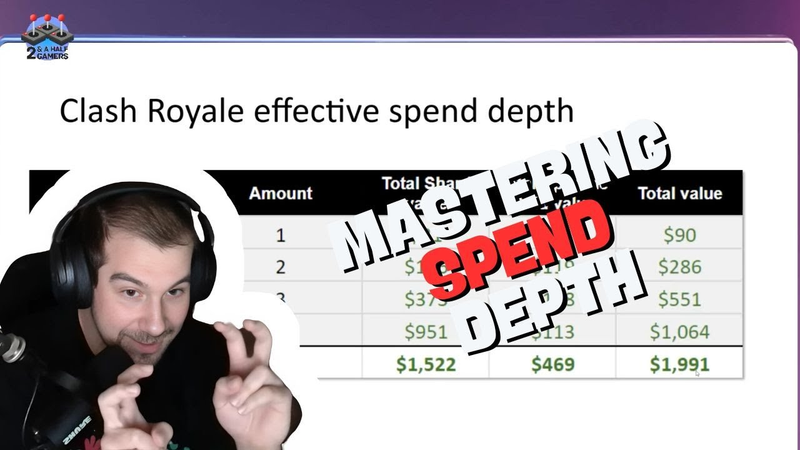
currency per dollar and then it goes up all the way usually to something like 50% discount on the highest one like those $100 packs. So you see it's like pretty much half of it. And we get some numbers finally. So what we do then is that we go into the content of the game and calculate how much stuff actually cost and how much because now that we know the how much one hard currency gem in the economy cost, we can then recalculated to soft currency for instance that we need for upgrade cost or like how many chests we need to buy or open in order to get all the cars for a specific character to upgrade. So suddenly we take all of these things and count them up yada yada yada and we end up with something like this. Uh beware this is an old spend that clash currently I think is way beyond 120 characters. So this is just old but for the example purposes is enough doesn't matter. So we have here for instance let's imagine this this was done at like
at the point where clash royale is like this. Uh so we have all the common cards, all the rare cards, all the epic card on the legendaries, all to get the 104 cards. And we see that the total shard value, I mean the actual shards that we would need to kind of get in order to get all these cards to fully max level would be something like 14,000. And then we would need to have also the gold to upgrade those cards, which would be something like 6,000. So therefore, if we all count this up, we see that the whole economy can absorb something like 20,000. And by that time, if we calculate it hopefully right, we have everything upgraded. But this is really everything, and I mean every single card in the game. Do we really need that? We probably don't. So if we again look at the effective spend depth uh because the deck has eight cards. So we again I just created a random number deck here where
uh there's like two legendaries, three epics, two rares, one common. Again this is just my kind of randomness here. Uh and by those numbers you see that it's a completely different number. It's like one10enth of the original where it's like 2k to upgrade all these. You also need to keep in mind that in order to kind of get to the end game, you even won't have the cards at the beginning that we now have upgraded in the deck. So you need to upgrade also some cards along the way. So this number for this specific game is probably higher. But again, nuances, we won't go into detail. Principles are what really what we care about. So what I'm just trying to demonstrate here that you see that you still need to count with a much lower number in order to can account how how strong the economy really is because again everybody upgrading everything is nice but it literally won't happen for like 90% of the players payers not players payers okay um as I said this is
very genre specific some games like Uh again, Survivor IO, they have pretty straightforward upgrade inventories based on based on HP damage scaling. So that's that's of course normal uh and pretty straightforward. Then we have stuff like Candy Crush or Puzzlers where we don't have inventories or HP damage scaling or like gold money upgrading. We have levels and these levels usually drive booster consumption because you know we fail we want to skip the fail state get those plus five moves so on so forth. So this is a different spend. This would be something like averaging out like how much boosters you use per x amount of levels in order to get somewhere yada yada yada. Much harder to calculate, but it still has of course spend them. And it's never ending because they keep adding like uh 40 levels every two weeks now at 15,000 or what. Uh then we have coin masters or pretty much social casinos.
uh similar setup where there's like never ending content where we're still upgrading that resetting city through soft currency and getting the energy and stuff like that. Again, it's probably possible to calculate is much more harder. But again, still it's possible. It's just depends on how I would recommend to calculate this. You assume average player engagement and based on that average player engagement meaning like this amount of sessions per day, this amount of like levels played per day, rolls per day, you assume, you assume and you balance around that. Of course, once you have the actual game data, you double check that and adjust. But in the first draft for like when you start the economy, you assume there's just no other way like sorry. Um, so let's continue with an RPG because it's again, as I said, very straightforward. So we can kind of dive deep into it. Uh one thing that I also want to mention uh is Forex because Forex have infinite
depth economies meaning that Forex economies work on destruction of property which never happens in all the other games which is super powerful mechanic. Meaning that the soldiers that you like takes you so much time to hard and buy and like farm resources for, they can be actually killed permanently in those battles because again my army gets killed and I don't know 30% of the killed gets moved to the hospital, the other 70% gets killed permanently because the hospital capacity cannot accommodate for that. So they're dead and I literally lost the progress even if I bought it with money. That's why these economies keep getting so money hungry because there's literally destruction of property. Similarly, also to something like Eve Online where you you read about these giant battles on the internet where all the starships and everything kind of go clash against each other and there's like millions evaporated during the process because it takes so much time to farm for them and then they're destroyed forever permanently. So this is this is somehow
similar. I don't think so that this this mechanic has been um like uh explored properly in other genres. Forex is I think the only one that's kind of going for it because it's so cutthroat and again very specific but again we won't talk about it anymore. Just saying that this is the mother of all like economies. Um moving on. So let's get to the basic example of something like Survivor IO. So, so the how how we actually create the spend dep now, now that we know what effective spend is, what spend is like, how do we increase it? So, Survivor IO launched um August 2022 if I remember with six slots in their inventory and that was it. Weapons were giving you attack damage. Uh the armor, belt, and boots were giving you HP and that was it. Nothing else. Six slots just there. Uh immediately I guess the team very very swiftly recognized that like this is just not enough because people were kind of buying it off the shelves like there's no tomorrow and getting it to the end of progression
which is the death of any game where you get to the end and there's nothing else to do. So they immediately add another inventory which is called tech parts which basically doubled the inventory size because suddenly we don't have just six slots we have 12 slots where there's three more additional slots for attack and three more additional slots for HP with some abilities flavor and stuff like that. But what's really important that they just added another progression layer here whereas these things have their own gacha these things have their own kind of separate inventory. So pretty much think of it as like doubling the inventory that you have like Ctrl Ctrl + V you add a little bit more flavor into it and suddenly you have double the spender because again you need to buy the first one already which is there and then the second one. Uh what happens afterwards like how do we go from here? We create another layer again in this case it was pets which was added later where again because we're scaling the economy with HP and damage
the pets gives us HP and damage. So we get pets to choose upgrade and move around so on so forth merge together on a similar gacha based like merge gacha based manner. Again, very simplistic. So, I guess you see where this is really going. Uh later on, they added outfits. These are a little bit different as uh yeah, those are like one time thing I guess. And uh you can really upgrade index straightforward. But the important part again which is rescaling HP and damage because when you adding these progression layers on top of each other the other important rule is that they kind of need to be equal with each other. So let's say imagine that your overall player power is like 100%. And I don't know, 20% is coming from base inventory, 20% from tech parts, 20% from pets, 20% for some something like this. Because if
you just prioritize one over the other, players will just go after the best one and ignore the one that's not giving them enough kind of performance for their resources. So this is also like buy beware like you need to also do this properly otherwise you will kind of make it irrelevant. So make sure that these things actually impact the player progression in terms of those statistics properly. Um yeah, so what happens afterwards? Uh we end up with base inventory. Again, I'm making this up, but just to give an example, 10k spend depth for the base inventory. Then we get tech parts which is not a 10k spend depth. So we effectively double that. Then we have pets, which isn't that robust, but it's still kind of robust. So 8k spend depth. And then we have outfits, which is 6k spend. So suddenly we add something like you know uh 34k which started as a 10k kind of easy game. Uh the other important thing to notice here that because this gets
pretty bloated as you see here compared to our previous character that was starting with like very low stat suddenly it goes into hundreds of thousands. You need to be aware that at some point these things stop working. You can't just increase the numbers all the time. That just needs to be also interesting functionality to base this upon to have new vectors of progression not only in terms of stats but also in terms of skill, in terms of strategic depth, so on so forth. Uh again it's a content treadmill. So in order to add all these progression layers, you also need to support them with new content. So it's not only that we add tech parts into the inside character is like super strong on the content that already is in the game. We need to add also a lot of content that is just much harder because the only way to go against it is again to properly fit your second inventory of tech cards because the content is just
so much harder and content that is based on HP damage scaling just so easy to balance because you just increase these numbers of HP and damage and there you go. Again, imagine something like uh World of Warcraft like every expansion they just increase the level cap very like uh significantly. So they create an entry point for new players, but it's still same HP and damage. And there were already I think once World of Warcraft had to kind of reroll the numbers back because there were just too many zeros, which happens on games that are live 20 years and so on so forth. So yeah, this is just very important to understand because even though it sounds easy once you know it, like it's not that easy. Uh yeah, as I said, content bloat is real. So beware because at some point this hits diminishing returns and you can just add another statbased layer and like okay this will work forever. It won't work forever. It will work to some degree and then it won't. Um another advanced example here uh that we can go
into is uh Honestiel from Mihoyo where it's not only like inventories, it's also another like gacha base vectors through the event banners because again the content width let's say. So we have exclusive gachas there with characters that are rotated every 3 weeks and again you can get them only through that time then they get maybe somewhere like half a year later or something like that and you need to have those characters because those characters are part of the elemental system and in order to tackle all of the challenges of the game u we need to have different teams and different elements of those characters. So again, another vector that we added into it instead of just a single inventory for a single character like in Survivor IO. And these characters have again many progression vectors because we have the base character with his level. We have his light cone which is pretty much based on the same premise as the character itself. Again, another gacha, another specific token that you
need to find for fully upgraded so on so forth. Then we have his skill tree. Then we have his inventory which is another game of itself because these pieces can roll stats that are you know like a Diablo inventory where it's like it can roll anything from defense to HP, damage, critical strike, whatever. And you're going after the best combinations which has very very low percentage chance to actually roll because you don't want to end up with like a crit piece gear on a defensive character whatever. So it gives you a lot of longevity in order to kind of fully equip your character. Then you have Adelons which is the duplicates of your character from your gacha where even though you got the character it can be just so much stronger where you get this duplicates because it literally unlocks these skills which are very very powerful. Um yeah and as I said each character represents a team role. So we are not again only going for like team dynamic because for instance here the team is four slots. So like four deck slots, but we need different teams for
different challenges. And the game even required us in some parts to kind of bring more teams that are fully equipped. So it could not it's not only four, it could be like 12 basically fully upgraded characters. Suddenly we are talking years years of kind of playing this game in order to get to this point. Uh of course if we not smash them our wallet on on the game. So yeah, this is again very important to understand because these characters as they're added into the game, they're usually, as I said, like tackling the content of the game. But again, this is a little bit more advanced part where in Hong Kong style like all these squadbased RPGs, you're also going around synergies between these characters which create like multiplying effects. Therefore, it's much more kind of harder and like deeper to kind of go there and to add more content uh sorry more more stand into the economy because again with each each specific character we can adding a lot there. Okay. Uh hopefully
you learned something today. Um yeah, feel free to let us know in the comments and in or join our Slack where there's always kind of we have dedicated channels to that like there's a game design one for instance or the general one when you can ask questions but TLDDR just for you know and kind of what I want you to kind of take from this one make sure you understand the difference between the spend depth and the effective spend depth what these two numbers mean for your game and how you can increase them. Make sure that you know how to actually calculate them, how you calculate them against competitor games because that's also a very good metric and like oh Remo how much tand them should my game has and like answer is like how much your competition or your competitors have in their economy spend them like you can go and calculate do it as a homework basically. It's not that hard but again takes time and practice and it's a great exercise to kind of go. Um so yeah make sure that you understand this and then once you
know this make sure that you also understand the point here where how these progression layers are added because it's not just about adding fancy new toys for your character to play with but you also need to add the content to support it. So those characters and new toys can be used in content that is actually driving the usage of them that is requiring them because if it's not that then again the game fails. Anyway u as I said thank you very much and see you on the one of the other solo episode. [Music] Ciao. Heat. [Music]
Auto-generated captions from YouTube — names and numbers may be misheard.
Key insights
Distilling the key insights…
Ask AI about this video
Cite this video
Citation
Generating citation…






















Comments