Mobile reports and market data
Documents
📊 Chart Compass: State of Mobile Revenue 2025 - What’s Actually Moving the Needle by Jakub Remiar
The mobile gaming industry in 2025 is characterized by a shift toward portfolio-based strategies, where top-tier publishers prioritize scaling multiple high-performing titles simultaneously rather than relying on a single flagship product.
- Publishers are shifting from single-flagship models to portfolio-based strategies, exemplified by Rivergame and Dream Games, to scale multiple high-performing titles simultaneously.
- The industry is increasingly bypassing app store ecosystems through web shops to capture a larger share of revenue and avoid platform fees.
- Market dominance remains split between stable legacy giants like Monopoly Go, Candy Crush, and Roblox, and high-growth emerging categories such as merge games led by Gossip Harbor.
Casual LiveOps Report: H1 2025
The casual mobile gaming market experienced modest growth during the first half of 2025, characterized by a 3.6% increase in global revenue and a 6% rise in downloads.
- The casual mobile gaming market grew by 3.6% in revenue and 6% in downloads during H1 2025, with legacy titles dominating as only 11% of top-grossing games were released within the last two years.
- Hypercasual games experienced a 111% revenue surge in H1 2025, driven by a strategic pivot toward deeper monetization mechanics.
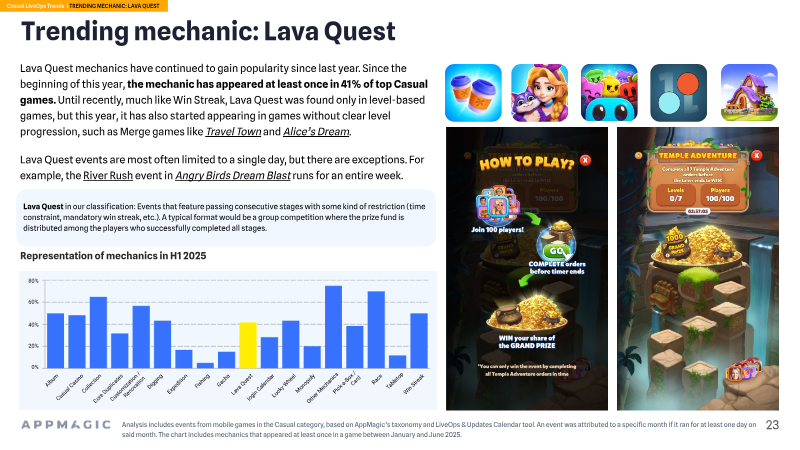
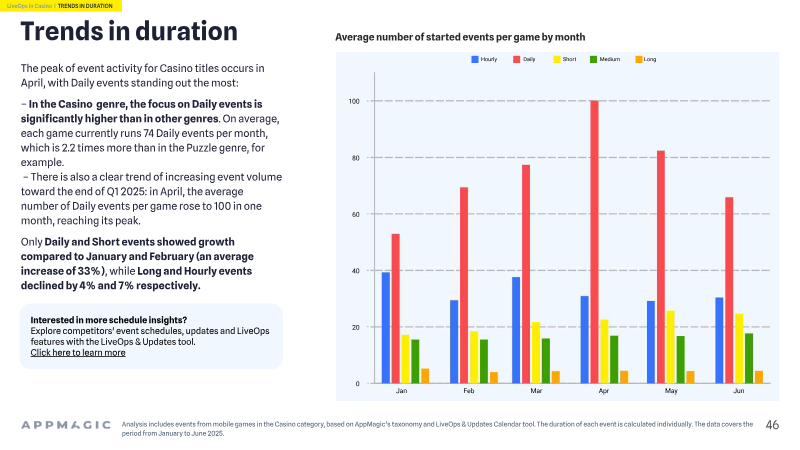
- LiveOps has become an industry standard, with 82% of top-grossing titles running at least one event to drive retention through recurring mechanics like win streaks and resource-depletion challenges.

Google Ads for Mobile Games: Best Practices for Apps with Hybrid Monetization
Hybrid mobile game studios must align their bidding strategies with the specific lifecycle stage of their applications to achieve sustainable growth.
- Hybrid monetization success requires integrating ad revenue data with in-app purchase signals to enable accurate value-based bidding for Google’s algorithms.
- Studios must transition bidding strategies from volume-focused install campaigns during launch to action-based or ROAS-focused bidding as the application matures.
- Campaigns require a daily budget of $50 to $100 to successfully exit the algorithm's learning phase and avoid premature scaling issues.

Why Data Is The New Superpower In Gaming!
The mobile gaming industry has entered a complex era where traditional tracking identifiers are no longer sufficient for growth.
- Prioritize ATT (App Tracking Transparency) consent as the primary growth strategy, as effective pre-prompt messaging can increase opt-in rates from 10–15% to as high as 40–50%.
- Adopt a holistic measurement stack by combining SKAN 4.0, web-to-app flows, and Marketing Mix Modeling (MMM) rather than relying on any single attribution method.
- Implement Conversions API (CAPI) to send server-side signals like hashed emails and phone numbers to ad platforms, which improves matching rates and targeting efficiency, particularly for PC and console games moving to mobile.

Is User Acquisition Really Broken in 2025?
User acquisition in 2025 remains a robust and essential growth engine for the mobile gaming industry, despite widespread perceptions that the sector is in decline.
- AppLovin currently dominates the user acquisition ecosystem by leveraging its MAX mediation platform integrated with the Axon 2 machine learning engine to create a superior data flywheel.
- Modern user acquisition has shifted from aggressive growth hacking to a model defined by incremental profitability, product quality, and sophisticated value optimization.
- Unity is attempting to challenge AppLovin’s market position with its Vector engine, which seeks to utilize in-app purchase data, though it currently faces significant technical and operational scaling hurdles.

Week in mobile games E62 - Apple's regulatory wins and 2025's top genres
The mobile gaming landscape is undergoing a significant structural shift as regulatory environments stabilize and genre dominance evolves.
- Strategy games have become the most lucrative mobile genre, generating $10.6 billion in the first half of 2025 and surpassing RPGs, which saw an 11% year-over-year revenue decline.
- The European Commission is expected to approve Apple’s revised App Store fee structure, effectively ending a major regulatory dispute, while UK interventions are not anticipated until 2026.
- The puzzle game market is highly concentrated, with Royal Match, Candy Crush, and Gardenscapes accounting for nearly one-third of total global revenue in that segment.

Granny: The untapped goldmine of horror games on mobile! How Granny Broke YouTube & TikTok?
The mobile horror genre, anchored by the runaway success of the Granny franchise, demonstrates that high-fidelity graphics and traditional user acquisition strategies are unnecessary for achieving massive scale.
- The Granny franchise has achieved nearly half a billion total downloads across its titles, with the original game still generating 14 million downloads per month seven years after its release.
- The game sustains a daily ad revenue of approximately $50,000 despite lacking a formal user acquisition (UA) strategy, relying entirely on organic virality from YouTube Let's Plays and TikTok.
- The developer potentially left $50 million in revenue on the table by failing to implement proper ad mediation, relying instead on limited demand sources that significantly underperform compared to optimized setups.

Steam Censorship, Live Action Zelda, and King’s Candy Crush AI | Games For Breakfast
The contemporary gaming industry faces a complex intersection of corporate consolidation, technological disruption, and external regulatory pressure.
- Payment processors like Visa and Mastercard are exerting de facto censorship on digital storefronts such as Steam and itch.io by threatening to revoke transaction capabilities for content flagged by advocacy groups.
- King has implemented layoffs following the automation of level design and monetization tasks, signaling a shift in how AI integration is impacting industry labor structures.
- Krafton is currently involved in litigation with the founders of Unknown Worlds regarding earnout payments for Subnautica 2, highlighting the critical importance of legal rigor in M&A deals.

TWIG #341 Ubisoft Tries “Succession” while Battlefield Attempts a Comeback
The global gaming industry is currently navigating a period of intense volatility characterized by structural financial challenges and shifting consumer behaviors.
- Ubisoft faces significant financial instability, including declining quarterly earnings and a sparse release pipeline through 2027, making it a potential acquisition target for Tencent.
- Standard cosmetic-based monetization models are failing to support games with low daily active user counts, forcing many studios into a cycle of unlaunching and re-releasing titles.
- Electronic Arts is attempting to revitalize the Battlefield franchise to exploit Call of Duty fatigue, though success depends on overcoming persistent issues with live service execution and matchmaking stability.
The year of the webstore has started - David Stelzer from Xsolla
The games industry is currently undergoing a significant shift toward direct-to-consumer monetization, characterized by the rise of web stores and off-store transaction models.
- The shift toward off-store web shops is accelerating, with some publishers successfully migrating 40% to 60% of their revenue away from traditional platform store transactions.
- Xsolla’s 'buy button' technology enables a headless checkout experience within games, allowing players to complete purchases via a small, embedded web browser that supports payment methods like Apple Pay while bypassing traditional store fees.
- Regulatory environments remain fragmented; while US rulings currently allow for anti-steering and direct-to-consumer purchasing, other regions like Canada and the EU operate under different legal frameworks that require developers to maintain geo-specific game builds.
The Real Story Behind Tasty Travels’ Meteoric Rise: Merge, Monetize, Repeat!
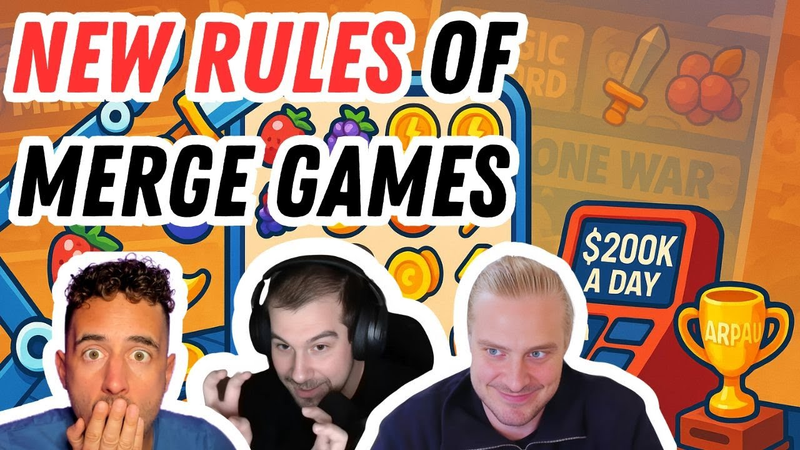
The merge game category is currently defined by intense competition and rapid evolution, with established titles like Travel Town and Seaside Escape facing pressure from aggressive newcomers such as Tasty Travels and Merge Cooking.
- Century Games' new title, Tasty Travels, is rapidly scaling toward $200,000 in daily revenue and currently boasts double the ARPDAU of competitor Travel Town.
- The merge game category is experiencing significant growth, with Gossip Harbor generating approximately $1.6 million per day and Travel Town and Seaside Escape each earning roughly $600,000 daily.
- Century Games utilizes an aggressive UA strategy characterized by high-velocity creative iteration, including AI-generated content, fake gameplay hooks, and concepts directly adapted from competitors like Gossip Harbor.

Pushing value into a digital ad ecosystem - Ben Jeger from Moloco
Moloco, a demand-side platform (DSP) specializing in user acquisition and ad monetization, has established itself as a significant player in the global gaming ecosystem.
- Moloco’s monetization SDK, launched in early 2024, became one of the fastest-growing in industry history, leading the company to temporarily pause onboarding new publishers to focus on product development.
- Moloco differentiates its monetization offering by leveraging its existing position as a major buyer on ad exchanges, allowing it to drive value to advertisers without acting as a traditional middleman.
- The gaming industry has experienced a recent revenue flattening, with stagnation more prominent on Android while iOS continues to show growth, particularly among high-value payers in the US.