Mobile reports and market data
Documents

🚁 How War Drone 3D Hits $65K/day mainly with Organics, not UA. Warfare drone game from Miniclip!
War Drone 3D has emerged as a significant success within the mobile gaming market, scaling to approximately 500,000 daily active users and generating daily revenues reaching $65,000.
- War Drone 3D generates over $65,000 in daily revenue, driven primarily by heavy rewarded ad monetization and a gacha-based progression system.
- The game achieved peak scaling of over 300,000 installs per day in July 2024, maintaining a strong baseline of 150,000 daily downloads shortly thereafter.
- Over 50% of the game's total downloads are organic, fueled by an immersive 'news media' aesthetic that mimics realistic drone footage.
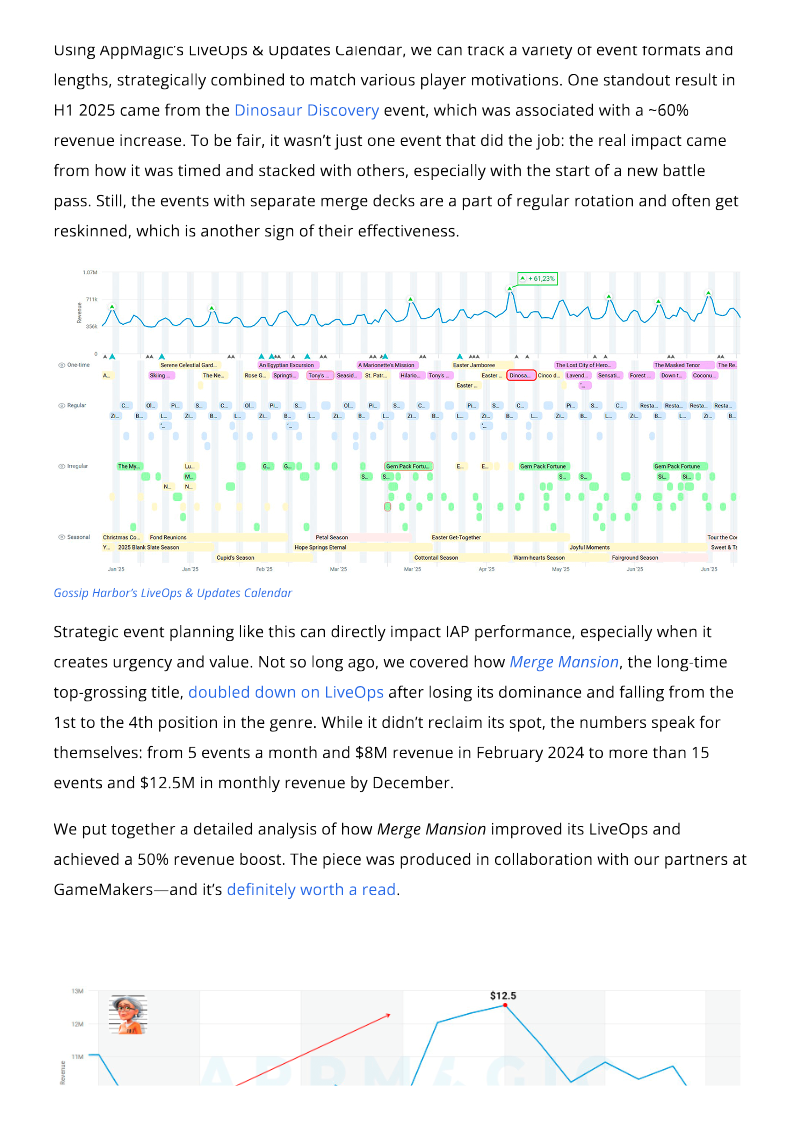
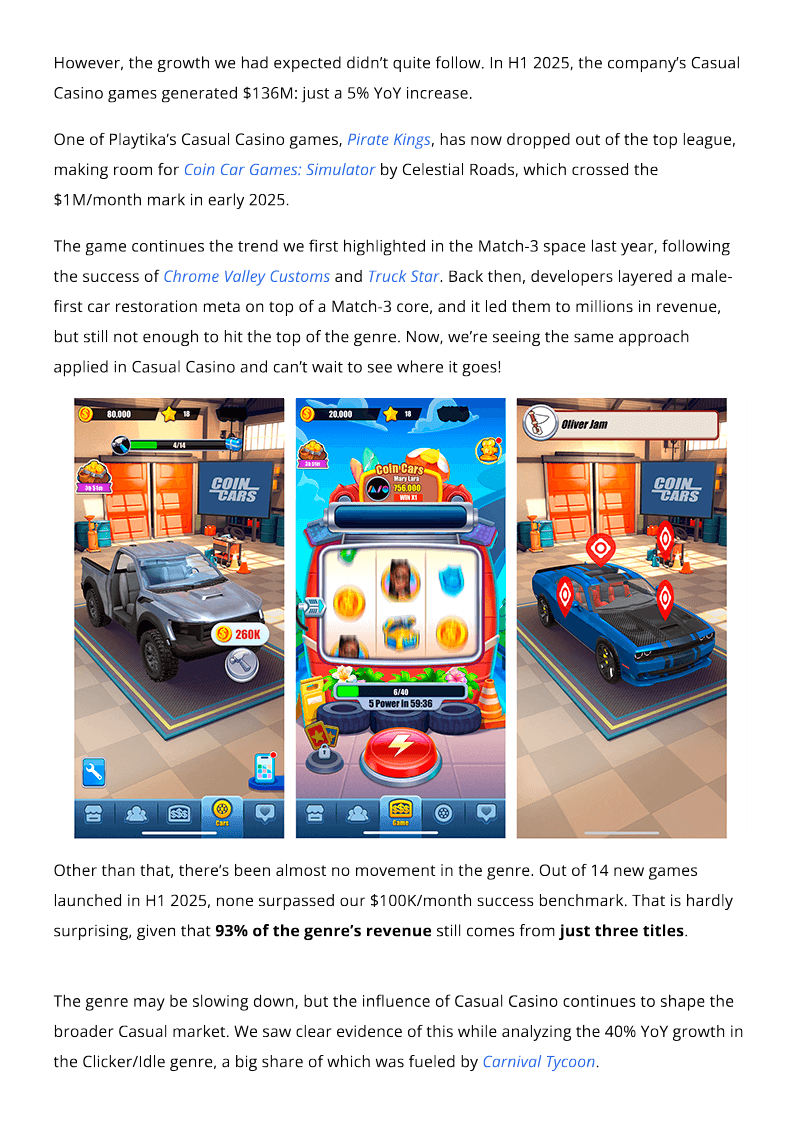
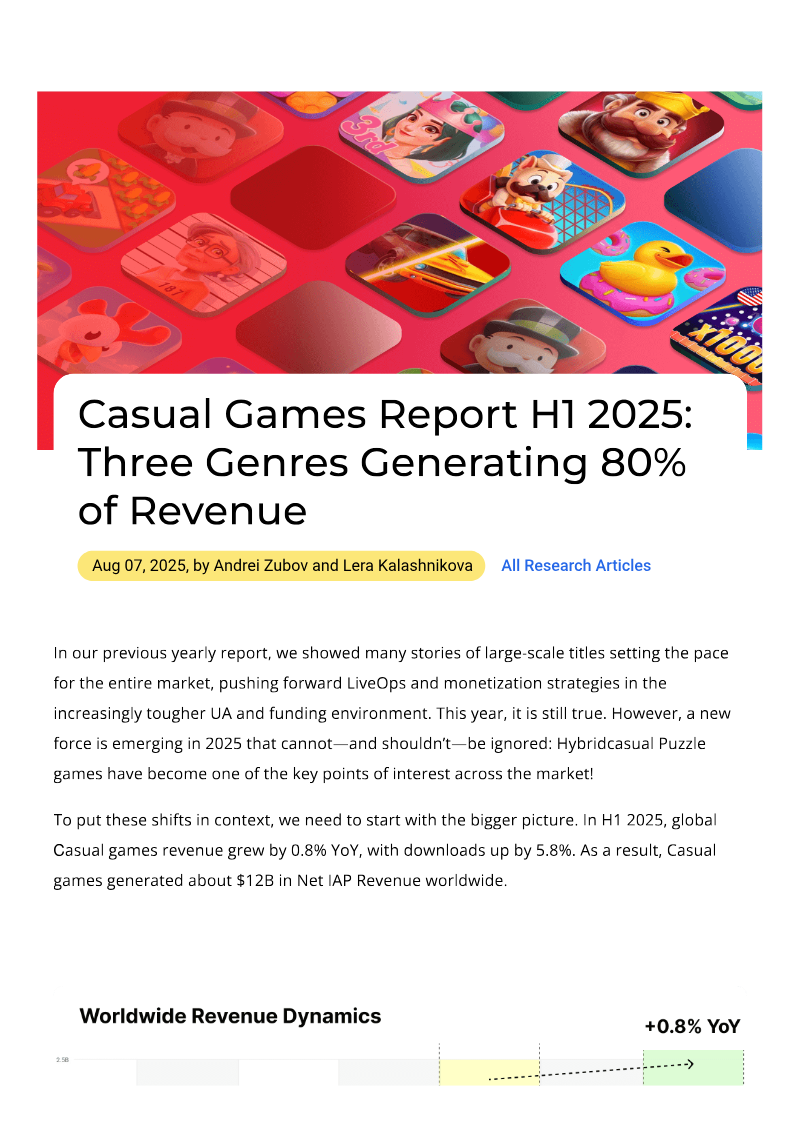
Casual Games Report H1 2025: Three Genres Generating 80% of Revenue
The casual games market generated $12 billion in net in-app purchase revenue during the first half of 2025, with 80% of this total concentrated within the Puzzle, Casino, and Simulation genres.
- The casual games market generated $12 billion in net in-app purchase revenue in H1 2025, with 80% of total earnings concentrated in the Puzzle, Casino, and Simulation genres.
- Puzzle games remain the primary growth engine with a 13% year-over-year revenue increase, driven largely by a 94% surge in the Merge-2 with Complex Meta subgenre.
- The Casual Casino sector saw a 33% revenue contraction in H1 2025, primarily due to the scaling back of major titles like Monopoly GO!.

EA Mobile is Suddenly Worth Watching Again
Electronic Arts is currently experiencing a resurgence in its mobile gaming portfolio, driven primarily by the sustained performance of EA Sports FC Mobile.
- EA Sports FC Mobile is currently generating approximately $20 million in monthly revenue, marking a record high for the company's mobile division.
- EA has shifted its mobile development strategy by outsourcing product management to specialized teams in China, a move that has proven more effective at monetization than previous North American-led efforts.
- The company is testing the expansion of its sports IP through spin-offs like EA Sports FC Tactical, which integrates squad RPG mechanics into the Ultimate Team framework.
The Walled Garden Stack: Why no new Mediation platform has Survived Since 2017 by Felix Braberg
The mobile ad monetization landscape in 2025 is defined by a rigid, consolidated mediation market and a strategic shift among top publishers toward in-app purchase (IAP) revenue.
- The mobile mediation market is a closed ecosystem dominated by AppLovin MAX, Unity LevelPlay, and Google AdMob, with no successful new entrants since 2017 due to high barriers to accessing essential bidding demand.
- Top studios like Habby and Rollic are shifting toward IAP-first monetization, with ad revenue now accounting for as little as 11% to 20% of total earnings in recent titles.
- Effective cost-per-mille (eCPM) rates have declined by approximately 20% from pandemic-era peaks due to privacy-related targeting limitations, market corrections, and the transition to automated bidding.

Slow-Motion Slump in Scopely’s Portfolio
The mobile gaming portfolio of Scopely is currently experiencing a significant, broad-based decline across key performance indicators.
- Scopely’s portfolio is experiencing a broad decline, marked by a 28% drop in topline revenue, a 24% decrease in monthly active users, and a 34% reduction in downloads between 2024 and 2025.
- Monopoly Go, which accounts for 60% to 65% of total portfolio earnings, has suffered a 36% year-over-year revenue decline.
- Revenue concentration has intensified, with Monopoly Go and the recently acquired Pokémon Go now generating over 90% of the company's total revenue.

Top Ad Monetization Channels for Mobile Games in 2025
The mobile game ad monetization landscape in the first half of 2025 reflects a market defined by platform-specific strategies and the dominance of integrated ad networks.
- AppLovin currently dominates the mobile gaming ad sector with a 43% revenue share, driven by its integrated user acquisition and monetization capabilities.
- Android remains the primary platform for ad-based monetization due to its global scale, while iOS continues to prioritize hybrid models and in-app purchases following privacy-related tracking shifts.
- Google AdMob, Unity, Liftoff, and Integral join AppLovin as the top five ad networks, with Google AdMob maintaining a particularly strong foothold in the Android ecosystem.

Segmentation Is Over. Long Live Personalization!
Traditional manual segmentation has become an obsolete framework for modern game development, failing to address the complexities of global scale and evolving privacy regulations.
- Manual segmentation is being replaced by machine learning-driven personalization, which uses contextual multi-armed bandits to create thousands of unique, real-time player journeys.
- Automated personalization systems typically increase player lifetime value by 8% to 15%.
- These automated growth strategies are most effective for titles that have reached a threshold of 25,000 to 30,000 daily active users.
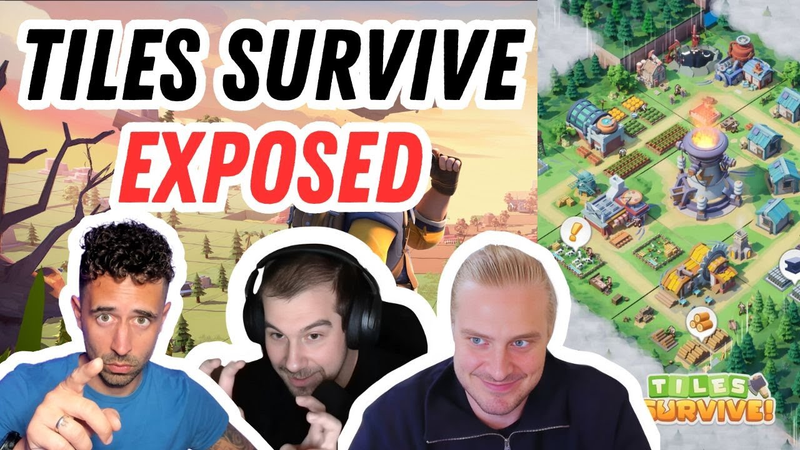
Tiles Survive Breakdown: FunPlus goes full Century Games
FunPlus has initiated a strategic pivot toward a proven, high-efficiency development model, moving away from experimental intellectual property in favor of the simplified, scalable frameworks popularized by Century Games.
- FunPlus's 'Tile Survive' is currently scaling at approximately $50,000 in daily revenue with roughly 60,000 daily downloads since its launch in March.
- The game utilizes a simplified version of the 'Dark War' 4X playbook, focusing on streamlined onboarding, events, and gacha mechanics rather than complex systems.
- Unlike its predecessors, 'Tile Survive' integrates scripted road-collection encounters directly into the core progression, effectively gating player advancement behind specific exploration levels.



Vorhaus Digital Strategy Study: All Findings 2025
The Vorhaus 2025 Digital Strategy Study is a nationally representative survey of 2,000 U.S. adults (margin of error ±2.2%, fielded May 28 to June 18, 2025).
- Digital-first entertainment has become the US standard, with smart TV penetration at 63% and connected devices officially surpassing traditional broadcast media.
- Gaming is now a near-universal activity with 80% of the population participating, driven by daily mobile play and a significant rise in total annual in-game spending.
- Consumers are adopting 'subscription cycling' to manage costs, despite the average household maintaining 3.5 video services and younger consumers (18–34) increasing annual digital media spending by $235.

TWIG #342 Scopely Meltdown, Crazy Anime Story and One SHOCKING Game Recipe
The gaming industry is currently navigating a period of significant adjustment, characterized by stagnant growth, a contraction in venture capital, and the persistent challenges of mobile user acquisition following IDFA changes.
- Scopely faces significant portfolio risk, with Monopoly Go and Pokémon Go now accounting for over 90% of the company's total revenue as its legacy titles and recent acquisitions decline.
- Sony is leveraging strategic partnerships, such as its stake in Bandai Namco, to integrate major Japanese anime franchises into its ecosystem, though localizing these properties for Western mass-market audiences remains a significant challenge.
- The gaming industry is experiencing a period of stagnant growth and reduced venture capital, forcing companies to move beyond incremental testing toward methodologies that prioritize significant product variations to generate actionable data.

Game Analytics 101: Why waiting "One more week" can kill your game!
Retention serves as the foundational metric for growth in the free-to-play mobile gaming sector, as monetization remains impossible without a consistent, active player base.
- Profitability in free-to-play mobile games requires that Lifetime Value (LTV) consistently exceeds the Cost Per Install (CPI), making retention the foundational metric for growth.
- Developers must hit specific Return on Ad Spend (ROAS) targets by Day 7; failing to meet these early benchmarks is a strong indicator that acquisition costs will not be recouped.
- Waiting for ad network performance to improve after missing early benchmarks is a strategic error, as the time required to break even increases exponentially when initial targets are missed.

Cloud Gaming: Fact & Fiction | BITKRAFT Summit 2024
The cloud gaming industry is currently undergoing a strategic shift, moving away from the failed model of subscription-based, console-style AAA gaming toward more specialized, platform-agnostic, and frictionless experiences.
- Cloud gaming success depends on targeting casual audiences rather than hardcore gamers, as the latter will always prefer dedicated hardware like a PlayStation 5 or high-end PC.
- The business model for cloud gaming is shifting away from subscription services toward transparent, free-to-play models where in-game monetization sustains profitability.
- Increasing GPU density—the number of games a single GPU can support simultaneously—is critical to reducing costs, with current technology enabling 4 to 12 games per GPU.