Mobile reports and market data
Documents

🎯 Hunting Sniper Review: Old game, new UA = SERIOUS Money!
The mobile game Hunting Sniper has emerged as a significant financial success within the realistic sports genre, generating approximately $200,000 in daily revenue.
- Hunting Sniper generates approximately $200,000 in daily revenue, outperforming established genre competitors like Hunting Clash by nearly tenfold.
- The game’s rapid scaling since its August 2024 launch is driven primarily by an aggressive user acquisition strategy rather than innovative game design.
- Developers maintain a high-volume creative output, releasing hundreds of new marketing assets monthly across Facebook, Google, and TikTok.

GDC concerns, AppLovin allegations, why app makers want game talent, jobs, data, more
The mobile gaming industry is currently navigating a period of significant transition, characterized by shifting event attendance patterns, ongoing corporate legal challenges, and a growing cross-industry demand for specialized talent.
- Global in-app purchase revenue for mobile games reached $81.75 billion in 2025, though U.S. spending remains largely flat with only 1% growth.
- Non-gaming companies, including Duolingo and major dating platforms, are actively recruiting mobile game talent for their expertise in gamification, user retention, and monetization.
- AppLovin is facing aggressive scrutiny and allegations from short sellers regarding ties to sanctioned entities, which the company has formally denied and labeled as defamatory.

🎯 Mobile Ad Monetization Checklist: From Soft Launch to Scale by Felix Braberg
This guide provides a strategic framework for mobile game developers to implement and scale ad monetization, covering the transition from soft launch to full-scale operations.
- Prioritize user retention by enforcing strict ad creative standards, as networks often default to intrusive, long-form end cards that degrade the user experience.
- During soft launch, target a 45% viewer rate for rewarded video ads and a 70% viewer rate for interstitials to balance monetization with retention.
- Maintain an updated app-ads.txt file to ensure full access to reseller demand and maximize potential ad revenue.
Influencer Marketing for Mobile Apps 101: 2026 Edition
Mobile app developers are increasingly pivoting away from traditional paid user acquisition toward micro-creator marketing to combat the unsustainable surge in advertising costs.
- Paid user acquisition costs have surged significantly, with CPMs increasing 10x over the last two years, making micro-creator marketing a necessary alternative for scaling apps.
- High-performing influencer campaigns can achieve CPMs as low as $0.60 to $0.70 in the U.S. market, compared to the standard industry range of $3 to $5.
- Effective creator compensation should prioritize performance-based bonuses over fixed fees, using the creator's median view count from the previous three months as the benchmark for success.
Building Games That Don't Die: The Zynga Model
Forever franchises represent the cornerstone of sustainable success in the mobile gaming industry, defined as titles engineered to endure for at least five years while generating annual revenues exceeding $100 million.
- A 'forever franchise' is defined as a mobile game engineered to last at least five years while generating over $100 million in annual revenue.
- Long-term viability is validated during soft launch by monitoring retention curves through day 60, allowing developers to mitigate financial risk before global scaling.
- Core gameplay must possess inherent engagement before meta-layers are added, prioritizing structural integrity over superficial feature iteration.
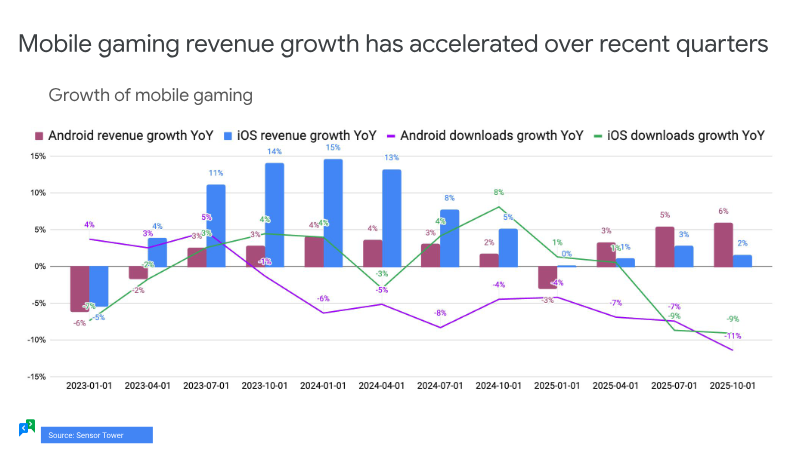
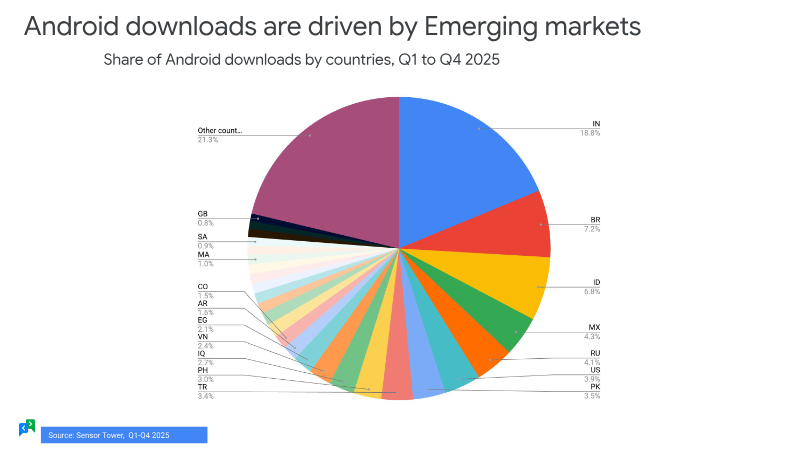

Key Insights and Data: 2023–2025
Mobile gaming drives the global industry’s growth through 2025, accounting for more than half of worldwide revenue and over eighty percent of players.
- Global gaming revenue is projected to reach $197 billion in 2025, representing a 7.5% year-over-year increase driven primarily by mobile and PC segments.
- Mobile gaming remains the dominant force in the industry, accounting for over 50% of global revenue and more than 80% of the total player base.
- The mobile market is increasingly a winner-take-all environment, with the top 10 to 50 titles on Google Play and the Apple App Store capturing a growing share of total revenue.
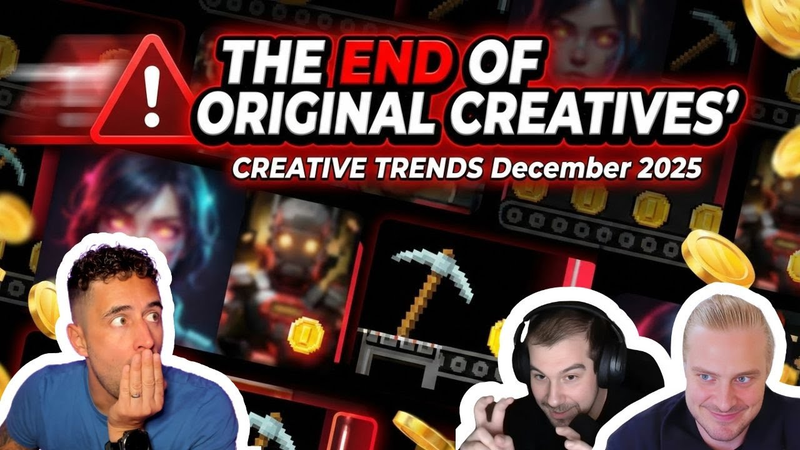
☠️ The end of original creatives: Creative Trends just got darker
The mobile gaming industry is currently undergoing a fundamental shift toward a copy-first development strategy, prioritizing high-volume, replicable creative assets over original intellectual property.
- The mobile gaming industry is shifting toward a copy-first strategy that prioritizes high-volume, replicable creative assets over original intellectual property to maximize conversion metrics.
- Artificial intelligence is being leveraged to mass-produce deceptive creative content, significantly lowering production costs while enabling the rapid deployment of fabricated, high-drama scenarios.
- Publishers are increasingly utilizing 'fake ads' that feature unauthorized use of major global brands and misleading gameplay representations to drive user acquisition.

🚨📢 BREAKING NEWS: Ubisoft Restructures, IAP Hits $167B, Turkey Keeps Raising, Pokémon Goes IRL
The gaming industry is currently undergoing a structural shift characterized by a transition toward a monetization-first era.
- Global mobile in-app purchase revenue reached $167 billion in 2025, confirming a strategic industry shift toward maximizing lifetime value over user acquisition scale despite declining download volumes.
- Ubisoft is reorganizing into five specialized creative houses to achieve $200 million in cost savings, a process that includes canceling projects like the Prince of Persia Sands of Time remake and mandating a full-time return to the office.
- Major publishers are prioritizing stability by leveraging legacy intellectual property and diversifying platforms, such as Outfit7 expanding into PC development and Rovio relaunching the Angry Birds franchise in China.

Pocket Gamer Connects London 2026 unwrapped | Week in Mobile Games podcast
The mobile gaming industry is currently experiencing a notable shift toward cautious optimism, marking a departure from the recent period of widespread workforce reductions.
- Direct-to-consumer web stores are gaining traction, with data indicating that 97% of web shop revenue is generated by repeat buyers, and 84% of customers who make three purchases will proceed to a fourth.
- User acquisition (UA) costs remain a persistent industry challenge, forcing developers to shift focus toward retargeting existing players rather than relying solely on expensive new user acquisition.
- The UK games industry continues to struggle with a lack of government support compared to international hubs like Canada, Vietnam, and Israel, prompting the formation of the UK Video Games Council to lobby for better policy alignment.

TWiG #367: A Certain IPO, 2026's 1st Cozy Launch & When CEOs Get Sued
Corporate governance and strategic pivots define the current landscape of the interactive entertainment industry.
- Shareholders have initiated legal action against former Activision Blizzard CEO Bobby Kotick, alleging that the $69 billion acquisition process prioritized personal financial gain and legal protection over fiduciary duties.
- Adtech firm Liftoff has reached a $4 billion valuation via IPO, signaling a growing industry reliance on AI-driven user acquisition financing to maintain growth despite significant debt burdens.
- Major publishers like Krafton are shifting strategies toward operational efficiency by leveraging AI-integrated development and user-generated content to scale established intellectual property like PUBG.
Ubisoft's big reorg, critics and mobile's reputation problem, PGC London thoughts, more
The mobile games industry is currently navigating a period of significant structural change and reputational scrutiny.
- Ubisoft is undergoing a major reorganization into five creative houses, with its mobile division—managing titles like Hungry Shark and Ketchup—tasked with achieving €200 million in cost reductions over the next two years.
- The mobile gaming sector continues to generate massive scale, with Monopoly Go reaching $6 billion in revenue and global user acquisition spending totaling $25 billion annually.
- Ubisoft’s restructuring strategy includes the potential for further layoffs and the divestiture of mobile assets that do not align with its new creative focus.
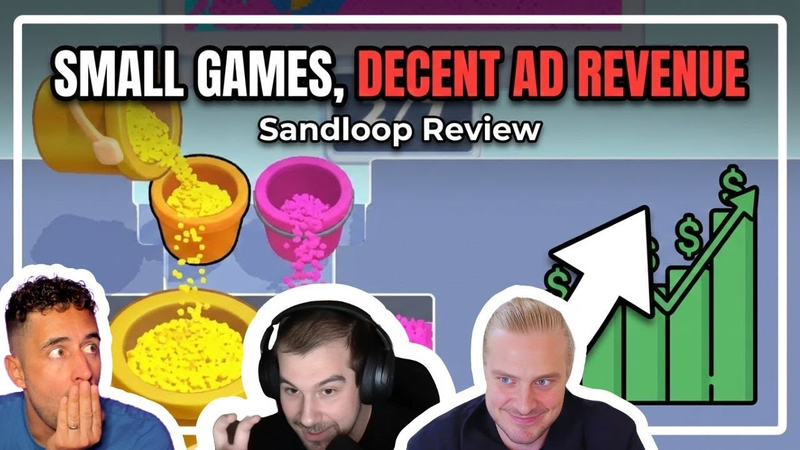
Sandloop review: It looks simple. That’s the point.
Sandloop, a physics-based sorting game published by Voodoo, exemplifies the effectiveness of a minimalist design philosophy in the hyper-casual mobile market.
- Sandloop generates $60,000 to $120,000 in daily ad revenue from approximately 50,000 daily downloads.
- The game utilizes a high-spend acquisition model with $200,000 in daily marketing costs, targeting a three-month payback period.
- To minimize initial user churn, the game delays all monetization and menu access until level 20.