Mobile reports and market data
Documents

Google’s Thomas Zybulski & Saejoon Oh on APAC’s New Wave: Data, Fintech & Vietnam’s Rising Talent
The Asia-Pacific (APAC) mobile app and gaming ecosystem is currently defined by a transition toward data-driven decision-making and the diversification of business models.
- APAC developers are increasingly adopting data-driven decision-making and scientific measurement to differentiate their apps in an oversaturated market.
- Non-gaming sectors, particularly fintech and finance companies, are aggressively entering the ad monetization space to better understand user behavior and maximize Lifetime Value (LTV).
- Rising user acquisition costs post-COVID are forcing developers to move beyond traditional models and innovate with new business models, genres, and service offerings.

SayGames’ Kate Dekalenkova on Vietnam’s Rapid Rise and the Shift Toward Hybrid Casual
The Vietnamese mobile gaming ecosystem is undergoing a rapid maturation, transitioning from a hyper-casual foundation toward more complex hybrid-casual and midcore models.
- Vietnam’s mobile game development ecosystem is identified as the fastest-evolving market globally, characterized by a rapid transition from hyper-casual titles toward hybrid-casual and midcore genres.
- SayGames is actively seeking to replicate its success in the Korean market by establishing long-term partnerships with top-tier Vietnamese studios.
- The primary challenge for publishers like SayGames in Vietnam is identifying studios that share a long-term vision and a commitment to high-quality product development rather than short-term ad-based gains.

Google’s Zachary Kuney on Monetisation, AI & Why Vietnam is a Global Growth Engine
Vietnam has emerged as a critical growth engine within the global mobile application ecosystem, characterized by a unique combination of young, highly skilled talent, strong government support, and a collaborative, innovation-focused developer community.
- Vietnam is currently a primary growth engine within the APAC mobile app ecosystem, driven by a young, tech-focused talent pool and strong government support for the digital economy.
- AI is being leveraged by developers to transform massive datasets into actionable insights, effectively providing small studios with the capabilities of an in-house data science team.
- Google is shifting its support strategy for developers by integrating cross-functional teams—covering cloud, infrastructure, ad buying, and monetization—to provide a more cohesive and simplified scaling experience.

New genre leader in cozy games by Jakub Remiar
Heartopia has emerged as a significant leader in the cozy, avatar-life simulation genre, demonstrating strong market performance shortly after its January launch.
- Heartopia, a mobile avatar-life simulation game launched in January, currently generates over $200,000 in daily revenue with hundreds of thousands of daily downloads.
- The game’s monetization is driven entirely by cosmetic-only gacha systems for clothing and furniture, avoiding gameplay-affecting mechanics or competitive stats.
- Market success is heavily concentrated in Asia, led by Japan, followed by the United States, Taiwan, South Korea, and Thailand.
Festive Season 2025: App Marketing Trends and Strategies for India
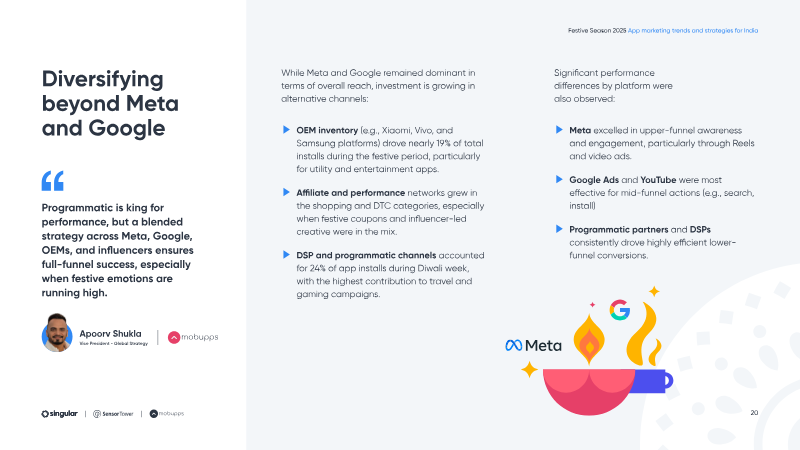
India’s festive season—from Onam in August through Diwali and Christmas in December—drives more than 30% of the country’s annual digital advertising spend, making it a pivotal period for app marketers.
- India's festive season (August–December) accounts for over 30% of annual digital ad spend, driving a 36% increase in installs and a 69% surge in re-engagements during the peak window.
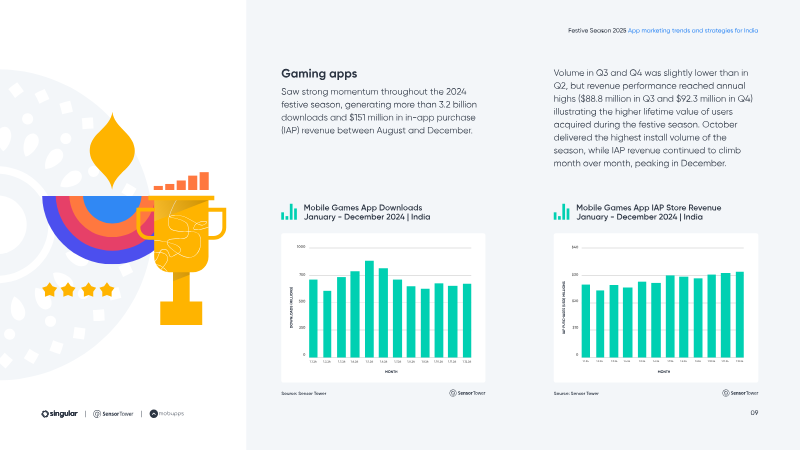
- Mobile gaming remains a primary growth driver, recording 3.2 billion downloads and $151 million in-app purchase revenue in 2024.
- Ad spend efficiency improved during the festive period, with a 53% increase in mobile ad investment accompanied by a 12% reduction in cost-per-install (CPI).

Tracy Phan on Vietnam’s Mobile Gaming Boom: Community, Culture & What's Next
The Vietnamese mobile gaming ecosystem has evolved from a bootstrapped, isolated industry into a globally recognized emerging market.
- Vietnam’s mobile gaming ecosystem is transitioning from a bootstrapped, ad-monetization-heavy model toward more sustainable, long-term revenue streams like hybrid-casual and in-app purchase (IAP) genres.
- The Vietnamese gaming community is characterized by a close-knit, collaborative culture where founders frequently share resources and network through informal social settings, which has historically fueled studio growth.
- Despite high download volumes, the industry currently faces a funding gap due to a cultural preference among founders to prioritize immediate profitability over raising venture capital or building for an exit.

Mobile Gaming Measurement in 2026: What's Actually Working?
The mobile gaming industry is undergoing a significant transition in measurement strategy as privacy regulations and the decline of traditional identifiers render last-click attribution insufficient.
- Ubisoft is shifting from last-click attribution to a holistic measurement framework for 2026 mobile launches, such as Rainbow Six Mobile and The Division Resurgence, to account for brand impact, content creators, and CTV.
- Effective growth measurement now requires integrating performance data with incrementality testing, organic lift, and K-factor analysis to capture the total value of multi-channel campaigns.
- Media Mix Modeling (MMM) is becoming a critical component of the modern growth stack, with AI being deployed specifically to analyze complex datasets and fill gaps in attribution data.
🤯 AI ads evolved from fake gameplay into full world simulations
The mobile gaming industry is undergoing a fundamental shift in user acquisition strategy as developers transition from traditional, manually animated advertisements to sophisticated, AI-generated creative assets.
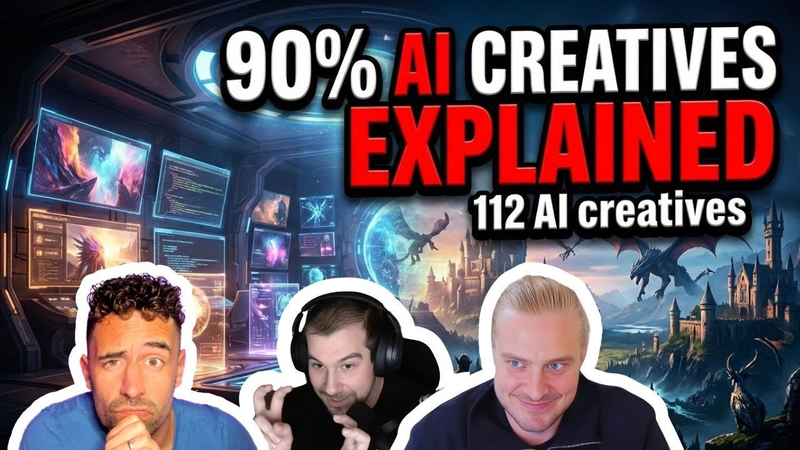
- Mobile game developers are shifting from deceptive 'fake gameplay' ads to AI-generated, high-fidelity world simulations that offer superior engagement and conversion rates.
- Leading titles such as Dark War and Top Heroes now rely on AI for 80% to 90% of their total marketing output.
- Generative tools like Genie 3 allow developers to create interactive, visually consistent environments from single source images, significantly outpacing traditional animation pipelines.

Pocket Gamer Connects London 2026 preview | Week in Mobile Games podcast
The global mobile gaming industry is currently navigating a period of intense structural transition, characterized by a shift toward artificial intelligence and a re-evaluation of long-term corporate strategies.
- Playtika is reducing its headcount by 15% as part of a strategic shift to streamline operations, specifically citing a transition toward AI and automation to replace headcount-heavy processes.
- Meta is cutting 10% of the staff at its Reality Labs division, which employs approximately 15,000 people, signaling a continued contraction in the company's investment in virtual reality.
- Paramount has initiated legal action against Warner Bros. to force financial disclosure and analysis of a competing acquisition offer from Netflix, which Warner Bros. previously favored over Paramount's bid.

TWIG #366 Türkiye’s Looming Winner and GenAI Gamer Backlash
The global gaming industry is currently navigating a period of structural transition defined by shifting monetization models, the aggressive pursuit of operational efficiency, and the integration of generative artificial intelligence.
- The global gaming industry is shifting toward operational efficiency and rapid content iteration as venture capital investment stalls and total M&A transaction values collapse.
- Epic Games is pivoting Fortnite to a creator-led transaction model to challenge Roblox, though the strategy faces ethical and legal scrutiny regarding gambling-adjacent mechanics.
- Chinese publishers are aggressively expanding into Western markets, now accounting for a significant share of the $25 billion global annual spend on user acquisition.

How Angry Birds reached the stars
The Angry Birds franchise serves as a definitive case study in transforming a mobile game into a global transmedia powerhouse.
- Angry Birds achieved the first-ever 1 billion download milestone in the mobile gaming sector, providing a massive ecosystem that facilitated high-profile partnerships for subsequent titles.
- Strategic partnerships with major entertainment entities like 20th Century Fox (Angry Birds Rio), NASA (Angry Birds Space), and Lucasfilm (Angry Birds Star Wars) allowed Rovio to leverage external marketing muscle and distribution channels without relying on a traditional internal marketing budget.
- The Angry Birds Star Wars licensing model set a premium industry standard by charging a 28% total royalty rate—14% for Rovio and 14% for Lucas Arts—while managing over 1,200 partnership opportunities to maintain brand exclusivity.

Red Dead Redemption, Moon Active, Playtika, Liftoff, 2025's top games, data, jobs and more
This analysis examines the state of the mobile games industry as of early 2026, focusing on performance metrics, corporate restructuring, and market trends.
- The mobile gaming market is dominated by a few high-earning titles, led by Honor of Kings ($1.68B in China), Last War ($1.57B), and Roblox ($1.5B) in 2025.
- Strategy games remain the industry's most lucrative genre, generating $13 billion in total market revenue during 2025.
- Playtika is restructuring its operations by laying off 500 employees to pivot toward AI-driven automation and a leaner corporate model.