Marketing reports and market data
Documents

AdMob Mediation: Top Tips and Best Practices
AdMob serves as a foundational pillar for mobile game monetization, offering high-quality ad inventory and reliable account management.
- Implement a mediation strategy immediately after soft launch by integrating Mintegral, AppLovin, and Unity alongside Google’s native inventory to create a competitive bidding environment.
- Maintain a lean ad stack by removing any mediation partners that contribute less than five percent of total revenue to reduce technical overhead and ensure app stability.
- Perform manual optimization of non-bidding waterfall price points every one to two weeks to maximize eCPM until real-time bidding becomes the industry standard.

Winning with Creators: How Gaming’s Marketing Strategy is Evolving
The gaming industry is undergoing a fundamental shift in marketing strategy, moving away from transactional, short-term influencer campaigns toward long-term creator programs.
- Gaming studios are shifting from transactional influencer campaigns to long-term creator partnerships that utilize in-game revenue-sharing systems, such as creator codes, to align financial incentives.
- Integrating creators into the development process through early access and direct communication channels transforms them into community stakeholders, fostering more authentic brand advocacy.
- Creator-led programs serve as a primary growth engine in mobile gaming by effectively driving both new player acquisition and the reactivation of churned users.

Capybara GO! Defining a new genre: Social Casino RPG! Another Mobile Sensation by Habby
Capybara GO! represents a strategic shift for Habby, establishing a new hybrid genre defined as a Social Casino RPG.
- Habby’s 'Capybara GO!' functions as a 'Social Casino RPG' that removes skill-based input, replacing active gameplay with passive, slot-machine-style mechanics that prioritize high-frequency monetization.
- The game demonstrates significant market potential, reaching 700,000 active users by November 1st following its August 30th soft launch, with expectations to outperform 'Survivor.io' after its official U.S. launch on November 22nd.
- The design strategy relies on 'gluing together' proven mechanics from other successful titles, such as the pet-building systems from 'Legend of Slime' and 'Legend of Mushroom,' while scaling them to increase depth and player retention.

TWIG #305 Music Stops at Netflix Games as Hell's Bells Ring for AA Games
The global gaming industry, currently valued at $184 billion, is navigating a period of structural transition characterized by slowing growth and a shift in investment priorities.
- The global gaming industry is experiencing a structural transition with projected year-over-year growth of only 3% through 2029, a significant slowdown from pre-2022 expansion levels.
- Netflix has shuttered its internal AAA studio, signaling a strategic shift away from high-cost development toward more cost-effective, IP-driven interactive content.
- The 'AA' or middle-market tier faces an existential crisis as rising production costs and the consolidation of consumer attention around massive franchises make mid-budget titles increasingly unsustainable.

How This Game Dev Got 150,000 Wishlists In A Month — Full Time Game Dev Podcast Ep. 021
Transitioning to full-time independent game development requires a strategic balance between creative ambition and financial pragmatism.
- Developer David Wehle achieved 150,000 wishlists for his upcoming game, 'We Harvest Shadows,' within one month by leveraging a high-quality, standalone demo.
- The game's marketing strategy relied on a 'genre-bending' approach that combined farming simulation with horror, a niche identified by analyzing market trends and player fatigue toward 'soulless' games-as-a-service titles.
- Strategic exposure through high-profile influencers, including Jacksepticeye (30 million subscribers) and Gab Smolders, significantly accelerated wishlist growth after they praised the demo's emotional depth and unique mechanics.

The Fingerprinting Problem Destroying Mobile Growth
The mobile performance marketing landscape has undergone a fundamental transformation, moving away from manual campaign optimization toward a model defined by advanced algorithms, high-volume creative production, and sophisticated data science.
- The mobile marketing industry is shifting away from probabilistic fingerprinting toward models built on consented first-party data to counter the decline of traditional deterministic measurement.
- Successful growth strategies now require internalizing data science capabilities rather than relying on external demand-side platforms, focusing instead on primary social platforms and rewarded video networks.
- Studios should adopt a two-stage growth model that validates retention and lifetime value metrics before investing in full-scale marketing organizations.
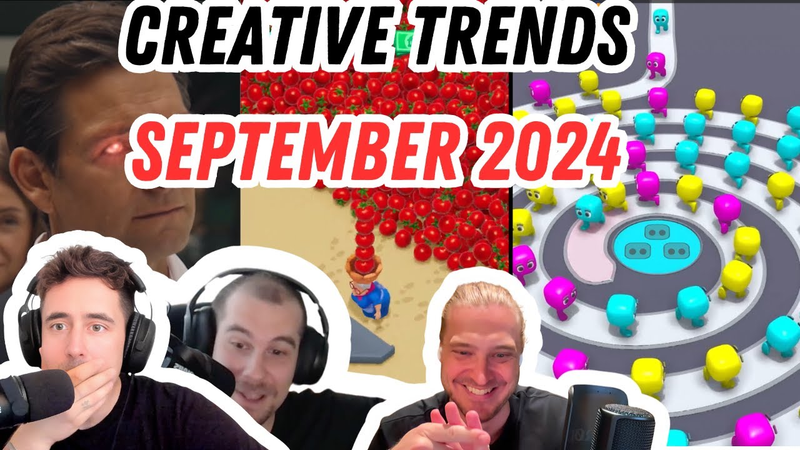
Creative Trends in Mobile Games - September 2024
The mobile gaming landscape is currently defined by a strategic shift toward high-production creative assets and the aggressive integration of hyper-casual mechanics into more complex genres.
- Market leaders like Royal Match and Last War are reducing cost-per-install (CPI) metrics by 30% to 50% by utilizing high-production creative assets and altered gameplay advertisements.
- The mobile gaming industry is increasingly adopting a hybrid-casual model that blends high-fidelity, Pixar-style CGI with familiar, iterative gameplay loops.
- Developers are systematically repurposing legacy mechanics from classic titles such as Zuma, Coin Dozer, and Helix Jump to refresh gameplay through asset swapping.
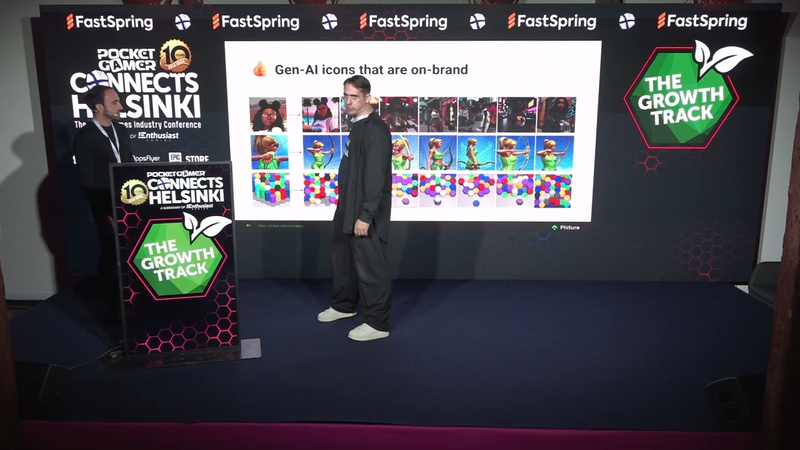
Session: Automating App Store Optimization With Generative AI - Andy Carvell & Livio Marcheschi
App Store Optimization (ASO) is increasingly defined by the ability to conduct high-volume, iterative experimentation to drive conversion rate optimization.
- Automating A/B testing for App Store assets using generative AI can drive significant conversion rate increases, with some implementations yielding up to a 57% improvement over a two-month period.
- Phiture’s 'Press Play' platform automates the testing of icons, feature graphics, short descriptions, and screenshot ordering, supporting up to 50 concurrent experiments per game title.
- The platform utilizes fine-tuned AI models to generate game-specific assets by training on existing brand guidelines, character art, and historical performance data to ensure stylistic consistency.

Panel: User Acquisition in 2024 & Beyond.
The landscape of user acquisition in 2024 is defined by a strategic shift toward channel diversification and the integration of advanced technology.
- User acquisition strategies must shift away from reliance on top-tier platforms toward a diversified ecosystem including web-first launches, alternative app stores, and Connected TV.
- Marketers are transitioning to probabilistic attribution models to address the industry-wide challenges of privacy regulations and signal loss.
- AI should be utilized as a tool for optimizing creative assets and predicting high-value player behavior rather than a replacement for human creative strategy.

Curated Panel: Buying on Rewarded Platforms: The Benefits & Challenges.
Rewarded platforms have evolved into a critical component of modern user acquisition strategies, experiencing significant growth in revenue share across the global gaming industry over the past year.
- Rewarded platforms have become a critical component of user acquisition, showing significant growth in revenue share across the global gaming industry over the past year.
- Profitability in rewarded channels requires aligning external reward structures with the internal player lifecycle to ensure lifetime value consistently exceeds the cost per install.
- Success depends on rigorous data maturity and the precise tracking of in-game events to manage the higher post-event churn rates typical of incentive-driven users.
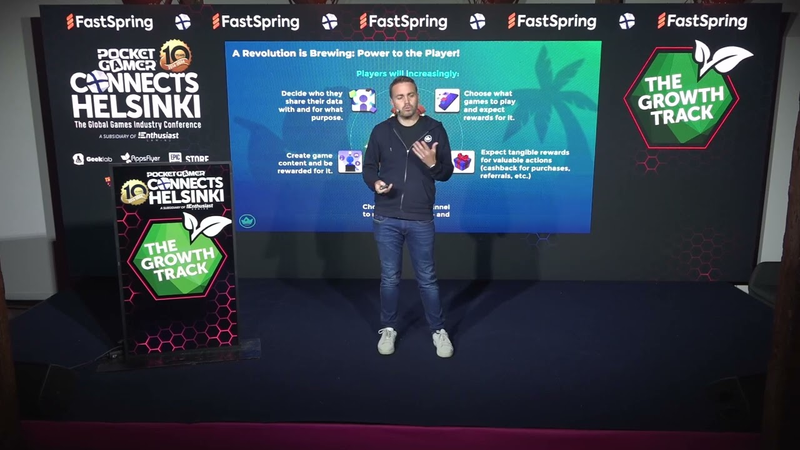
Session: The Rise of Player-Powered UA: How Incentives Will Shape the Future of Mobile Growth.
The mobile gaming industry is undergoing a fundamental shift toward a player-powered growth model, where developers increasingly treat players as partners rather than mere consumers.
- Over 80% of mobile players express interest in games that offer tangible rewards, and 25% of users are willing to switch games specifically to access these incentives.
- Developers are shifting toward value-exchange models that provide in-game items or real-world currency in exchange for player engagement and data to mitigate the impact of privacy-related tracking limitations.
- The adoption of web shops is increasing as a strategic method to bypass platform gatekeepers, capture first-party data, and provide more competitive value propositions directly to players.
Session: Mastering Game Marketing in the era of Data Privacy - Jesse Lempiäinen, Geeklab.
The game marketing industry faces a significant paradigm shift due to the erosion of user-level tracking, specifically following the removal of Apple’s Identifier for Advertisers (IDFA) and the impending implementation of Google’s Privacy Sandbox.
- The erosion of user-level tracking, driven by the removal of Apple’s IDFA and the introduction of Google’s Privacy Sandbox, has rendered traditional device-based attribution models obsolete.
- Marketing strategies must pivot from tracking individual user journeys to analyzing creative-level performance to maintain visibility in a privacy-focused landscape.
- Implementing creative-level tracking links allows developers to bridge the gap between ad networks and applications, enabling real-time campaign optimization without relying on invasive user data.