Market Forecast

101 documents·48 publishers

Documents

Page 1
Report13 pages

China Game Industry Report 2025

The China Game Industry Report for 2025 presents a comprehensive assessment of the domestic and overseas gaming markets, highlighting sustained growth driven by youth protection initiatives, technological innovation, and cross‑sector integration. In 2025, China’s self‑developed mobile games generated US$20.455 billion in overseas revenue, a 10.23% year‑on‑year increase and the sixth consecutive year surpassing RMB 100 billion. Strategy games, including SLG, dominated overseas earnings at 49.97%, followed by shooters (9.69%) and RPGs (9.39%). The United States remains the largest market, contributing 32.31% of overseas revenue, with Japan (16.35%) and South Korea (9.15%) also significant.

Domestically, mobile games accounted for 73.29% of total sales, with MOBA leading at 19.45%, followed by shooting (18.29%) and RPG (15.10%). The domestic console market expanded sharply, reaching RMB 8.362 billion (US$1.18 billion) in 2025, a 37.38% year‑on‑year rise, driven by both software and hardware sales.

Global market projections indicate the worldwide gaming industry will reach RMB 130.17 billion in 2025, with mobile gaming contributing RMB 66.69 billion—a growth rate of 4.93%, slower than previous years but still positive.

Methodologically, the report aggregates data from CADPA’s industry surveys and market analyses, covering 2020‑2025 for domestic sales and 2019‑2025 for overseas performance. The findings underscore a resilient Chinese gaming sector, poised to maintain strong export growth while deepening domestic diversification across mobile and console platforms.

  • Chinese self-developed mobile games generated US$20.455 billion in overseas revenue in 2025, marking a 10.23% year-on-year increase and the sixth consecutive year exceeding RMB 100 billion.
  • The United States remains the primary overseas market for Chinese games, accounting for 32.31% of total export revenue, followed by Japan at 16.35% and South Korea at 9.15%.
  • Strategy games (SLG) dominate the overseas market, capturing 49.97% of earnings, significantly outpacing shooters at 9.69% and RPGs at 9.39%.
  • The domestic Chinese console market experienced a sharp 37.38% year-on-year growth in 2025, reaching a total value of RMB 8.362 billion (US$1.18 billion).
  • Mobile gaming continues to lead the domestic market, representing 73.29% of total sales, with MOBA (19.45%), shooting (18.29%), and RPG (15.10%) as the top-performing genres.
+4
Meridian PlayJan 2025
Page 1
Report8 pages

Global Gaming Industry Takes Center Stage

The provided text does not contain the content of the document titled Global Gaming Industry Takes Center Stage, as the source link is restricted and inaccessible. Consequently, it is impossible to extract the main thesis, key findings, or methodological details required for an analytical summary. The available information consists solely of a server-side error message indicating a lack of authorization to view the requested file.

To provide a professional and accurate summary, the full text of the report must be made available. Once the content is accessible, the analysis will focus on identifying the primary industry trends, geographic scope, and statistical data points presented by the authors. Please provide the complete text or a functional link to the document to facilitate a comprehensive review of the gaming industry's current market position and future outlook.

  • The provided report content is currently inaccessible due to a server-side authorization error.
  • No factual data, market statistics, or industry trends are available for analysis from the provided source text.
  • The document failed to load, preventing the extraction of any concrete insights regarding the global gaming industry.
  • A comprehensive summary cannot be generated until the full text of the report is provided.
  • The current input contains only an error message rather than the intended industry research.
+1
Morgan StanleyJan 2025
Page 1
Report37 pages

Games 2025: The Industry Quest for Growth

The global games market reached a record $199.4 billion in 2024, cementing its status as the preeminent force in the entertainment sector. Despite this scale, the industry faces a period of moderated growth, with projections for 2025 hovering at approximately 1%. This deceleration stems from a combination of high-profile release delays, such as the postponement of major titles, and a tightening early-stage funding environment. To navigate this landscape, firms are shifting their focus from aggressive expansion toward operational efficiency, lean development cycles, and the optimization of existing intellectual property.

Strategic growth in 2025 will rely heavily on geographic diversification and demographic expansion. Emerging markets in the Middle East and Southeast Asia represent significant frontiers, while developers are increasingly targeting underserved cohorts, including older gamers and young adult females. Furthermore, the industry is leveraging user-generated content platforms like Roblox to maintain engagement among younger audiences. Hardware cycles, particularly the anticipated launch of the Nintendo Switch 2, remain a critical catalyst for consumer spending, providing a necessary boost to the broader market ecosystem.

To combat the dual pressures of escalating AAA development costs and fragmented consumer attention, publishers are adopting more conservative financial models. This includes a heavy reliance on remakes, remasters, and multi-platform porting to extract maximum value from established assets. Simultaneously, companies are pursuing margin expansion through diversified monetization strategies, such as hybrid mobile models and direct-to-consumer web shops that bypass traditional app store fees. By transitioning toward holistic franchise management that spans licensing, subscription services, and cross-media integration, the industry aims to stabilize revenue streams and ensure long-term sustainability in an increasingly competitive global environment.

  • The global games market reached $199.4 billion in 2024, but growth is projected to decelerate to approximately 1% in 2025 due to release delays and reduced early-stage funding.
  • Publishers are prioritizing operational efficiency and asset optimization, focusing on remakes, remasters, and multi-platform porting to mitigate the rising costs of AAA development.
  • Strategic growth is shifting toward geographic expansion in the Middle East and Southeast Asia, alongside targeting underserved demographics like older gamers and young adult females.
  • Companies are pursuing margin expansion by implementing hybrid mobile monetization models and direct-to-consumer web shops to bypass traditional app store fees.
  • The industry is leveraging user-generated content platforms like Roblox to maintain engagement among younger audiences while managing fragmented consumer attention.
+1
Ampere AnalysisJan 2025
Page 1
Report72 pages

Africa Games Industry Report 2025

The African games industry is undergoing a period of rapid expansion, with total revenues projected to surpass $1 billion in 2024. This growth is primarily fueled by a mobile-first market that accounts for nearly 90% of the sector’s revenue, driven by a young, tech-savvy population and increasing smartphone penetration. While South Africa remains the most lucrative individual market, Nigeria has demonstrated the most significant momentum, with mobile revenues increasing fivefold since 2019. On a global scale, the Middle East and Africa region has emerged as a growth leader, maintaining an 8.9% year-on-year increase despite the historical dominance of North American and Asian markets.

The developer ecosystem has matured significantly, expanding from a handful of entities to approximately 250 studios by 2024. West Africa has emerged as the primary regional hub, experiencing a nearly fivefold increase in the number of active studios over the past year. Development is characterized by a youthful, male-majority demographic that favors the Unity engine to create entertainment-focused content for mobile platforms. High-profile international partnerships with brands like Microsoft Xbox, Disney, and Gameloft, alongside the success of global titles like Candy Crush and PUBG Mobile within the region, signal increasing integration into the global gaming economy.

Despite these advancements, the industry faces substantial structural and financial hurdles. Infrastructure remains a critical concern, as developers struggle with unstable power and high-speed internet access. Furthermore, a significant performance gap exists in funding and institutional support; only 3% of developers receive government funding, and over half of the continent's developers currently earn no income from their work. This has led to a trend of conservative, small-scale investment. To transition from early-stage prototyping to commercial acceleration, the sector requires a collaborative model focused on building talent pipelines, implementing rebate programs, and establishing localized payment methods to unlock the continent's full economic potential.

  • The African games industry is projected to exceed $1 billion in revenue in 2024, driven by a mobile-first market that generates nearly 90% of total sector earnings.
  • Nigeria has shown the most significant momentum in the region, with mobile revenues increasing fivefold since 2019, while South Africa remains the most lucrative individual market.
  • The developer ecosystem has grown to approximately 250 studios by 2024, with West Africa emerging as the primary hub after a fivefold increase in active studios over the past year.
  • Despite industry growth, over 50% of African developers currently earn no income from their work, and only 3% receive government funding.
  • The Middle East and Africa region is a global growth leader, maintaining an 8.9% year-on-year revenue increase despite the historical dominance of North American and Asian markets.
Maliyo GamesJan 2025
Page 1
Report224 pages

Gaming 2025 (Epyllion)

The global video game industry has transitioned from a decade of rapid expansion into a period of contraction and market maturation. Following the 2011–2021 growth wave, the sector now faces a "zero-sum" environment characterized by stagnant player spending, plummeting stock values, and a collapse in venture capital. This downturn has triggered an unprecedented wave of studio closures and mass layoffs as publishers move away from risky new ventures to focus on aggressive multiplatform strategies for established franchises. While the industry maintains a higher net headcount than in 2022, the current climate is defined by an oversupply of content competing for limited consumer hours, with the top ten titles capturing 60% of all sales.

Market dominance is increasingly concentrated in "Black Hole" titles and User-Generated Content (UGC) platforms like Roblox and Fortnite. These ecosystems leverage deep social integration and digital entitlements to create a "lock-in" effect that makes it difficult for new live-service titles to gain traction. While the PC ecosystem is gaining momentum over traditional consoles due to its larger libraries and native social tools like Discord, the handheld market is poised for a shift with the impending launch of the "Switch 2" and Valve’s expansion of SteamOS. Furthermore, the rise of high-quality AAA titles from China and localized media in emerging markets is successfully challenging Western dominance by prioritizing domestic cultural themes and lower hardware specifications.

Future growth is expected to be driven by technological innovation and regulatory shifts rather than traditional software sales. Generative AI is being deployed to create autonomous virtual agents and lower development costs, while major publishers are aggressively pursuing programmatic in-game advertising to offset decades of price deflation. Simultaneously, the deregulation of mobile app stores is expected to improve developer margins by 10–20%, enabling new cloud-native experiences and third-party storefronts. By 2030, nearly one billion mobile devices will be capable of running high-fidelity console-spec games, positioning emerging regional markets as the primary engine for the industry’s next economic cycle.

  • The industry has shifted to a zero-sum environment where the top ten titles now capture 60% of all sales, forcing publishers to prioritize established franchises over new, risky ventures.
  • Market dominance is increasingly concentrated in 'Black Hole' titles and UGC platforms like Roblox and Fortnite, which utilize deep social integration to create high consumer lock-in.
  • Future revenue growth is shifting toward programmatic in-game advertising and the deregulation of mobile app stores, which is projected to improve developer margins by 10–20%.
  • By 2030, nearly one billion mobile devices will support console-spec gaming, positioning emerging regional markets as the primary driver for the industry's next economic cycle.
  • Western market dominance is being challenged by high-quality AAA titles from China that prioritize domestic cultural themes and lower hardware requirements.
+1
EpyllionJan 2025
Page 1
Report46 pages

MiDiA Research Global Games Forecasts 2025–2031

The global games market has transitioned into a phase of structural maturity, with 2025 revenues projected at $236.9 billion. While this represents a 4.6% year-on-year increase, the growth is essentially flat when adjusted for inflation, signaling an end to the era of consistent double-digit expansion. Significant industry catalysts, specifically the anticipated launch of the Nintendo Switch 2 and the release of Grand Theft Auto 6, are expected to drive a recovery in hardware and software sales. However, these gains will likely be concentrated among market leaders rather than lifting the broader industry. By 2031, the global player base is forecast to reach 4.02 billion, with long-term growth sustained by premium game sales and advertising as the live-service sector faces saturation.

Software revenue continues to be dominated by in-game spending, which accounts for 69% of the market in 2025. Despite this dominance, premium full-game purchases are regaining momentum as consumers pivot toward high-quality single-player experiences. The subscription sector, while reaching $11.8 billion in 2024, is also maturing; future revenue in this segment will likely depend on price adjustments and the introduction of ad-supported tiers rather than rapid user acquisition. This shift reflects a broader trend where the industry is moving away from saturated multi-game models toward more traditional premium monetization and the expansion of game-based intellectual property into film and television.

Geographically, the Asia Pacific region maintains its position as the largest market by player count and leads in in-game revenue. A significant shift is expected by 2028, as premium game revenue in Asia Pacific is projected to overtake North America, driven by the rising success of high-end titles in China. While North America currently retains its lead in full-game purchase revenue, the global landscape is increasingly defined by regional cultural adaptation and the porting of legacy titles to new hardware platforms. These dynamics suggest a future where growth is driven by strategic price increases and regional expansion rather than the explosive user growth seen in previous decades.

  • The global games market is entering a phase of structural maturity with 2025 revenues projected at $236.9 billion, representing a 4.6% year-on-year increase that is effectively flat when adjusted for inflation.
  • In-game spending remains the dominant revenue driver at 69% of the market, though the industry is shifting toward premium full-game purchases and the expansion of intellectual property into film and television.
  • The global player base is forecast to reach 4.02 billion by 2031, with long-term growth increasingly reliant on strategic price adjustments and regional expansion rather than rapid user acquisition.
  • Market recovery in the near term is heavily dependent on specific catalysts, namely the launch of the Nintendo Switch 2 and Grand Theft Auto 6, which are expected to benefit market leaders disproportionately.
  • The subscription sector reached $11.8 billion in 2024 but is now maturing, with future growth expected to come from price hikes and ad-supported tiers rather than user base expansion.
+1
MiDiA ResearchJan 2025
Page 1
Report17 pages

La Fiscalidad en el Sector de los Videojuegos: España

The guide aims to clarify the tax framework that applies to video‑game developers, publishers and related service providers operating in Spain, outlining both mandatory obligations and available fiscal incentives. It serves as a practical reference for resident legal entities, self‑employed professionals and non‑resident firms that generate income in the Spanish market, helping them meet compliance deadlines while exploiting deductions that can significantly lower the effective tax burden.

Key obligations are mapped to the principal Spanish taxes: corporate income tax (IS) at a standard 25 % rate, personal income tax (IRPF) ranging from 19 % to 47 % for individuals, value‑added tax (IVA) generally set at 21 %, the economic activities tax (IAE) with fixed tariffs and exemptions for the first two years or turnover below €1 million, and withholding obligations on salaries and payments to non‑resident contractors. Filing deadlines are detailed for each model form (e.g., Model 200/210 for IS, Model 303/390 for IVA, Model 111/190 for IRPF withholdings) and the guide notes the possibility of fiscal consolidation for groups of related companies.

The most valuable incentives for the sector include a 12 % deduction on qualifying research, development and innovation (R&D +i) expenses, which can rise to 45 % for projects carried out in the Canary Islands, and a patent‑box regime that reduces taxable income from intangible assets such as patents and advanced software. The 2022 Spanish Video‑Game Development White Paper underpins the emphasis on genuine technological advancement. Start‑up companies meeting ENISA criteria benefit from a reduced corporate rate of 15 % for four years, exemption from advance payments, and deferred tax liabilities. Small and medium‑sized entities with turnover under €10 million can also apply accelerated depreciation, enhanced lease deductibility and loss‑carry‑forward mechanisms.

Operational guidance covers the procedural steps required to register for a tax identification number, declare activity commencement or cessation, and submit electronic filings via the Agencia Tributaria’s portal using a digital certificate. Complementary tools include a searchable tax‑question database, an annually updated taxpayer calendar, virtual assistance services for the main tax types, and a dedicated helpline. Together, these resources aim to streamline compliance, reduce administrative risk and enable video‑game firms to maximize the fiscal advantages embedded in Spanish law.

  • Video game companies in Spain can access a 12% tax deduction for qualifying R&D+i expenses, which increases to 45% for projects developed in the Canary Islands.
  • Start-ups meeting ENISA criteria qualify for a reduced 15% corporate tax rate for four years, along with exemptions from advance payments and deferred tax liabilities.
  • The standard corporate income tax (IS) rate in Spain is 25%, while personal income tax (IRPF) for self-employed professionals ranges from 19% to 47%.
  • A patent-box regime is available to reduce taxable income derived from intangible assets, including patents and advanced software.
  • Small and medium-sized enterprises with an annual turnover under €10 million are eligible for accelerated depreciation, enhanced lease deductibility, and loss-carry-forward mechanisms.
+2
AEVIJan 2025
Page 1
Report46 pages

Global Games Forecasts 2025-2031

The analysis projects that the worldwide video‑game market has entered a mature phase, with revenue expected to reach $236.9 billion in 2025 and to climb modestly to $280.1 billion by 2031. Growth rates flatten to around 4–5 percent annually, roughly matching global inflation, and the compound annual growth rate through 2031 is low enough that double‑digit expansion is deemed unrealistic. Software sales remain the primary engine, buoyed by premium launches such as the next Grand Theft Auto installment and new Switch titles, while in‑game spending—currently about 68 percent of software revenue—will dip slightly to 67 percent by 2031. Subscription services are forecast to rise from $13.1 billion to $18.5 billion, driven largely by price increases as user bases saturate.

Geographically, the Asia‑Pacific region dominates the player base, comprising roughly 53 percent of the 1.53 billion gamers counted in 2024 and exhibiting the highest penetration at about 13 percent of the regional population. Although software revenues are set to grow modestly across all markets, the analysis warns that live‑service oversaturation is eroding in‑game spend, while premium purchases and subscription models gain traction, particularly in China and other APAC economies.

Strategically, the findings suggest that developers and publishers should shift from a survival‑until‑2025 mindset to a longer‑term “stick‑till‑2026” approach, emphasizing high‑quality premium releases, selective investment in live‑service titles, and cross‑platform integration. The forecasts rely on a proprietary model that combines company financials, survey data, and third‑party sources, and the authors note that the projections reflect their own assumptions and carry no liability for potential losses.

  • The global video-game market has entered a mature phase, with revenue projected to grow from $236.9 billion in 2025 to $280.1 billion by 2031 at a modest annual rate of 4–5 percent.
  • Asia-Pacific remains the dominant market, accounting for 53 percent of the 1.53 billion global gamers in 2024 and showing the highest regional penetration at 13 percent.
  • In-game spending, which currently accounts for 68 percent of software revenue, is expected to experience a slight decline to 67 percent by 2031 due to live-service market oversaturation.
  • Subscription service revenue is forecast to grow from $13.1 billion to $18.5 billion by 2031, with growth driven primarily by price increases rather than user base expansion.
  • Software sales remain the primary revenue engine, supported by major premium releases such as the upcoming Grand Theft Auto installment and new Nintendo Switch titles.
+1
MiDiA ResearchJan 2025
Page 1
Report7 pages

10 Major Trends to Watch in Asia & MENA

The video game industry across Asia and the Middle East and North Africa (MENA) is undergoing a period of significant transformation as of 2025, driven by shifting player demographics and evolving monetization strategies. These regions represent the primary engines of global gaming growth, characterized by a massive mobile-first audience and a rapidly expanding middle class with increasing discretionary income. Market dynamics are increasingly defined by the convergence of social media, competitive gaming, and cross-platform accessibility, which have collectively lowered the barrier to entry for new consumers while deepening engagement among existing enthusiasts.

Strategic focus in these territories has shifted toward hyper-localization and the integration of emerging technologies to enhance user retention. In the MENA region, government-backed initiatives and large-scale investments are accelerating the development of local infrastructure and talent, positioning countries like Saudi Arabia and the United Arab Emirates as central hubs for international esports and game development. Meanwhile, the Asian market continues to lead in the refinement of live-service models and the adoption of innovative payment ecosystems that bypass traditional storefront limitations.

The current landscape emphasizes the necessity of understanding regional regulatory environments and cultural nuances to achieve commercial success. As the industry moves forward, the integration of artificial intelligence in content creation and the rise of niche gaming communities are expected to further diversify the market. Companies that prioritize local expertise and adapt to the unique technological preferences of these diverse populations will be best positioned to capitalize on the sustained upward trajectory of the Asia and MENA gaming sectors.

  • Asia and MENA are the primary engines of global gaming growth, driven by a mobile-first audience and a rising middle class with increased discretionary income.
  • Government-backed investments in Saudi Arabia and the UAE are rapidly establishing these nations as central hubs for international esports and game development infrastructure.
  • Market success in these regions now requires hyper-localization and the adoption of innovative payment ecosystems that bypass traditional storefront limitations.
  • The convergence of social media, competitive gaming, and cross-platform accessibility is successfully lowering barriers to entry while deepening user engagement.
  • Future market growth will be defined by the integration of artificial intelligence in content creation and the strategic targeting of niche gaming communities.
+2
Niko PartnersJan 2025
Page 1
Report46 pages

The Global State of Game Publishing & Marketing 2025 Industry Report

The global game publishing market is entering a period of significant expansion, with revenues projected to rise from $117.4 billion in 2025 to $150.5 billion by 2030. This growth is underpinned by a fundamental shift toward digital distribution, which already accounted for 95% of industry revenue in 2023. While traditional publishers maintain a competitive edge through high-budget user acquisition and advanced analytics, the democratization of the industry via platforms like Steam and the Epic Games Store has enabled self-published titles to achieve massive commercial success. Consequently, the industry is moving toward a hybrid landscape where multiplatform launches have increased by 40% to maximize player engagement and revenue potential.

Strategic success in the current market relies heavily on closed-loop marketing and data-driven publishing. Developers are increasingly utilizing real-time telemetry and AI analytics to optimize player retention and monetization strategies. This is particularly evident in the rise of Live Service Games, with 95% of studios now developing titles designed for recurring revenue. However, community management and influencer marketing have emerged as equally vital pillars; approximately 40% of gamers now make purchases based on creator recommendations, and social touchpoints drive over 54% of player motivation to continue gameplay. Furthermore, transmedia collaborations, such as television adaptations of gaming franchises, have doubled their share of box office revenues, illustrating the power of cross-media synergy.

The monetization landscape is further diversifying through the growth of subscription services and the esports sector. Subscriptions are expected to reach 318 million active users and a $21.6 billion valuation by 2030, while the esports market is projected to hit $87.7 billion in the same timeframe. To navigate this complexity, many developers are adopting publishing-as-a-service models and leveraging AI to manage diverse revenue streams across platforms. Ultimately, the integration of cross-platform development, which can boost revenue by up to 40%, combined with sophisticated digital marketing and community-focused strategies, defines the modern trajectory of the global gaming industry.

  • The global game publishing market is projected to grow from $117.4 billion in 2025 to $150.5 billion by 2030, driven by a market where 95% of revenue is already generated through digital distribution.
  • Multiplatform launches have increased by 40% as developers prioritize cross-platform strategies, which can boost total revenue by up to 40%.
  • Live Service Games have become the industry standard, with 95% of studios now developing titles specifically designed for recurring revenue models.
  • Community-driven marketing is critical, as 40% of gamers make purchases based on creator recommendations and social touchpoints drive 54% of player retention.
  • Subscription services are forecast to reach 318 million active users and a $21.6 billion valuation by 2030, while the esports market is expected to hit $87.7 billion in the same period.
+1
Game Publishing & Marketing SummitJan 2025
Page 1
Report3 pages

Asian & MENA Markets: 2025 Half-Year Report

The video game markets across Asia and the Middle East are entering a period of recalibrated growth, with total revenues across key sub-regions projected to reach significant milestones by 2025. China remains the dominant force, with revenues expected to hit $51.2 billion in 2025, supported by a 4.1% year-over-year increase. This growth is fueled by a 24% rise in game approvals and proactive government subsidies. While China maintains a steady long-term outlook with a 3.0% five-year compound annual growth rate, India emerges as the fastest-growing market. India is projected to surpass the $1 billion threshold in 2025 with a 16.2% year-over-year increase, driven by the PROG Act of 2025, which pivoted the industry away from real-money gaming toward traditional video games and esports.

Regional performance varies significantly based on local macroeconomic conditions and hardware cycles. East Asia, comprising Japan and South Korea, shows a more optimistic outlook than previously anticipated, with a revised five-year growth rate of 1.7%. This shift is attributed to the successful launch of the Nintendo Switch 2 and a recovery in the South Korean mobile sector. Conversely, Southeast Asia and the MENA-3 region (Saudi Arabia, UAE, and Egypt) face more tempered expectations. Southeast Asia’s growth forecast was lowered to 3.5% due to headwinds in Thailand and Indonesia, despite strong performance in Vietnam. Similarly, the MENA-3 forecast was adjusted downward to a 6.4% growth rate as economic challenges in Egypt and slower mobile growth in Saudi Arabia offset increased government support for localization and age-rating reforms.

The data, derived from Niko Partners’ 2025 half-year market model updates, covers PC, mobile, and console platforms across 13 distinct markets. The methodology integrates proprietary market models, macroeconomic indicators, and qualitative regulatory analysis to provide a comprehensive five-year outlook through 2029. Overall, the findings suggest that while mature markets like China and East Asia are stabilizing, emerging markets like India and Vietnam are becoming critical drivers of global industry expansion.

  • China remains the dominant regional market with projected 2025 revenues of $51.2 billion, supported by a 4.1% year-over-year increase and a 24% rise in government game approvals.
  • India is the fastest-growing market, projected to exceed $1 billion in 2025 with 16.2% year-over-year growth following the PROG Act's shift toward traditional gaming and esports.
  • The MENA-3 region (Saudi Arabia, UAE, and Egypt) has a revised growth forecast of 6.4%, as economic challenges in Egypt and slowing mobile growth in Saudi Arabia temper the impact of government-led localization efforts.
  • East Asia’s five-year growth outlook has been revised to 1.7%, bolstered by the launch of the Nintendo Switch 2 and a recovery in the South Korean mobile sector.
  • Southeast Asia’s growth forecast is 3.5%, with strong performance in Vietnam being offset by macroeconomic headwinds in Thailand and Indonesia.
+1
Niko PartnersJan 2025
Page 1
Report26 pages

Video Gaming Report: How Platforms Are Colliding and Why This Will Spark the Next Era of Growth

The video gaming industry is transitioning into a new era of growth following a post-pandemic stabilization period. While the sector is unlikely to replicate the rapid doubling of the 2010s, a convergence of technological and structural shifts is expected to revitalize the market. This evolution is driven by four primary strategic trends: the integration of Generative AI, the expansion of the user-generated content (UGC) creator economy, the mainstream adoption of cloud gaming, and the regulatory opening of mobile app stores.

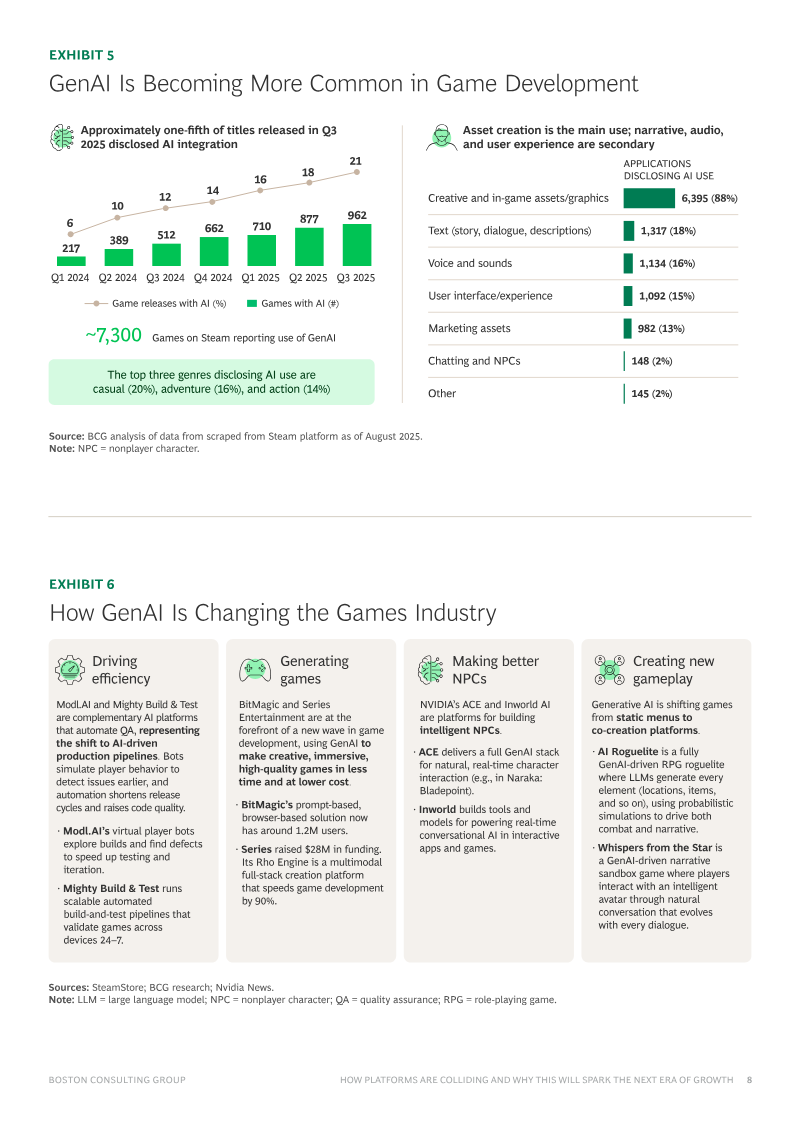
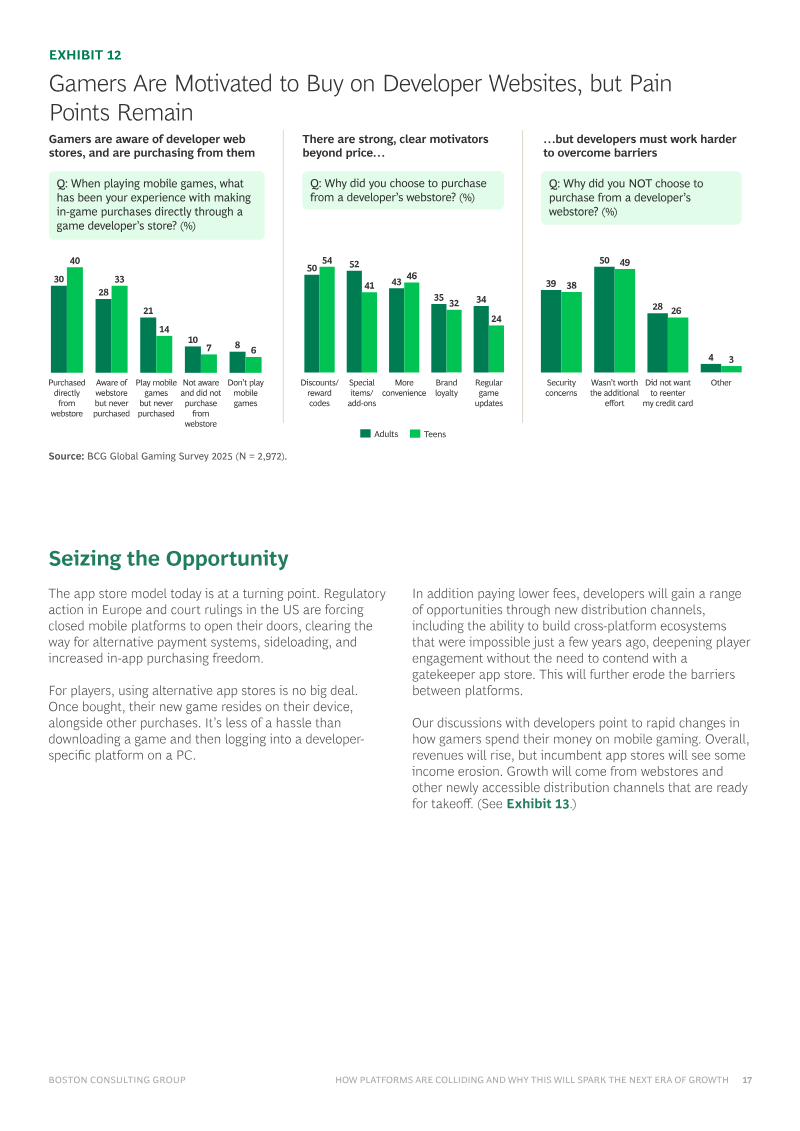
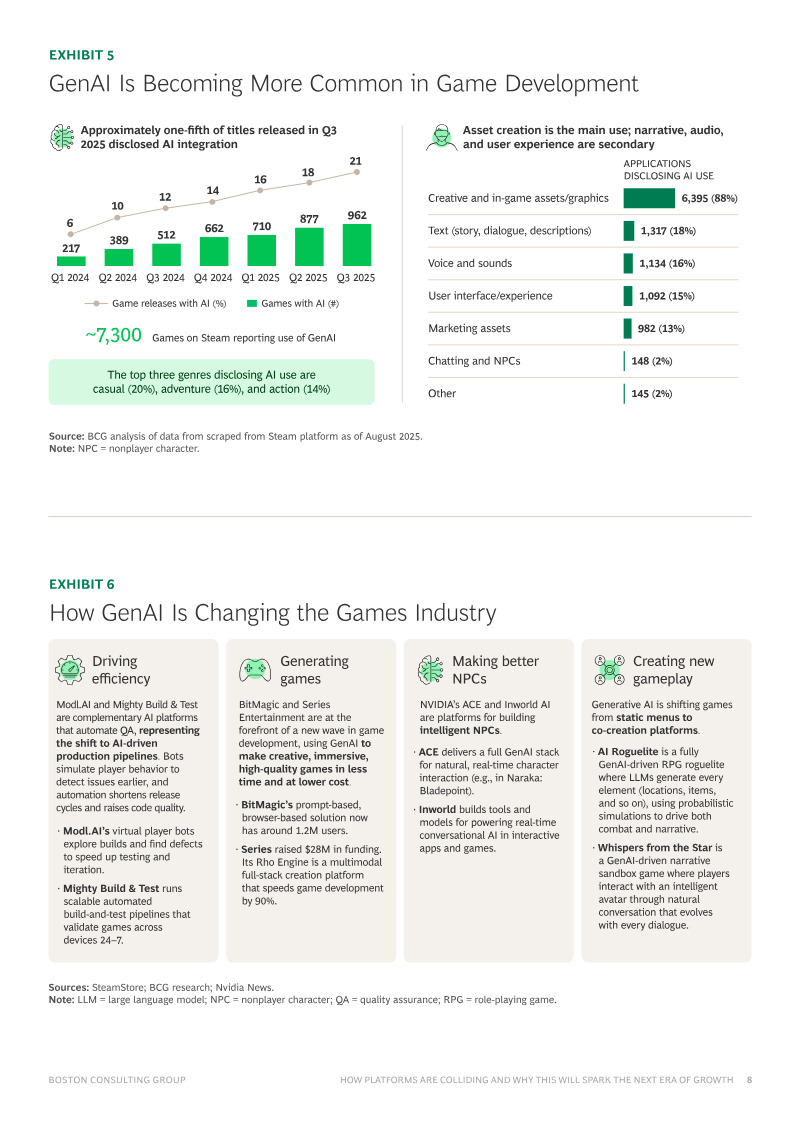
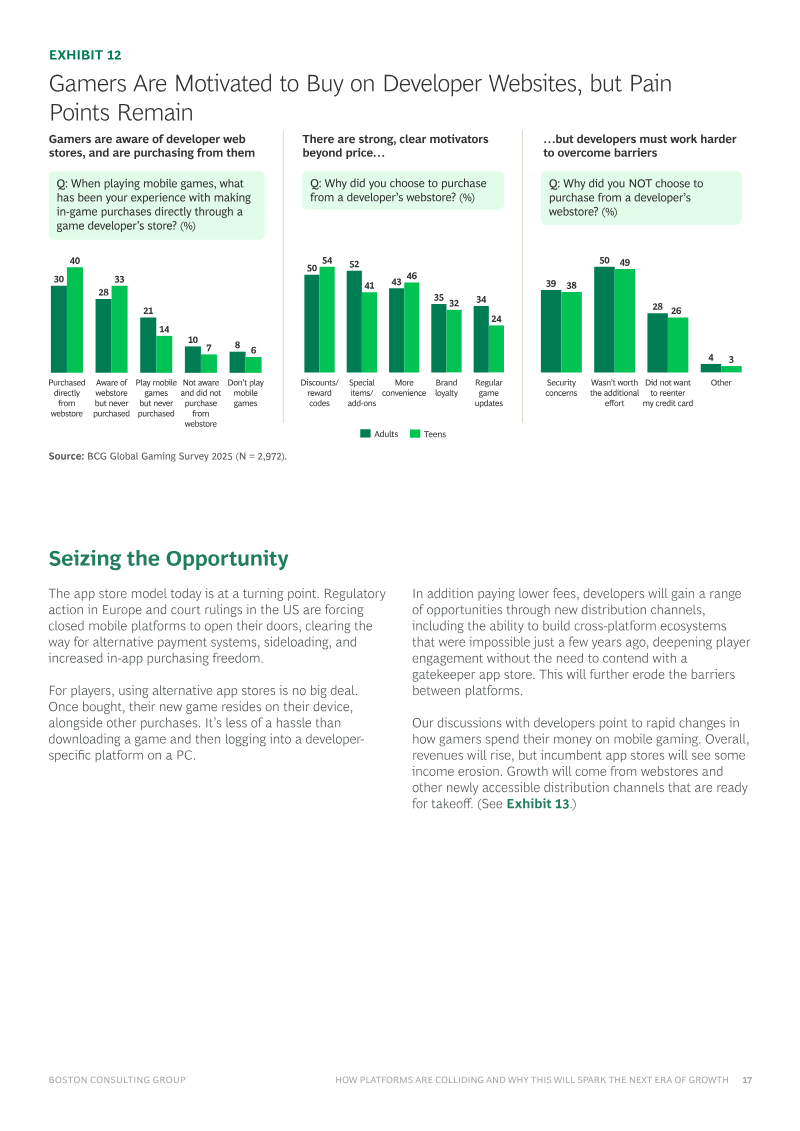
Key findings indicate that Generative AI is already being utilized by approximately 50% of studios to improve development efficiency and create adaptive gameplay, with 20% of new Steam games disclosing AI use by mid-2025. Simultaneously, the creator economy is surging; payouts from platforms like Roblox and Fortnite are projected to exceed $1.5 billion in 2025. Cloud gaming is also positioned for a massive scale-up, with revenues forecasted to grow from $1.4 billion in 2025 to $18.3 billion by 2030. This shift toward hardware-agnostic play is mirrored in distribution, where 33% of adult gamers have already purchased titles directly from developer web stores to bypass traditional platform fees.

The scope of this analysis is global, with a particular focus on major markets including the US, China, Germany, Japan, and South Korea. It covers the industry from late 2025 through projections for 2030, spanning mobile, console, and PC segments. Data is derived from the Global Gaming Survey of approximately 3,000 gamers, metadata analysis of the Steam platform, and interviews with industry leaders and developers.

The industry concludes that success in this new landscape requires a departure from traditional "console war" mentalities in favor of ecosystem-based strategies. Developers must master new monetization models, such as tiered pricing and windowing, to protect the value of premium content while navigating a market increasingly defined by infinite digital shelf space and algorithmic discovery.

  • Cloud gaming revenue is projected to scale from $1.4 billion in 2025 to $18.3 billion by 2030, marking a transition toward hardware-agnostic play.
  • The creator economy is expanding rapidly, with payouts to creators on platforms like Roblox and Fortnite projected to exceed $1.5 billion in 2025.
  • Generative AI is currently used by 50% of studios to enhance development efficiency, with 20% of new Steam games expected to disclose AI usage by mid-2025.

  • Direct-to-consumer distribution is gaining traction, as 33% of adult gamers have already purchased titles via developer web stores to circumvent traditional platform fees.
  • Industry success now requires shifting from console-centric competition to ecosystem-based strategies that utilize tiered pricing and windowing to manage content value.
+1
Boston Consulting GroupJan 2025

Publishers

Related Topics