Market (Overall)·Updated Mar 17, 2026 by Niko Partners
Report · January 1, 2025
Published by Niko Partners
The video game markets across Asia and the Middle East are entering a period of recalibrated growth, with total revenues across key sub-regions projected to reach significant milestones by 2025. China remains the dominant force, with revenues expected to hit $51.2 billion in 2025, supported by a 4.1% year-over-year increase. This growth is fueled by a 24% rise in game approvals and proactive government subsidies. While China maintains a steady long-term outlook with a 3.0% five-year compound annual growth rate, India emerges as the fastest-growing market. India is projected to surpass the $1 billion threshold in 2025 with a 16.2% year-over-year increase, driven by the PROG Act of 2025, which pivoted the industry away from real-money gaming toward traditional video games and esports. Regional performance varies significantly based on local macroeconomic conditions and hardware cycles. East Asia, comprising Japan and South Korea, shows a more optimistic outlook than previously anticipated, with a revised five-year growth rate of 1.7%. This shift is attributed to the successful launch of the Nintendo Switch 2 and a recovery in the South Korean mobile sector. Conversely, Southeast Asia and the MENA-3 region (Saudi Arabia, UAE, and Egypt) face more tempered expectations. Southeast Asia’s growth forecast was lowered to 3.5% due to headwinds in Thailand and Indonesia, despite strong performance in Vietnam. Similarly, the MENA-3 forecast was adjusted downward to a 6.4% growth rate as economic challenges in Egypt and slower mobile growth in Saudi Arabia offset increased government support for localization and age-rating reforms. The data, derived from Niko Partners’ 2025 half-year market model updates, covers PC, mobile, and console platforms across 13 distinct markets. The methodology integrates proprietary market models, macroeconomic indicators, and qualitative regulatory analysis to provide a comprehensive five-year outlook through 2029. Overall, the findings suggest that while mature markets like China and East Asia are stabilizing, emerging markets like India and Vietnam are becoming critical drivers of global industry expansion.

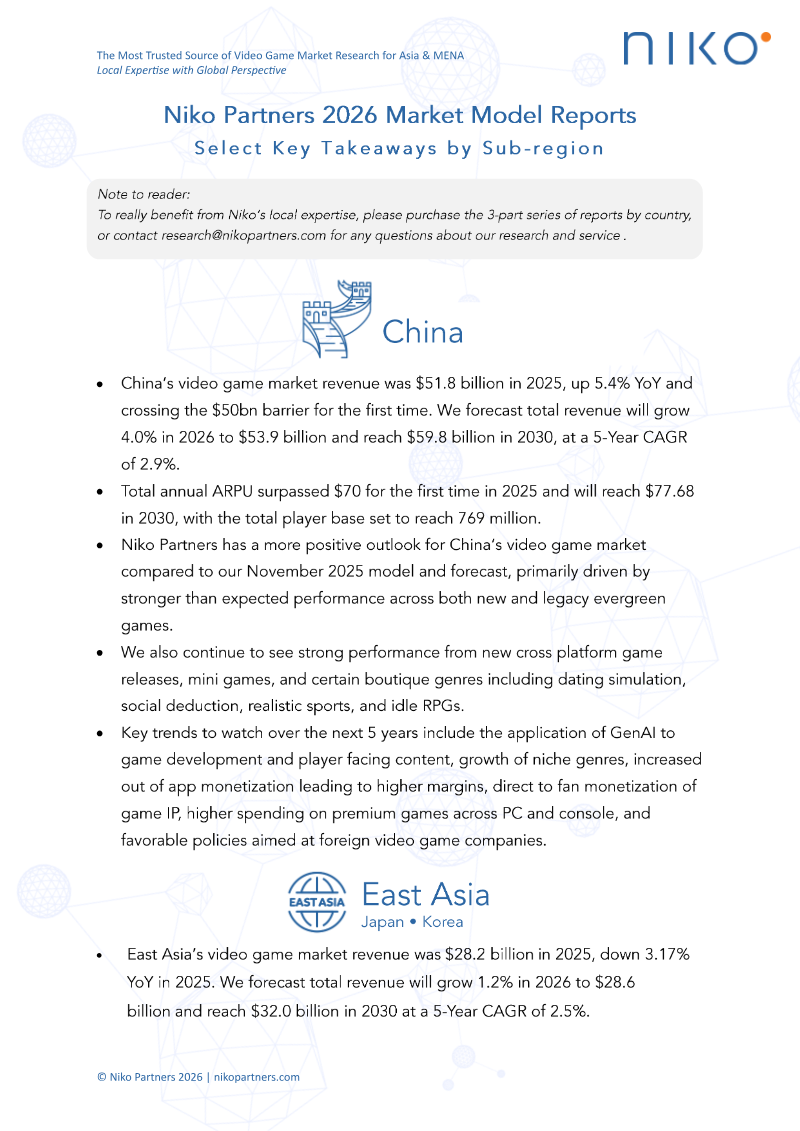
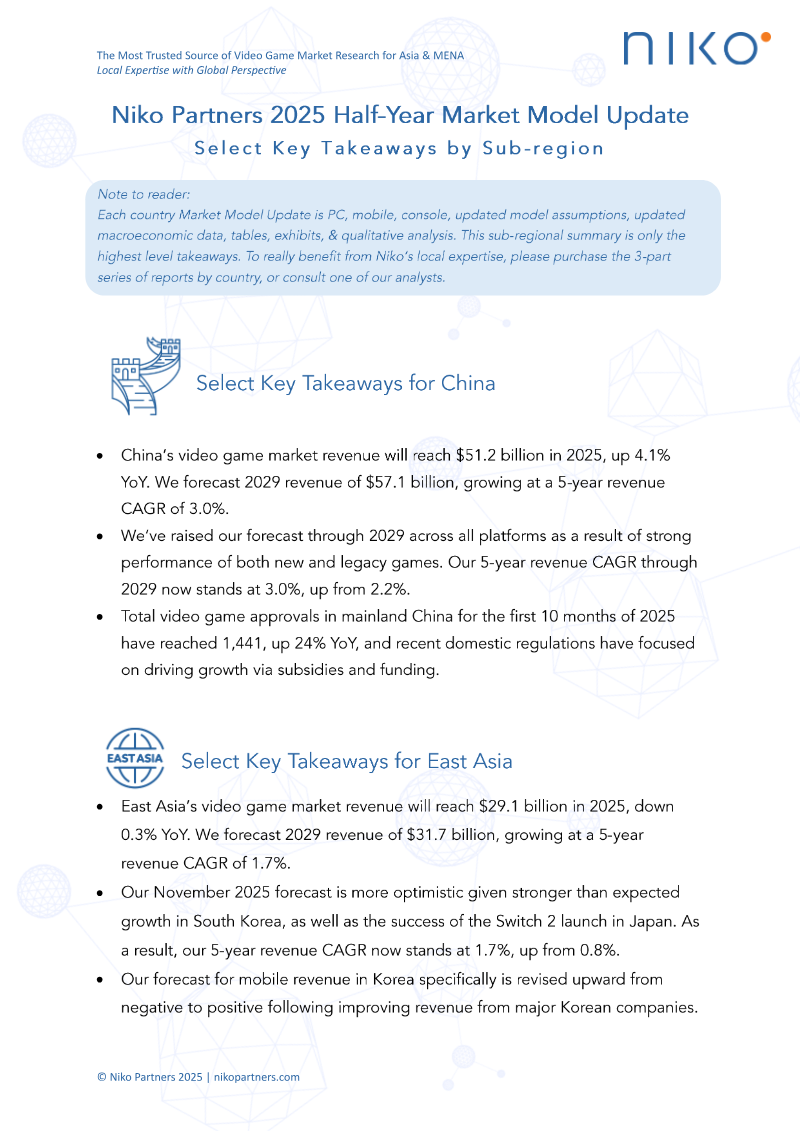
# Niko Partners 2025 Half-Year Market Model Update Select Key Takeaways by Sub-region Note to reader: Each country Market Model Update is PC, mobile, console, updated model assumptions, updated macroeconomic data, tables, exhibits, & qualitative analysis. This sub-regional summary is only the highest level takeaways. To really benefit from Niko's local expertise, please purchase the 3-part series of reports by country, or consult one of our analysts. # Select Key Takeaways for China - China's video game market revenue will reach $51.2 billion in 2025, up 4.1% YoY. We forecast 2029 revenue of$ 57.1 billion, growing at a 5-year revenue CAGR of 3.0%. - We've raised our forecast through 2029 across all platforms as a result of strong performance of both new and legacy games. Our 5-year revenue CAGR through 2029 now stands at $3.0\%$ , up from $2.2\%$ . - Total video game approvals in mainland China for the first 10 months of 2025 have reached 1,441, up $24\%$ YoY, and recent domestic regulations have focused on driving growth via subsidies and funding. # Select Key Takeaways for East Asia - East Asia's video game market revenue will reach \(29.1 billion in 2025, down \(0.3\%\) YoY. We forecast 2029 revenue of \(\$ 31.7\) billion, growing at a 5- year revenue CAGR of \(1.7\%\). - Our November 2025 forecast is more optimistic given stronger than expected growth in South Korea, as well as the success of the Switch 2 launch in Japan. As a result, our 5-year revenue CAGR now stands at $1.7\%$ , up from $0.8\%$ . - Our forecast for mobile revenue in Korea specifically is revised upward from negative to positive following improving revenue from major Korean companies.
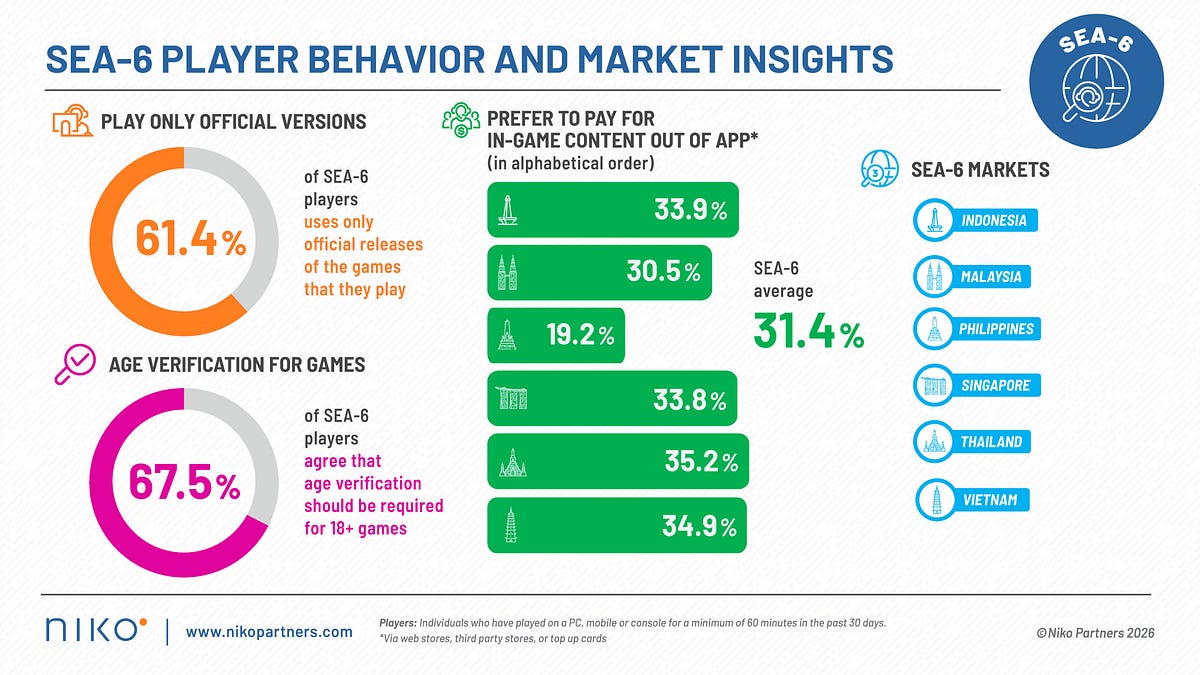
# Select Key Takeaways for India - India's video game market revenue will reach \(1.1 billion in 2025, up \(16.2\%\) YoY, surpassing the \(\$ 1\)billion milestone. We forecast 2029 revenue of \(1.67 billion, growing at a 5- year CAGR of \(12.9\%\). - While our short-term outlook for India remains relatively unchanged, we are more bullish on long-term prospects and have increased our 5-year revenue CAGR through 2029 to $12.9\%$ , up from $12.3\%$ as per our May 2025 forecast. - The introduction of the PROG act in August 2025, effectively banning Real Money Gaming and increasing government support for video games and esports, is a positive sign for the market and we see it as a deliberate move to allow the domestic video games and esports industries to grow. # Select Key Takeaways for Southeast Asia - Southeast Asia's video game market revenue will reach $5.5 billion in 2025, up 2.1% YoY. We forecast 2029 revenue of$ 6.4 billion at a 5-year CAGR of 3.5%. - While we expect stronger growth across Malaysia, the Philippines and Vietnam, we have reduced our forecast for Thailand and Indonesia which has resulted in our 5-year CAGR dropping from $3.8\%$ to $3.5\%$ . - Macroeconomic indicators are showing strong signs of growth in Vietnam, in particular, combined with the government's support for the games industry, leading to increasing revenue forecast for Vietnam. # Select Key Takeaways for MENA-3 - MENA-3 video game market revenue will reach $2.2 billion in 2025, up 8.5% YoY. We forecast 2029 revenue of$ 2.8 billion, growing at a 5-year CAGR of 6.4%.
- The slight decrease in our long-term forecast is a result of ongoing headwinds negatively impacting Egypt, as well as lower than expected mobile games growth in Saudi Arabia and the UAE. - Government support remains strong in the region with the introduction of a new $21+$ age rating, as well as increased localization support from public and private firms, increasing the supply of games and tournaments in the region. Niko Partners Market Reports are produced by our expert analysts & include Niko's proprietary data & insights, curated & organized for a broad range of companies. We include the most important & relevant data, market models, analysis of gamer survey results, & so much more. Perfect for companies who want the key information reported to them in an easy-to-read manner with bullet points & exhibits. A set of three reports are produced for each of the 13 markets we track: - Annual Market Model Report - PC, mobile, console, survey demographics, model assumptions, macroeconomic data, tables, exhibits & qualitative analysis - Annual Gamer Behavior & Market Insights Reports by country - Gamer survey results, trends analysis, M&A, Internet cafes, regulations, esports & more - Six-Month Model Update to the Market Model Click here to learn more about our market reports
The global games market is entering a period of moderate maturation, with total revenue projected to reach $188.8 billion in 2025, a 3.4% increase over the previous year. The industry now serves 3.6 billion players, reflecting a 4.4% year-over-year expansion. While mobile gaming maintains its dominance, accounting for $103.0 billion or 55% of total revenue, console gaming is poised for the strongest growth at 5.5%, reaching $45.9 billion. PC gaming remains a stable pillar with $39.9 billion in revenue. Despite the growth in player counts, average spend per payer is experiencing a slight decline, signaling a strategic pivot toward maximizing engagement and retention within saturated markets rather than relying solely on aggressive monetization. Strategic success in this environment increasingly depends on long-tail engagement and the effective management of post-launch content. Data indicates that releasing single-player titles during the second quarter yields 34% higher engagement compared to the saturated holiday season. Furthermore, simultaneous multi-platform launches significantly outperform staggered releases, and titles exiting Early Access after a six-month window demonstrate superior acquisition results. Developers are also increasingly leveraging remakes and remasters to mitigate rising development costs, while user-generated content platforms like Roblox continue to expand as foundational ecosystems for daily active users. Geographically, the market continues to diversify, with Latin America emerging as a notable growth region projected to reach $8.3 billion, driven primarily by mobile adoption. The industry’s analytical framework, which focuses on consumer spending on software and services, highlights that player attrition typically stabilizes after 12 weeks. Consequently, long-term commercial viability is now inextricably linked to aligning content updates and discounting strategies with this post-launch retention curve, ensuring that community support remains as critical as initial sales performance.
The analysis projects that the worldwide video‑game market has entered a mature phase, with revenue expected to reach $236.9 billion in 2025 and to climb modestly to $280.1 billion by 2031. Growth rates flatten to around 4–5 percent annually, roughly matching global inflation, and the compound annual growth rate through 2031 is low enough that double‑digit expansion is deemed unrealistic. Software sales remain the primary engine, buoyed by premium launches such as the next Grand Theft Auto installment and new Switch titles, while in‑game spending—currently about 68 percent of software revenue—will dip slightly to 67 percent by 2031. Subscription services are forecast to rise from $13.1 billion to $18.5 billion, driven largely by price increases as user bases saturate. Geographically, the Asia‑Pacific region dominates the player base, comprising roughly 53 percent of the 1.53 billion gamers counted in 2024 and exhibiting the highest penetration at about 13 percent of the regional population. Although software revenues are set to grow modestly across all markets, the analysis warns that live‑service oversaturation is eroding in‑game spend, while premium purchases and subscription models gain traction, particularly in China and other APAC economies. Strategically, the findings suggest that developers and publishers should shift from a survival‑until‑2025 mindset to a longer‑term “stick‑till‑2026” approach, emphasizing high‑quality premium releases, selective investment in live‑service titles, and cross‑platform integration. The forecasts rely on a proprietary model that combines company financials, survey data, and third‑party sources, and the authors note that the projections reflect their own assumptions and carry no liability for potential losses.
The global games market has transitioned into a phase of structural maturity, with 2025 revenues projected at $236.9 billion. While this represents a 4.6% year-on-year increase, the growth is essentially flat when adjusted for inflation, signaling an end to the era of consistent double-digit expansion. Significant industry catalysts, specifically the anticipated launch of the Nintendo Switch 2 and the release of Grand Theft Auto 6, are expected to drive a recovery in hardware and software sales. However, these gains will likely be concentrated among market leaders rather than lifting the broader industry. By 2031, the global player base is forecast to reach 4.02 billion, with long-term growth sustained by premium game sales and advertising as the live-service sector faces saturation. Software revenue continues to be dominated by in-game spending, which accounts for 69% of the market in 2025. Despite this dominance, premium full-game purchases are regaining momentum as consumers pivot toward high-quality single-player experiences. The subscription sector, while reaching $11.8 billion in 2024, is also maturing; future revenue in this segment will likely depend on price adjustments and the introduction of ad-supported tiers rather than rapid user acquisition. This shift reflects a broader trend where the industry is moving away from saturated multi-game models toward more traditional premium monetization and the expansion of game-based intellectual property into film and television. Geographically, the Asia Pacific region maintains its position as the largest market by player count and leads in in-game revenue. A significant shift is expected by 2028, as premium game revenue in Asia Pacific is projected to overtake North America, driven by the rising success of high-end titles in China. While North America currently retains its lead in full-game purchase revenue, the global landscape is increasingly defined by regional cultural adaptation and the porting of legacy titles to new hardware platforms. These dynamics suggest a future where growth is driven by strategic price increases and regional expansion rather than the explosive user growth seen in previous decades.
Southeast Asia solidified its position as the world’s second-largest mobile gaming market by downloads in early 2025, reaching 1.93 billion installs. While the region currently ranks seventh globally in revenue at $625 million, it demonstrates significant monetization potential fueled by expanding digital payment infrastructure and rising smartphone penetration. Indonesia serves as the primary volume driver with 870 million installs, while Thailand leads the region in consumer spending, generating $162 million. This growth is increasingly supported by publishers based in Singapore and Vietnam, who have emerged as a dominant global force, contributing over 5.8 billion installs to the international market through a mix of hypercasual hits and competitive titles. Market dynamics reveal a shift toward high-engagement genres and localized content strategies. Although casual arcade and simulation games drive the highest download volumes, monetization is concentrated in Strategy, MOBA, and RPG segments. Mobile Legends: Bang Bang remains the regional revenue leader, sustained by hyper-local live operations and community engagement. Simultaneously, the 4X Strategy genre is experiencing rapid expansion, highlighted by a 77.7% revenue surge for titles like Last War: Survival. Conversely, traditional MMORPGs have seen a decline of nearly 20%, making way for Open World Adventure RPGs and sophisticated strategy games that leverage deep social and competitive mechanics. The regional landscape is characterized by distinct national preferences and the global expansion of local firms. Vietnam has become a powerhouse for survival-themed hypercasual games, while Thailand shows a unique affinity for realistic sports simulations. Established titles like Garena Free Fire continue to dominate global charts by blending cultural relevance with nostalgic collaborations. Ultimately, the region’s trajectory is defined by a transition from high-volume downloads to sophisticated monetization, driven by a combination of community-led activations and the strategic global influence of Southeast Asian publishers.