Market Analysis
Documents
Prezentacja Wyników Q3 2021
The financial results for PCF Group (People Can Fly) through the third quarter of 2021 reflect a period of significant scaling and strategic expansion. The group reported a 66.2% year-over-year increase in revenue, reaching 131.8 million PLN, while net profit rose by 112.6% to 46.4 million PLN. This growth was accompanied by a substantial increase in cash reserves, which grew by 262.6% to 149.8 million PLN, and a 62.7% expansion of the workforce to over 450 employees across global hubs including Warsaw, New York, and Montreal.
The operational focus centered on the continued development of the Outriders franchise and the diversification of the production pipeline. Following the release of the New Horizon update, the game saw a significant resurgence in player engagement, including a peak of over 10,000 concurrent users on Steam and an increase in positive player sentiment to 80%. Looking forward, the group is developing several major projects: Project Gemini with Square Enix and Project Dagger with Take-Two Interactive, both slated for 2024, alongside a self-published original IP and two additional projects in the conceptual phase.
The updated corporate strategy aims to establish the group as a leading independent developer capable of releasing at least one game annually starting in 2024. This roadmap includes expanding into new genres and the "compact AAA" segment. Financial stability is supported by a shift in revenue structure, where development services remain the primary driver, supplemented by royalties. The group’s methodology for these results follows IFRS standards, with adjusted EBITDA figures accounting for IPO costs and stock-based compensation to provide a normalized view of operational performance.
- PCF Group achieved significant financial growth in Q3 2021, with revenue increasing 66.2% year-over-year to 131.8 million PLN and net profit rising 112.6% to 46.4 million PLN.
- The company is executing a strategic roadmap to release at least one game annually starting in 2024, focusing on the 'compact AAA' segment and genre diversification.
- Development is underway for major titles including Project Gemini with Square Enix and Project Dagger with Take-Two Interactive, both targeted for 2024 release.
- Cash reserves grew by 262.6% to 149.8 million PLN, while the workforce expanded by 62.7% to over 450 employees across global hubs in Warsaw, New York, and Montreal.
- The Outriders franchise saw a resurgence in engagement following the New Horizon update, reaching a peak of over 10,000 concurrent users on Steam and achieving an 80% positive sentiment rating.

Strategy Genre Snapshot: October 2021
The strategy genre represents a cornerstone of the mobile gaming market, accounting for approximately 17% of total revenue on the US iOS platform as of October 2021. Analysis reveals that the genre is heavily dominated by the 4X strategy subgenre, which comprises 20 of the top 25 grossing strategy titles. While the market is characterized by aging hits and high competition, recent success has been driven by genre-blending, where developers integrate mechanics from other categories—such as merge, match-3, or RPG elements—to broaden player appeal.
Key market leaders include State of Survival, which became the top-grossing 4X title following a massive year-long collaboration with The Walking Dead, and Supercell, which remains the primary outlier succeeding with non-4X strategy titles like Clash of Clans. In contrast, the MOBA subgenre continues to face sustainability challenges in the US; despite a strong launch, League of Legends: Wild Rift struggled to maintain a position in the top 200 grossing charts, leaving the long-term viability of newer entries like Pokémon UNITE uncertain.
The core appeal of the genre is rooted in long-term power progression, complex live operations, and deep social integration. Data indicates that successful titles leverage permanent boosts, recurring event loops, and competitive guild mechanics to drive engagement. According to a survey of over 7,000 mobile gamers in English-speaking Western markets, the primary motivational drivers for strategy players are strategic planning, resource optimization, and social competition. These findings suggest that while the 4X subgenre remains the revenue leader, the path to growth lies in sophisticated monetization through battle passes and the continuous expansion of social and competitive features.
- As of October 2021, the strategy genre accounts for 17% of total mobile revenue on the US iOS platform, with 4X titles occupying 20 of the top 25 grossing spots.
- Genre-blending is the primary growth strategy, with developers integrating merge, match-3, and RPG mechanics to broaden appeal beyond traditional 4X gameplay.
- State of Survival leads the 4X market following a year-long collaboration with The Walking Dead, while Supercell remains the primary outlier succeeding with non-4X titles like Clash of Clans.
- The MOBA subgenre faces significant sustainability challenges in the US, as evidenced by League of Legends: Wild Rift failing to maintain a top 200 grossing position.
- Strategy players are primarily motivated by strategic planning, resource optimization, and social competition, according to a survey of over 7,000 mobile gamers in Western markets.

Strategy Genre Snapshot 2021
The strategy genre remains a cornerstone of the mobile gaming market, currently ranking as the third-largest genre in the United States on iOS with a 17% revenue market share. The landscape is heavily dominated by the 4X strategy subgenre, which accounts for 20 of the top 25 grossing strategy titles. While the market is crowded with aging titles, recent growth is driven by genre-blending, where developers integrate mechanics from other categories—such as merge, match-3, or RPG elements—to broaden player appeal.
Market analysis reveals that 4X strategy games rely on three primary pillars: long-term power progression through permanent boosts and deep economies, complex live operations featuring recurring events, and robust social frameworks centered on competition and collaboration. High-performing examples include State of Survival, which reached the top of the 4X subgenre through massive IP collaborations, and Top War, which successfully scaled using merge mechanics. Conversely, the MOBA subgenre continues to face challenges in the U.S. market; despite a strong launch, League of Legends: Wild Rift struggled to maintain its top-grossing position, leaving the subgenre's future performance to newer entries like Pokémon UNITE.
Player motivation data, derived from a survey of over 7,000 respondents across English-speaking Western territories, indicates that strategy players are primarily driven by strategic planning, resource optimization, and social competition. Successful titles capitalize on these drivers by offering deep technology trees, competitive guild mechanics, and diverse PvP modes. While Supercell remains the only major player finding significant success outside the 4X subgenre with titles like Clash of Clans, the broader trend suggests that sustained revenue in this space requires a sophisticated mix of deep monetization loops and constant feature innovation.
- The 4X subgenre dominates the U.S. mobile strategy market, accounting for 20 of the top 25 grossing titles within a genre that holds a 17% total iOS revenue share.
- Successful strategy titles are increasingly driven by genre-blending, integrating mechanics like merge, match-3, or RPG elements to expand their player base beyond traditional core audiences.
- High-performing 4X games rely on three core pillars: long-term power progression through deep economies, complex live operations with recurring events, and social frameworks built on competition and collaboration.
- Player motivation data from over 7,000 Western respondents confirms that strategic planning, resource optimization, and social competition are the primary drivers for engagement in the genre.
- While Supercell remains a notable exception with Clash of Clans, the broader strategy market is currently defined by aging titles that require constant feature innovation and deep monetization loops to maintain revenue.
Sports & Racing Games Report: Q3 2021
The sports and racing gaming sectors experienced a transformative period throughout 2020 and early 2021, characterized by a 40.2% year-over-year revenue increase to $2 billion. This growth was underpinned by a clear bifurcation in market dynamics: while realistic sports and racing titles consistently outperformed arcade-style counterparts in revenue generation, arcade games maintained higher download volumes. The industry remains highly concentrated, with a small cohort of major publishers—including Electronic Arts, Konami, Tencent, and Zynga—exerting significant control over both market share and intellectual property. Strategic consolidation through high-profile mergers and acquisitions, such as the integration of Glu Mobile and Codemasters into Electronic Arts, reflects a broader industry trend toward portfolio expansion and market dominance.
Geographic performance reveals distinct regional preferences that dictate global revenue flows. The United States remains the primary revenue driver for Western-centric sports and drag racing, while Japan serves as the critical hub for baseball and soccer titles. Conversely, emerging markets such as India and Brazil lead in total download volume, highlighting a disparity between user acquisition and monetization potential. Within the racing segment, kart racing has emerged as a superior model for long-term player retention and balanced gender demographics, contrasting with the gradual revenue decline observed in racing simulators since late 2019.
Despite a temporary pandemic-induced surge in arcade racing downloads during 2020, the market has largely normalized to pre-pandemic levels. The sports manager sub-genre exemplifies the industry’s shift toward high-value monetization, as it has successfully increased net revenue despite a multi-year decline in download volume. Ultimately, the sector is defined by a reliance on established intellectual property and a strategic focus on realistic simulation, with revenue spikes frequently tethered to the launch of major new titles. These trends underscore a mature, consolidated market where success is increasingly dependent on publisher scale and the ability to sustain engagement within specific, high-performing sub-genres.
- The sports and racing sectors saw a 40.2% year-over-year revenue increase to $2 billion between 2020 and early 2021.
- Market power is highly concentrated among major publishers like Electronic Arts, Konami, Tencent, and Zynga, who are driving growth through strategic acquisitions such as Glu Mobile and Codemasters.
- Realistic simulation titles consistently outperform arcade-style games in revenue, while arcade games continue to lead in total download volume.
- The United States remains the primary revenue driver for Western-centric titles, whereas India and Brazil lead in download volume, revealing a significant gap between user acquisition and monetization.
- Sports manager games have successfully increased net revenue despite a multi-year decline in download volume, signaling a shift toward high-value monetization strategies.
Omówienie wyników H1 2021
PCF Group S.A. presents a comprehensive financial and operational overview for the first half of 2021, highlighting a period of significant scaling and strategic evolution. The group reported a 47% year-over-year increase in revenue, reaching 77.3 million PLN, while EBITDA rose by 36.5% to 28.8 million PLN. Net profit for the period grew by 25.4% to 21.7 million PLN. This financial growth was accompanied by a substantial expansion of the workforce, which increased by nearly 42% to over 420 employees across global hubs including Warsaw, New York, and Montreal.
The strategic focus centers on transitioning toward a dual-model production cycle involving both major publisher partnerships and self-publishing. Key projects include continued support for Outriders, despite publisher reports indicating no royalties were earned in the first quarter post-launch. Future growth is anchored by Project Gemini with Square Enix and Project Dagger with Take-Two Interactive, both slated for 2024 releases. Additionally, the group is developing a new proprietary IP funded internally and exploring two conceptual projects.
Geographically, the group has strengthened its North American presence, with 120 employees now based in that region. This expansion is supported by a robust cash position of 150.3 million PLN, representing a 263.9% increase from the end of 2020. The long-term objective is to achieve a position as a leading independent global developer, targeting annual game releases starting in 2024 through the development of the PCF Framework and potential future acquisitions.
- PCF Group achieved strong H1 2021 financial growth, with revenue rising 47% to 77.3 million PLN, EBITDA up 36.5% to 28.8 million PLN, and net profit increasing 25.4% to 21.7 million PLN.
- The company is scaling its global operations, increasing its workforce by 42% to over 420 employees and significantly strengthening its North American presence with 120 staff members.
- Strategic growth is anchored by two major publisher-partnered titles, Project Gemini with Square Enix and Project Dagger with Take-Two Interactive, both scheduled for release in 2024.
- The group is transitioning toward a dual-model production strategy that combines major publisher partnerships with internal self-publishing of new proprietary IP.
- Financial stability is supported by a robust cash position of 150.3 million PLN, representing a 263.9% increase compared to the end of 2020.
Gaming Deals Activity Report Q1‑Q3 ’21
The global video games industry experienced a period of significant financial expansion during the first three quarters of 2021, characterized by a 2.5x year-over-year growth in cumulative deal value. Total closed transactions reached $57.7 billion across 667 deals, nearly tripling the $22.7 billion recorded during the same period in 2020. This surge was driven by a robust performance in mergers and acquisitions, which accounted for 48% of total value, followed by public offerings at 37% and private investments at 15%.
The gaming segment remained the primary driver of activity, representing 75% of total deal value. Mobile gaming emerged as a particularly dominant force, contributing 84% of M&A value in the third quarter alone, highlighted by Electronic Arts’ $1.4 billion acquisition of Playdemic. While public offerings faced a cooling period in the third quarter due to market turbulence and share price declines among industry leaders, the period still saw massive exits, including the $3.75 billion IPO of Krafton. Private placements also hit record levels, with late-stage funding rounds for companies like Sorare and Discord signaling sustained investor confidence.
A notable shift in the industry landscape is the rapid ascent of blockchain gaming. This sub-sector saw a 34x year-over-year increase in deal value, reaching $1.56 billion. Investment is currently concentrated in companies building platform layers and infrastructure for non-fungible tokens and play-to-earn models. Geographically, China remained a focal point for strategic activity, largely led by Tencent, which closed 69 deals during the nine-month period.
The data is compiled through the tracking of closed transactions across the gaming, platform, tech, and esports segments, excluding pure gambling and betting. Methodology involves a combination of public media monitoring, business partner insights, and S&P Capital IQ data. The findings suggest that despite a slight quarterly deceleration in public markets, the broader gaming ecosystem continues to attract record-breaking capital from both venture funds and strategic corporate investors.
- The global video games industry saw a 2.5x year-over-year increase in deal value, totaling $57.7 billion across 667 closed transactions during the first three quarters of 2021.
- Mergers and acquisitions dominated the market, accounting for 48% of total deal value, with mobile gaming specifically driving 84% of M&A value in Q3, exemplified by Electronic Arts' $1.4 billion acquisition of Playdemic.
- Blockchain gaming experienced explosive growth, recording a 34x year-over-year increase in deal value to reach $1.56 billion, with investment focused on NFT infrastructure and play-to-earn platforms.
- Public offerings contributed 37% of total deal value, highlighted by the $3.75 billion IPO of Krafton, despite a cooling trend in the third quarter due to market turbulence.
- Tencent remained a primary strategic force in the industry, closing 69 deals during the nine-month period to maintain China's position as a focal point for investment.
India Market Update: September 2021
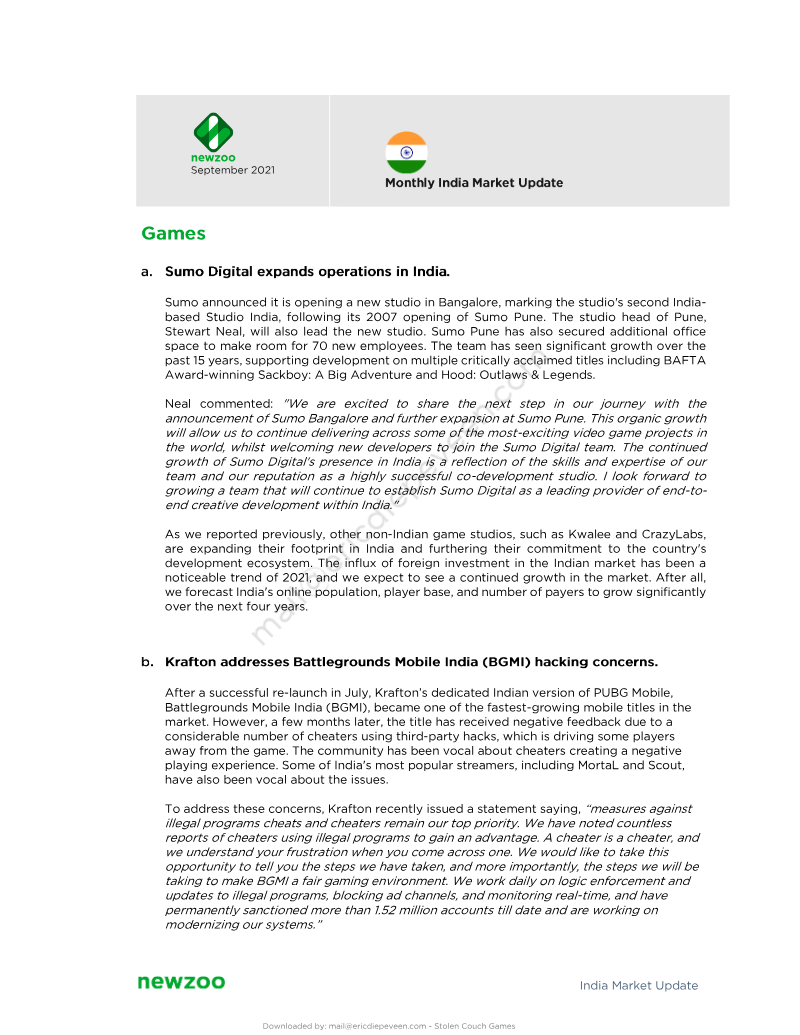
The Indian gaming and esports landscape is undergoing a period of rapid institutional growth and diversification, characterized by significant foreign investment and the expansion of domestic infrastructure. During the 2021 period, international developers such as Sumo Digital, Kwalee, and CrazyLabs have deepened their commitment to the region. Sumo Digital’s establishment of a second studio in Bangalore and the expansion of its Pune facility highlight a strategic shift toward utilizing India as a hub for end-to-end creative development rather than just a support center. This trend aligns with forecasts predicting substantial increases in India’s online population, player base, and total number of paying users over the next four years.
The mobile gaming sector remains a primary driver of market activity, though it faces operational hurdles. Krafton’s Battlegrounds Mobile India has seen explosive growth but must navigate the technical challenge of maintaining competitive integrity. The company has permanently sanctioned over 1.52 million accounts to combat cheating, illustrating the friction between accessibility in free-to-play titles and the necessity of robust anti-cheat measures. Simultaneously, the real-money and fantasy gaming segments are accelerating, evidenced by Mobile Premier League reaching a $2.3 billion valuation following a $150 million Series E funding round intended to fuel global expansion into markets like the United States.
The esports ecosystem is maturing through consolidation and the convergence of gaming with broader entertainment sectors. Market leader NODWIN Gaming has expanded its reach into the casual and mid-core demographics by acquiring OML Entertainment’s IP business and partnering with PVR Cinemas to pilot in-theater esports viewing. These moves signify a transition toward a more integrated media model where gaming, music, and comedy intersect to drive brand engagement. Overall, the Indian market is evolving into a sophisticated environment defined by high-value capital raises, localized content strategies, and the professionalization of the broader creator economy.
- India is transitioning from a support-focused hub to a center for end-to-end creative development, evidenced by Sumo Digital expanding its Bangalore and Pune facilities.
- Mobile Premier League achieved a $2.3 billion valuation following a $150 million Series E funding round, signaling significant investor confidence in the real-money and fantasy gaming segments.
- Krafton’s Battlegrounds Mobile India has permanently banned over 1.52 million accounts to address cheating, highlighting the operational challenges of maintaining competitive integrity in high-growth free-to-play titles.
- NODWIN Gaming is diversifying its esports model by acquiring OML Entertainment’s IP business and partnering with PVR Cinemas to bring esports content into theater environments.
- International developers including Sumo Digital, Kwalee, and CrazyLabs are deepening their strategic commitments to the Indian market in anticipation of growth in the online population and paying user base.

Shooter Genre Snapshot: September 2021
Shooter Genre Snapshot – September 2021 (GameRefinery)
1. Market Overview | Metric | Insight | |--------|----------| | Genre rank (US iOS) | 6th largest mobile genre, ~6 % of total iOS revenue. | | Revenue share | The “Big Three” – Call of Duty: Mobile, PUBG Mobile, and Garena Free Fire – generate > 84 % of shooter revenue. | | Impact of Fortnite removal | Apple‑Epic lawsuit (Fortnite removed Aug 2020) erased a game that once held ~30 % of the shooter market on iOS. | | Growth leader | Garena Free Fire doubled its iOS revenue in 2021, climbing from ~10 % to ~30 % market share and now rivals CoD Mobile for the top spot (Q2 2021). | | New‑entry stagnation | No shooter launched in the last 2 years cracked the top‑grossing 200; only Bullet Echo (May 2020) entered the top‑500. |
2. Top‑Performing Titles (US iOS – Q2 2021)
| Rank | Game | Publisher | Sub‑genre | Share | |------|------|-----------|-----------|-------| | 1 | Garena Free Fire – 4th Anniversary | Garena International | Battle‑Royale | 28.56 % | | 2 | Call of Duty: Mobile | Activision | Classic FPS/TPS | 28.17 % | | 3 | PUBG Mobile – Ignition | Tencent | Battle‑Royale | 26.55 % | | 4 | War Robots | Pixonic | Tactical Shooter | 3.5 % | | 5 | Sniper 3D | Fun Games | Sniper | 3.5 % | | 6 | Pixel Gun 3D | Cubic Games | Classic FPS/TPS | 2.12 % | | 7 | War Machines: Tank | Fun Games | Tactical Shooter | 1.9 % | | 8 | Zooba: Zoo Battle Royale | Wildlife Studios | Battle‑Royale | 1.88 % | | 9 | World of Tanks Blitz | Wargaming | Tactical Shooter | 1.61 % | | 10| Tacticool | – | – | ~1 % |
Key takeaway: The top three dominate ~83 % of the genre’s revenue; the rest of the field is highly fragmented.
3. Why the “Big Three” Stay on Top
| Driver | How It’s Implemented | |--------|----------------------| | Battle Pass | Seasonal “free + paid” tracks that reward playtime, cosmetics, and progression. | | Limited‑time Gachas | Time‑bound loot‑box style draws with increasing price/odds, often tied to events or milestones. | | Live Events & New Modes | Frequent, high‑visibility updates (e.g
- The shooter genre on US iOS is highly concentrated, with the 'Big Three'—Garena Free Fire, Call of Duty: Mobile, and PUBG Mobile—collectively generating over 84% of total genre revenue.
- Garena Free Fire experienced significant growth in 2021, doubling its iOS revenue and capturing approximately 30% of the market share to rival Call of Duty: Mobile for the top position as of Q2 2021.
- The shooter genre accounts for roughly 6% of total US iOS revenue, currently ranking as the platform's 6th largest mobile genre.
- The removal of Fortnite from the App Store in August 2020 eliminated a title that previously commanded approximately 30% of the iOS shooter market.
- New-entry performance is stagnant, as no new shooter titles launched in the two years prior to September 2021 have cracked the top 200 grossing list.

Global Mobile Market Report 2021
The 2021 global mobile market analysis underscores a rapidly expanding ecosystem in which smartphone ubiquity, rising active‑device counts, and the early rollout of 5G networks are driving unprecedented growth in mobile gaming. By integrating socio‑economic indicators, device‑usage data from more than 400 million monthly active devices, and revenue tracking from major app‑store partners, the study projects that mobile‑game spending will climb from $90.7 billion in 2021 to $116.4 billion by 2024, reflecting an 11.2 % compound annual growth rate. Smartphone penetration reached 3.9 billion users in 2021, a 6 % year‑over‑year increase, while 5G‑ready devices are beginning to reshape gameplay experiences and monetisation models.
Regulatory shifts, notably Apple’s App‑Tracking Transparency and Google’s parallel privacy policies, together with the high‑profile Apple‑Epic litigation, are redefining user‑acquisition strategies and prompting developers to explore platform‑driven revenue streams such as in‑game advertising, subscriptions, and direct storefronts. Revenue distribution remains heavily skewed: the top 20 % of spenders—players who spend $25 or more per month—account for roughly 80 % of total income, favouring socially rich, competitive titles and showing greater openness to ads and subscription offers.
A consumer survey of 5,400 gamers aged 10‑50 across the United States, China, Germany, and Japan reveals modest regional variation in intellectual‑property preferences, suggesting that aligning established entertainment IPs—books, comics, movies, and TV series—with appropriate game genres can enhance engagement. Overall, the findings highlight a market poised for continued expansion, driven by technological adoption, evolving privacy landscapes, and a concentrated core of high‑value players.
- Mobile game spending is projected to grow from $90.7 billion in 2021 to $116.4 billion by 2024, representing an 11.2% compound annual growth rate.
- The top 20% of players, defined as those spending $25 or more per month, generate approximately 80% of total mobile gaming revenue.
- Smartphone penetration reached 3.9 billion users in 2021, marking a 6% year-over-year increase that continues to drive market expansion.
- Regulatory changes, including Apple’s App-Tracking Transparency and Google’s privacy policies, are forcing developers to pivot toward in-game advertising, subscriptions, and direct storefronts for user acquisition.
- The rollout of 5G-ready devices is actively reshaping mobile gameplay experiences and monetization models.
Global Cloud Gaming Report: The Infrastructure Edition 2021
This analysis provides a comprehensive overview of the cloud gaming sector in 2021, focusing on how network infrastructure and global economic conditions have accelerated industry adoption. The primary thesis asserts that while the COVID-19 pandemic provided an initial surge in engagement, the market is now transitioning toward sustainable growth driven by technological maturity, strategic business partnerships, and a global semiconductor shortage that has made cloud streaming a viable alternative to expensive, unavailable local hardware.
The scope of the research is global, with specific emphasis on ten subregions and thirty-three individual markets, including deep dives into China, North America, and Western Europe. Data was gathered through a proprietary model incorporating internet connection speeds, urbanization rates, and service availability, supplemented by a July 2021 survey of 6,788 gamers across China, Germany, Japan, and the United States. The methodology utilizes three forecasting scenarios—base, optimistic, and pessimistic—to account for the inherent volatility of a nascent technology market.
Key findings indicate that the global cloud gaming market reached $1.6 billion in revenues and 23.7 million paying users in 2021. Projections suggest significant expansion, with revenues expected to exceed $6.5 billion and paying users reaching 60.7 million by 2024. While North America and Europe currently account for 59% of consumer spending, emerging markets in Asia-Pacific, Latin America, and the Middle East are poised for rapid growth due to the rollout of 5G infrastructure and high consumer interest in regions where gaming hardware is prohibitively expensive.
The analysis concludes that the industry is moving toward a more frictionless user experience through edge computing and B2B partnerships between service providers and telecommunications companies. Despite the closure of some first-party studios, investment remains high among stakeholders like NVIDIA, Haima Cloud, and now.gg. Consumer sentiment remains positive, characterized by high satisfaction levels and low churn, though long-term success depends on overcoming hardware ownership preferences and continuing to improve global network stability.
- The global cloud gaming market reached $1.6 billion in revenue and 23.7 million paying users in 2021, with projections estimating growth to over $6.5 billion and 60.7 million users by 2024.
- North America and Europe currently dominate the sector, accounting for 59% of total consumer spending.
- The global semiconductor shortage has acted as a catalyst for cloud gaming adoption by positioning streaming services as a viable alternative to scarce and expensive local hardware.
- Rapid growth is expected in Asia-Pacific, Latin America, and the Middle East, driven by the rollout of 5G infrastructure and high demand in regions where local gaming hardware is cost-prohibitive.
- Industry stakeholders, including NVIDIA, Haima Cloud, and now.gg, are prioritizing edge computing and B2B partnerships with telecommunications companies to improve service stability and user experience.
Mobile Game Genre Report: Puzzle Games
This analysis examines the mobile puzzle game market, contrasting dynamics between Western and Eastern regions with a focus on the United States, United Kingdom, Japan, and South Korea. In 2021, mobile emerged as the primary gaming platform globally, with puzzle games representing a significant 8% of total mobile game revenues, totaling $6.9 billion in 2020. The United States leads as the largest market for the genre ($2.0 billion), followed by Japan ($1.2 billion) and China ($0.9 billion).
While puzzle games are the most popular genre across all surveyed markets, regional player behaviors and monetization preferences vary significantly. In the West, players favor casual experiences and show a higher tolerance for in-app advertising (IAA). Conversely, Eastern markets, particularly Japan, demonstrate a higher propensity for in-app purchases (IAP) and deeper engagement with character collection, progression mechanics, and "gacha" systems. Demographically, puzzle gamers worldwide skew female and hold mid-to-high incomes, though players in the East tend to be younger and more highly educated than their Western counterparts.
The findings highlight a shift toward hybrid monetization models that combine IAP, IAA, and subscription-based "Battle Passes." While classic Match-3 remains the dominant subgenre, developers are increasingly integrating "meta" elements such as narrative, decoration, and RPG mechanics to drive retention. Successful global expansion requires localized user acquisition strategies; for instance, Japanese players respond better to longer intervals between ads and collaborative events with popular anime IPs, whereas U.S. marketing often benefits from performance-based ads and localized creative content. The data suggests that while the core appeal of puzzle solving is universal, long-term commercial success depends on tailoring the in-game economy and social engagement tools to specific regional expectations.
- The global mobile puzzle game market generated $6.9 billion in 2020, with the United States leading at $2.0 billion, followed by Japan at $1.2 billion and China at $0.9 billion.
- Puzzle games account for 8% of total mobile game revenue and represent the most popular genre across the United States, United Kingdom, Japan, and South Korea.
- Western markets favor casual experiences and in-app advertising (IAA), whereas Eastern markets demonstrate a higher propensity for in-app purchases (IAP) and complex mechanics like gacha systems.
- Developers are increasingly integrating 'meta' elements—such as narrative, decoration, and RPG mechanics—into classic Match-3 gameplay to improve player retention.
- Successful monetization is shifting toward hybrid models that combine IAP, IAA, and subscription-based 'Battle Passes' to maximize revenue.

3Q FY2021 Presentation Material: April to June 2021
CyberAgent experienced exceptional financial growth during the third quarter of fiscal year 2021, covering the period from April to June. Consolidated sales reached 192.2 billion yen, representing a 70.3% year-over-year increase, while operating profit surged more than fivefold to 44.5 billion yen. This performance was primarily catalyzed by the Game business, specifically the massive commercial success of Uma Musume Pretty Derby. The title surpassed nine million downloads within five months of its launch, driving segment sales up by 151.7% and operating profit by over 480%. The success of this intellectual property has further expanded into a multi-media franchise encompassing anime, music, and live events, prompting an upward revision of full-year forecasts to 650 billion yen in sales and 100 billion yen in operating profit.
The media segment, led by the streaming platform ABEMA, also demonstrated significant momentum with quarterly sales more than doubling to 10.5 billion yen. Weekly Active Users reached a peak of 14.9 million, supported by high-profile sports broadcasting and original content. A critical component of this segment's monetization strategy is the WINTICKET online betting service, which saw transaction volumes grow 5.5 times year-over-year to 39.3 billion yen through strategic integration with ABEMA’s programming.
Beyond current hits, the strategic focus remains on technological innovation and pipeline development. The advertising business reported high adoption rates for AI-driven creative tools, while the gaming division is preparing for future growth with high-profile upcoming titles based on the Final Fantasy VII and Jujutsu Kaisen franchises. These results indicate a robust diversification strategy where high-performing gaming assets and integrated media services drive record-breaking financial outcomes across the Japanese market.
- CyberAgent’s consolidated sales grew 70.3% year-over-year to 192.2 billion yen in 3Q FY2021, with operating profit increasing more than fivefold to 44.5 billion yen.
- The 'Uma Musume Pretty Derby' game drove a 151.7% increase in gaming segment sales and a 480% surge in operating profit, reaching nine million downloads within five months of launch.
- Driven by the success of 'Uma Musume', CyberAgent revised its full-year forecasts upward to 650 billion yen in sales and 100 billion yen in operating profit.
- The ABEMA streaming platform saw quarterly sales more than double to 10.5 billion yen, supported by a peak of 14.9 million Weekly Active Users.
- The WINTICKET online betting service, integrated with ABEMA, achieved a 5.5-fold year-over-year increase in transaction volume to 39.3 billion yen.