Market (Overall)·Updated Mar 21, 2026 by Vungle
Report · October 1, 2021
Published by Vungle
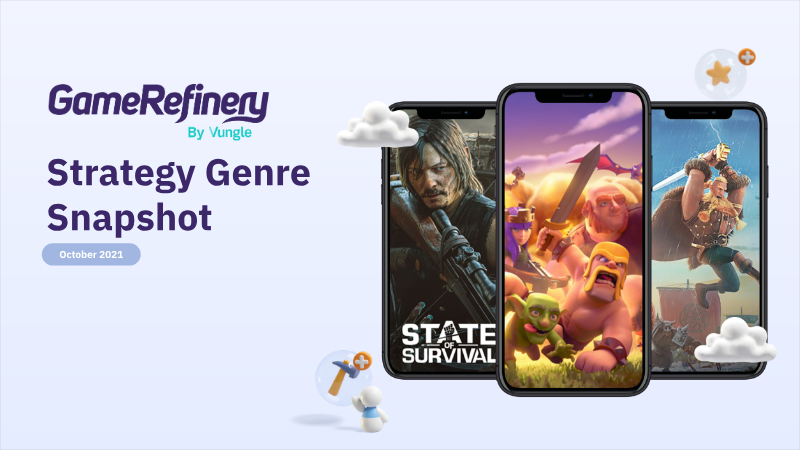
The strategy genre represents a cornerstone of the mobile gaming market, accounting for approximately 17% of total revenue on the US iOS platform as of October 2021. Analysis reveals that the genre is heavily dominated by the 4X strategy subgenre, which comprises 20 of the top 25 grossing strategy titles. While the market is characterized by aging hits and high competition, recent success has been driven by genre-blending, where developers integrate mechanics from other categories—such as merge, match-3, or RPG elements—to broaden player appeal. Key market leaders include State of Survival, which became the top-grossing 4X title following a massive year-long collaboration with The Walking Dead, and Supercell, which remains the primary outlier succeeding with non-4X strategy titles like Clash of Clans. In contrast, the MOBA subgenre continues to face sustainability challenges in the US; despite a strong launch, League of Legends: Wild Rift struggled to maintain a position in the top 200 grossing charts, leaving the long-term viability of newer entries like Pokémon UNITE uncertain. The core appeal of the genre is rooted in long-term power progression, complex live operations, and deep social integration. Data indicates that successful titles leverage permanent boosts, recurring event loops, and competitive guild mechanics to drive engagement. According to a survey of over 7,000 mobile gamers in English-speaking Western markets, the primary motivational drivers for strategy players are strategic planning, resource optimization, and social competition. These findings suggest that while the 4X subgenre remains the revenue leader, the path to growth lies in sophisticated monetization through battle passes and the continuous expansion of social and competitive features.
# GameRefinery uses a three-layered approach to categorize games - Using a Category $= >$ Genre $= >$ Subgenre hierarchy we are able to differentiate games in a meaningful way and offer accurate insights for all individual game types currently found in the market - Our taxonomy is created together with industry experts and is based on thorough testing and data-analysis of the market - In this report we are focusing on the Strategy genre under Mid-core # Casual # Puzzle - Action Puzzle - Board Games - Bubble Shooter - Match 3 Puzzle - Merge Games - Other Puzzle - Word Games - Trivia Games - Coloring Games - Hidden Objects - Solitaire/Mahjong # Lifestyle Customisation Interactive Story Music/Band # AR / Location # Based AR / Location Based # Arcade - Platformer - Shoot/Beat 'em Up - Other Arcade - Tower Defense # Hyper Casual - HC - Puzzle - HC - Tap - HC - Steer - HC - Swipe/Drag - HC - .io - HC - Other # Simulation - Adventures - Breeding - Tycoon/Crafting - Sandbox - Time Management - Idler # RPG # Strategy # Card Games # Sports Arcade Sports Realistic Sports # Driving Arcade Driving Realistic Driving # Casino # Shooter # Casino Bingo Casual Casino Other Casino Poker/Cards Slots
# Short Strategy Genre Overview # Erno Kiiski The Strategy genre has always been one of the cornerstones of modern midcore/hardcore mobile gaming. For example, it is the third biggest genre in the US, with about 17% of the market share. Games like Clash of Clans and Game of War – Fire Age were among the super hits in the early days of smartphone gaming, and the genre hasn’t stopped there. If we look at the current statistics for the genre, it is VERY MUCH driven by 4X strategy. For example, from the current top-grossing 200 strategy games in US iOS, 20 out of 25 falls under the 4X strategy subgenre. Interestingly 3/5 of these games that are NOT 4X strategy games are Supercell’s games. But even though the 4X strategy has dominated the genre, the trend of implementing elements from other genres into 4X continued among the top games. For example, Top War (merge) has been scaling a lot, and Puzzles & Survival (match3) entered the top charts as a new game. MOBA is a historically tough subgenre for the US mobile market, with only Mobile Legends: Bang Bang + Brawl Stars able to sustain among top-grossing 200 games. The past 12 months saw launches of League of Legends: Wild Rift and Pokémon UNITE (only a few days ago when writing the report). LoL had a strong launch, and the game is super solid, but ever since the launch, it has struggled with its monetization and has already dropped outside top-grossing 200 games in the US. Will LoL turn their boat around, or can Pokémon UNITE sustain its position to get more MOBA action for the US top charts in the long run? That remains to be seen.
# Key points # Erno Kiiski - Currently, Strategy is the third biggest genre in the US iOS market, contributing about $1 7 \%$ of the market’s revenues. - 4X strategy success found with “genre-blending” continues ( $\sqsupseteq$ bunch of elements outside of traditional 4X strategy mechanics implemented on top of 4X Strategy features to appeal to a wider audience). - Top War (merge elements) scaled heavily this year - New game Puzzles & Survival (match3 elements) entered the top of the charts - State of Survival (RPG/line-defense elements) took the top spot of 4X strategy subgenre - Supercell (dominating player in Strategy outside 4X strategy subgenre) is back on a positive track after a period of decline - Long term power progression, strong event loops, and social elements are the cornerstones of most modern mobile 4X Strategy games - Strategic resource optimization with a very competitive social landscape motivate most Strategy players
# Top games and their current market share within the Strategy genre in the US on iOS Key takeaway: 1) Only one brand new game within the top 10 grossing strategy games during the past year, Puzzles & Survival. 2) Supercell is the only company with other types of Strategy games in the top 10 other than 4X Strategy. 3) All Supercell’s games have turned the tide back to a positive trend after a longer period of decline. 4) Top War scaled heavily with a massive revenue increase compared to the situation last year.
# Top games and challengers in the Strategygenre (US iOS) Key takeaway: The strategy market in the US is very crowded, and most of the top-grossing games are getting quite old. Most noteworthy new additions during the past year: Puzzles & Survival, Warpath. Pokémon UNITE $^ +$ The Lord of the Rings: War are JUST released games when this report was written, it remains to be seen how they sustain in the long run. Another interesting factor is that League of Legends: Wild Rift was released last year, but currently, it cannot sustain in the top-grossing 200 charts. MOBAs have had a tough time in the US mobile market, with only Mobile Legends / Brawl Stars maintaining their position in the top for an extended period. Will LoL turn their boat around, or can Pokémon UNITE sustain its position? That remains to be seen.
# Top features with the biggest importance within the 4X Strategy subgenre | Number of different permanent boosts: 51+ | ●●●●●● | | --- | --- | | Live events - Recurring | ●●●●●● | | Special rewards from live events | ●●●●●● | | Number of different permanent buildings: 21+ | ●●●●●● | | Promotional collaboration events | ●●●●●● | | Live events - Non-recurring | ●●●●●● | | Battle Pass plan | ●●●●●● | | Number of different permanent boosts to purchase: 51+ | ●●●●●● | | Special live event currency/materials | ●●●●●● | | Number of different PvP-modes: 5+ | ●●●●●● | | Number of different currencies: 5+ | ●●●●●● | | Guild mechanics | ●●●●●● | | Number of different PvP-modes: 3-4 | ●●●●●● | | Special PvE modes/levels | ●●●●●● | | Competitive co-op - Guild wars/competitions | ●●●●●● | # Erno Kiiski 4X Strategy is the dominating subgenre in the Strategy genre. There are a couple of things that make these games tick that become quite clear when looking at the data. 1) Long term progression loops with different kinds of permanent boosts/perks (such as technology trees), training/upgrading troops, constructing/upgrading buildings etc. often combined with a very rich/deep economy of several currencies. The possibility of constantly becoming more and more powerful is the main principle of most the Strategy games both in terms of engagement and monetization. (especially in 4X games which form the majority of the genre). 2) Complex live ops structures. Most strategy games have quite complex event calendars running several different types of recurring/non-recurring events to keep players engaged 3) Social is the key. If we look at top Strategy games, pretty much all of them are built on top of the idea of competition and social collaboration with other players. Of course these are just a handful of features, check the GameRefinery service for more data on over 250 features.
During the first half of 2022, IGG faced a challenging financial period characterized by a 23% year-on-year revenue decline to HK$2.49 billion. This downturn was primarily driven by the natural maturity of the company’s flagship title, *Lords Mobile*, and compounded by significant investment losses totaling HK$114 million. Consequently, the company recorded a net loss of HK$172 million, a sharp reversal from the profit of HK$577 million reported in the same period of 2021. In response to these pressures, the Board opted not to declare an interim dividend, prioritizing resource optimization and long-term strategic investments. Operational adjustments included an 11% reduction in total headcount and a strategic pivot toward increased research and development, which saw a 48% rise in spending to HK$738 million. While core game operations returned to profitability by the second quarter, the company continues to navigate a transition phase, marked by significant capital commitments such as the construction of a new office facility in Fuzhou. The company maintains a diversified investment portfolio, holding material stakes in private equity funds like MFund and Griffin Gaming Partners to support its long-term focus on the global mobile gaming sector. Corporate governance remains centered on a leadership structure where the chairman and CEO roles are unified, a deviation from standard codes that the company justifies through existing internal checks and balances. Furthermore, IGG continues to utilize structured contracts to operate within the People’s Republic of China, ensuring compliance with foreign investment restrictions. Although these entities represent a small portion of total revenue, the company acknowledges the inherent regulatory uncertainty of this model. Moving forward, the organization intends to leverage its R&D investments to launch innovative titles, aiming to stabilize performance despite expectations of continued net losses through the remainder of 2022.
IGG Inc. experienced a period of robust financial expansion during the first nine months of 2014, characterized by a 180.9% year-over-year revenue increase to $144.1 million. This performance represents a significant fiscal turnaround, shifting from a $2.7 million loss in the previous year to a profit of $51.3 million. The primary catalyst for this growth is the company’s successful transition toward mobile gaming, with titles such as Castle Clash and Clash of Lords now accounting for 87% of total revenue. While gross profit margins experienced a marginal contraction to 71.8% due to rising channel costs, the company remains focused on global market penetration, portfolio diversification, and the monetization of its proprietary social platform, Link. Corporate governance and internal restructuring remained central to operations throughout this period. The company maintained strict compliance with securities transaction codes and formalized an act-in-concert agreement among its primary controlling shareholders. Strategic human capital management was evidenced by the appointment of a new Chief Financial Officer and the continued consolidation of the Chairman and CEO roles under Mr. Zongjian Cai. Furthermore, the company actively utilized share-based incentive programs, granting over 10 million options and more than 2.4 million awarded shares to align the interests of management and employees with long-term corporate performance. The company’s operational scope remains international, supported by a diversified tax profile across its global subsidiaries. By successfully converting preferred shares and executing open-market share purchases to support its award schemes, the organization has strengthened its capital structure. Moving forward, the strategic emphasis remains on sustaining mobile-first growth while navigating the competitive landscape of the global digital entertainment industry through continued investment in both product development and platform infrastructure.
IGG Inc. achieved substantial financial expansion during the first quarter of 2014, signaling a successful transition from a net loss of US$3.9 million in the prior year to a profit of US$13.6 million. Total revenue reached US$44.1 million, representing a 206.3% year-over-year increase. This growth was primarily fueled by the mobile gaming segment, which accounted for 79.3% of total revenue, largely due to the widespread success of the title Castle Clash. Despite rising operational, marketing, and research expenditures, adjusted net income climbed to US$13.8 million, a 193.6% increase compared to the first quarter of 2013. The company maintained a robust international footprint as of March 31, 2014, serving 14.5 million monthly active users across 180 countries. Strategic initiatives during this period included a partnership with Tencent for distribution within the People’s Republic of China and the expansion of research and development capabilities through new subsidiaries in Canada. These efforts underscore a commitment to scaling global operations while diversifying the company’s technical infrastructure. Corporate governance and internal management remained central to the company’s operations, characterized by a structured shareholding arrangement and the implementation of long-term incentive programs. Specifically, the company utilized Pre-IPO and post-listing share option schemes, granting 3.7 million options and 1.56 million awarded shares to employees and directors with four-year vesting schedules. While the company adheres to standard governance protocols, it maintains a combined Chairman and CEO role, which the board justifies as a necessary measure for effective strategic management. No dividends were declared for the period, as the company prioritized reinvestment and the allocation of capital toward share purchase schemes to support its ongoing growth trajectory.
The 2026 State of Gaming analysis demonstrates a shifting landscape in which mobile gaming remains the largest driver of downloads—approximately 50 billion in 2025—but its growth rate is slowing. Revenue, however, continues to climb as monetization models mature and lifetime value deepens, especially within hybrid‑casual titles that now generate the most incremental income. In contrast, PC and console platforms experience record revenue growth, with Steam’s premium segment up 32 % and blockbuster releases such as Battlefield 6 capturing significant market share from incumbents. Shooter downloads on these platforms have plateaued, suggesting new titles are primarily cannibalizing existing audiences rather than expanding the category. Genre‑specific dynamics reveal that strategy games are the only mobile genre to grow in downloads, driven by 4X titles from Eastern developers. Action and shooter games dominate PC/console gains, while hyper‑casual remains the largest download engine but shows a notable lift in time spent, particularly in Tier 2 markets. Casual titles face declining day‑7 retention, indicating a stickiness challenge that could erode long‑term player value. Live‑ops and acquisition strategies have evolved toward retention‑focused events, multi‑tier season passes, and expedition‑style rewards. These mechanisms now represent the most reliable revenue drivers across competitive genres such as RPG, action, and simulation. Advertising spend remains concentrated on social channels—YouTube, Facebook/Instagram—and high‑attention formats like video, playable, and rewarded ads. Battlefield 6’s pre‑launch spend surpassed Call of Duty titles, leveraging Facebook, Reddit, and desktop display, while its post‑launch strategy pivoted to YouTube with cinematic, celebrity‑hook creatives. Geographically, the U.S. market shows a skew toward lifestyle and puzzle categories despite lower IAP shares, whereas casino titles exhibit higher spend‑to‑revenue efficiency. Overall, the industry is moving from acquisition toward deeper monetization per user, with indie shooters and simulation titles gaining traction amid intense competition in the shooter segment.