Market Analysis
Documents
Key Insights Into UK Gamers
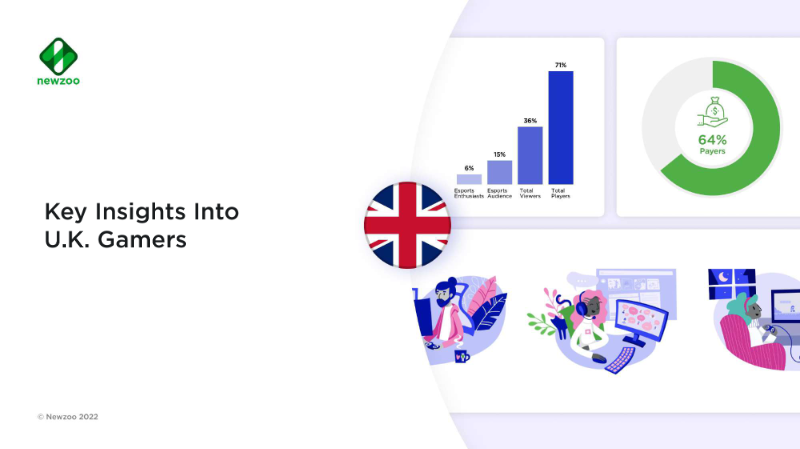
The United Kingdom represents a major global gaming hub, ranking as the sixth-largest market by revenue and tenth by player population as of late 2022. Research conducted among the online population aged 10 to 65 indicates that gaming is a primary entertainment pillar in the region, with 71% of the population identifying as game enthusiasts. This engagement is split between active play and content viewership, with 36% of the population exclusively playing games and another 35% both playing and viewing gaming video content.
The demographic profile of UK gamers is nearly balanced by gender, consisting of 52% male and 47% female players. While gaming spans all age groups, the 21-35 bracket is the most active. Motivation for play is driven primarily by the desire to unwind and relax, followed by the pursuit of achievement and social interaction. When categorized by persona, Time Fillers—those who play casually to pass the time—represent the largest segment, followed by Mainstream Gamers who engage deeply with both play and viewership.
Platform preferences show that mobile gaming has the highest reach at 46%, followed by console at 41% and PC at 29%. However, PC and console players demonstrate higher average weekly time commitments compared to mobile users. Financial engagement is also significant, with 63% of players identified as payers. The primary driver for spending is the availability of sales or special offers, though social motivations, such as spending to play with friends or family, also influence purchasing behavior.
The findings are based on a 2022 survey of 2,010 respondents in the United Kingdom, part of a broader global study covering 36 markets. The methodology utilizes a representative sample of the online population to track dozens of key performance indicators, including audience profiles, platform behavior, and monetization trends.
- The UK is a major global gaming hub, ranking sixth in revenue and tenth in player population, with 71% of the population aged 10-65 identifying as game enthusiasts.
- Engagement is evenly split between active players (36%) and those who both play and view gaming video content (35%).
- Mobile gaming has the highest reach at 46%, followed by console (41%) and PC (29%), though PC and console users dedicate more time to gaming weekly.
- The gamer demographic is nearly gender-balanced at 52% male and 47% female, with the 21-35 age bracket serving as the most active segment.
- 63% of UK gamers are payers, with spending primarily driven by sales, special offers, and social motivations like playing with friends or family.
State of the Game Industry 2022
The global game development landscape in 2022 is defined by a tension between technological tradition and evolving labor standards. PC remains the primary platform for 63% of developers, while the PlayStation 5 has established itself as the leading console for both current and future development cycles. Despite the industry’s technical foundations, there is profound skepticism regarding decentralized technologies; over 70% of studios express no interest in cryptocurrency or NFTs, and a third of professionals believe the metaverse concept will fail to materialize. Conversely, accessibility has reached a critical milestone, with 39% of developers now integrating features for impaired players, marking the first time such initiatives have outpaced non-implementation.
Labor dynamics are undergoing a significant transformation as professionals increasingly prioritize social activism and workplace equity. While a record 60% of developers now work 40 hours or less per week, the industry continues to struggle with systemic cultural issues. Approximately 62% of companies failed to formally address widespread reports of toxicity and misconduct, and the workforce remains predominantly male and relatively inexperienced, with over half of all professionals having ten years or less in the field. Furthermore, the rise of unionization discussions, reported by 23% of professionals, suggests a growing movement toward formal collective bargaining.
The industry’s geographic footprint remains heavily concentrated in the West, with 54% of developers based in the United States and 16% in Western Europe. Although remote work has become more prevalent, this shift has not yet decentralized the industry’s core hubs, as regions like Asia, Canada, and South America each represent 6% or less of the global workforce. This distribution reflects a Western-centric bias in current industry data and highlights the continued dominance of North American and European studios in shaping global development trends and labor standards.
- PC remains the primary development platform for 63% of developers, while the PlayStation 5 is the leading console for current and future project cycles.
- Industry interest in decentralized technologies is low, with over 70% of studios expressing no interest in cryptocurrency or NFTs and one-third of professionals predicting the metaverse will fail.
- Workplace culture remains a critical challenge, as 62% of companies have failed to formally address reports of toxicity and misconduct, despite 60% of developers now working 40 hours or less per week.
- Accessibility has reached a milestone with 39% of developers now integrating features for impaired players, marking the first time such initiatives have outpaced non-implementation.
- The industry remains heavily concentrated in the West, with 54% of developers based in the United States and 16% in Western Europe, while Asia, Canada, and South America each represent 6% or less of the workforce.
Global Games Market Report 2022
The global games market entered a corrective phase in 2022, with annual revenues projected to decline by 4.3% to $184.4 billion. This contraction follows a period of unsustainable pandemic-driven expansion and is further exacerbated by macroeconomic inflation, supply chain disruptions, and a sparse release schedule for major titles. Despite this short-term dip, the industry maintains a massive engagement base of 3.2 billion players and is expected to resume an upward trajectory, reaching an estimated $211.2 billion by 2025. While mature markets like North America and Asia-Pacific are experiencing revenue declines, emerging mobile-first regions such as Latin America and the Middle East & Africa continue to show positive growth.
The industry is currently undergoing a structural shift toward platform-agnostic ecosystems and hybrid monetization strategies. As traditional mobile advertising faces challenges from privacy policy changes like Apple’s IDFA, console and PC developers are increasingly adopting programmatic in-game advertising to monetize the hundreds of millions of players who do not make direct purchases. This shift is supported by major platform holders like Sony and Microsoft, who are integrating non-intrusive, blended advertisements to create recurring revenue streams. Furthermore, the rise of user-generated content, cloud gaming, and blockchain-based models is redefining how players interact with and derive value from digital environments.
Future market stability is increasingly tied to ecosystem-based analysis rather than hardware-specific metrics, reflecting a broader trend of cross-platform play and industry consolidation. Regulatory shifts in China have also prompted a strategic pivot toward global expansion in other emerging markets. As the industry evolves, success will likely depend on balancing diverse monetization models with authentic player experiences, while leveraging new technologies in virtual reality and cloud infrastructure to maintain long-term engagement across a diversifying global audience.
- The global games market is projected to decline 4.3% to $184.4 billion in 2022, marking a corrective phase after pandemic-driven expansion, before recovering to an estimated $211.2 billion by 2025.
- The industry maintains a massive global reach of 3.2 billion players, with growth shifting away from mature North American and Asia-Pacific markets toward mobile-first regions like Latin America and the Middle East & Africa.
- Developers are increasingly adopting programmatic, non-intrusive in-game advertising to monetize non-paying users, a strategy supported by platform holders like Sony and Microsoft to counter mobile privacy policy changes such as Apple’s IDFA.
- Market analysis is shifting from hardware-specific metrics to ecosystem-based models, driven by the rise of cross-platform play, industry consolidation, and the integration of cloud gaming and user-generated content.
- Regulatory changes in China are forcing developers to pivot their growth strategies toward global expansion in emerging markets.
Key Insights Into French Gamers
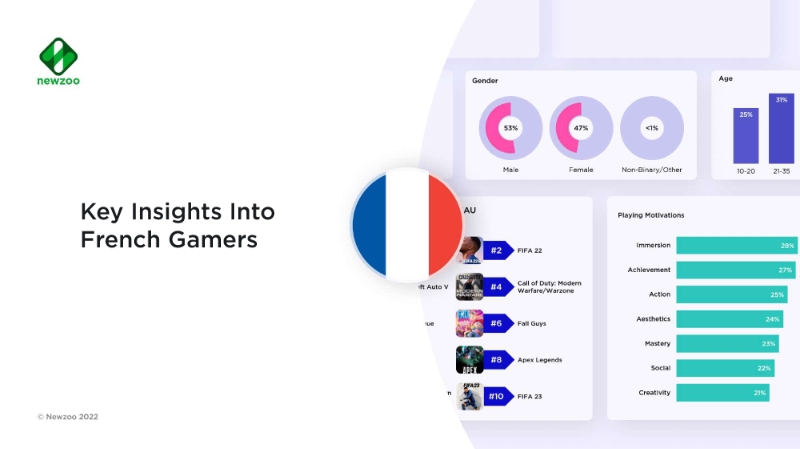
France represents a significant gaming market, ranking seventh globally in terms of revenue and fifteenth in total player count as of 2022. The French gaming population is highly engaged, with 71% of the online population aged 10 to 65 identifying as game enthusiasts. While 38% of this group only plays games, a substantial 34% also views gaming video content, and 15% are classified as esports enthusiasts who watch professional competitive gaming at least once a month.
The demographic profile of French players is nearly balanced by gender, consisting of 52% men and 48% women. The largest age cohort is the 21-35 bracket, representing 31% of the player base. In terms of behavior, Time Fillers and Mainstream Gamers are the most common personas. Time Fillers use games primarily to pass the time and show less interest in viewing content, whereas Mainstream Gamers are deeply invested in both playing and watching gaming media. Mobile is the most popular platform, utilized by 44% of the online population, followed by console at 41% and PC at 30%. Despite mobile's reach, PC players record the highest average weekly playtime at four hours and forty minutes.
Monetization data indicates that 56% of French players are payers, driven primarily by value-based incentives such as sales or special offers. Other significant spending motivators include unlocking exclusive content and the desire to play with friends or family, underscoring the social nature of the market. This analysis is based on a 2022 survey of 2,080 online consumers in France, part of a broader global study covering 36 markets and over 75,000 respondents.
- France is a top-tier global gaming market, ranking seventh in revenue and fifteenth in player count as of 2022.
- The French gaming population is highly engaged, with 71% of online users aged 10–65 identifying as enthusiasts, including 15% who follow esports monthly.
- Mobile is the leading platform with 44% reach, followed by console at 41% and PC at 30%, though PC users record the highest average weekly playtime at four hours and forty minutes.
- The player base is gender-balanced at 52% men and 48% women, with the 21–35 age bracket serving as the largest demographic segment at 31%.
- 56% of French players are payers, with spending primarily motivated by value-based incentives, exclusive content, and social play with friends or family.
Key Insights Into Spanish Gamers
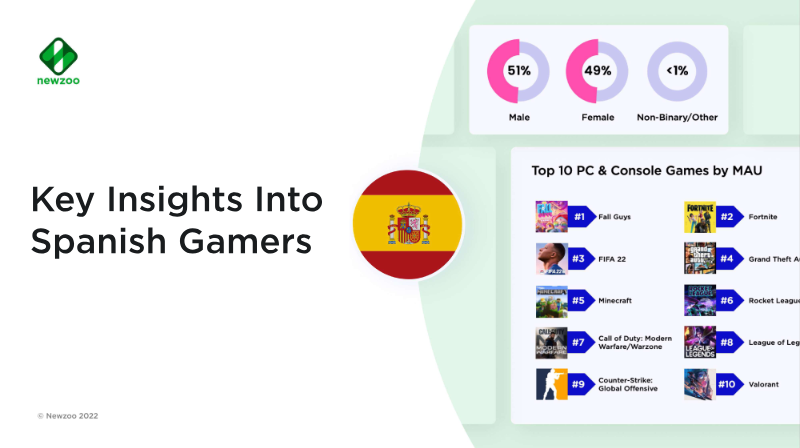
Spain represents a significant global gaming market, ranking 13th in the world with an annual revenue of $2.38 billion. The industry maintains a massive reach within the country, as 83% of the online population aged 10 to 65 are classified as game enthusiasts. Engagement is multifaceted, with 82% of the population playing games and 45% viewing gaming content. Notably, there is a high degree of overlap between these behaviors; 38% of the population both plays and watches games, while only 7% are exclusive viewers.
The demographic profile of Spanish gamers is nearly evenly split between genders, with 51% female and 49% male. Participation remains strong across age groups, though it peaks among those aged 21 to 50. Achievement, action, and mastery serve as the primary motivations for play. While mobile is the most popular platform by reach, utilized by 60% of the population, PC and console players demonstrate higher engagement depth, averaging four hours of play per week compared to three hours on mobile.
Market behavior indicates a strong propensity for spending, with 48% of the online population identified as payers. The primary drivers for monetization include sales or special offers and the desire to play with friends or family. In terms of content, the market is dominated by major global franchises such as Fall Guys, Fortnite, and FIFA 22, with adventure and sports ranking as the top genres by monthly active users. These findings are based on a 2022 consumer study involving a sample of 2,086 online respondents in Spain, forming part of a broader global research initiative covering 36 markets.
- Spain is the 13th largest global gaming market, generating $2.38 billion in annual revenue with 83% of the online population aged 10 to 65 identified as enthusiasts.
- The Spanish gaming audience is gender-balanced at 51% female and 49% male, with peak participation occurring between the ages of 21 and 50.
- While mobile is the most popular platform with 60% reach, PC and console users exhibit higher engagement, averaging four hours of weekly play compared to three hours for mobile users.
- Gaming engagement is highly integrated, as 38% of the population both plays and watches gaming content, while only 7% are exclusive viewers.
- 48% of the online population are payers, primarily motivated by sales, special offers, and the desire to play with friends or family.

For the Game
The global gaming industry is undergoing a transformative shift into a primary mass medium, projected to reach 3.5 billion players and $225 billion in revenue by 2025. This evolution is characterized by gaming’s role as a central pillar of culture and social connection, with over a third of players utilizing the medium specifically for socialization. Analysis across 21 global markets reveals that gamers are highly engaged "super-consumers" who spend nearly 60 hours a week across television and internet platforms, making them a critical demographic for brand attention.
To effectively reach this audience, the industry must move beyond traditional demographic stereotypes and adopt a motivation-based segmentation. This approach identifies six distinct player types, allowing for more authentic engagement. However, a significant gap remains between the diverse player base and the industry’s internal demographics, which remain predominantly male and white. Prioritizing equity, inclusion, and accessibility is essential for future growth, as evidenced by the commercial success of titles that prioritize inclusive design and representation.
Successful brand integration requires a departure from standard advertising in favor of intrinsic in-game experiences and value-driven partnerships. Strategies such as gamified commerce, immersive virtual events, and the utilization of original intellectual property yield higher attention and recall rates than traditional social media formats. By fostering mutually beneficial relationships and respecting established gaming codes, brands can leverage the medium not just for visibility, but as a sophisticated tool for long-term community building and commercial innovation.
- The global gaming industry is projected to reach 3.5 billion players and $225 billion in revenue by 2025.
- Gamers are high-value 'super-consumers' who engage with television and internet platforms for nearly 60 hours per week.
- Over one-third of the global player base uses gaming primarily as a social platform, necessitating a shift toward community-focused engagement strategies.
- Effective audience targeting requires moving beyond traditional demographics to a motivation-based segmentation model that identifies six distinct player types.
- Internal industry demographics remain predominantly white and male, creating a strategic gap that can be addressed through inclusive design to drive commercial success.
Key Insights Into South Korean Gamers
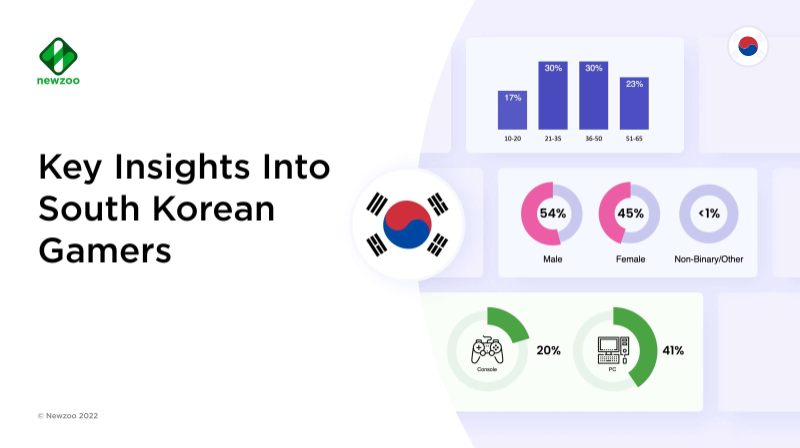
South Korea represents the fourth largest gaming market globally by revenue, valued at $8.3 billion, with a highly engaged population of 33 million gamers. Research conducted in 2022 indicates that 76% of the online population are game enthusiasts who engage with the medium through playing, viewing, or social interaction. While 72% of the population plays games, there is a significant overlap with viewership; 48% of South Koreans both play and watch gaming content, while 22% specifically engage with esports.
The demographic profile of South Korean gamers is diverse, with a nearly even split between males (54%) and females (45%) and broad representation across age groups, particularly those between 21 and 50. Socializing is the primary motivator for play, followed by action and achievement. Despite the high engagement levels, player personas vary; the most common types are Time Fillers, who play casually to pass the time, and Mainstream Gamers, who invest heavily in both playing and viewing.
Mobile is the dominant platform, utilized by 59% of the online population, though PC players record the highest average weekly engagement at five hours. In terms of software, League of Legends and Shooter genres lead in monthly active users. Monetization is also robust, with 38% of the population spending money on games. The primary drivers for spending include the desire to advance more quickly or easily in-game, followed by responding to sales or special offers.
The findings are based on a 2022 consumer insights survey of 2,094 respondents from the South Korean online population. The data highlights a mature market where gaming is a mainstream social activity integrated into daily life across all demographics, supported by a strong esports culture and a high propensity for in-game spending.
- South Korea is the world's fourth-largest gaming market, generating $8.3 billion in annual revenue from a highly engaged base of 33 million gamers.
- Gaming is a deeply integrated social activity, with 76% of the online population participating, 48% both playing and watching content, and 22% specifically following esports.
- Mobile is the primary platform for 59% of the online population, though PC gamers demonstrate higher engagement with an average of five hours of play per week.
- The player base is demographically balanced, with a 54% male and 45% female split and strong representation across the 21–50 age range.
- Monetization is robust, with 38% of the population spending money on games, primarily driven by the desire for faster progression or to capitalize on special offers.
Consumer Insights: Games & Esports 2022
Gaming has evolved into a multi-dimensional entertainment ecosystem where traditional play is no longer the sole driver of engagement. Findings indicate that 79% of the global online population are game enthusiasts, participating through playing, viewing content, or socializing in virtual worlds. This shift is most pronounced among younger generations; for Gen Alpha, gaming has surpassed social media and streaming video as the primary source of entertainment.
The research highlights a significant trend toward the "metaverse," with 75% of players and 44% of non-players engaging in game worlds for social interaction without playing the core game. This high level of engagement translates into substantial economic impact, with consumer spending in the sector projected to exceed $200 billion in 2023. Approximately half of Gen Alpha, Gen Z, and Millennial gamers are already classified as payers, a figure expected to rise as younger cohorts gain independent purchasing power.
Data suggests that gamers are a highly receptive audience for brands, exhibiting 36% more positive attitudes toward brand messaging compared to non-players. However, the diversity of the audience necessitates a nuanced approach. Using proprietary segmentation, the analysis shows that while older generations often act as "Time Fillers," younger audiences are more likely to be "Ultimate Gamers" or "All-Round Enthusiasts." Even within the same genre, such as Battle Royale, player demographics and motivations vary significantly between titles like Fortnite and Apex Legends, affecting their preferences for products like energy drinks or alcohol.
The findings are based on a 2022 study utilizing Computer Assisted Web Interviewing (CAWI) with a representative sample of 75,930 respondents. The scope covers 36 global markets across North America, Europe, Latin America, and Asia-Pacific, targeting the online population aged 10 to 65. Additional sentiment studies on the metaverse and blockchain gaming supplement the core consumer data.
- Gaming has become a primary entertainment ecosystem for 79% of the global online population, with Gen Alpha prioritizing gaming over social media and streaming video.
- Consumer spending in the gaming sector is projected to exceed $200 billion in 2023, driven by a payer base that includes approximately 50% of Gen Alpha, Gen Z, and Millennial gamers.
- Game worlds are increasingly used for social interaction rather than gameplay, with 75% of players and 44% of non-players utilizing these environments for non-gaming social engagement.
- Gamers are a highly receptive audience for advertising, demonstrating a 36% more positive attitude toward brand messaging compared to non-players.
- Audience motivations vary significantly by demographic, with older users often acting as 'Time Fillers' while younger cohorts are more likely to be 'Ultimate Gamers' or 'All-Round Enthusiasts'.
The New Destination to Reach Global Gamers: The 2021 Global Mobile Gamers Whitepaper
Mobile gaming represents the largest and fastest-growing segment of the global entertainment industry, generating $93.2 billion in 2021 with a projected trajectory toward $126.1 billion by 2024. Within this landscape, a distinct synergy has emerged between mobile gaming and social media platforms, particularly TikTok, where nearly half of all mobile gamers are active. These users demonstrate significantly higher value than non-users, installing 50% more games, playing 36% longer, and showing a 66% higher likelihood of making in-game purchases. This demographic functions as a highly social and evangelical audience that consumes an average of seven different genres and responds more favorably to innovative advertising formats like sponsored livestreams and user-generated content.
Global player behavior reveals a consistent preference for realistic art styles and fantasy or mystery settings, though regional nuances remain critical for market penetration. While Southeast Asian markets are dominated by MOBA titles, Japanese and South Korean audiences show a marked preference for immersive RPGs and Puzzle RPGs. Across all regions, the primary motivation for gameplay is relaxation or passing time, yet monetization is driven by progression-based incentives, such as the desire to unlock content or bypass difficult levels. This suggests that while the initial draw of a game is often casual, long-term financial viability depends on structured advancement and consistent content updates.
Retention and re-engagement strategies must address the primary drivers of player churn, which are identified as technical bugs and slow leveling speeds. Conversely, the introduction of new missions, story-driven updates, and technical optimizations are the most effective methods for reclaiming lapsed players. To maximize impact, advertisers and developers should prioritize action-packed, narrative-driven creative content that leverages the social metaverse. By focusing on regional aesthetic preferences—such as "cute" or anime styles in Asia versus cartoonish realism in Western markets—and addressing the specific progression needs of players, stakeholders can better navigate the increasingly competitive global mobile gaming ecosystem.
- The global mobile gaming market generated $93.2 billion in 2021 and is projected to reach $126.1 billion by 2024.
- Mobile gamers active on TikTok install 50% more games, play 36% longer, and are 66% more likely to make in-game purchases than non-users.
- While players primarily game to relax or pass time, long-term monetization is driven by progression-based incentives like unlocking content and bypassing difficult levels.
- Technical bugs and slow leveling speeds are the primary drivers of player churn, while new missions and story-driven updates are the most effective methods for re-engagement.
- Regional preferences vary significantly, with MOBA titles dominating Southeast Asia, while Japan and South Korea favor immersive RPGs and Puzzle RPGs.
Video Games – A Force for Good: Europe's Video Game Industry
This analysis provides a comprehensive overview of the European video games industry as of 2021, detailing its economic impact, demographic reach, and social contributions. Jointly produced by ISFE and EGDF, the findings highlight a sector that remained stable following the pandemic-induced surge of 2020, maintaining a market value of €23.3 billion across key European territories. The industry supports a significant workforce, employing over 98,000 people across Europe, with 74,000 located within the EU. Data is primarily sourced from Ipsos, GameTrack, and GSD, covering major markets including France, Germany, Italy, Spain, and the United Kingdom.
The demographic data reveals that video gaming is a mainstream cultural activity, with 52% of the European population aged 6 to 64 participating. The average player age is 31.3 years, and women represent nearly 48% of the total player base. While engagement remains high, average weekly playtime returned to pre-pandemic levels of nine hours. The digital ecosystem dominates the market, accounting for 81% of total revenue, driven largely by app-based gaming and in-game extras.
A significant portion of the analysis focuses on industry responsibility and social impact. It underscores the effectiveness of the PEGI age rating system and the prevalence of parental control tools, noting a sharp decline in unsupervised in-game spending by minors. Furthermore, the industry is positioned as a driver for digital literacy and mental well-being, with specific initiatives targeting STEM education for girls and climate change through the Green Game Jam. The report concludes that the sector is a vital component of Europe’s digital economy, increasingly recognized for its pedagogical value and commitment to diversity and environmental sustainability.
- The European video game market maintained a stable value of €23.3 billion in 2021, following the initial pandemic-driven surge.
- The industry employs over 98,000 people across Europe, with 74,000 of those roles based within the EU.
- Digital revenue dominates the sector, accounting for 81% of total market value through app-based gaming and in-game purchases.
- Video gaming is a mainstream activity in Europe, engaging 52% of the population aged 6 to 64 with an average player age of 31.3 years.
- Gender representation in gaming is nearly balanced, with women accounting for 48% of the total player base.
Member Survey & Report 2021
The blockchain gaming industry experienced a transformative period of expansion in 2021, driven primarily by the emergence of play-to-earn mechanics and the implementation of true digital asset ownership. Industry professionals identify these features as the most significant catalysts for growth, with a vast majority anticipating that traditional gaming entities will integrate blockchain technology within the next two years. This momentum is further evidenced by approximately $4 billion in capital inflows from venture firms and decentralized autonomous organizations, signaling strong institutional confidence in the sector’s long-term viability.
Despite this rapid financial and technological acceleration, the industry faces substantial structural headwinds. Regulatory uncertainty remains the most pressing concern for over half of the organizations operating in the space, followed closely by a general lack of public understanding regarding core blockchain concepts. Additionally, the sector must navigate technical challenges related to user-friendliness and a shortage of specialized engineering talent. While environmental sustainability has been a point of external criticism, the industry is actively transitioning toward carbon-neutral protocols and Proof of Stake networks to mitigate its ecological footprint.
The ecosystem is characterized by a diverse and collaborative landscape that spans game studios, major traditional publishers like Ubisoft, and specialized firms in decentralized finance, legal, and infrastructure. While financial incentives have been the primary driver of initial adoption, long-term sustainability is widely believed to depend on the development of high-quality gameplay that can compete with traditional titles. This cross-sector synergy suggests that the future of the industry relies on balancing innovative monetization models with the fundamental entertainment value required for mainstream appeal.
- The blockchain gaming sector saw $4 billion in capital inflows from venture firms and DAOs in 2021, signaling strong institutional confidence in the industry's long-term viability.
- Industry professionals expect traditional gaming entities to integrate blockchain technology within the next two years, driven by the adoption of play-to-earn mechanics and true digital asset ownership.
- Regulatory uncertainty is the primary concern for over 50% of organizations in the space, followed by challenges regarding public education, user-friendliness, and a shortage of specialized engineering talent.
- Long-term industry sustainability is contingent upon shifting from financial-incentive models to the development of high-quality gameplay that competes directly with traditional titles.
- The industry is actively addressing environmental criticism by transitioning toward carbon-neutral protocols and Proof of Stake networks.
Swedish Games Industry 2021
The Swedish games industry experienced a transformative period of growth in 2020, reaching a record revenue of EUR 3.3 billion. This 43% increase significantly outpaced global market trends, marking the sector's twelfth consecutive year of profitability. The landscape is increasingly defined by corporate consolidation and international expansion, with 667 active companies and 19 listed entities commanding a combined market capitalization of EUR 10.7 billion. Major players such as Embracer Group, King, and Mojang have transitioned Sweden from a target for foreign acquisition into a dominant global investor, with Swedish-owned firms now employing more personnel abroad than domestically across 126 international studios.
Despite this commercial success, the industry faces a critical bottleneck regarding skilled labor. While domestic employment rose to over 6,500 positions, a severe talent shortage and a cumbersome work permit process hinder further expansion. These systemic issues are compounded by a lack of early-stage financing and tax incentives for smaller developers, who must also navigate digital regulations often tailored for larger tech platforms. Furthermore, while Swedish-developed titles like Minecraft and Candy Crush have achieved over six billion downloads, the sector continues to grapple with internal demographic challenges. Women currently represent only 21% of the workforce, and over 100 companies remain entirely male-operated, prompting a surge in diversity initiatives aimed at leveling the playing field.
Geographically, while Stockholm remains the primary hub with over 4,000 employees, regional development clusters and educational programs are expanding throughout Sweden to support the growing ecosystem. The industry is also pivoting toward long-term sustainability, addressing workplace culture and the environmental implications of energy-intensive cloud gaming. As the sector matures, its primary challenges have shifted from achieving market viability to managing rapid globalization, securing specialized talent, and fostering a more inclusive and sustainable professional environment.
- The Swedish games industry reached a record revenue of EUR 3.3 billion in 2020, marking a 43% growth rate and the sector's twelfth consecutive year of profitability.
- Sweden has shifted from an acquisition target to a global investor, with 19 listed entities commanding a combined market capitalization of EUR 10.7 billion and Swedish-owned firms operating 126 international studios.
- A severe talent shortage and restrictive work permit processes are critical bottlenecks, despite domestic employment rising to over 6,500 positions.
- The workforce faces significant demographic imbalances, with women representing only 21% of employees and over 100 companies remaining entirely male-operated.
- Stockholm remains the primary industry hub with over 4,000 employees, though development clusters are expanding regionally to support the growing ecosystem.