Market Analysis
Documents
A Rising Market: Southeast Asia
Southeast Asia represents a rapidly accelerating segment of the global esports market, characterized by high growth rates in both viewership and revenue. Between 2019 and 2024, the region is projected to see a compound annual growth rate (CAGR) in audience size that significantly outpaces global averages, with year-over-year increases reaching as high as 18.2%. This expansion is driven by a mobile-first gaming culture where 82% of the online population plays mobile games and 39% of players identify mobile as their primary platform. Key markets fueling this trend include Indonesia, Vietnam, the Philippines, Thailand, Malaysia, and Singapore.
The regional ecosystem is heavily influenced by mobile-centric titles, specifically Mobile Legends: Bang Bang, Garena Free Fire, and PUBG Mobile. These three games accounted for roughly half of all global esports hours watched for those titles on Twitch and YouTube Live during the first half of 2021. Revenue streams in the region mirror global trends, with sponsorship serving as the primary contributor, supported by media rights, publisher fees, and digital goods. Government intervention also plays a critical role in market maturation, with initiatives like the Youth Esports Program in the Philippines and the integration of esports into the 30th SEA Games as a medal event.
Data for these findings was sourced from Newzoo’s 2021 Global Esports and Live Streaming Market Report and Consumer Insights. The methodology utilized a Major City Approach for most Southeast Asian nations to represent active internet users aged 10-50, while Singapore data covered the general online population within that age bracket. The findings conclude that improved internet infrastructure and the accessibility of mobile devices are the primary catalysts for long-term engagement and the continued attraction of non-endemic brand sponsorships to the region.
- Southeast Asia's esports audience is experiencing rapid expansion, with year-over-year growth reaching as high as 18.2% between 2019 and 2024.
- The market is defined by a mobile-first culture where 82% of the online population plays mobile games and 39% identify mobile as their primary gaming platform.
- Three mobile titles—Mobile Legends: Bang Bang, Garena Free Fire, and PUBG Mobile—accounted for approximately 50% of all global esports hours watched for those specific games on Twitch and YouTube Live in the first half of 2021.
- Key growth markets in the region include Indonesia, Vietnam, the Philippines, Thailand, Malaysia, and Singapore.
- Revenue generation in the region is primarily driven by sponsorships, supplemented by media rights, publisher fees, and digital goods.
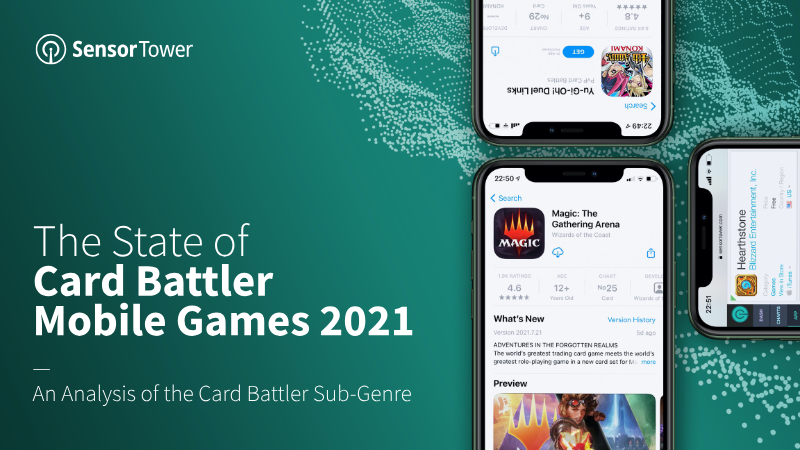
State of Card Battler Mobile Games Report 2021
The mobile card-battler sub-genre represents a high-growth segment within the broader mid-core strategy market, characterized by strong monetization and increasing global diversification. While mid-core games account for only 20 percent of worldwide installs, they drive 60 percent of total player spending. Within this ecosystem, card battlers represent 5 percent of strategy game revenue and 6 percent of downloads. Data from the first half of 2021 indicates a significant shift in market composition; while historically dominated by Asian markets like Japan and China, the United States has emerged as a critical growth engine, increasing its revenue market share to 27 percent.
Financial performance in the sub-genre reached a new baseline of over $55 million in monthly player spending during early 2021. This stability is supported by "forever franchises" such as Yu-Gi-Oh! Duel Links and Hearthstone, which have accumulated $700 million and nearly $1 billion in lifetime revenue, respectively. However, the market is also seeing rapid disruption from newer titles. Magic: The Gathering Arena and Mighty Party have utilized aggressive user acquisition strategies across major ad networks to challenge established leaders, with the former reaching the top 10 grossing list within three months of its mobile launch.
The analysis, which utilizes Sensor Tower’s proprietary store and ad intelligence data, concludes that the sub-genre offers significant opportunities for both major intellectual properties and niche titles. In the U.S. market specifically, card battlers exhibit the fastest-growing revenue per download among all strategy sub-genres, rising 53 percent. This trend suggests that as the segment matures, it has the potential to match the commercial scale of dominant categories like 4X strategy and MOBA games.
- Mid-core games drive 60 percent of total mobile player spending despite accounting for only 20 percent of worldwide installs.
- The U.S. has become a critical growth engine for card battlers, capturing 27 percent of the revenue market share and seeing a 53 percent increase in revenue per download.
- Mobile card battlers reached a new financial baseline of over $55 million in monthly player spending during the first half of 2021.
- Established 'forever franchises' like Hearthstone and Yu-Gi-Oh! Duel Links have generated nearly $1 billion and $700 million in lifetime revenue, respectively.
- Newer titles are rapidly disrupting the market, with Magic: The Gathering Arena reaching the top 10 grossing list within three months of its mobile launch.
Casual Puzzle Category Review 2021
The casual puzzle market experienced a period of significant expansion and structural transformation between 2020 and mid-2021, characterized by a 17% increase in monthly revenue and a surge in successful new releases. While legacy giants like Activision Blizzard and Playrix maintain a combined 58% revenue share, the competitive landscape is shifting as the Puzzle & Decorate sub-genre surpasses Classic Match-3 as the industry’s primary revenue driver. This evolution is defined by the rise of titles like Project Makeover and Royal Match, which have successfully disrupted established hierarchies through superior Day-1 retention rates and the integration of narrative-driven 3D customization and fluid gameplay mechanics.
The Merge sub-genre represents the most aggressive growth area, posting a 498% four-year compound annual growth rate. This segment’s 44% revenue increase over 18 months was largely propelled by Merge Mansion and EverMerge, which utilized innovative "merge-2" mechanics and substantial user acquisition investments to erode the market share of previous leaders like Zynga. Despite this volatility, the Puzzle & Decorate segment remains highly consolidated, with Playrix and AppLovin controlling 88% of total downloads and revenue, illustrating the high barrier to entry for sustained market dominance.
In contrast to the rapid fluctuations of the Merge and Match-3 segments, the Hidden Objects category maintains a steady 13% four-year growth rate, dominated by June’s Journey. This title accounts for over half of the sub-genre's revenue despite a disproportionately low download share, highlighting the high monetization potential of its core audience. Across all casual puzzle segments, the most successful titles are increasingly those that integrate sophisticated decoration metas and narrative episodes, suggesting that future market leadership depends on blending traditional puzzle mechanics with deep, meta-driven player engagement.
- The Puzzle & Decorate sub-genre has overtaken Classic Match-3 as the primary revenue driver, led by titles like Project Makeover and Royal Match that utilize narrative-driven 3D customization.
- The Merge sub-genre is the fastest-growing segment, achieving a 498% four-year compound annual growth rate and a 44% revenue increase over 18 months.
- Market consolidation remains high in the Puzzle & Decorate segment, where Playrix and AppLovin control 88% of total downloads and revenue.
- Legacy giants Activision Blizzard and Playrix maintain a combined 58% revenue share of the overall casual puzzle market, which saw a 17% increase in monthly revenue between 2020 and mid-2021.
- The Hidden Objects category maintains a steady 13% four-year growth rate, with June’s Journey generating over half of the sub-genre's revenue despite a low download share.

India: Mobile Market Spotlight: A Booming Mobile Economy
This analysis examines the rapid expansion of India’s mobile economy, focusing on user behavior, app categories, and market growth between 2019 and mid-2021. Utilizing proprietary intelligence data, the findings characterize India as one of the world’s most mobile-first markets, ranking second globally in total app downloads. In 2020, Indian users downloaded 24 billion apps, a 28% year-over-year increase, and spent a total of 651 billion hours on Android devices. Driven by the COVID-19 pandemic, average daily time spent per user rose from 3.3 hours in 2019 to 4.8 hours by the third quarter of 2021.
Mobile gaming represents a significant pillar of this growth, with India becoming the largest market for game downloads in the first half of 2021, accounting for nearly one-fifth of global installs. While titles like Ludo King and Free Fire dominate active user and spend charts, homegrown publishers represent only 7.6% of the top 1,000 downloaded games, suggesting a major opportunity for local development. Additionally, monetization strategies are evolving, with a 15% increase in top-grossing games adopting hybrid models that combine in-app purchases with advertising.
The financial services sector has also seen a dramatic transformation. Hours spent in investment and trading apps grew by 65% in 2020, led by platforms like Upstox Pro and WazirX. The Unified Payments Interface (UPI) continues to drive the market, with transaction volumes doubling year-over-year by mid-2021. Emerging segments such as "Buy Now Pay Later" and merchant utility apps like Khata Book are gaining significant traction. Beyond finance and gaming, the report highlights surging engagement in digital-first shopping, video streaming services like MX Player and Netflix, and a growing demand for mental health resources through meditation apps.
- India is a global mobile-first leader, ranking second in total app downloads with 24 billion installs in 2020, a 28% year-over-year increase.
- India became the world's largest market for game downloads in the first half of 2021, accounting for nearly 20% of global installs.
- Daily mobile usage per user surged from 3.3 hours in 2019 to 4.8 hours by Q3 2021, fueled by pandemic-driven engagement.
- Homegrown publishers hold only 7.6% of the top 1,000 downloaded games, indicating a significant market opportunity for local developers.
- Monetization in top-grossing games is shifting toward hybrid models, with a 15% increase in titles combining in-app purchases and advertising.

Online Nation 2021 Report
Overview............................................................................................................................ 3 What we have found – in brief ........................................................................................................... 3 1. The online consumer ......................................................................................................
- Adults spent significantly more time online in 2020 compared to 2019, with the 18-24 age group showing the largest increase, particularly during lockdown periods.
- Despite a potential decrease, 6% of UK households (approximately 1.5 million) still lacked internet access in March 2021, though direct comparability with previous years is limited due to methodology changes.
- Social video platforms are actively launching new features to maintain and build engagement, exemplified by Snapchat's 'Spotlight' which gained 100 million users by January 2021 and offers creators a share of $1 million daily.
- TikTok removed 104.5 million videos in the first half of 2020 and 89.1 million in the second half, with 'minor safety' and 'adult nudity/sexual activities' consistently being among the top removal reasons.
- The COVID-19 pandemic led to a significant increase in online education for children, with nearly 90% of parents in Britain homeschooling their children in May-June 2020 and January-February 2021.
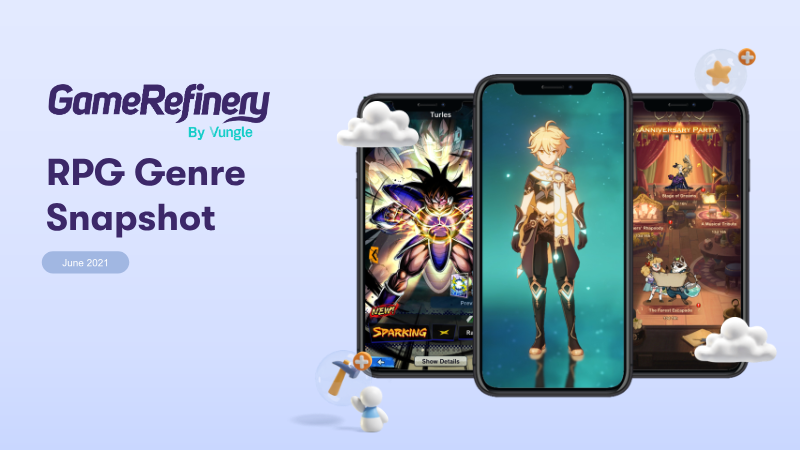
RPG Genre Snapshot
Role-playing games represent a significant pillar of the mobile gaming market, currently holding a 14% revenue share on the US iOS platform. While established titles like Raid: Shadow Legends and Marvel Strike Force maintain their positions at the top of the charts, the genre is undergoing a fundamental shift in subgenre dominance. Historically led by turn-based titles, the market is increasingly defined by high-production action RPGs. This transition is primarily driven by the massive success of Genshin Impact, which alone accounts for 10% of the total RPG market share, and the more recent launch of My Hero Academia: The Strongest Hero.
Analysis of these market leaders reveals a trend toward open-world experiences, narrative depth, and console-quality production values. While both leading titles utilize action-based combat and anime art styles, they cater to different player motivations. Genshin Impact focuses on single-player exploration and skill-based mechanics, whereas My Hero Academia emphasizes social and competitive elements through synchronous and asynchronous PvP. Despite these innovations in gameplay, the genre remains anchored by character collection and gacha-based monetization.
Revenue performance in the sector is heavily dictated by live operations and content updates. Data indicates that the most significant revenue spikes occur during limited-time events, particularly those introducing new characters via "banner gachas" or step-up mechanics. Furthermore, collaboration events with external intellectual properties, such as the crossover between The Seven Deadly Sins: Grand Cross and Stranger Things, have proven highly effective at engaging audiences. These findings, derived from GameRefinery’s proprietary SaaS dashboard and genre taxonomy, cover the US iOS market over a twelve-month period ending in mid-2021.
- RPG titles account for 14% of the total revenue share on the US iOS mobile gaming market.
- Genshin Impact alone captures 10% of the total RPG market share, signaling a shift from turn-based titles toward high-production action RPGs.
- Market leaders are increasingly defined by console-quality production values, open-world environments, and narrative-heavy gameplay.
- Revenue performance is primarily driven by live operations, specifically limited-time events, new character 'banner gacha' releases, and external IP collaborations.
- While action-based combat and anime aesthetics are common, top titles differentiate by focusing on either single-player exploration or competitive PvP elements.
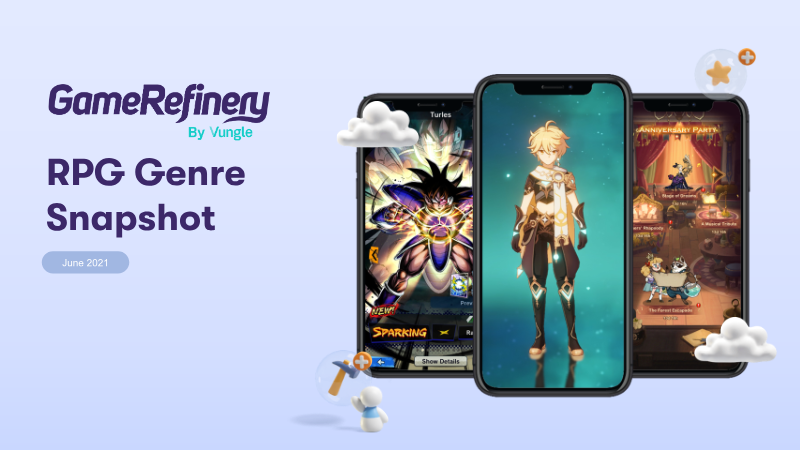
RPG Genre Snapshot Report June 2021
Role-playing games (RPGs) represent a cornerstone of the mobile gaming market, accounting for approximately 14% of total revenue on the US iOS platform as of mid-2021. While the genre has long been dominated by established turn-based titles like Raid: Shadow Legends and Marvel Strike Force, recent market data indicates a significant shift toward Action RPGs. This transition is driven primarily by high-production, open-world titles that bridge the gap between mobile and console-quality experiences.
The primary catalyst for this shift is Genshin Impact, which alone commands over 10% of the RPG market share. Alongside the more recent launch of My Hero Academia (MHA): The Strongest Hero, these titles emphasize narrative depth, exploration, and high-fidelity graphics. While both utilize an anime art style, they cater to different player motivations: Genshin Impact focuses on single-player exploration and skill-based combat, whereas MHA integrates more competitive social elements, including synchronous and asynchronous PvP.
Monetization within the genre remains heavily reliant on character collection mechanics and sophisticated gacha systems. Analysis of top-performing updates shows that revenue spikes are most frequently tied to limited-time "banner" gachas and IP collaboration events, such as the crossover between The Seven Deadly Sins: Grand Cross and Stranger Things. These events often introduce bespoke gameplay modes, such as tower defense or unique PvE challenges, to maintain engagement.
The findings are based on GameRefinery’s proprietary three-layered taxonomy and a motivation framework derived from a survey of over 7000 mobile gamers across English-speaking Western markets. The data specifically covers the US iOS market for the 12-month period leading up to June 2021, highlighting a clear evolution from traditional turn-based mechanics toward immersive, open-world action experiences.
- As of mid-2021, RPGs account for approximately 14% of total revenue on the US iOS mobile gaming platform.
- The RPG market is shifting from traditional turn-based titles toward high-fidelity, open-world Action RPGs that offer console-quality experiences.
- Genshin Impact is the primary driver of the genre's evolution, currently commanding over 10% of the total RPG market share.
- Top-performing RPGs increasingly differentiate themselves through specific player motivations, such as Genshin Impact’s focus on single-player exploration versus My Hero Academia’s emphasis on competitive PvP.
- Revenue growth in the genre is primarily driven by limited-time 'banner' gacha systems and IP collaboration events, such as the crossover between The Seven Deadly Sins: Grand Cross and Stranger Things.

Q2 2021: Store Intelligence Data Digest
Global app downloads reached 35.9 billion in the second quarter of 2021, representing a 4.8% year-over-year decline as the market stabilized following the unprecedented pandemic-driven highs of 2020. Despite this slight contraction, the mobile ecosystem demonstrated significant resilience and evolution across various sectors. TikTok remained the dominant global application with over 200 million quarterly installs, while the mobile gaming sector saw Pokémon GO surpass the $5 billion lifetime revenue milestone. The quarter was characterized by a resurgence in travel and finance applications, such as Google Maps and Coinbase, alongside a notable surge in the gig economy as Uber and Lyft downloads returned to pre-pandemic levels.
The mobile gaming landscape was primarily defined by the continued dominance of the Hypercasual genre, with titles like Bridge Race and Hair Challenge leading global charts. Regional performance remained distinct, with Asian markets showing high stability through established titles like Ludo King, while the United States and Europe favored rapid-growth Hypercasual releases. India maintained its status as the world’s largest market by volume, exceeding 7 billion downloads. On the publisher side, Google and Facebook retained their global leadership, though Zynga and Supersonic Studios saw significant upward mobility due to aggressive expansions into the Hypercasual space.
Geographically, the market exhibited a clear divide in platform influence. Chinese firms like Tencent and ByteDance dominated the App Store in Asia, where China alone accounted for over half of all iOS installs. Conversely, U.S. publishers maintained a firm grip on domestic and European markets. Emerging trends in the Photo and Video category, driven by viral AI-based applications and video editing tools like CapCut, further illustrated the shifting consumer interests toward creative and social content. This period ultimately reflects a transition toward a post-pandemic equilibrium, marked by the recovery of service-based apps and the sustained profitability of established gaming franchises.
- Global app downloads reached 35.9 billion in Q2 2021, a 4.8% year-over-year decline as the market stabilized from 2020 pandemic highs.
- TikTok maintained its position as the top global application with over 200 million installs during the quarter.
- India remained the largest market by volume, exceeding 7 billion downloads in Q2 2021.
- The mobile gaming sector was led by the Hypercasual genre, with titles like Bridge Race and Hair Challenge dominating global charts and driving growth for publishers like Supersonic Studios.
- Service-based applications saw a post-pandemic recovery, with travel and gig economy apps like Google Maps, Uber, and Lyft returning to pre-pandemic download levels.

Match3 Genre Snapshot: US iOS (May 2021)
The Match3 subgenre represents the largest individual segment of the US iOS mobile gaming market, accounting for approximately 16% of total market revenue as of May 2021. While the category has long been dominated by established titles that have maintained chart positions for years, recent market shifts indicate a move away from traditional swapping mechanics. Notably, none of the new Match3 titles entering the top 500 grossing rankings over the last 18 months utilize standard swapping gameplay, signaling a diversification in core mechanics and the rising importance of meta-layers.
Meta-elements, particularly those focused on decoration and customization, have become essential components for modern success in the genre. Successful megahits like Royal Match and Project Makeover demonstrate the effectiveness of combining core puzzle gameplay with deep progression systems and sophisticated monetization strategies. Data indicates that recurring live events, special event rewards, and limited-time in-app purchase offers have the highest impact on revenue. Furthermore, social features such as guild mechanics and "send/ask help" systems are increasingly vital for driving engagement and retention.
Player motivation analysis, based on a survey of over 7,000 mobile gamers across English-speaking Western markets, reveals distinct psychological drivers within the genre. While "Thinking and Solving" remains the primary driver for traditional titles like Candy Crush Saga, newer successful entries increasingly lean into "Customization and Decoration" and "Role-playing and Emotions." This shift reflects a broader industry trend where loss aversion mechanics and social competition are leveraged to enhance the player experience and maximize lifetime value in a highly competitive landscape.
- As of May 2021, the Match3 subgenre accounts for approximately 16% of total US iOS mobile gaming revenue.
- No new Match3 titles entering the top 500 grossing rankings over the last 18 months utilize standard swapping mechanics, indicating a shift toward gameplay diversification.
- Modern Match3 success is increasingly driven by meta-layers, specifically decoration and customization features seen in titles like Royal Match and Project Makeover.
- Revenue performance in the genre is most heavily influenced by recurring live events, special event rewards, and limited-time in-app purchase offers.
- Social features, including guild mechanics and help-request systems, are now essential for maintaining player engagement and retention.
Q1 2021 – Omówienie Wyników
People Can Fly Group experienced steady financial growth during the first quarter of 2021, characterized by a 19.1% year-over-year increase in total revenue to 30.9 million PLN. While adjusted EBITDA rose by 6.6% to reach 10.4 million PLN, net profit saw a 10% decline to 7.8 million PLN compared to the same period in 2020. A significant highlight of the quarter was a dramatic surge in net cash flow, which jumped by 2,390% to 106.1 million PLN, largely driven by capital activities and the company's public market presence.
The group’s operational footprint expanded significantly through international growth and strategic acquisitions. By May 2021, the corporate structure evolved to include new entities such as Game On Creative in Canada and People Can Fly Chicago in the United States, adding to existing studios in the UK and Poland. This expansion is reflected in the workforce growth, which increased by 7.1% to 301 employees and associates. Revenue remains heavily concentrated in development services, which accounted for 30.2 million PLN of the quarterly total, while external outsourcing activities contributed a smaller portion of the overall financial mix.
Strategic financial management during this period involved complex accounting adjustments related to subscription warrants for Square Enix and the forgiveness of a PPP loan. Following the acquisition of Game On Creative and private subscriptions, the shareholder structure shifted, with the majority stake remaining at approximately 65.9%. Additionally, the Board of Directors recommended a dividend payout of 0.19 PLN per share from the 2020 net profit, totaling 5.6 million PLN, while allocating the remaining 23.5 million PLN to reserve capital to support continued development.
- People Can Fly Group reported a 19.1% year-over-year revenue increase to 30.9 million PLN in Q1 2021, with development services accounting for 30.2 million PLN of that total.
- Net cash flow surged by 2,390% to 106.1 million PLN during the quarter, primarily fueled by capital activities and the company's public market presence.
- Net profit declined by 10% to 7.8 million PLN compared to Q1 2020, despite a 6.6% increase in adjusted EBITDA to 10.4 million PLN.
- The company expanded its international footprint by May 2021 with the addition of Game On Creative in Canada and People Can Fly Chicago, contributing to a 7.1% increase in total workforce to 301 employees.
- The Board of Directors recommended a dividend payout of 0.19 PLN per share (5.6 million PLN total) from 2020 profits, while allocating 23.5 million PLN to reserve capital for future development.
Esports Rising: State of the Global Esports Market
The global esports market is experiencing a period of robust expansion, characterized by double-digit growth in both viewership and revenue. Total industry revenues are projected to reach $1.08 billion by the end of 2021, representing a 14.5% year-over-year increase. This financial growth is primarily driven by sponsorships and media rights, which remain the dominant revenue streams. China has solidified its position as the primary market leader, maintaining the largest share of both global esports revenues and the highest concentration of esports enthusiasts.
Audience engagement has surged significantly, with total hours watched on major streaming platforms like Twitch and YouTube increasing by 76% in 2020. While general live-streaming saw the most dramatic rise, dedicated esports viewership also grew by 12.6% during the same period. The global audience is on a trajectory to exceed 577 million viewers by 2024, split between occasional viewers and dedicated enthusiasts. Regional growth is particularly strong in emerging markets, with the Rest of World category seeing a 10% year-over-year increase in enthusiasts, outpacing the growth rates of North America and Europe.
The sponsorship landscape is undergoing a structural shift from short-term, one-year experimental deals to multi-year strategic partnerships. This evolution reflects increased confidence from brands in the long-term stability of the industry. There is a notable influx of non-endemic sponsors, particularly from the financial services sector, including banks and insurance companies seeking to reach younger demographics. Additionally, the furniture industry has accelerated its involvement, with 32 sponsorship deals closed by manufacturers in a twelve-month period as remote work and home-based gaming increased.
Despite the logistical challenges posed by the transition to online-only formats during global lockdowns, the industry demonstrated resilience. While traditional sports faced total shutdowns, esports leagues successfully migrated to digital play, though issues like internet latency persisted. Major publishers like Riot Games have seen significant returns on new titles, with Valorant emerging as a major driver of live esports hours. As the industry moves forward, a return to in-person LAN events is anticipated, though the timeline for the return of live audiences remains contingent on global health conditions.
- The global esports market is projected to reach $1.08 billion in revenue by the end of 2021, marking a 14.5% year-over-year increase driven primarily by sponsorships and media rights.
- Total hours watched on major streaming platforms like Twitch and YouTube surged by 76% in 2020, with the global audience expected to exceed 577 million viewers by 2024.
- China remains the dominant market leader, holding the largest share of global esports revenue and the highest concentration of enthusiasts.
- Sponsorship models are shifting from short-term experimental deals to multi-year strategic partnerships, with non-endemic sectors like financial services and furniture manufacturers increasingly entering the space.
- Emerging markets categorized as 'Rest of World' are currently outpacing North America and Europe in growth, recording a 10% year-over-year increase in enthusiasts.
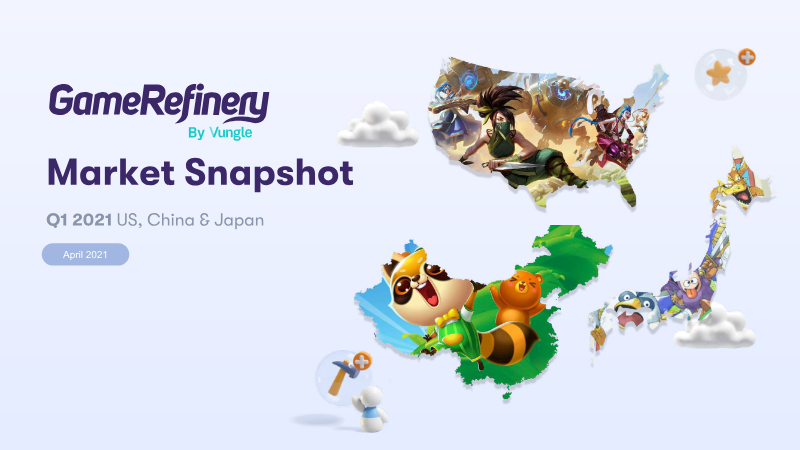
Market Snapshot: Q1 2021 US, China & Japan
The mobile gaming market in the first quarter of 2021 demonstrated regional divergence in genre performance, with the United States remaining relatively stable while China and Japan experienced notable shifts in market share. In the US, simulation games continued to grow, and Roblox Corporation solidified its position as the top-grossing publisher. Conversely, Japan saw a decline in RPG market share alongside a significant rise in sports titles, driven by the breakout success of Cygames’ Uma Musume Pretty Derby. China’s market moved away from traditional RPG and strategy dominance, favoring a surge in shooter games.
Data analysis reveals distinct trends in monetization and feature implementation across these regions. Collectible albums have become a staple in the US, utilized by over 70% of top-grossing games. In Japan, battle pass mechanics are gaining traction, appearing in over 25% of top-grossing titles. Meanwhile, Chinese developers have doubled the year-over-year utilization of special gacha mechanics, which now appear in 30% of top-grossing games. Social features, particularly guild mechanics and co-op modes, remain essential for retention across puzzle, RPG, and strategy genres.
The analysis utilizes a proprietary genre taxonomy and a motivation framework to categorize player archetypes. In the US market, the top 200 grossing games primarily appeal to five distinct archetypes, with a rising trend toward the Skill Master archetype, indicating an increased consumer appetite for competitive gameplay that rewards reflexes and skill. These findings are based on iOS market performance data, publisher share metrics, and an evaluation of soft-launch titles, providing a comprehensive view of the mobile landscape during the transition from late 2020 to early 2021.
- In Q1 2021, mobile gaming genre preferences diverged globally: US markets favored simulation games, Japan saw a shift from RPGs to sports titles led by Cygames’ Uma Musume Pretty Derby, and China moved toward shooter games.
- Roblox Corporation established itself as the top-grossing publisher in the US market during Q1 2021.
- Monetization strategies varied by region, with collectible albums appearing in over 70% of top-grossing US games, battle passes in over 25% of top-grossing Japanese titles, and special gacha mechanics in 30% of top-grossing Chinese games.
- Chinese developers doubled their year-over-year utilization of special gacha mechanics in top-grossing titles.
- US mobile gaming trends indicate a rising consumer appetite for the 'Skill Master' archetype, reflecting a growing preference for competitive gameplay that rewards reflexes and skill.