In-Game Advertising reports and market data
Documents

two & a half gamers session #52 - Admon gossip corner, Unity expensive bug, APS, Google 3 placements
Technical stability and strategic ad stack management remain critical pillars for mobile game publishers seeking to optimize revenue.
- AdMob has removed its restriction limiting publishers to three ad placements per waterfall when using third-party mediation, allowing for greater inventory exposure to Google demand.
- A significant reporting error within the Unity platform recently caused widespread data discrepancies, forcing many developers to disable placements to mitigate financial risk.
- Amazon Publisher Services is becoming a high-potential monetization channel, with developers encouraged to pursue direct Transparent Ad Marketplace deals to bypass intermediary margins.

two & a half gamers session #46 - Deconstruction of App businesses from UA, GD & Admon perspective
The mobile application landscape is undergoing a significant transformation as non-gaming apps increasingly adopt the rigorous monetization and design frameworks traditionally reserved for casual mobile games.
- Non-gaming apps are increasingly adopting gaming-centric monetization frameworks, such as gacha systems and streak-based retention loops, to drive daily engagement and increase lifetime value.
- Developers should implement a hybrid revenue model that combines subscription tiers with rewarded video units to capture additional revenue without degrading the core user experience.
- To maximize eCPMs, non-gaming apps should integrate gaming-specific demand sources like AppLovin and Unity while using interstitial ad floors to safeguard long-term retention.

two & a half gamers session #36 - Google AdROAS campaigns, Admon Exchanges, Survivor.io update
Google’s Target ROAS (tROAS) campaigns have become a critical tool for ad-monetized mobile games, offering robust performance even for titles that integrate hybrid in-app purchase models.
- Integrating competing ad exchanges like Digital Turbine into mediation layers forces demand-side platforms to bid against each other, yielding revenue increases of 12% to 20% on lower-value inventory.
- Google tROAS campaigns perform optimally when developers adjust budgets and bids by 10% to 20% increments while maintaining frequent creative asset rotation.
- Survivor.io maintains daily revenues of $1.3 million to $1.5 million by prioritizing aggressive live-ops and rapid value extraction, despite facing low long-term retention rates of 3% at day 30.

two & a half gamers session #32 - Global launch games like a pro, Playrix GL rumour, Google updates
Global mobile game launches have transitioned from high-risk, singular events to iterative, data-driven processes that prioritize long-term retention and technical stability.
- Modern mobile game launches should move away from single 'big splash' events in favor of iterative, data-driven processes that prioritize long-term retention and technical stability.
- Developers should set initial price floors 30 to 40 percent above benchmarks during the launch window, refining these figures only after two weeks of empirical performance data.
- Monetization strategy requires a mix of global and geocentric ad networks organized into tiered waterfalls based on eCPM values to maximize revenue.

two & a half gamers session #30 - survivor.io global launch case study UA, GD, Admon view
Survivor.io represents a significant evolution in mobile gaming, successfully refining the established Archero formula into a faster, action-oriented experience.
- Survivor.io generates between $1 million and $1.5 million in daily revenue by refining the Archero formula into a faster, action-oriented experience.
- The developer sustains daily install volumes of 400,000 to 600,000 by utilizing aggressive, zombie-themed creative assets on platforms like TikTok and IronSource.
- Current daily ad revenue outside of China ranges from $60,000 to $90,000, with potential to reach $250,000 through optimized rewarded ad placements.

two & a half gamers session #28 - Admob bidder uplift update, how do hypercasual games make money?
The mobile gaming industry is currently experiencing a period of significant structural evolution, characterized by aggressive corporate expansion and the refinement of ad-monetization technologies.
- Transitioning to a hybrid monetization model that combines traditional waterfall placements with Google’s AdMob bidder can increase average revenue per user (ARPU) by 14% to 18% for rewarded video inventory.
- While hybrid bidding offers significant revenue potential, it currently suffers from inconsistent eCPM stability and lower performance on low-quality traffic compared to fixed placements.
- Top-tier hyper-casual studios are maintaining profitability by replacing intrusive interstitial ads with compliant, end-of-level ad formats that adhere to new platform regulations.

two & a half gamers session #18 - How could King make 30% more revenue? Full UA, GD & Ads analysis!
King maintains a dominant position in the global mobile gaming market, anchored by the enduring success of the Candy Crush franchise.
- King could increase its annual ad revenue by approximately $22 million, a 30% boost, by transitioning from direct-contract negotiations to an open-market programmatic mediation model.
- King generates $2.5 billion in annual revenue primarily through its Candy Crush franchise, which is supported by a massive library of over 11,000 levels.
- Internal innovation efforts outside of King's core match-three expertise, including forays into endless runners, narrative-driven restoration, and midcore RPGs, have failed to achieve long-term sustainability.

two & a half gamers session #14 - How to read Ad mon data for beginners? ATT & player segmentation
The mobile gaming industry is currently navigating a complex landscape defined by significant financial volatility and shifting privacy paradigms.
- Apple’s App Tracking Transparency (ATT) framework has resulted in a $10 billion revenue impact, though opt-in rates have stabilized at a resilient 40–42% rather than the feared 10–20%.
- Developers are shifting focus from privacy-centric segmentation to strategies based on in-game progression and spending depth to navigate the current market landscape.
- To maintain competitive ad monetization, developers must ensure ad auctions conclude within a 300-millisecond window to avoid latency and revenue loss.

two & a half gamers session #9 - How to increase AdARPDAU? How Adnetworks make money? Admonetisat...
The gaming industry is currently navigating a complex transition period characterized by aggressive investment in blockchain technology and the strategic repurposing of established mobile intellectual property.
- Hiring a dedicated ad monetization manager is only financially viable once a game reaches $20,000 to $30,000 in daily ad revenue, as the role typically yields a 20% revenue improvement that must justify the salary.
- Games with high ad reliance, particularly in the idle genre, should aim for more than five impressions per daily active user (DAU) to effectively scale campaigns and ensure ad revenue accounts for at least 40% of total income.
- The blockchain gaming sector saw significant investment growth in 2022, reaching $2 billion by mid-March, following a trend of increasing quarterly funding from $430 million in Q1 2021 to $1.6 billion in Q4 2021.

two & a half gamers session #4 - How to soft launch a mobile game Ad monetisation Perspective
The mobile gaming industry is undergoing a period of rapid expansion, with ad spending projected to reach $130 billion by 2025.
- Ad spending in the mobile gaming industry is projected to reach $130 billion by 2025, necessitating sophisticated monetization strategies as Meta’s dominance declines and platforms like TikTok rise.
- Developers should target a baseline of 60% player engagement with at least five ad impressions per daily active user to maximize revenue without increasing friction.
- To protect profit margins, publishers must maintain a competitive ad waterfall and obscure performance rankings from individual networks to prevent revenue leakage.

CTV Special: Connected TV Ads examples Unpacked with Arthur from Vibe.co. Ideal customer for CTV?
Connected TV advertising has transitioned from a traditional branding medium into a sophisticated performance-based channel.
- Connected TV (CTV) has evolved into a performance-based channel that uses household IP-based device graphs to link TV impressions to specific mobile installs and revenue events.
- To generate sufficient data for meaningful campaign optimization, a daily budget of $500 to $1,000 is recommended.
- Gaming titles, specifically midcore, hardcore, and social casino, are the primary audience for CTV advertising due to the platform's ability to track return on ad spend (ROAS) through mobile measurement partners.
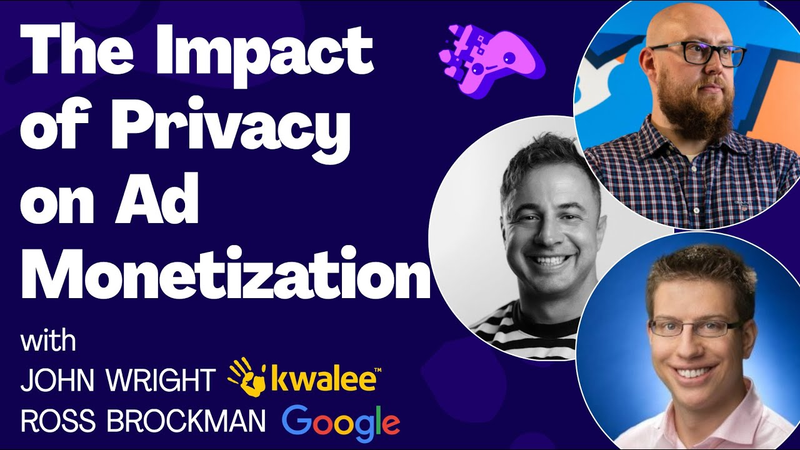
Privacy vs. Ad Monetization with Google's Ross Brockman and Kwalee's John Wright
The mobile advertising industry is undergoing a fundamental structural transition, moving away from legacy waterfall ad-buying models toward real-time bidding (RTB) systems.
- The mobile advertising industry is shifting from legacy waterfall models to real-time bidding (RTB) systems to reduce latency and increase market efficiency.
- Developers should anticipate a manageable 10% to 20% decline in ad revenue throughout 2024 as the ecosystem adjusts to ongoing privacy-centric mandates.
- To maintain access to personalized ad demand, developers must implement standardized consent management platforms in response to EU and UK regulatory pressures and Apple’s App Tracking Transparency.