In-Game Advertising reports and market data
Documents

Unicorns, Camels, and Hogs: How Smart Ad Monetisation Saves Your App from Getting Eaten Alive
Mobile game studios frequently struggle due to a creative-first bias that prioritizes gameplay design while neglecting the financial potential of the 95% of users who never make in-app purchases.
- Developers must monetize the 95% of users who never make in-app purchases by treating ad revenue as a core pillar of product architecture rather than an afterthought.
- Ad monetization should be integrated into the initial design phase to ensure long-term viability and prevent the common creative-first bias that neglects financial potential.
- Rewarded ad experiences allow studios to monetize non-paying players without negatively impacting user retention or the overall player experience.

Using AI to decide if it's worth showing ads in your app
The primary objective of this analysis is to demonstrate how developers and user acquisition managers can leverage generative AI to perform complex data analysis without requiring advanced SQL expertise or a dedicated data science team.
- Developers can use generative AI to analyze the correlation between in-app purchase lifetime value and ad revenue to determine if ads will cannibalize high-value user spending.
- By uploading a database schema to an AI tool, non-technical teams can generate complex SQL queries to perform statistical analysis without needing dedicated data scientists.
- A weak or positive correlation coefficient between ad revenue and in-app purchases serves as a data-driven justification for testing ad monetization strategies.

How to Bring Brands to Roblox
Roblox has emerged as a primary destination for brand engagement, evidenced by a 100% year-over-year increase in activations throughout 2023.
- Roblox brand activations grew 100% year-over-year in 2023, with total brand spend reaching $80 million and accounting for approximately 10% of total developer earnings.
- Gen Z audiences now spend more time in immersive Roblox environments than on TikTok and YouTube combined, driving a shift in marketing budgets toward gaming strategies.
- Brands achieve higher ROI and deeper consumer affinity by integrating into existing, high-traffic games rather than building standalone branded experiences.

Kelly Kang’s Secret Sauce To Monetise Your Game Like A Boss
Successful mobile game monetization hinges on fostering deep internal collaboration between ad strategy teams and game developers.
- Modern offer walls have shifted from internal cross-promotion to external brand partnerships, which now account for 50% to 60% of total revenue.
- Monetization teams must prioritize long-term player retention over short-term gains to overcome rigid development roadmaps and quality assurance constraints.
- To secure high-value brand partnerships, developers must improve transparency by adopting ethical advertising practices, viewability metrics, and Consent Management Platforms.
Top 10 Ad Networks For Mobile Games 2024… and the Latest Ad Creative trends!
The mobile gaming advertising landscape in 2024 is defined by a paradox of increasing competition and strategic refinement.
- Mobile gaming advertisers are shifting from high-volume creative output to fewer, higher-quality assets, even as the total number of active advertisers in the market continues to grow.
- Developers are increasingly diversifying their user acquisition strategies by targeting Tier 2 markets like Brazil, India, and Mexico to offset rising costs in saturated Tier 1 regions.
- Generative AI is lowering production barriers and enabling rapid creative iteration, leading to a resurgence in image-based advertising alongside high-paced, narrative-driven video templates.
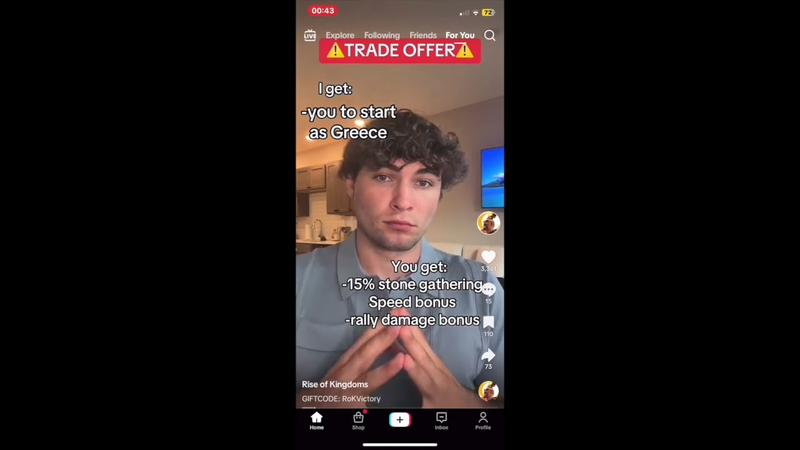
Rise of Kingdoms' 'player tips' ads from TikTok.
Rise of Kingdoms utilizes a strategic influencer-led marketing campaign on TikTok to drive user acquisition by framing gameplay decisions as high-stakes debates.
- Rise of Kingdoms uses influencer-led TikTok campaigns to frame gameplay decisions as high-stakes debates, leveraging conflicting expert advice to drive user acquisition.
- The marketing strategy utilizes a specific psychological hook by citing that only 5% of the player base achieves 10 million power, framing the game as a high-skill challenge.
- The game features 14 distinct civilizations, each offering unique bonuses like infantry health buffs or gathering speed increases to emphasize strategic depth.

How AppHarbr Puts A Stop To Bad Ads Before Your Users See Them
Mobile game publishers face a critical challenge in maintaining user retention and brand integrity due to the prevalence of low-quality, disruptive, and malicious advertisements.
- Low-quality and malicious advertisements directly increase user churn rates and trigger negative app store reviews, threatening long-term brand integrity.
- Manual monitoring of ad content is an inefficient use of operational resources that fails to address the root causes of disruptive or deceptive creative assets.
- Publishers are shifting toward AI-driven, automated filtering tools to proactively block policy-violating content in real time before it reaches the end user.

AdTech Evolution: Navigating the Privacy-First Frontier
The advertising technology landscape is undergoing a fundamental transition away from reliance on personally identifiable information and universal identifiers toward a privacy-first model centered on first-party behavioral data.
- Publishers can achieve eCPM increases of 5% to 11% among users who opt out of tracking by utilizing per-app machine learning models that analyze player behavior.
- The industry is shifting from universal identifiers and personally identifiable information toward a privacy-first model centered on first-party behavioral data.
- Studios can maintain revenue performance without compromising anonymity by using sequence embeddings and machine learning to cluster user archetypes based on standardized in-game interaction events.
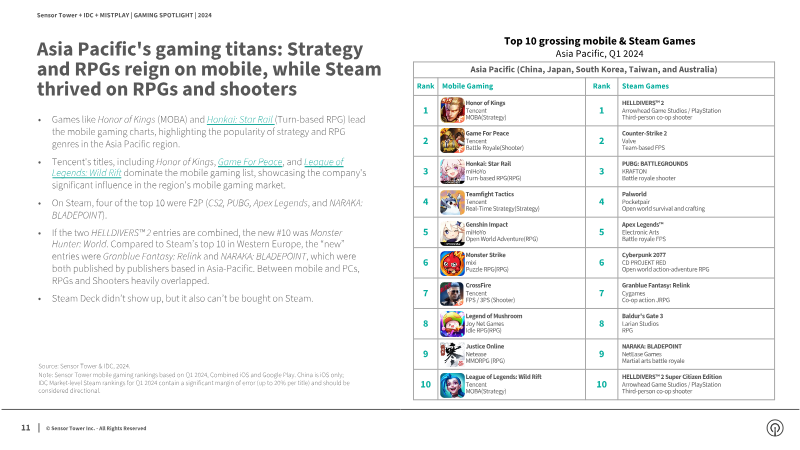
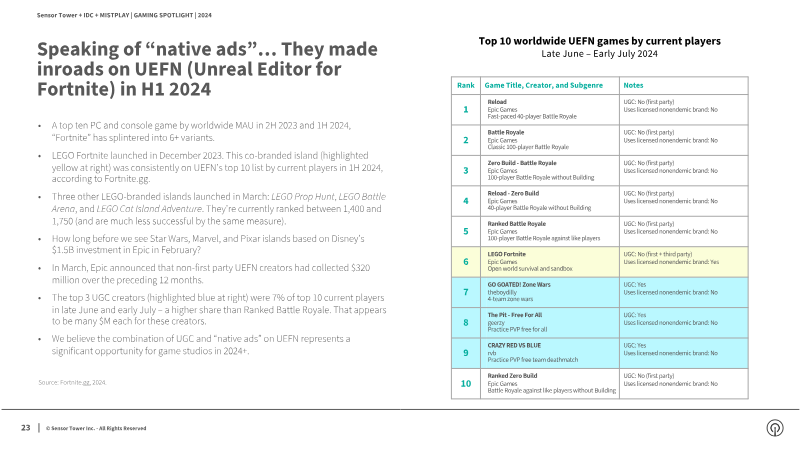

Gaming Spotlight H1 2024
Mobile gaming solidifies its position as the leading segment of the global video-game market, with revenue projected to reach $83 billion in 2024, reflecting a 6 percent year-over-year increase.
- Mobile gaming remains the dominant market segment with projected 2024 revenues of $83 billion, representing a 6 percent year-over-year increase.
- Home-console and handheld gaming segments are experiencing a decline, with projected revenues of $42 billion (down 1 percent) and $2.5 billion (down 2 percent) respectively.
- Growth in the mobile sector is primarily driven by rapid user acquisition and spending expansion in emerging markets, specifically India and Indonesia.

Google CMP update, Google Ad transparency, Tiktok AI script generator, Game review radar (#71)
Mobile game publishers operating in the European Union and the United Kingdom face a critical regulatory shift as Google mandates the integration of certified Consent Management Platforms for all AdSense, Ad Manager, and AdMob users by the end of the year.
- Mobile publishers in the EU and UK must integrate a Google-certified Consent Management Platform (CMP) for AdMob, AdSense, and Ad Manager by the end of the year or face a total cessation of ad revenue in those regions.
- Whiteout Survival achieved $18 million in monthly revenue by utilizing a deceptive onboarding funnel that transitions players from casual simulation mechanics into complex 4X gameplay.
- Google’s new Ads Transparency Center now allows users to search verified advertiser content, though it currently lacks the advanced filtering and usability features found in the Facebook Ad Library.

Legend of Slime review - User Acquisition, Creatives, Ad monetisation, Game design deep dive (#61)
Legend of Slime functions as a high-performing idle RPG that demonstrates the viability of aggressive, high-frequency ad monetization within the mobile gaming sector.
- Legend of Slime demonstrates strong retention metrics on iOS, achieving 61% Day 1, 30% Day 7, and 11% Day 30 retention rates.
- The game utilizes a 'merge gacha' system that avoids the steep exponential difficulty curves of traditional shard-based gachas, allowing for a more lenient and player-friendly progression model.
- A significant revenue spike occurred in December following a game update that introduced new rewarded ad placements, including a 'welcome back' boost and gameplay speed-up features.

Deep-dive into Google Privacy Sandbox. Same disaster as Apple ATT? When is it happening? (#57)
Google’s Privacy Sandbox represents a fundamental shift in digital advertising, aiming to preserve performance marketing capabilities on Chrome and Android without relying on third-party cookies or device-level identifiers like the GAID.
- Google’s Privacy Sandbox replaces third-party cookies and GAID with on-device, audience-level data processing to maintain ad targeting while keeping sensitive user information local.
- Major implementation changes for Chrome and Android are scheduled to occur between late 2024 and 2025.
- Unlike Apple’s App Tracking Transparency (ATT), which severely restricted retargeting, the Privacy Sandbox architecture is specifically designed to preserve retargeting capabilities for advertisers.