Global
Documents
Annual and Sustainability Report 2024
Modern Times Group (MTG) concluded the 2024 fiscal year as a focused European mobile gaming entity, reporting net sales of SEK 6,015 million, representing a 3% currency-adjusted growth. Despite achieving an adjusted EBITDA of SEK 1,666 million, the group recorded a net loss of SEK 210 million. The company maintains a strong liquidity position with SEK 3,543 million in cash and equivalents and no utilized external debt, supported by a disciplined capital allocation strategy that includes active share buybacks and a commitment to long-term, evergreen game franchises.
The company’s strategic trajectory is defined by its "Gaming Village" model, which emphasizes organic growth and accretive M&A to bolster its portfolio of studios, including InnoGames, Hutch, and Ninja Kiwi. A transformative development in this period was the acquisition of Plarium Global Ltd, finalized in early 2025, which significantly scales the group’s mid-core gaming capabilities and adds the flagship title RAID: Shadow Legends to its offerings. This expansion is supported by the "Flow Platform," a centralized infrastructure designed to share business intelligence and user acquisition tools across the group’s subsidiaries.
Sustainability and governance remain central to the company’s operational framework. In 2024, MTG transitioned its reporting to align with the Corporate Sustainability Reporting Directive (CSRD) and European Sustainability Reporting Standards (ESRS). While this methodological shift resulted in a reported 118.2% increase in location-based greenhouse gas emissions due to expanded accounting scopes, the company has committed to a 50% reduction in value chain emissions by 2032. Furthermore, the group maintains a robust governance structure, reporting no incidents of corruption or bribery, and continues to prioritize consumer safety through transparent odds disclosure and data protection measures. The board remains focused on long-term shareholder value, integrating ESG metrics into executive incentive schemes while maintaining a stable, low-leverage financial foundation.
- MTG finalized the acquisition of Plarium Global Ltd in early 2025, significantly scaling its mid-core gaming capabilities and adding the flagship title RAID: Shadow Legends to its portfolio.
- The company reported 2024 net sales of SEK 6,015 million, reflecting 3% currency-adjusted growth, alongside an adjusted EBITDA of SEK 1,666 million and a net loss of SEK 210 million.
- MTG maintains a strong financial position with SEK 3,543 million in cash and equivalents and zero utilized external debt, supporting a strategy of active share buybacks and evergreen franchise investment.
- The group utilizes a 'Gaming Village' model supported by the 'Flow Platform,' a centralized infrastructure designed to share business intelligence and user acquisition tools across studios like InnoGames, Hutch, and Ninja Kiwi.
- Following a transition to CSRD and ESRS reporting standards, MTG reported a 118.2% increase in location-based greenhouse gas emissions and has committed to a 50% reduction in value chain emissions by 2032.
2026 Global Mobile App Marketing Trends White Paper
The white paper argues that the 2025 mobile app market has shifted from volume‑driven traffic growth to value‑centric, technology‑enabled optimization. It identifies a “scissor gap” where the number of active advertisers fell 16.7 % YoY while creatives per advertiser rose 73.3 %, indicating higher competitive thresholds and a focus on creative quality. Market share remains strongest in business & productivity, utilities, entertainment, and finance, but creative volume is dominated by short‑drama, reading, and AI apps. iOS and Android advertising ratios stabilized at 4:6, with iOS advertisers producing more creatives due to higher monetization expectations.
User acquisition spend reached $78 billion, a 13 % YoY increase driven almost entirely by iOS, with e‑commerce, fintech, and betting leading non‑gaming verticals. Video remains the dominant ad format (≈70 % of social inventory), while static and playable ads serve testing, Android traffic, and engagement signals. AI has moved from a marketing tool to a core capability; leading AI apps scale through volume and quality, while many smaller entrants exit due to weak monetization.
Finance apps maintain steady growth focused on user quality, lifetime value, and compliance, contrasting with AI’s rapid scaling. North America remains the most selective market, demanding high content quality and long‑term trust; success here signals scalability elsewhere. The paper concludes that sustainable growth now hinges on creative capability, system efficiency, AI integration, and long‑term value creation rather than sheer traffic volume.
- The mobile app market has shifted from volume-based growth to a quality-focused model, evidenced by a 16.7% YoY decline in active advertisers alongside a 73.3% surge in creatives per advertiser.
- Global user acquisition spend grew 13% YoY to $78 billion, with the increase driven almost exclusively by iOS advertising.
- Video remains the dominant advertising format, accounting for approximately 70% of social media inventory, while static and playable ads are relegated to testing and engagement signaling.
- The iOS-to-Android advertising ratio has stabilized at 4:6, though iOS advertisers maintain higher creative output due to expectations for superior monetization.
- AI has transitioned from a marketing tool to a core operational capability, where success is defined by the ability to scale volume and quality while maintaining sustainable monetization.

Insight into Global Micro Drama App Marketing for 2026
SocialPeta’s analytics platform aggregates data from more than 90,000 micro‑drama advertisers and 80 million ad creatives across over 55 countries, positioning itself as a key resource for launching and scaling micro‑drama apps worldwide. The platform projects the global micro‑drama market to reach $6 billion by 2026, emphasizing its capacity to deliver actionable insights into advertising strategies, creative formulas, and regional audience preferences.
In 2025 the ecosystem expanded sharply: active advertisers rose by 63.6 % to over 700, while each advertiser produced a 144.9 % increase in creatives, largely thanks to AI‑powered production tools. Southeast Asia dominated genre preferences for “reversal of fortune” and “rebirth” dramas, whereas North America’s high‑paying users gravitated toward premium romance content. Europe remained the largest source of creative volume, underscoring a sustained upward trend in both advertiser participation and output across the globe.
A case study of “Evil Bride vs. The CEO’s Secret Mom” illustrates high‑impact marketing: 44 K creatives generated an estimated 2.7 B impressions in key markets such as the USA, UK, Canada, Australia, and Germany. AI‑driven tools—DSV restructuring and automated cover/clip generation—reduced production time, enabling rapid localization. Short, cliffhanger‑style ads with intense conflict and strong visual hooks outperformed longer formats, driving downloads and engagement in North America, Southeast Asia, Latin America, and the Middle East.
By late 2024 vertical micro‑dramas had matured into a stable ecosystem, with regional preferences—“reversal of fortune” in Southeast Asia and conflict‑driven stories in Latin America—fueling audience engagement. Production scaled to 55 vertical dramas in 2025 through standardized pipelines and AI‑enhanced marketing, allowing faster creative validation, lower volatility, and continuous data‑driven optimization. The analysis stresses that audience‑first IP development—testing concepts in short form before scaling—and multi‑platform, AI‑supported workflows are essential for reducing creative risk and converting IP into long‑term company capital.
- The global micro-drama market is projected to reach $6 billion by 2026, supported by a 63.6% increase in active advertisers to over 700 in 2025.
- AI-powered production tools drove a 144.9% increase in creative output per advertiser in 2025, enabling rapid localization and standardized production pipelines.
- High-impact marketing campaigns, such as the 44,000 creatives for 'Evil Bride vs. The CEO’s Secret Mom,' demonstrate that short, cliffhanger-style ads with intense conflict are the most effective format for driving global engagement.
- Regional audience preferences are highly segmented, with Southeast Asia favoring 'reversal of fortune' and 'rebirth' themes, while North American users gravitate toward premium romance content.
- Europe currently leads the global market in total creative volume, while Latin America and the Middle East show strong engagement with conflict-driven storytelling.
Gaming the Future: How to Make an Impact With Younger Generations
Gaming has become the dominant entertainment medium for younger generations, with 80 % of under‑18s actively gaming and Gen Z allocating up to 22 % of free time to play. The study, combining first‑party data from SuperAwesome and Anzu with social listening, qualitative research, quantitative surveys, syndicated data, brand lift studies and parent‑tracking panels, covers the UK, France, Germany, the United States and global markets from 2023‑24. A sample of 30 000 children, teens and young adults (ages 4‑24) plus parent responses informs the analysis.
Key findings show that gaming captures more attention than social media for Gen Z, with 55 % of under‑18s reporting a strong affinity for branded in‑game experiences. Younger gamers are highly receptive to ads, with 75 % of Gen Z players in the UK and US saying in‑game ads improve their experience, compared to 34 % of older adults. In‑game advertising drives higher brand recall (+7 pts) and purchase intent (+9 pts) for audiences under 34, and generates a “halo effect” that boosts brand affinity by up to 86 % among under‑18s. Parents report that children influence household spending, with 86 % saying their child’s opinions matter in purchases and 82 % prioritising items for children.
The report recommends a multi‑platform, contextual approach that respects emerging data‑protection regulations and Age Appropriate Design Codes. It emphasizes early engagement before brand loyalties lock at age 16, contextual targeting over behavioural profiling, and rigorous creative vetting to avoid manipulative design. The analysis underscores gaming’s strategic importance for reaching Gen Alpha and Gen Z, offering measurable lift across awareness, consideration and purchase stages.
- Gaming has become the primary entertainment medium for younger demographics, with 80% of under-18s actively gaming and Gen Z dedicating up to 22% of their free time to play.
- In-game advertising significantly outperforms traditional metrics for younger audiences, driving an 86% boost in brand affinity among under-18s and increasing brand recall by 7 points and purchase intent by 9 points for those under 34.
- Younger gamers are notably more receptive to in-game ads than older adults, with 75% of Gen Z players in the UK and US reporting that ads improve their gaming experience compared to only 34% of older adults.
- Children exert substantial influence on household economics, as 86% of parents report that their child’s opinions impact household purchases and 82% prioritize spending on items for their children.
- Gaming captures more attention than social media among Gen Z, with 55% of under-18s expressing a strong affinity for branded in-game experiences.

State of Gaming 2026
The 2026 State of Gaming analysis demonstrates a shifting landscape in which mobile gaming remains the largest driver of downloads—approximately 50 billion in 2025—but its growth rate is slowing. Revenue, however, continues to climb as monetization models mature and lifetime value deepens, especially within hybrid‑casual titles that now generate the most incremental income. In contrast, PC and console platforms experience record revenue growth, with Steam’s premium segment up 32 % and blockbuster releases such as Battlefield 6 capturing significant market share from incumbents. Shooter downloads on these platforms have plateaued, suggesting new titles are primarily cannibalizing existing audiences rather than expanding the category.
Genre‑specific dynamics reveal that strategy games are the only mobile genre to grow in downloads, driven by 4X titles from Eastern developers. Action and shooter games dominate PC/console gains, while hyper‑casual remains the largest download engine but shows a notable lift in time spent, particularly in Tier 2 markets. Casual titles face declining day‑7 retention, indicating a stickiness challenge that could erode long‑term player value.
Live‑ops and acquisition strategies have evolved toward retention‑focused events, multi‑tier season passes, and expedition‑style rewards. These mechanisms now represent the most reliable revenue drivers across competitive genres such as RPG, action, and simulation. Advertising spend remains concentrated on social channels—YouTube, Facebook/Instagram—and high‑attention formats like video, playable, and rewarded ads. Battlefield 6’s pre‑launch spend surpassed Call of Duty titles, leveraging Facebook, Reddit, and desktop display, while its post‑launch strategy pivoted to YouTube with cinematic, celebrity‑hook creatives.
Geographically, the U.S. market shows a skew toward lifestyle and puzzle categories despite lower IAP shares, whereas casino titles exhibit higher spend‑to‑revenue efficiency. Overall, the industry is moving from acquisition toward deeper monetization per user, with indie shooters and simulation titles gaining traction amid intense competition in the shooter segment.
- PC and console platforms are seeing record revenue growth, highlighted by a 32% increase in Steam’s premium segment and the strong market performance of Battlefield 6.
- Mobile gaming growth is slowing despite reaching 50 billion downloads in 2025, with hybrid-casual titles now serving as the primary drivers of incremental revenue.
- Shooter games on PC and console have reached a download plateau, indicating that new releases are cannibalizing existing player bases rather than expanding the total market.
- Retention-focused live-ops, including multi-tier season passes and expedition-style rewards, have become the most reliable revenue drivers for RPG, action, and simulation genres.
- Strategy games are the only mobile genre experiencing download growth, fueled primarily by 4X titles from Eastern developers.
Q4 2023 Gaming Industry Report: Global & MENAP Outlook
The Q4 2023 Gaming Industry Report presents a global market that expanded to $212 billion, with the MENAP region contributing $2.8 billion and experiencing a 30% quarter‑over‑quarter rise in both gamers and investment activity. Mobile gaming remains the dominant platform, accounting for 46% of the global player base, while indie PC titles capture a growing share of revenue at roughly 30%. The report also highlights the continued diversification of the industry, noting that game‑to‑movie adaptations generated over $1.4 billion in 2023, underscoring cross‑media opportunities.
Regulatory scrutiny intensified across the sector, with a 15% increase in litigation and high‑profile antitrust cases against major platform holders such as Google and Apple. Significant fines were imposed for deceptive practices, reflecting a tightening legal environment that could reshape market dynamics.
M&A activity rebounded sharply in Q4, with transactions totaling $68.7 billion—a 769% jump largely driven by the Activision‑Blizzard deal—while global venture capital funding fell. In contrast, MENAP venture activity rose 30%, indicating a strategic pivot toward emerging markets including Asia, Africa, and MENAP for future consolidation. This trend presents both challenges and opportunities for indie studios, potentially enabling higher‑quality titles through increased resources.
Shorooq Partners focuses on early‑stage gaming investments within MENAP, targeting pre‑seed to Series A deals with ticket sizes of $1–8 million. The firm prioritizes studios that possess strong intellectual property, robust monetization models, and software solutions that enhance processing efficiency and scalable user connectivity. By engaging through conferences such as the WN Conference Abu Dhabi and LEAP 2024, newsletters, and partnership initiatives, Shorooq aims to nurture the growing MENAP gaming ecosystem.
- The global gaming market reached $212 billion in Q4 2023, with M&A activity surging to $68.7 billion, a 769% increase primarily driven by the Activision-Blizzard acquisition.
- Mobile gaming remains the industry's primary platform, capturing 46% of the global player base, while indie PC titles have grown to represent approximately 30% of total revenue.
- The MENAP region is a key growth area, contributing $2.8 billion to the market and recording a 30% quarter-over-quarter increase in both gamer population and venture capital investment.
- Regulatory pressure is intensifying, marked by a 15% rise in litigation and significant antitrust actions against major platform holders like Google and Apple regarding deceptive practices.
- Cross-media expansion is a proven revenue driver, with game-to-movie adaptations generating over $1.4 billion in 2023.

Ad Monetization Without Killing Retention
Hybrid monetization can increase revenue without eroding player retention by treating advertisements as an integral part of the game’s design system. Three core ad formats—interstitials, rewarded video (RV), and banners—are positioned strategically through careful gating on level progression, playtime, or cooldown periods. Optimal triggers and placement reduce player frustration while maximizing eCPM, ensuring that monetization flows naturally with gameplay.
Rewarded video is most effective when offered during high‑stakes moments such as revives, boosters, or time‑limited rewards. Leveraging scarcity and urgency in these contexts drives conversions while preserving the core experience. Consistent visual cues, a clear distinction between coin rewards and RV value, and optional “No Ads” bundles further balance monetization with player comfort.
Selling “No Ads” bundles requires thoughtful presentation. Bundles should appear side‑by‑side with regular items, use distinct visual cues and anchoring to convey high value, and be gated behind a minimum purchase tier to protect payer retention. Segmenting ad exposure—capping impressions, applying cooldowns, and filtering out disruptive creatives—maintains a positive user experience while sustaining revenue.
Overall, the strategy blends ad formats with gameplay mechanics, employs scarcity and urgency for rewarded video, and offers high‑value “No Ads” options. This approach delivers robust monetization across diverse segments while safeguarding long‑term player engagement and retention.
- Integrate advertisements as core gameplay design elements rather than external overlays to increase revenue without negatively impacting player retention.
- Deploy rewarded video ads during high-stakes moments—such as revives, boosters, or time-limited rewards—to leverage scarcity and urgency for higher conversion rates.
- Implement strategic gating for ad triggers based on level progression, total playtime, or specific cooldown periods to minimize player frustration.
- Market 'No Ads' bundles by presenting them alongside regular items using clear visual anchoring to establish high value, while gating them behind minimum purchase tiers to protect payer retention.
- Maintain a positive user experience by segmenting ad exposure through impression caps, cooldown timers, and the filtering of disruptive creative content.
2026 Global Mobile Gaming Marketing Trends White Paper
The white paper establishes that the mobile‑gaming advertising ecosystem expanded rapidly in 2025, with more than 90 000 active advertisers and an influx of roughly 8 000 new entrants each month, a 22 % year‑over‑year rise. Advertisers increasingly deploy fresh creatives, with video accounting for 74 % of all ads—up 14 % YoY—and Android remains the dominant acquisition platform, though iOS shares grow for mid‑core and hard‑core titles.
Top mobile games in 2025 show a clear split between volume‑driven casual installs and value‑focused premium titles. Casual hits such as Block Blast! and Subway Surfers dominate downloads, while mid‑core and premium games generate the bulk of revenue. Leading spenders—FunPlus, Yotta Games, Hungry Studio—continue to favor Android for lower cost‑per‑install acquisition, whereas iOS delivers higher monetization per install.
The industry is moving from a linear funnel to an “Infinity Loop” model that integrates acquisition, retargeting, and lifecycle actions. Aarki’s supervised‑AI engine demonstrates the potential to boost lifetime value by up to 30 % and reduce campaign volatility, underscoring the importance of a unified, data‑driven full‑funnel strategy that prioritizes LTV over instant installs.
Early‑stage mobile games must achieve rapid habit formation, with 60‑minute daily play by week 2 and high alliance join rates. Paid‑traffic validation is critical; a Day‑1 acquisition rate below 35 % signals readiness issues. Creative trends vary by genre: lightweight socializing and parkour mini‑games dominate SLG spend, RPGs favor narrative IP‑linked content, while simulation and casual titles rely on realistic or viral short‑video formats that capture 70–80 % of impressions.
Regional insights reveal puzzle and casino titles lead creative trends in 2026, with Japan/Korea driving new creative volume and Southeast Asia showing higher local IP acceptance. Mobile‑gaming ad spend rises modestly in Oceania and South America, with Android dominating creative output. A strategic pivot toward “authenticity‑utility‑impact” stacks—solving real problems and building defensible communities—drives higher retention, while AI‑powered creatives accelerate rapid testing. Finally, marketers increasingly adopt AI and programmatic DSPs beyond walled gardens; performance gaps and trust issues persist, yet data show significant install uplifts when CTV campaigns complement mobile ads, indicating a shift toward transparent, scalable programmatic solutions.
- The mobile gaming advertising ecosystem grew by 22% year-over-year in 2025, with over 90,000 active advertisers and 8,000 new entrants joining monthly.
- Video content now accounts for 74% of all mobile game ads, representing a 14% year-over-year increase in usage.
- A shift toward an 'Infinity Loop' marketing model, supported by supervised AI, can increase player lifetime value (LTV) by up to 30% by integrating acquisition, retargeting, and lifecycle management.
- Android remains the primary platform for volume-driven acquisition due to lower costs, while iOS is increasingly favored for mid-core and hard-core titles to maximize monetization per install.
- Early-stage games require a Day-1 acquisition rate of at least 35% and 60 minutes of daily play by week two to signal long-term viability.
State of the Game Industry 2026
The industry snapshot reveals a workforce that remains predominantly male and White, yet shows growing diversity in gender identity, sexual orientation, and geographic mobility. Two‑thirds of respondents are male, 24 % female, and 8 % non‑binary, with 28 % identifying as LGBTQ+. The U.S. dominates the sample (54 %), and California remains the top state of residence, while Washington has experienced the largest influx. Most workers are under 35 (64 %) and concentrated in design, programming, and visual arts roles.
Layoffs continue to be a significant concern, especially within AAA studios where two‑thirds of respondents report company layoffs and nearly one in five have been personally let go. Indie studios experience fewer corporate cuts, yet a higher proportion of individuals report personal layoffs. Roughly half of all respondents anticipate no layoffs in the next year, but those with prior layoff experience express greater uncertainty.
Generative AI elicits polarized views: 42 % see it as a productivity catalyst, while 38 % view it as ethically problematic and potentially job‑threatening. The debate centers on balancing efficiency gains against concerns over originality, labor displacement, and environmental impact.
VR/AR/MR remains a niche segment, with only 8 % of respondents engaged in such projects. Meta Quest/Horizon dominates the market, and accessibility features are widely adopted, though advanced options lag behind. Monetization trends show premium titles favor digital downloads and physical copies, whereas free‑to‑play games rely heavily on in‑app purchases for currency and cosmetics.
Crunch culture persists, with 87 % of workers clocking overtime in the past year and over half citing essential work or self‑pressure as drivers. Union support is strong in the U.S., with 82 % backing unionization and a majority expressing interest, though leadership opinions are slightly more divided.
- Layoffs remain a critical industry issue, with two-thirds of AAA studio employees reporting company-wide cuts and nearly 20% of the total workforce having been personally let go.
- Workplace culture remains characterized by persistent crunch, as 87% of employees clocked overtime in the past year, largely driven by perceived necessity or self-imposed pressure.
- Generative AI adoption is deeply polarized, with 42% of professionals viewing it as a productivity tool while 38% fear it poses ethical risks and threats to job security.
- Support for labor organization is high, with 82% of U.S. respondents backing unionization and a majority expressing personal interest in joining a union.
- The industry workforce is predominantly male (66%) and under 35 (64%), with a significant concentration of talent located in the United States (54%), particularly in California and Washington.

PC & Console Gaming Report 2026
1. Market trajectory What direction is the PC and console market heading in 2026? 8 What direction is the PC and console market heading in 2026? 2. Attention & value allocation Where do players spend time and money on PC and console? 17 3. Market concentration What happens if you are not a top-20 game? 45 4.
- PC player base is projected to exceed one billion by 2028, with a CAGR of 2.9% from 2025-2028, while console player growth moderates with a 2.2% CAGR in the same period.
- Almost two-thirds of console revenues (PlayStation and Xbox) go to the top 20 games, whereas on PC, over half of revenue comes from games ranked 21+.
- PC is the only platform effectively monetizing Free-to-Play (F2P) games, with revenue holding stable despite falling playtime in the west; on console, F2P revenue is dropping faster than engagement.
- Games ranked 21+ are capturing a growing share of playtime across platforms, with PC showing the strongest shift since 2022, indicating market disaggregation and growth from outside the top 20 titles.
- Premium game revenue is growing on PC and PlayStation, but Xbox's more modest growth cannot offset declines in F2P and Call of Duty.
The Future of Consumer Apps: How AI and Game Design Principles Are Reshaping Every Category
The analysis establishes that consumer applications are entering a “Game‑Design 2.0” era, driven by AI‑native personalization, real‑time feedback and progression systems that elevate engagement and monetization across education, fintech, e‑commerce, health, social media and emerging verticals. 2025 data reveal that spending on non‑gaming apps has already eclipsed gaming, with AI emerging as the primary revenue catalyst and consumer demand for instant, tailored experiences rising sharply. Founders are advised to secure durable competitive advantages by harvesting proprietary data from launch, embedding culturally resonant narratives, and deploying AI to deliver seamless, game‑like value rather than merely branding an app as “AI‑powered.”
In high‑friction sectors, AI‑augmented game mechanics transform user behavior. Fintech platforms such as StockGro employ practice portfolios, leaderboards and AI‑personalized tutorials to convert financial discipline into instant gratification. E‑commerce brands like Temu and Bins use algorithmic discovery feeds, mystery boxes and streak rewards to boost retention beyond price. Health apps leverage voice‑first AI coaches with progression loops, while social networks such as TikTok demonstrate that behavioral AI coupled with variable rewards can drive record‑setting daily engagement. These examples underscore how immersive, AI‑enhanced game design unlocks higher user engagement and monetization in traditionally low‑engagement sectors.
BITKRAFT Ventures positions itself as a top‑decile investor in consumer apps, employing equity, crypto and non‑dilutive user acquisition financing to accelerate growth. The firm projects that by 2025 non‑gaming mobile apps will surpass gaming revenue, reaching $150 B by 2030, and that AI‑driven gamification will create rapid, defensible moats. By 2035, BITKRAFT forecasts that at least five consumer non‑gaming companies could exceed $10 B in valuation, highlighting the strategic importance of AI and game design for future digital experiences.
- Non-gaming mobile app revenue is projected to reach $150 billion by 2030, with spending in this sector already surpassing traditional gaming apps as of 2025.
- AI-driven gamification is the primary catalyst for revenue and engagement, with BITKRAFT forecasting at least five non-gaming consumer companies will exceed $10 billion valuations by 2035.
- High-friction sectors are successfully using game mechanics to drive retention; for example, fintech platforms like StockGro use leaderboards and AI-personalized tutorials to convert financial discipline into instant gratification.
- E-commerce brands such as Temu and Bins are leveraging algorithmic discovery feeds, mystery boxes, and streak rewards to boost user retention beyond simple price competition.
- Behavioral AI combined with variable rewards, as demonstrated by TikTok, is the current industry standard for driving record-setting daily engagement across social platforms.
Ubisoft First-Half 2025-26 Earnings Figures
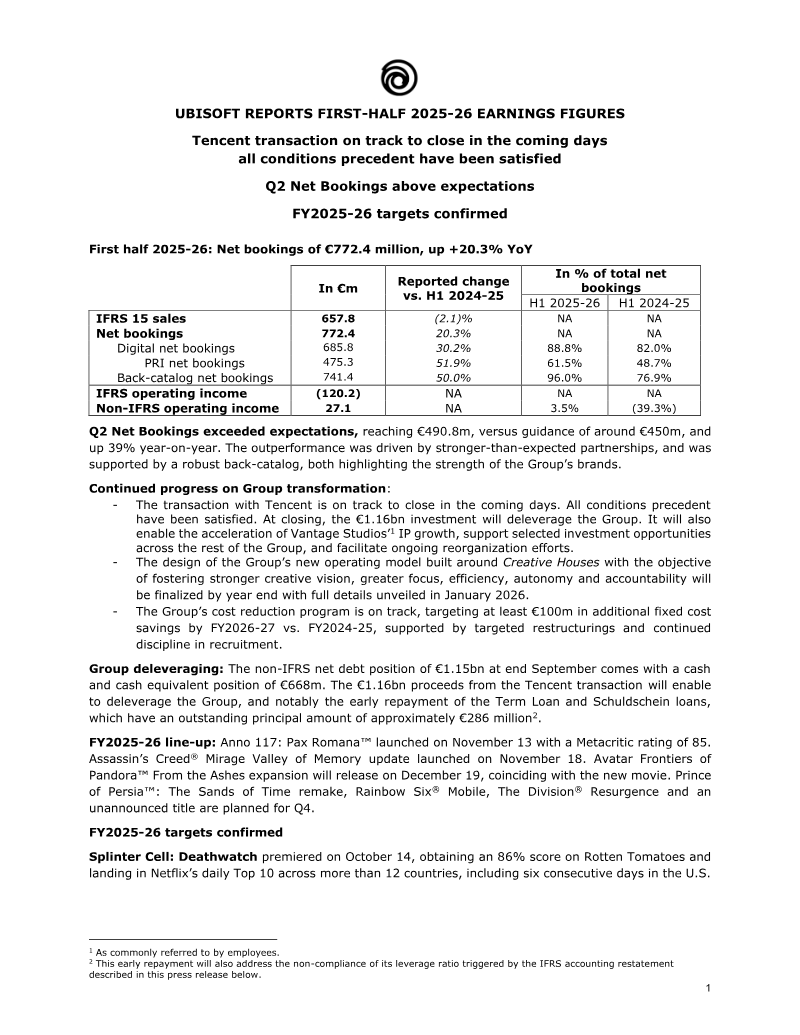
UBISOFT REPORTS FIRST-HALF 2025-26 EARNINGS FIGURES Tencent transaction on track to close in the coming days all conditions precedent have been satisfied Q2 Net Bookings above expectations First half 2025-26: Net bookings of €772.4 million, up +20.3% YoY Reported change In % of total net In €m vs.
- Ubisoft's H1 2025-26 net bookings reached €772.4 million, a 20.3% year-over-year increase, with Q2 net bookings exceeding expectations at €490.8 million (versus guidance of €450 million) due to strong partnerships and back-catalog performance.
- The transaction with Tencent, involving a €1.16 billion investment, is on track to close soon, with all conditions precedent satisfied, which will deleverage Ubisoft by enabling early repayment of approximately €286 million in loans.
- Ubisoft confirmed its FY2025-26 targets, expecting stable net bookings year-on-year, approximately break-even non-IFRS operating income, and negative free cash flow, but anticipates returning to positive non-IFRS operating income and free cash flow in FY27.
- Digital net bookings grew by 30.2% year-over-year to €685.8 million, representing 88.8% of total net bookings, while back-catalog net bookings increased by 50.0% to €741.4 million.
- Ubisoft's headcount decreased by approximately 1,500 employees over the past 12 months to 17,097, with a targeted Voluntary Leave Program and restructuring introduced at Nordic studios in October.