Global reports and market data
Documents
Overwatch vs. Call of Duty: The Battle Pass War
The current landscape of Western first-person shooters is defined by a struggle to optimize monetization and player retention through evolving battle pass structures.
- Western AAA studios are struggling to balance battle pass monetization with player retention, as current models fail to generate the ARPU necessary to sustain high-quality live service teams.
- Major FPS titles are pivoting their progression mechanics: Call of Duty is implementing permanent boosts, Overwatch is adopting tiered unlock tracks, and Battlefield is introducing a three-month blackout period before rotating content into the store.
- The industry is currently stifled by a risk-averse culture where AAA developers prioritize avoiding negative community sentiment on platforms like Reddit over testing innovative monetization strategies.

Tencent’s bid to create the next FromSoftware and Larian
Tencent Games, through its Interactive Entertainment and Game Global (IEG) division, is actively pursuing a long-term strategy to cultivate category-leading game studios capable of achieving the global success seen by developers like FromSoftware and Larian.
- Tencent is shifting its global strategy to cultivate category-leading studios capable of producing high-quality console and PC titles, modeled after the success of FromSoftware and Larian.
- The company currently manages approximately 20 studios worldwide, utilizing a 'long game' approach that prioritizes creative autonomy and operational support over rigid corporate oversight.
- Tencent is leveraging the global success of Chinese-developed titles like Black Myth: Wukong to bridge the gap between its traditional mobile-centric expertise and the high-end console market.

Life at the Speed of Play: Mark Pincus, Zynga founder, on Leadership and Risk
Product success in the gaming industry hinges on the ability to distinguish between intuitive instincts and flawed ideas.
- The gaming industry has grown from a $23 billion market in 2007 to a $280 billion global powerhouse, yet it remains dominated by ephemeral, time-wasting experiences that lack social or dimensional depth.
- Founders should utilize the 'proven, better, new' strategic framework, which anchors products in established mechanics and incremental improvements to mitigate the high failure rates of purely novel features.
- Effective leadership requires a 'democratic dictatorship' model where CEOs prioritize being right over being liked, dedicating at least 50% of their time to product strategy rather than administrative tasks.
How to Win with H5 Gamers
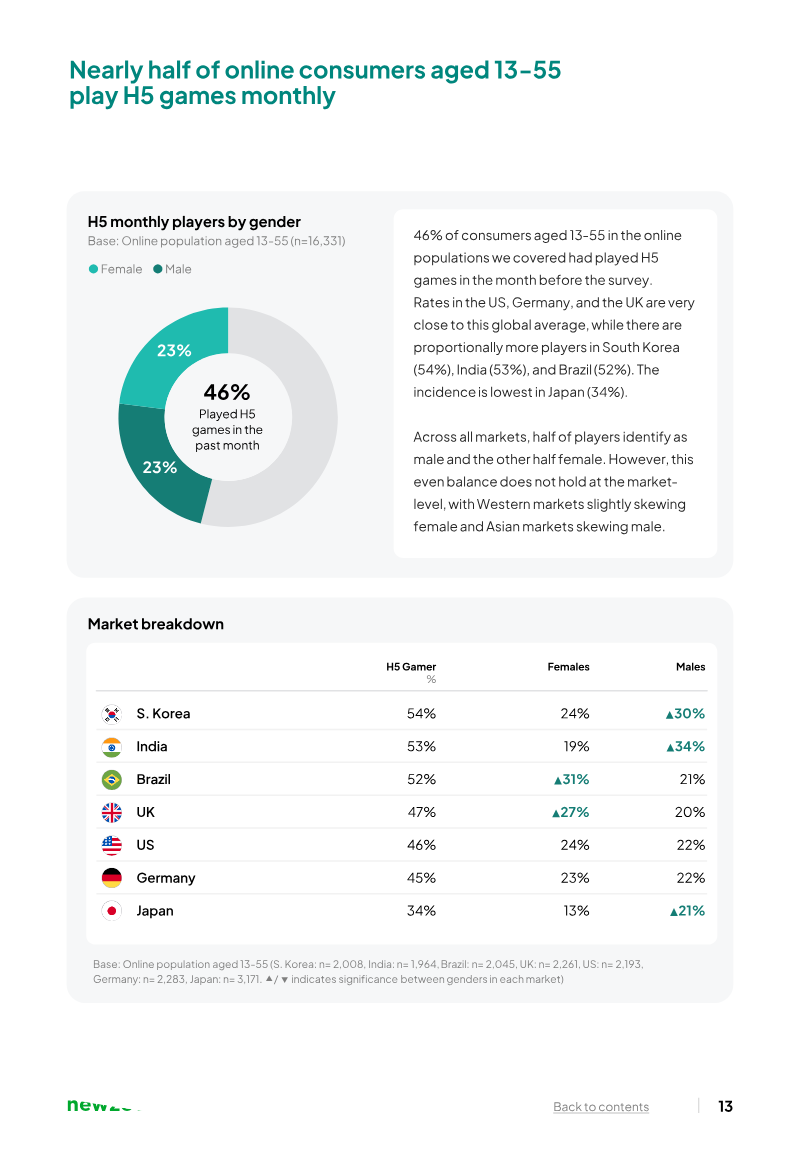
HTML5 gaming has emerged as a significant, mobile-first sector that captures the attention of 46 percent of online consumers aged 13 to 55 on a monthly basis.
- HTML5 games increase user time spent on websites and social platforms by approximately 40 percent, serving as a highly effective retention tool.
- The sector reaches 46 percent of online consumers aged 13 to 55 on a monthly basis, driven by a low-friction, mobile-first, free-to-play model.
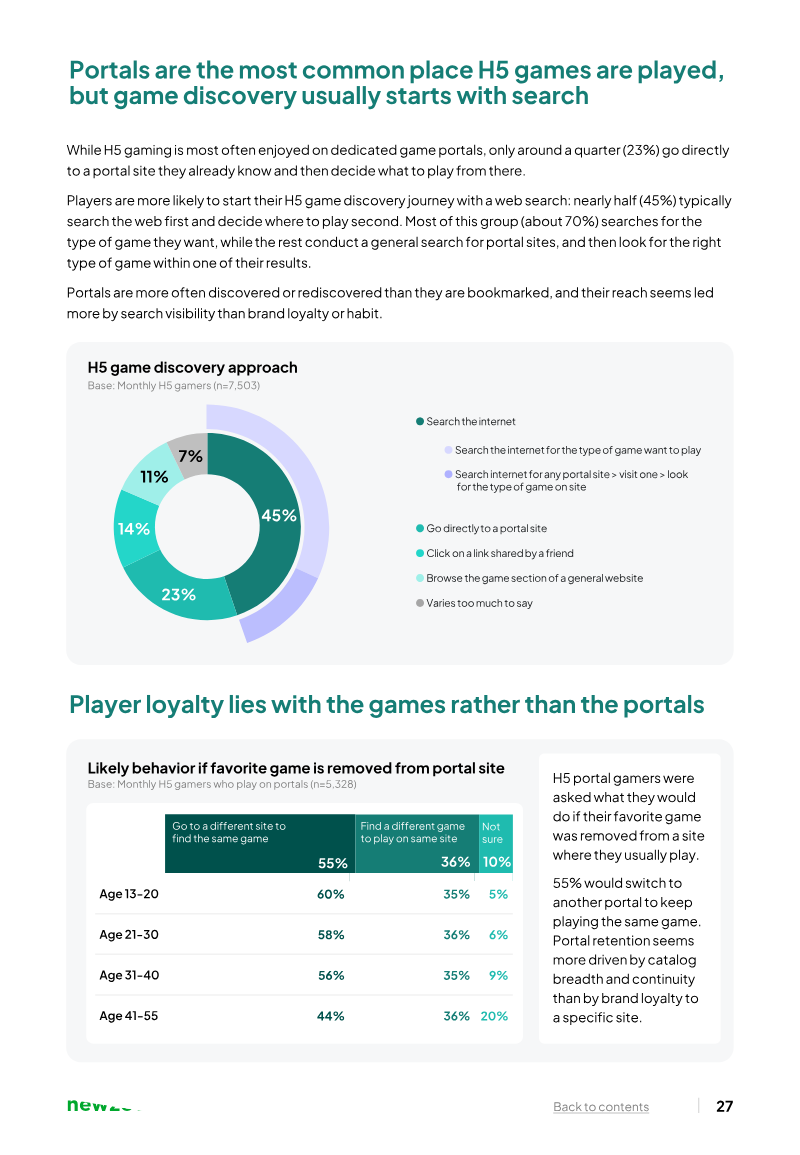
- 69 percent of players prefer ad-supported experiences over paid, ad-free alternatives, making non-intrusive advertising the primary monetization strategy.



Programming Mechanics in Commercial Games: A Multiple Case Study
This paper conducts a close reading of two commercial programming games, GLADIABOTS and The Farmer Was Replaced, to identify design strategies that educational game designers could adapt.
- Commercial programming games often innovate more in weaving programming into the core gameplay loop than educational games, which remain largely unchanged since LOGO and Karel the Robot maze navigation, while educational titles are stronger in pedagogical grounding.
- The study is a single-researcher hermeneutic close reading of two games selected from the fifty most positively reviewed Steam titles tagged "programming", so its findings reflect one interpreter's reading rather than measured learner outcomes.
- GLADIABOTS uses a visual scripting language to program robot AI in arena battles, using hidden information and player unpredictability to sustain iteration rather than converge on a single optimal solution.



Energy Systems Engineering and Education: A Serious Game for Literacy
"Primary Energy" is a Unity-based serious game designed to build energy literacy among secondary students by having them manage a 24-hour electricity system using authentic hourly renewable generation data from Portugal's REN Data Hub.
- "Primary Energy" is a Unity-based serious game that has secondary students manage a 24-hour electricity system across 24 sequential missions, using authentic hourly renewable generation data from Portugal's REN Data Hub.
- The first Design-Based Research cycle tested the game with 31 students aged 12 to 18, and the study is explicitly exploratory and formative, measuring no learning gains.
- Roughly 80 percent of participants enjoyed the game, students adapted their strategies to renewable variability, and they reasoned about environmental trade-offs during play.



Searching for the Golden Thread: Game-Based Learning for Awareness of Gender Equity
This study examines The Golden Thread, a hybrid tabletop and app-based educational game designed to raise awareness of gender inequity in career progression, particularly the barriers women face in reaching senior positions.
- The Golden Thread is a hybrid tabletop and app-based game adapting Snakes and Ladders to a workplace setting, where male personas are routed onto a faster 'golden thread' path through access to information and informal networks while female personas face different barriers despite similar choices.
- The game was evaluated through two pilot sessions with 19 master's-level engineering students in a Swedish university project management course, analysed via reflexive thematic analysis, yielding five themes: reflection and awareness, active participation, pedagogical relevance, active learning environment, and prototype refinement.
- Players generated high energy and substantive discussion, including perceptions of unfair treatment based on gender and age, and the course teacher adapted insights from the session into an exam question.



Playing for Quality: A Competitive Educational Game for Teaching Unit Testing in Computer Science Education
Test Royale is a web-based competitive educational game designed to teach unit testing, with its score computed directly from validated test-quality indicators such as mutation score, code coverage, useful test code, and execution time, rather than from how much activity a player performs.
- Test Royale is a web-based competitive game for teaching unit testing that scores players on validated test-quality indicators (mutation score, code coverage, useful test code, execution time) rather than on activity volume.
- In a 16-student undergraduate classroom pilot, the gamified group outperformed a non-gamified control on mutation score, branch and line coverage, useful test lines, and total score with large effect sizes, though only total score survived the stricter Bonferroni correction.
- An 11-developer industry pilot gave Test Royale a mean System Usability Scale score of 80.0, but the 95% confidence interval's lower bound (just above 68) sits only marginally above the benchmark, and motivation did not change significantly for professionals.



From Cultural Game Jams to Applied Jam Models: A Longitudinal Evaluation
This longitudinal evaluation examines the Applied Jam Model (AJM), a structured framework for applied game jams, as implemented across four Óbidos Cultural Game Jam (ECGJ) editions held in Óbidos, Portugal, between 2024 and 2025.
- The Applied Jam Model's effectiveness depended on the continuity linking preparation, facilitation, thematic immersion, and implementation rather than on any single activity.
- Pre-jam preparation usefulness ratings swung sharply by edition: 100% in ECGJ#02 after a full-day lagoon field visit, 52.6% in ECGJ#03 when preparation was compressed to one day, and 76.0% in ECGJ#04.
- The four Óbidos Cultural Game Jam editions (2024–2025) involved 146 participants (95 university, 51 secondary school) who produced 40 game prototypes, with ECGJ#02 yielding the series' highest output at fourteen prototypes.



Game-Based Learning for Integrated Care Implementation
This paper argues that Game-Based Learning (GBL) can be designed as an implementation-oriented strategy for embedding new integrated care organisational models into everyday healthcare practice, rather than serving only as an instructional tool for discrete clinical skills.
- Game-Based Learning is proposed not just as an instructional tool for discrete clinical skills but as an implementation strategy for embedding new integrated care organisational models into everyday healthcare practice.
- The authors combine Normalisation Process Theory (coherence, cognitive participation, collective action, reflexive monitoring), Argyris and Schön's single- and double-loop organisational learning, and the Learning Mechanics-Game Mechanics model into a single conceptual framework, using the DARE Health seven-pillar model for cardiovascular-kidney-metabolic care as the illustrative context.
- The four NPT mechanisms are treated as recursive and overlapping rather than sequential, and each is linked to a design principle and an illustrative class of game mechanics.



Leveling Up Physics Education with Gamified Virtual Reality Simulations
PhysiVerse, a gamified virtual reality physics environment built around a predict-then-verify learning loop, is evaluated here for its usability, presence, emotional response, and early learning gains among 23 undergraduate students.
- PhysiVerse, a gamified VR physics environment, scored a mean System Usability Scale of 83.04, well above the conventional benchmark of 68, and reached 6.06 on a 7-point Spatial Presence scale in a study of 23 undergraduates.
- Correct answers on the first physics question rose from 39.1% to 78.3% between pre- and post-testing, while the second question improved more modestly, from 21.7% to 34.8%.
- Perceived usefulness (4.26) and external control (4.35) landed near the scale midpoint, showing that ease of use outpaced perceived educational value.



A Board Game Approach to Hospitality Career Education in Schools
This paper examines whether a board game can broaden early adolescents' awareness of hospitality careers, a sector often perceived as low-skilled despite its demand for transferable skills.
- A board game called Adventures in Hospitality Land was piloted with 68 students in Malta, and 84.1% of students named a hospitality role they had not previously known after playing.
- Simplifying the game into a Lite version cut the share of students reporting rules difficulty from 71.1% to 17.4%, with no Lite players reporting low enjoyment.
- Educational outcomes were nearly identical between the Full (n=45) and Lite (n=23) versions, with 60.0% versus 60.9% learning about tourism roles and 82.2% versus 87.0% naming a previously unknown hospitality role.