Market (Overall)·Updated Apr 13, 2026 by Modern Times Group
Report
Published by Modern Times Group
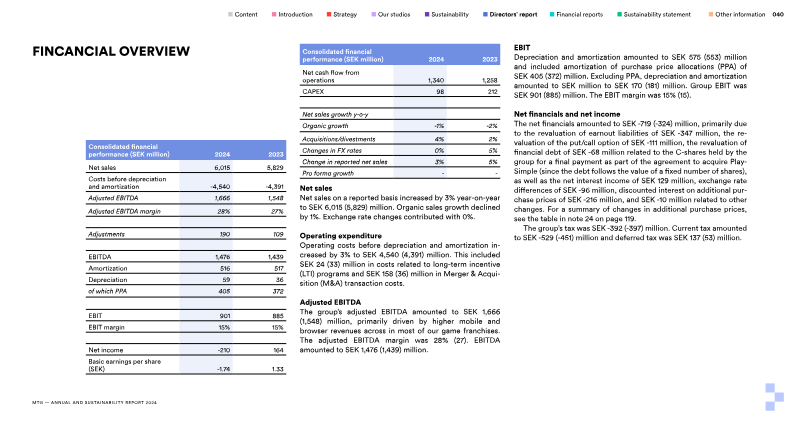
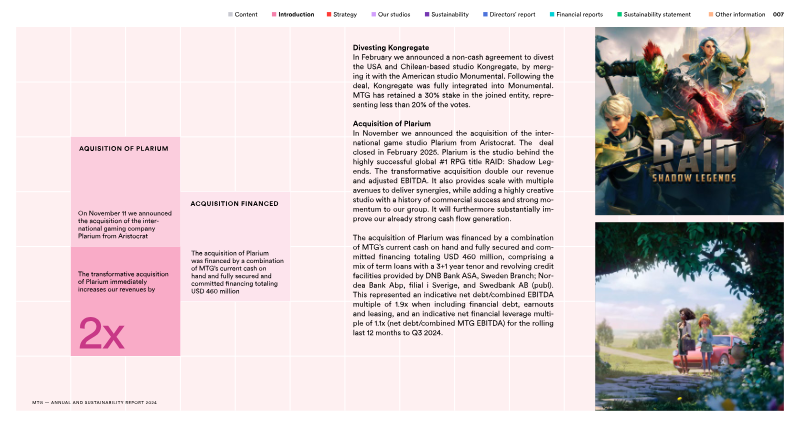
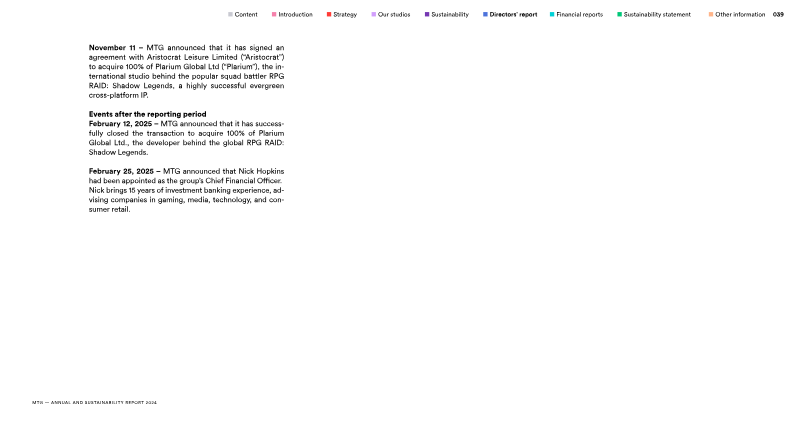
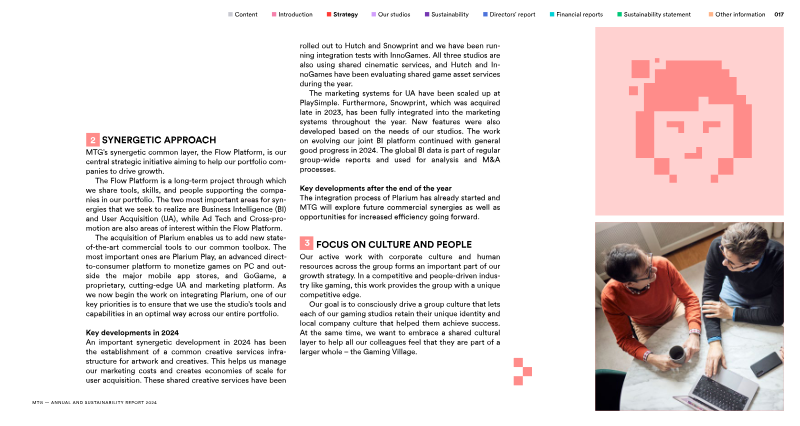
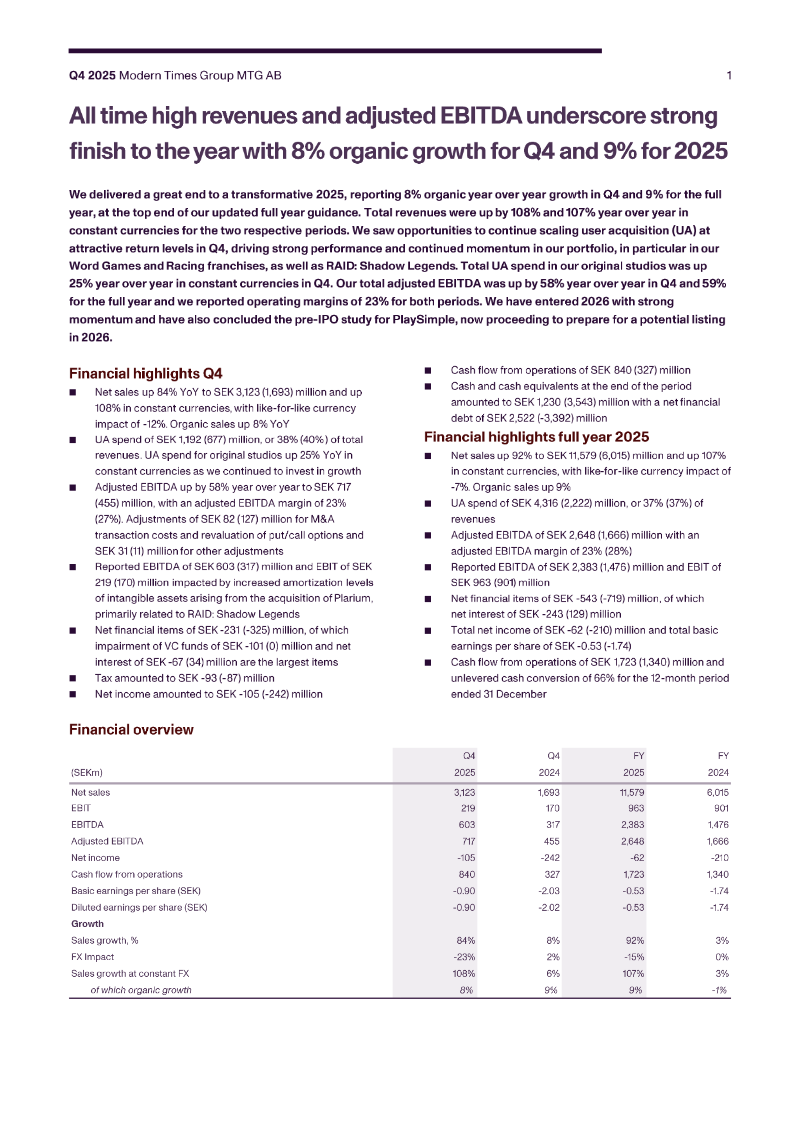
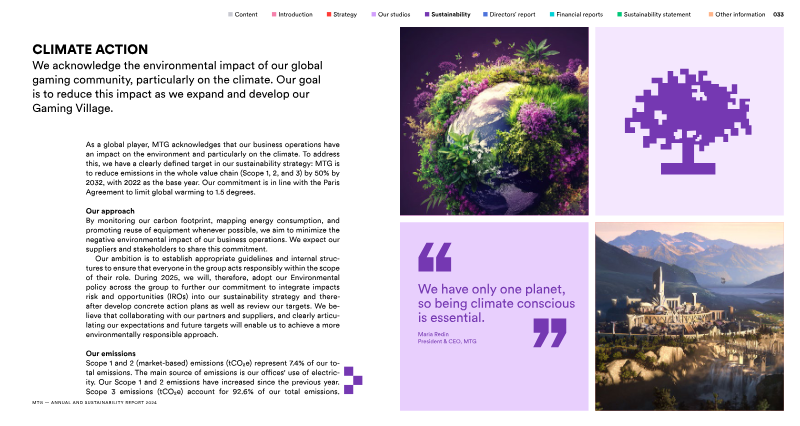
Modern Times Group (MTG) concluded the 2024 fiscal year as a focused European mobile gaming entity, reporting net sales of SEK 6,015 million, representing a 3% currency-adjusted growth. Despite achieving an adjusted EBITDA of SEK 1,666 million, the group recorded a net loss of SEK 210 million. The company maintains a strong liquidity position with SEK 3,543 million in cash and equivalents and no utilized external debt, supported by a disciplined capital allocation strategy that includes active share buybacks and a commitment to long-term, evergreen game franchises. The company’s strategic trajectory is defined by its "Gaming Village" model, which emphasizes organic growth and accretive M&A to bolster its portfolio of studios, including InnoGames, Hutch, and Ninja Kiwi. A transformative development in this period was the acquisition of Plarium Global Ltd, finalized in early 2025, which significantly scales the group’s mid-core gaming capabilities and adds the flagship title *RAID: Shadow Legends* to its offerings. This expansion is supported by the "Flow Platform," a centralized infrastructure designed to share business intelligence and user acquisition tools across the group’s subsidiaries. Sustainability and governance remain central to the company’s operational framework. In 2024, MTG transitioned its reporting to align with the Corporate Sustainability Reporting Directive (CSRD) and European Sustainability Reporting Standards (ESRS). While this methodological shift resulted in a reported 118.2% increase in location-based greenhouse gas emissions due to expanded accounting scopes, the company has committed to a 50% reduction in value chain emissions by 2032. Furthermore, the group maintains a robust governance structure, reporting no incidents of corruption or bribery, and continues to prioritize consumer safety through transparent odds disclosure and data protection measures. The board remains focused on long-term shareholder value, integrating ESG metrics into executive incentive schemes while maintaining a stable, low-leverage financial foundation.
ninjAkiwi Snowprint InnoGames H TOPDRIVES NASCAR W MANAGER O D R ETAIRTI W s EAC ANNUAL AND CLASH XOR c W R PL R H 0 R D SUSTAINABILITY D S JAM s REPORT WORD
CONTENT 003 Introduction 027 Sustainability 058 Financial reports 004 MTG today 028 Corporate sustainability strategy 059 Financial statements 006 2024 in brief 029 Sustainability targets 071 Notes 008 Letter from the CEO 030 Inclusive and welcoming 122 Signatures 011 Business model 033 Climate action 123 Auditor's report 035 Proud and respectful 012 Strategy 013 Vision, Mission, Strategy 014 Building the Gaming Village 015 Our strategy 128 Sustainability statement 129 General information 143 Environmental information 158 Social information 173 Governance information 037 Directors’ report 176 Sustainability notes 038 Business operations 179 Auditor's report 040 Financial overview 042 Other group information 043 The MTG share 019 Our studios 046 Financial policies and risk 180 Other information 020 Snapshot 2024 049 management 181 Definitions 021 PlaySimple 053 Corporate governance report 182 Alternative measures 022 InnoGames 054 Internal control report 183 Five-year summary 023 Ninja Kiwi 057 Board of directors 184 Financial calendar 024 Hutch Group management 025 Snowprint 026 Plarium MTG — ANNUAL AND SUSTAINABILIT Y REPORT 2024
MTG TODAY We are an international, mobile-first gaming group. With the acquisition of Plarium completed in February 2025, we now have one of the world's leading mid-core gaming portfolios. Our portfolio also includes one of the top global line-ups of casual word games. MTG is an international gaming group with a mobile-first acquisition of Plarium. Our ambition is to deliver profitable focus and a multi-platform approach. We are well-posi - growth for our shareholders, but even in periods of slower tioned to capture above-market growth in the medium growth, our business model provides us with leverage to and long term, thanks to our strong and highly focused maintain strong profits and margins while we work on fu - portfolio of high-quality games, long-standing partner - ture projects. The acquisition of Plarium is a major ships with global entertainment IPs and strategic focus on During most of 2024, the group’s five gaming studios milestone in our journey as a gaming commercial synergies driven by a shared, state-of-the art were PlaySimple, InnoGames, Ninja Kiwi, Hutch, and and toolkit across the group. We create value by supporting the Snowprint. At the beginning group and represents a catalyst for gaming studios and companies that are part of the group in of 2024, MTG divested our future evolution and growth. We accelerating their growth.
mes, Ninja Kiwi, Hutch, and and toolkit across the group. We create value by supporting the Snowprint. At the beginning group and represents a catalyst for gaming studios and companies that are part of the group in of 2024, MTG divested our future evolution and growth. We accelerating their growth. We are also continuously evolv - Kongregate, combining ing the Flow Platform, our common layer of commercial it with the US studio now have one of the strongest midtechnology and skills, which will now be further strength - Monumental, in which core portfolios in the world, strong ened by the tools developed in-house by Plarium (see more MTG is now a shareholder. in the section on strategy, page 12). In February 2025 MTG casual games, and the relevant scale Our industry is supported by positive long-term so - completed the acquisition we need to continue creating value. cial, technological, and demographic trends and mobile of Plarium and has now gaming is a daily staple for both adults and young peo - consolidated the company we n ple around the world. Our goal is to grow organically by into its portfolio. continuously expanding the content available in our cur - rent games, and by launching and growing new titles over time. Our growth will be further supported by future in - cremental M&A opportunities, enabled by our strong cash generation capabilities, which are further solidified by the MTG — ANNUAL AND SUSTAINABILIT Y REPORT 2024
> **[Chart page]** This page contains visual data — view in PDF for the best experience. MTG 2024 SUMMARY¹) 1+6 7 1 DAU – DAILY ACTIVE USERS, 4 7 2 million 5 3 6 3 6.29 7 7 4 GROUP SALES, SEK million 6 6,015 7 7 Snowprint GROUP ADJUSTED EBITDA, SEK million 2 1,666 PlaySimple InnoGames Ninja Kiwi Hutch Snowprint NUMBER OF LIVE GAMES 18 10 5 6 3 REVENUE MIX IAP²) 19% 96% 34% 91% 97% IAA²) 81% 4% 2% 8% 3% OTHER 0% 0% 64% 1% 0% NUMBER OF EMPLOYEES >390 >350 >90 >150 >50 4 1) MTG’s reported numbers for 2024 do not include Plarium, as the company was consolidated from February 1, 2025 2) In app purchase (IAP), in app advertisement (IAA) MTG — ANNUAL AND SUSTAINABILIT Y REPORT 2024
2024 IN BRIEF We generate value – today, tomorrow and beyond. REVENUE SEK million 2,000 1,600 Executing on our strategy 1,200 SALES GROWTH We continued to execute on our organic strategy, which fo - 800 cuses on driving growth in our evergreen titles through liveops and in-game content and launching new titles to scale 400 the group further over time. Our two major new game MTG reported revenues of SEK launches in 2024 were Heroes of History from InnoGames and 0 Q1 Q2 Q3 Q4 Q1 Q2 Q3 Q4 Q1 Q2 Q3 Q4 6,015 million for the full year Bloons Card Storm from Ninja Kiwi. Furthermore, PlaySimple 2022 2023 2024 2024, delivering 3% currency has focused on localizing key word games to reach a broader adjusted growth. This was in audience. We launched a common creative agency for the the middle of the full year out- group through the Flow Platform, our means to accelerate look of 1-5% revenue growth on a currency adjusted basis group evolution and growth by identifying and realizing synergies. We also had an active M&A agenda during the year ADJUSTED EBITDA
Thunderful Group’s 2024 Annual Report documents a decisive pivot toward a pure gaming focus, achieved through divestment of non‑gaming assets and a 20 % workforce reduction. The restructuring tightened the balance sheet, halving interest‑bearing net debt and leaving a modest cash position of SEK 29.6 million, yet it also produced a sharp decline in operating performance: net revenue fell 23.8 % to SEK 292.8 million and adjusted EBITA swung to a loss of SEK 383.9 million, largely due to cost‑cutting and the transition to higher‑margin publishing and co‑development activities. The global gaming market grew modestly in 2024, reaching USD 187.7 billion with a 5 % rise in the player base to 1.5 billion, projected to reach 1.67 billion by 2027. Thunderful’s strategy targets a 3.1 % CAGR in the PC segment, high‑quality titles priced USD 10–30, and external project investments capped at EUR 2 million. The company has reorganised into Publishing and Co‑development & Services segments to optimise resource allocation, lower fixed costs through third‑party publishing, and balance riskier internal IP development with predictable service revenue. Governance remains robust: a board‑led risk framework, annual review of a Zero‑tolerance Code of Conduct, and an anonymous whistleblowing function reinforce ethical standards. Executive remuneration is tightly linked to long‑term value, with fixed salaries capped at 30 % variable pay and share‑based incentives that could dilute equity by up to 4.65 % if fully exercised. Despite a net loss of SEK 887.5 million in 2024, the Group’s operating profit rose 57 % to SEK 292.8 million, signalling a turnaround post‑restructuring. Financially, the Group’s liquidity is constrained; total assets fell from SEK 3.15 billion to SEK 772.9 million, and net cash turned negative. Impairments of over SEK 444 million on goodwill and other intangibles, coupled with significant restructuring costs, underpin the negative operating margin of –46.9 %. The company’s exposure to foreign‑exchange, interest‑rate and liquidity risks remains moderate but requires ongoing monitoring. Overall, the report presents a company in transition, balancing aggressive cost discipline and strategic realignment against a challenging financial backdrop.
Fiscal year 2026 ended with a 13 % rise in sales to ¥487.5 bn, yet operating income swung from a ¥48.1 bn profit in FY2025 to a ¥5.7 bn loss, driven by significant goodwill impairments on Rovio and Stakelogic and a widening deficit in the Gaming segment. Adjusted EBITDA fell to ¥16.6 bn, reflecting heavy upfront development costs and impairment charges, while net equity contracted by ¥48.7 bn as cash balances were depleted following the acquisitions of GAN and Stakelogic. Within Entertainment Contents, sales edged up to ¥326.6 bn from ¥321.5 bn, but operating income declined from ¥40.8 bn to ¥32.4 bn because new Full‑Game and F2P titles underperformed, despite steady growth in licensing revenue. Forecasts for FY2027 project sales of ¥357 bn and operating income of ¥42.5 bn, contingent on successful new IP launches, repeat sales, and a planned lift in licensing income. Margin erosion from title underperformance remains a key risk. Capital allocation for FY2026/3 was restructured to focus on ¥190 bn of cumulative investment over FY2025–FY2027, allocating ¥80 bn to development, ¥120 bn to strategic acquisitions, and planning ¥70 bn in share buybacks while pausing large‑scale M&A. Shareholder returns are expected to rise sharply, with FY2026/3 projected at ¥31.5 bn (≈¥11.7 bn in dividends) and FY2027/3 potentially reaching ¥16.2 bn under a 50 % total‑return ratio applied to projected net income. Pachislot sales showed modest growth, buoyed by new titles and strong first‑week performance of flagship IPs such as “Hokuto No Ken” and “Kabaneri of the Iron Fortress.” Pachinko sales declined as the temporary lift from Lucky Trigger 3.0 Plus faded and hall utilization softened. The group plans to introduce reel‑exchangeable cabinets, expected to account for roughly 20 % of pachislot revenue, and is positioning the gaming business for a J‑curve bottom in FY2027 through intensive lease sales and B2B platform upgrades. The release schedule for FY2026/3 emphasizes a concentrated push of multi‑platform titles, including the Nintendo Switch 2 launch in March 2026 and a slate of global releases across consoles, PC, and mobile from late 2025 to mid‑2026. Key animation properties such as *Detective Conan* and *Lupin the Third* are slated for April–June 2025, with several new IPs and Netflix exclusives planned for early 2026. Pachislot and pachinko product launches are detailed with projected unit sales ranging from 8,000 to 49,000 units across varying gambling‑specification tiers.
Sony Group’s FY2025 consolidated results demonstrate modest revenue growth and a mixed profitability profile across its core business units. Total sales increased 4 % to ¥12.48 trn, largely driven by higher operating income in the Imaging & Sensing Solutions (I&SS) and Music segments. Operating income rose 13 % to ¥1.45 trn, while net income attributable to shareholders fell 3 % to ¥1.03 trn because of a larger equity‑method loss in the Financial Services arm and higher impairment charges. Operating cash flow remained flat at ¥1.97 trn, and the spin‑off of Sony Financial Group was treated as a discontinued operation from Q1 FY25 onward. Within the Music division, sales climbed 15 % to ¥277.5 billion, propelled by growth in Recorded Music and Music Publishing streaming revenues (+9 % and +14 % respectively), live‑event income, and a strong contribution from the Demon Slayer franchise. Operating income in this segment surged 25 % to ¥89.7 billion, reaching a record high even after excluding one‑time items. Sony projects flat sales for FY2026, with operating income expected to decline 11 % to ¥47 billion as streaming gains are offset by the loss of Demon Slayer’s impact. The company consolidates its Pictures and Music results on a U.S. dollar basis, translating foreign‑currency sales and costs using weighted average exchange rates while accounting for hedging transactions. Foreign‑exchange fluctuations affect both sales and operating income, with I&SS hedging gains or losses incorporated into these calculations. These disclosures supplement, but do not replace, Sony’s IFRS‑compliant consolidated financial statements.
Enthusiast Gaming Holdings Inc. experienced a pronounced deterioration in financial health during 2025, with total assets halving to $64.9 million from $128.4 million in 2024 and a cumulative deficit of $484.9 million. Net loss narrowed to $44 million, yet revenue fell sharply to $32 M and operating losses from discontinued operations reached $34 M. Shareholders’ equity collapsed to $1.78 million, while liabilities rose to $64.9 M, creating a working‑capital deficit that raises serious going‑concern doubts. Key accounting policies emphasize foreign‑currency translation, principal‑vs‑agent revenue recognition across media, subscription, events, esports and merchandise streams, and goodwill impairment testing. IFRS‑based policies apply CGU impairment reviews, fair‑value measurement for financial instruments, and simplified expected credit loss provisioning. Recent IAS 21 amendments had no material effect, but forthcoming IFRS 18 and IFRS 9 changes are under review. Debt restructuring dominated 2025, with multiple forbearance agreements and new term loans (A and B) carrying high fixed rates (14–16%) and PIK/convertible features. Losses on debt modification totaled over $400 million, and covenant breaches triggered potential acceleration of repayments. Current long‑term debt portions rose to $45.58 million, while earn‑out liabilities were largely settled. Liquidity remains fragile; trade receivables fell to $4.81 million, and interest expense—including default interest—reached $1.81 million. Capital management remains heavily reliant on external financing, with significant deferred tax assets tied to Canadian loss carryforwards expiring by 2045. Overall, the company’s financial position has weakened sharply, and continued viability depends on additional capital or restructuring.