Game Engines reports and market data
Documents
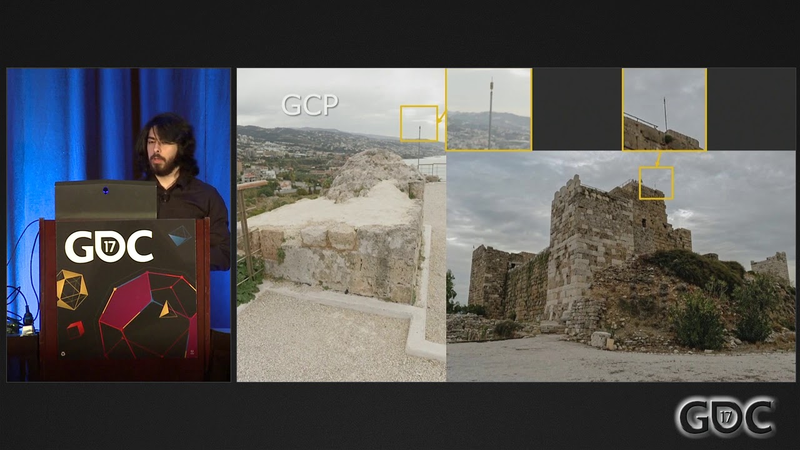
Porting a Real Life Castle into Your Game When You're Broke
This presentation outlines a cost-effective methodology for indie developers to perform high-quality 3D photogrammetry of large-scale historical structures, such as castles, without significant capital investment.
- Large-scale photogrammetry of historical structures can be achieved using consumer-grade hardware like standard DSLRs or high-end smartphones instead of professional-grade equipment.
- To minimize errors from shifting light or environmental obstacles, complex structures should be broken down into manageable individual components rather than captured in a single continuous loop.
- Ground control points are essential for accurately aligning disparate sections of a model, especially when aerial drone access is unavailable.

Continuous World Generation in No Man's Sky
No Man’s Sky achieves a seamless, galaxy-wide exploration experience through a custom C++ engine designed to handle real-time, procedural world generation.
- No Man’s Sky utilizes a custom C++ engine that balances procedural generation with artistic control by prioritizing developer-facing tools over purely autonomous algorithms.
- The engine simulates terrain on a sphere using an octree structure projected onto a cube, which eliminates flat-plane wrapping artifacts and manages complex gravity and coordinate systems.
- To optimize performance and memory, the system employs dynamic levels of detail and a multi-threaded job system that offloads generation tasks across diverse hardware.

Lessons Learned from Creating a Virtual Reality Engine
This presentation outlines the development process and technical lessons learned from building a custom virtual reality (VR) engine, known as the Horror Engine.
- The 'Horror Engine' project demonstrates that integrating a secondary 'social screen' allows non-VR users to manipulate environments, fostering collaborative and inclusive gameplay experiences.
- Building a custom engine from scratch using C++, DirectX 11, and Windows sockets provides a deeper understanding of rendering pipelines and hardware integration compared to relying on pre-built plugins.
- Successful engine development requires rigorous pre-planning, specifically the use of visual flowcharts to map data flow and class relationships before writing any code.

Designing with Physics: Bend the Physics Engine to Your Will
This presentation addresses the common challenge of achieving solid, responsive physics in indie games without requiring custom engine development.
- Combat 'floatiness' by increasing gravity beyond realistic levels, as the issue is a design-driven limitation of default engine settings rather than a purely technical failure.
- Improve simulation stability and perceived weight by implementing significant mass ratios between objects rather than using uniform mass defaults.
- Mitigate tunneling and jitter in fast-moving objects by reducing the fixed time step and enabling continuous collision detection.

Automated Testing and Instant Replays in Retro City Rampage
The development of Retro City Rampage demonstrates the efficacy of a deterministic game engine architecture in streamlining quality assurance and feature implementation.
- Implementing a deterministic game engine architecture by prioritizing input recording over state logging enables high-efficiency file sizes for features like instant replays and leaderboard playback.
- Deterministic design allows for automated cross-platform testing and precise bug reproduction, significantly reducing the time and labor required for manual quality assurance cycles.
- Achieving determinism requires decoupling the game loop from rendering processes, utilizing fixed update loops, and enforcing strict state sandboxing to ensure consistent gameplay across different hardware.

Halo 4: Content Performance Tips & Techniques
Maintaining a consistent 30 frames per second on the Xbox 360 hardware required a rigorous, performance-driven workflow that balanced high-fidelity visual goals with strict technical constraints.
- Maintaining a consistent 30 FPS on Xbox 360 hardware required establishing strict per-mission frame budgets and using diagnostic tools like heat maps, debug view frustum analysis, and PIX timing captures to identify CPU and render thread bottlenecks.
- GPU load was reduced by minimizing draw calls, addressing excessive small triangles, and replacing expensive shaders with specialized, stripped-down versions.
- Rendering efficiency was improved through aggressive distance culling, the use of proxy geometry and occlusion cards, and breaking down large meshes.
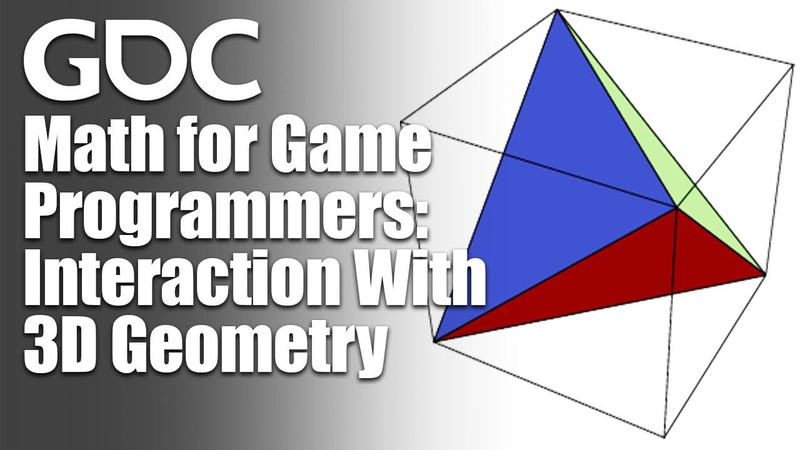
Math for Game Programmers: Interaction With 3D Geometry
Effective 3D game development relies on a rigorous application of vector arithmetic, including dot and cross products, to manage lighting, navigation, and collision detection.
- Achieving stable physics simulations requires moving beyond forward Euler integration, which often introduces energy gain, in favor of Runge-Kutta methods for rigid bodies and implicit integration for soft-body systems.
- Complex physics engines rely on Jacobians and simultaneous equation solving to maintain stability and prevent simulation collapse during high-fidelity interactions.
- Tetrahedron summation is the preferred method for calculating volume, center of mass, and inertia tensors, providing more realistic object movement than simple bounding boxes.

The 2017 GDC Tech Toolbox
Custom tool development serves as a critical catalyst for modern game production, enabling studios to overcome technical constraints while fostering creative iteration.
- Custom internal tool development is essential for overcoming technical constraints and enabling small teams to achieve high-fidelity results that off-the-shelf software cannot support.
- Procedural pipelines, as seen in titles like No Man's Sky, utilize modular texture layers, XML metadata, and shader-based processing to increase visual variety while maintaining memory efficiency.
- Development productivity is significantly improved by tools like Dark Config, which allow for the hotloading of configuration files to accelerate the design iteration cycle.

The Terrain of Halo Wars
The development of Halo Wars marked a significant technical evolution in real-time strategy design, driven by the need to transition from legacy engine architectures to a custom environment capable of running on Xbox 360 hardware.
- The development team utilized Vector Field Terrain to enable per-vertex displacement across three axes, allowing for complex organic structures like overhangs and bridges that traditional height-field systems could not support.
- To maintain performance on Xbox 360 hardware, the engine decoupled high-fidelity visual terrain from a low-resolution, CPU-optimized height field to ensure efficient physics calculations and ray casting.
- Memory usage was restricted to a 14MB footprint by leveraging DXT compression and a custom GPU-based virtual texturing cache.

Deformable Snow Rendering in Batman: Arkham Origins
The development of the snow rendering system for Batman: Arkham Origins focused on creating a high-performance, low-memory solution for organic, deformable surfaces.
- The deformable snow system uses a runtime-generated displacement height map technique that avoids expensive raycasting or physics-heavy calculations, making it performant for previous-gen consoles like the PS3 and Xbox 360.
- To manage memory efficiently, the system uses a pre-allocated memory pool and only tracks 'active' surfaces—those within a specific distance of characters—releasing memory for distant surfaces to maintain a strict 2MB budget.
- The technique renders character interactions into a height map, which is then processed via a four-tap bilinear Poisson disc blur to create smooth, organic gradients for footprints, sliding, and fighting movements.
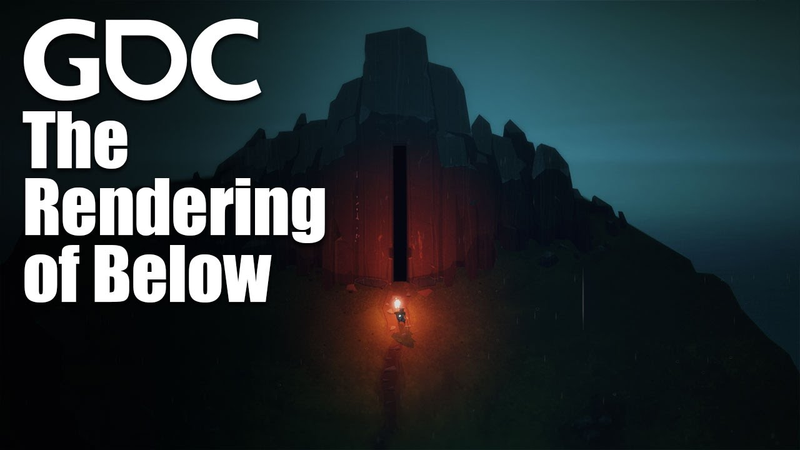
The Rendering of Below
The development of the rogue-like action-adventure game Below required a specialized rendering pipeline to balance high-density visual detail with a moody, intentionally dark aesthetic.
- The development team implemented a tiled forward lighting system using compute shaders to overcome the performance inefficiencies of standard deferred lighting on Xbox hardware.
- A gamma-correct pipeline was utilized to perform all lighting, post-processing, and color grading in linear space, effectively mitigating color banding and visual artifacts.
- The engine leveraged binary arithmetic and bit-masking to manage numerous light sources simultaneously, enabling complex light-based gameplay mechanics while maintaining compatibility with multi-sample anti-aliasing (MSAA).

The Future of Art Production in Games
The future of game art production is defined by a shift from labor-intensive technical execution toward a focus on artistic intent and storytelling.
- Art production is shifting from manual, labor-intensive technical execution toward a focus on artistic intent and storytelling as automation replaces reductive tasks like UV unwrapping and collision mesh creation.
- The integration of photogrammetry, procedural generation, and simulation allows studios to treat virtual environments as sets to be dressed and lit, significantly increasing production efficiency and visual fidelity.
- Deep learning and neural networks are poised to automate animation and asset creation, enabling software to execute artistic intent with minimal manual intervention.