Game Engines reports and market data
Documents
Honey, Where is My Wingsuit? - Building the Just Cause 3 Animation and Rigging Pipeline
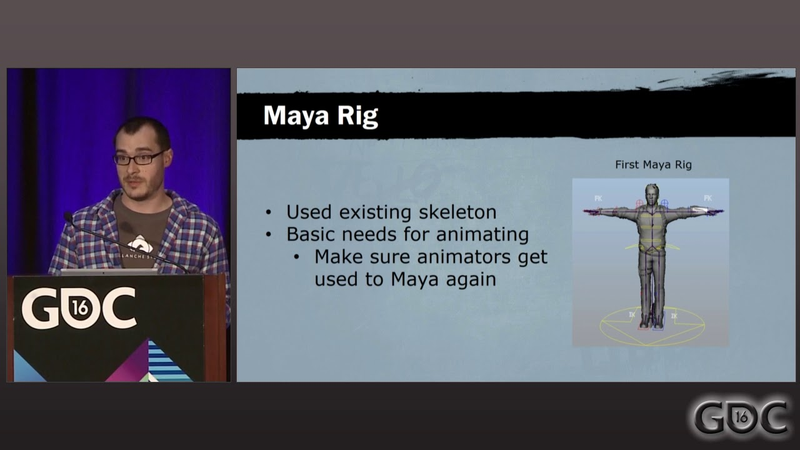
The development of the Just Cause 3 animation and rigging pipeline centered on transitioning from a MotionBuilder-centric workflow to a Maya-based environment to better accommodate the game’s unique hand-keyed mechanics, such as the wingsuit.
- Avalanche Studios implemented a dual-software pipeline for Just Cause 3, transitioning animation workflows between Maya for rigging and MotionBuilder for animation editing using a shared HumanIK (HIK) skeleton system.
- The team utilized a modular rigging architecture where all character types—including humans, animals like cows, and specialized gear like wingsuits—shared a standardized initialization and finalization process to ensure consistency.
- To manage 13,000 lines of English dialogue, the studio used MotionBuilder’s built-in voice device to automate lip-syncing, driving face poses via float data (0 to 1) that the game engine blended at runtime.
Rendering Rainbow Six Siege
Maintaining a consistent 60 frames per second in Rainbow Six Siege across diverse console and PC hardware requires a sophisticated approach to architectural optimization and resource management.
- To maintain 60 FPS during heavy destruction, the team implemented a hierarchical Z-buffer (Hi-Z) system that enabled aggressive GPU-side occlusion culling, reducing total rendered triangles by 73%.
- The engine utilizes a clustered lighting structure with 32x32 pixel cells and Z-distribution, allowing for efficient light volume culling against the Hi-Z buffer while supporting up to eight shadowed lights.
- To support low-end hardware with 1GB of VRAM, the team replaced standard DirectX 11 deferred contexts with a custom, compute-shader-driven rendering architecture that manages unified constant buffers and vertex data manually.

Dear YoYo Games...
The current business model for GameMaker Studio 2 faces significant criticism for its restrictive free-tier limitations, which threaten the engine's long-term competitiveness against industry rivals like Unity and Unreal Engine.
- GameMaker Studio 2’s current business model, which imposes a $40 fee to remove object and sprite count limitations, creates significant friction that discourages new users.
- The engine’s restrictive free-tier model is causing beginners to migrate toward competitors like Unity and Unreal Engine, which offer more robust free versions for experimentation.
- By prioritizing short-term revenue over user acquisition, GameMaker risks alienating the youth demographic, which serves as the primary pipeline for future professional developers.
Rendering the World of Far Cry 4
The development of Far Cry 4 centered on the implementation of a physically based rendering pipeline designed to achieve high-fidelity material realism while maintaining performance across five distinct hardware platforms.
- The development team implemented a physically based rendering (PBR) pipeline using the Disney BRDF model, incorporating metallic and anisotropic parameters to achieve high-fidelity material realism across five hardware platforms.
- A custom anti-aliasing solution combining SMAA with temporal super-sampling achieved high-fidelity image quality at a performance cost of only two milliseconds.
- The transition to a GPU-based virtualized radiance transfer system eliminated CPU-GPU synchronization bottlenecks, while offline G-buffer baking and real-time GPU filtering reduced memory overhead by approximately two megabytes.

The Pathfinding for OVUS NOVA! (Walls) - Part 1
The development of an efficient pathfinding system for the real-time strategy game Ovus Nova requires balancing complex navigation with high-performance demands.
- The pathfinding system for Ovus Nova utilizes a flood-fill algorithm to pre-calculate shortest paths from every grid cell to target 'eggs', allowing units to follow directional data rather than calculating individual routes.
- To resolve severe performance bottlenecks that caused frame rates to drop to zero, the project migrated from the Game Maker Studio 2 Virtual Machine to the YoYo Compiler (YYC).
- Computational load was further optimized by spreading pathfinding calculations across 60 frames instead of attempting to update the entire map in a single frame.
How a reborn determinism will disrupt multiplayer games development
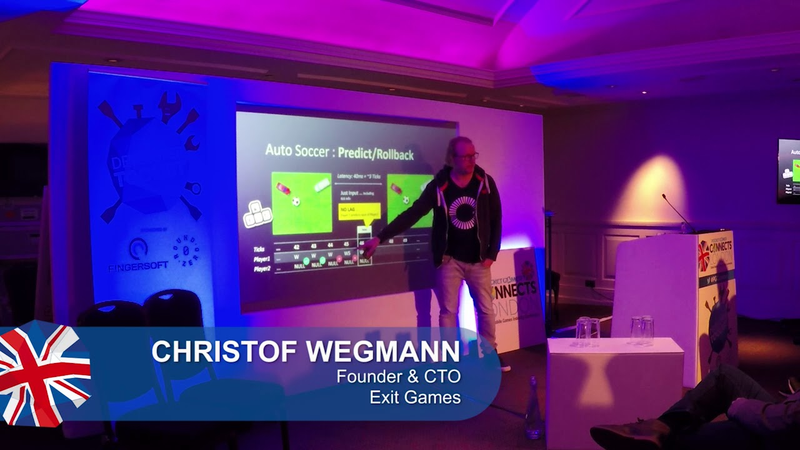
The evolution of multiplayer game development is shifting toward a renewed reliance on determinism, a foundational technique that simplifies synchronization by focusing on input rather than state.
- Multiplayer development is shifting from state synchronization, which transmits object data like position and velocity, to deterministic lockstep models that only transmit user inputs.
- The 'predict and rollback' mechanism solves the traditional latency issues of lockstep by allowing local clients to simulate actions immediately and re-simulate the timeline if network data reveals a prediction error.
- Deterministic systems significantly reduce bandwidth requirements compared to state-sync models, as they only need to synchronize input commands rather than the entire game state.

A fireside chat with games industry legends Peter Vesterbacka and David Helgason
Mobile gaming continues to serve as the primary engine for global industry growth, maintaining its dominance even as hardware saturation approaches.
- Mobile gaming remains the primary driver of global industry growth, maintaining its market dominance despite approaching hardware saturation.
- The Chinese market is shifting toward premium gaming experiences, offering independent developers a lucrative alternative to traditional free-to-play models.
- Artificial intelligence is identified as the most significant driver of future industry innovation, while eSports is viewed as a nascent sector with the potential to eventually rival traditional sports.

Game Maker Studio 2 - Make a Game Before This Video Ends! (Tutorial)
GameMaker Studio 2 serves as a highly efficient and accessible engine for independent developers aiming to produce professional-grade 2D titles.
- GameMaker Studio 2 is a 2D-focused engine designed for rapid prototyping and deployment, as demonstrated by commercial titles like Hotline Miami and Risk of Rain.
- The engine utilizes an event-driven architecture where Create events define initial variables and Step events manage real-time input responsiveness, friction, and acceleration.
- Standardizing the frame rate at 60 FPS is a core practice for maintaining technical stability and a smooth user experience.
Rayman Legends: The Design Process Within the UbiArt Framework
The development of Rayman Legends centers on the implementation of the UbiArt Framework, an engine architecture designed to democratize the creative process by empowering level designers and artists to prototype independently.
- The UbiArt Framework enables rapid prototyping by allowing designers to combine 'white box' assets, movement tweens, and Lua scripting to prove gameplay concepts in as little as half a day.
- The development philosophy prioritizes frequent failure—up to 40 times a day—to quickly discard ineffective ideas and identify viable mechanics without becoming overly attached to early concepts.
- The engine utilizes a template-and-instance system that enforces core gameplay behaviors while allowing designers to tweak specific parameters, preventing the need for constant programmer intervention.

Adaptive Virtual Texture Rendering in Far Cry 4
Adaptive Virtual Texture rendering serves as a foundational technology for Far Cry 4, enabling the display of high-fidelity terrain and thousands of procedural decals without exceeding strict memory constraints.
- Ubisoft's Adaptive Virtual Texture (AVT) rendering technique allows for the rendering of thousands of terrain decals in under 1 millisecond, achieving a high resolution of 10 pixels per centimeter.
- The AVT system dynamically adjusts texture resolution based on camera distance by dividing the world into 64x64 meter sectors, allocating larger virtual image sizes for sectors closer to the camera and smaller sizes for those further away.
- To minimize memory footprint and bandwidth, the system uses a 32-bit page ID buffer during the G-buffer rendering pass, with bits allocated specifically for page ID, mipmap level, and virtual image size.
Math for Game Programmers: Mixing Geodetic, Hand-crafted and Procedural Geometry
This presentation explores the application of implicit geometry and radial basis functions (RBFs) for procedural content generation and simulation in video games.
- Implicit geometry using radial basis functions (RBFs) allows for continuous, morphing surfaces that interpolate scattered data points more effectively than traditional mesh-based methods.
- Unbounded kernel functions are superior to bounded kernels like Gaussians for complex surface interpolation because they provide the infinite support necessary to eliminate gaps between control points.
- Potential flow fields governed by Laplace’s equation can generate high-quality offset surfaces by solving a linear system based on source elements placed on handcrafted mesh polygons.
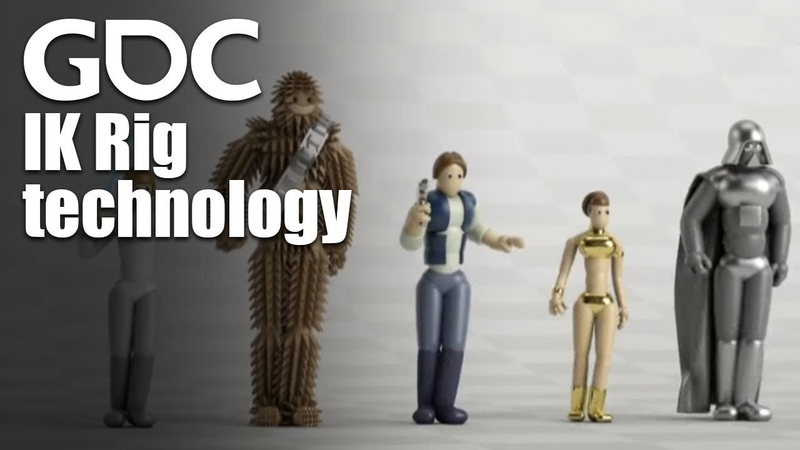
IK Rig: Procedural Pose Animation
The IK Rig represents a fundamental shift in animation pipelines by decoupling motion data from specific character skeletons.
- The IK Rig decouples animation data from specific bone hierarchies, enabling real-time retargeting of movement across diverse character scales, proportions, and species.
- This procedural system reduces production overhead by applying systemic behavioral rules—such as crouching or carrying weight—without requiring per-character keyframing or redundant motion capture.
- The rig utilizes real-time spatial anticipation, dynamic footstep tracing, and physical collision detection to mitigate common animation artifacts like foot sliding and environmental clipping.