Game Development reports and market data
Documents


Interactive XMF: File Format Specification
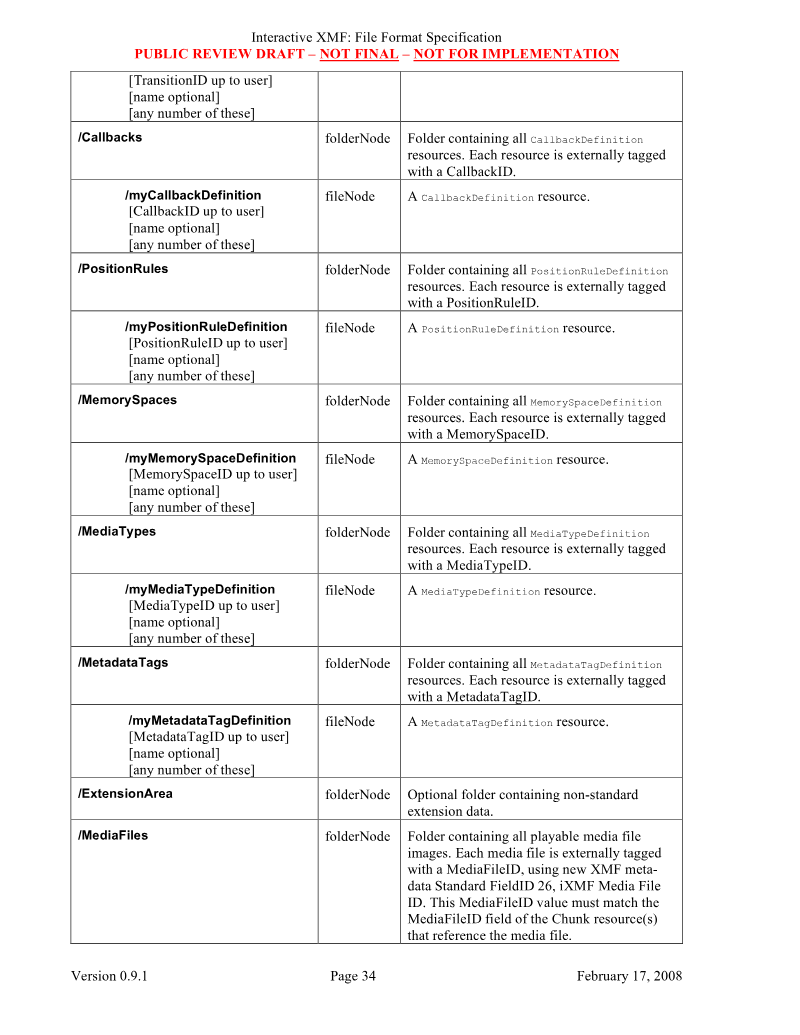
Interactive XMF (iXMF) serves as an open, interoperable standard for adaptive audio in gaming and interactive media.
- Interactive XMF (iXMF) is an open, interoperable file format that bundles MIDI, digital audio, and scripting into a unified structure for dynamic, event-driven game audio.
- The iXMF Engine utilizes a stack-based expression processor to manipulate 32-bit signed integer variables across global, cue-specific, and instance-specific scopes.
- Developers can implement complex, non-linear audio through a built-in scripting language that supports conditional logic, DSP parameter adjustments, and memory management.



Spelutvecklarindex 2007: Sverige
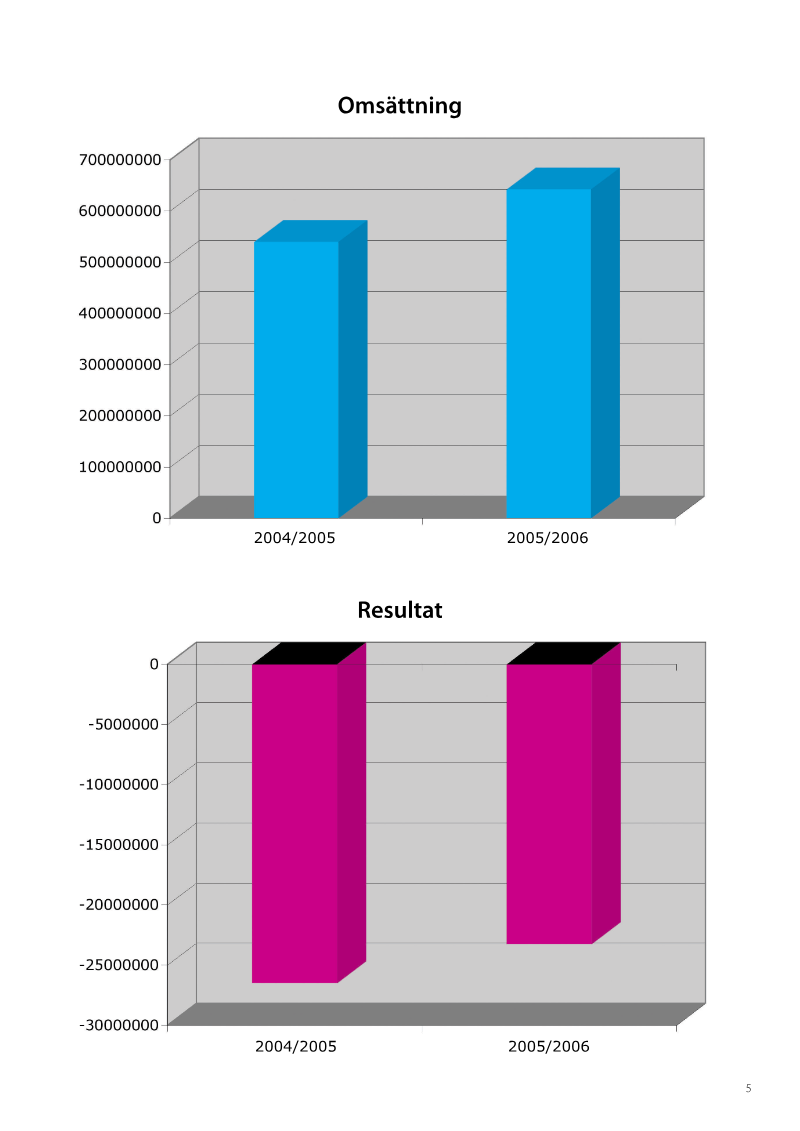
The Swedish game development industry experienced significant growth throughout 2007, characterized by a rapid expansion in both workforce and revenue.
- The Swedish game development industry saw a 49 percent increase in total turnover to 959 million SEK and a 42 percent rise in employment to 1,153 individuals in 2007.
- Industry revenue and labor are highly concentrated, with the five largest companies accounting for over 56 percent of total turnover and nearly 45 percent of the total workforce.
- Despite significant growth, the aggregate financial result for the 91 analyzed companies remained negative, reflecting the capital-intensive nature of long development cycles.


Ubisoft Annual Report 2007
The 2007 Ubisoft Annual Report details a period of robust financial expansion and strategic consolidation for the fiscal year ending March 31, 2007.
- Ubisoft achieved a 24.4% increase in annual sales to €680 million for the fiscal year ending March 31, 2007, shifting from debt to a net cash position of €55 million.
- The company successfully expanded its global workforce by 15% to nearly 4,000 employees to support aggressive in-house production and the development of proprietary brands.
- Strategic growth was driven by the acquisition of the Driver and Anno franchises and a commitment to launching three new brands every two years.

Mobile Audio Technology: Report and Recommendations
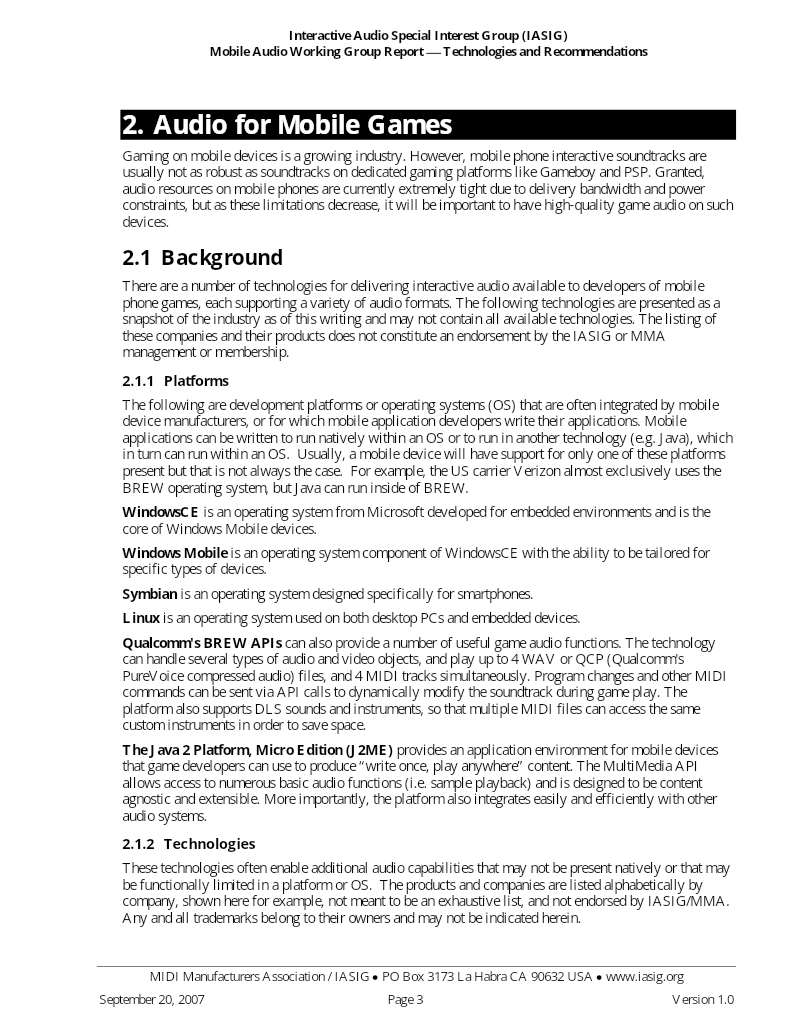
The mobile audio industry faces significant operational challenges due to extreme market fragmentation, characterized by the existence of over 50 file formats and 400 distinct device implementations.
- The mobile audio industry is hindered by extreme fragmentation, involving over 50 file formats and 400 distinct device implementations that inflate development and quality assurance costs.
- To achieve cross-platform interoperability, the industry must transition to non-proprietary standards, specifically adopting SP-MIDI, General MIDI, and the XMF format.
- Standardizing APIs such as JSR-234 and OpenSL ES is essential to provide developers with consistent access to advanced features like Digital Signal Processing and 3D audio.


Spelutvecklarindex: Sweden 2005
The Swedish game development industry experienced significant growth and consolidation during 2005, characterized by rising revenues and an expanding workforce despite a reduction in the total number of active firms.
- The Swedish game industry generated 642 million SEK in total turnover in 2005, marking a 19 percent increase from the previous year.
- Market concentration is high, with five major studios—Avalanche Studios, EA DICE, Jadestone, Paradox Interactive, and Starbreeze—generating 59 percent of total industry revenue.
- The industry workforce grew by 14 percent to 812.5 full-time equivalents, though the gender balance remained stagnant with women representing only 15 percent of staff.

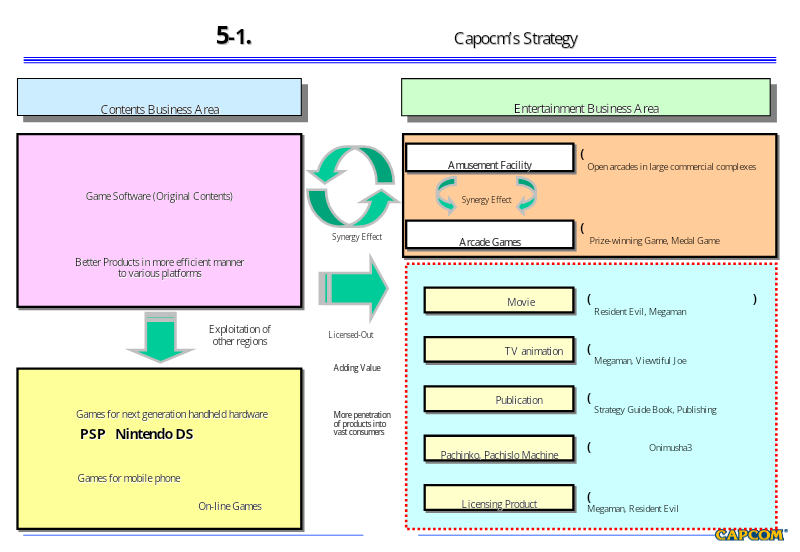

Company Profile: May 2005
Capcom concluded the fiscal year ending March 31, 2005, with robust financial results, reporting net sales of 65.8 billion yen and an operating income of 7.7 billion yen.
- Capcom reported fiscal year 2005 net sales of 65.8 billion yen and an operating income of 7.7 billion yen, driven by Resident Evil 4, Mega Man, and the pachislo LCD business.
- The company projects net sales of 70 billion yen for the 2006 fiscal year, despite acknowledging volatility in the hit-driven home console market.
- Capcom is targeting a global sales distribution ratio of 2:5:3 across Japan, North America, and Europe to mitigate the maturity of the domestic Japanese market.



Interactive Audio on the Web: Review and Recommendations
The web audio landscape in 2002 is defined by extreme fragmentation, characterized by a reliance on incompatible, vendor-specific technologies that hinder the development of consistent interactive experiences.
- The 2002 web audio landscape is defined by extreme fragmentation, forcing developers to rely on incompatible proprietary technologies like Macromedia Flash, QuickTime, RealOne, and Java.
- Macromedia Flash is currently the most viable and ubiquitous tool for interactive web audio, despite its lack of native digital signal processing and advanced sequencing capabilities.
- Advanced platforms like Java Sound and Beatnik offer superior synthesis and real-time manipulation but are marginalized by high barriers to entry and inconsistent browser integration.



Issues and Approaches in Artificial Intelligence Middleware Development for Digital Games and Entertainment Products
This paper examines the design and development of artificial intelligence middleware for digital games and entertainment products.
- AI has shifted from a secondary concern to a priority in game development, yet developers still rely on a narrow set of techniques and lack flexible, reusable tooling.
- Dedicated AI middleware, a software layer that supplies agent behavior and decision-making services to game engines, is presented as the likely next step for improving game AI and freeing developers for creative work.
- Dominant practice relies on finite state machines, hierarchical and fuzzy state machines, A pathfinding, steering behaviors, decision trees, and rule-based systems, each trading off speed, expressiveness, and predictability.



Expressive AI: Games and Artificial Intelligence
Michael Mateas's paper argues that as graphical gains yield diminishing returns, game development is shifting its attention toward artificial intelligence, and that AI-driven art and entertainment forms a new interdisciplinary agenda linking games studies, design practice, and technical research, which he names "expressive AI."
- Mateas argues that as graphical gains yield diminishing returns, game development is shifting attention toward artificial intelligence, and proposes "expressive AI" as an interdisciplinary agenda linking games studies, design practice, and technical research.
- Game AI is defined as the production of behavior that players read as intentional, distinguishing it from game physics: Asteroids' asteroids and water simulations generate behavior without inviting psychological interpretation, whereas enemies like Pac-Man's ghosts invite readings of goals, desires, and moods.
- The paper positions game AI as a "white box" vocabulary for analyzing and designing games, complementing the "black box" vocabularies of design patterns and humanistic game studies that deliberately ignore implementation.



Participatory Design and Opposing Interests in Development of Educational Computer Games
This study examines a participatory design process in which a class of 11- and 12-year-old Danish children was invited to help design a mathematics-education computer game, with the aim of producing a game engaging enough that children would voluntarily play it outside school.
- The study examined a participatory design process in which 11- and 12-year-old Danish children helped design a math-education computer game meant to be engaging enough that they would voluntarily play it outside school.
- The children's ideas had little practical effect on the final design, mainly because the developers adopted their own time-travel concept early, where it was perceived as strong and hard to modify.
- A key organizational failure was that the developers did not attend the workshops, so insights from the children reached them only secondhand through researchers as general guidelines that were hard to integrate.


WADs, Bots and Mods: Multiplayer FPS Games as Co-creative Media
Sue Morris's paper examines multiplayer first-person shooter (FPS) games such as Quake, Half-Life, and Counter-Strike as "co-creative media," arguing that these games are not produced solely by developers or solely by players, but through the combined input of both.
- The paper argues that multiplayer FPS games such as Quake, Half-Life and Counter-Strike are 'co-creative media,' shaped jointly by developers and players rather than by either alone, extending beyond the participatory-media framing common in fan studies.
- Wolfenstein 3-D (1992) and Doom (1993) set the foundation for the genre, and Doom's source-code release and multiplayer capabilities enabled a durable mod scene.
- Player contributions materially influenced development: early public betas and leaked alphas produced bug reports and patches, volunteer-built anti-cheat tool PunkBuster was later adopted by publishers, and mod authors behind ThreeWave CTF and Counter-Strike were hired or commercially acquired.



Enchanting Reality: A Vision of Big Experiences on Small Platforms
Martin Ericsson's paper argues that mobile gaming has so far largely cloned or ported existing console and desktop titles, leaving the distinctive capabilities of handheld devices (mobility, GPS, and communications) underused.
- The paper argues mobile gaming has largely cloned or ported console and desktop titles, leaving handheld capabilities such as mobility, GPS, and communications underused.
- Its central thesis is that compelling physical-world games create immersion through "diegetic consistency," where the fictional world aligns with the player's sensory reality.
- The authors propose "enchanted reality" games, in which real-world actions meaningfully alter the virtual world rather than merely triggering isolated events.