Game Development reports and market data
Documents

UpCloud on competing in the games industry cloud computing space
UpCloud positions itself as a specialized alternative to major global cloud providers by focusing on high-performance infrastructure and reliability tailored for small-to-medium enterprises.
- UpCloud competes with hyperscale cloud providers by utilizing its proprietary MaxIOPS storage technology, which uses commodity hardware to achieve performance benchmarks exceeding those of major industry leaders.
- The company targets small-to-medium enterprises (SMEs) and technical decision-makers by offering high-performance, cost-effective infrastructure specifically optimized for gaming, SaaS, and media applications.
- Customer satisfaction is a primary business metric, with the company currently maintaining a support satisfaction rate exceeding 90 percent.

Developing accessible virtual reality games for new players
Developing accessible virtual reality experiences requires prioritizing intuitive design to accommodate users who may have no prior gaming experience.
- Prioritize intuitive design by replacing complex button inputs with natural physical movements to bridge the gap between real-world actions and virtual interactions.
- Implement a non-demanding acclimation period at the start of the experience to allow new users to adjust to the sensory novelty of virtual reality without becoming overwhelmed.
- Utilize real-world metaphors, such as using a deck of cards to represent data selection, to simplify complex user interfaces for players without gaming experience.

Sound Design Action for My Indie Game Again!
Sound design and music composition serve as critical components in defining the player experience and atmosphere of an indie game.
- Indie developers can produce professional-grade audio using accessible software like Cubase for music composition and Audacity for sound effect recording.
- Effective sound design relies on a consistent workflow of recording, editing, filtering, and volume adjustment rather than requiring expert-level training.
- Sound effects can be created by capturing organic noises and manipulating them through layering and reversal techniques to simulate complex impacts like explosions.
Go Outside: Jonas Plays Your Game #004
The indie puzzle platformer Go Outside presents a unique mechanical concept centered on a day-night cycle that automatically transitions the player to the next level once the sun sets.
- The game's core mechanic utilizes spatial persistence, where a player's coordinates on a platform are maintained across levels to allow access to otherwise unreachable areas.
- A mandatory day-night cycle automatically transitions players to the next level, creating a time-sensitive constraint that requires environmental awareness.
- The lack of player guidance and tutorials leads to significant user frustration, as the core objectives and progression logic are not clearly communicated.
Ten Principles for Good Level Design
Effective level design functions as a holistic delivery system that integrates narrative, mechanics, and mission structure to create immersive, replayable experiences.
- Designers should prioritize emotional resonance over simple player empowerment by working backward from a desired emotional impact to ensure every spatial choice and mechanic serves a specific purpose.
- Levels should function as a holistic delivery system that integrates narrative, mechanics, and mission structure to foster emergent gameplay and player agency.
- To maintain engagement and avoid predictable pacing, developers should use subversion by revisiting familiar locations with altered contexts to disrupt player expectations.

7 Game Development Facts - Let's Face It!
Independent game development is a demanding discipline characterized by significant market saturation and high barriers to commercial success.
- Market saturation in the independent game sector is high, meaning developers cannot rely on organic discovery and must implement deliberate, strategic marketing to achieve visibility.
- Consumers are indifferent to the technical methodology or personal struggles behind a game's production, prioritizing only the final product's quality and playability.
- Success requires transitioning from a romanticized view of development to a pragmatic business approach that treats the game as a commercial product rather than a personal project.

Modeling AI Perception and Awareness in Splinter Cell: Blacklist
The design of artificial intelligence in Splinter Cell: Blacklist centers on the philosophy that player experience and perceived fairness must take precedence over strict, uncompromising simulation.
- To ensure AI feels intelligent, developers should prioritize 'plausibility' over complex simulation, focusing on what the player perceives rather than what the AI technically knows.
- The Tactical Environment System (TESS) uses position nodes linked by choke points to prevent NPCs from staring at players through walls, ensuring they only react to threats within a logical pathing or line-of-sight connection.
- Detection models should utilize raycasting against multiple body bones to determine visibility, with the number of required visible bones scaling based on the player's stance and cover state.

4 Sound Styles in 1 Day??? (Fail)
The process of establishing a cohesive audio identity for an indie game requires focused iteration rather than rapid, multi-directional experimentation.
- Attempting to develop four distinct audio styles in a single day results in inconsistent, underdeveloped, and technically flawed sound design.
- Prioritizing quantity over quality leads to execution errors, such as overly complex chord progressions and ineffective use of processed vocals that fail to match the game's visual aesthetic.
- Rapid-fire production models prevent the necessary refinement of sound effects, causing them to feel underpowered and lacking in impact.
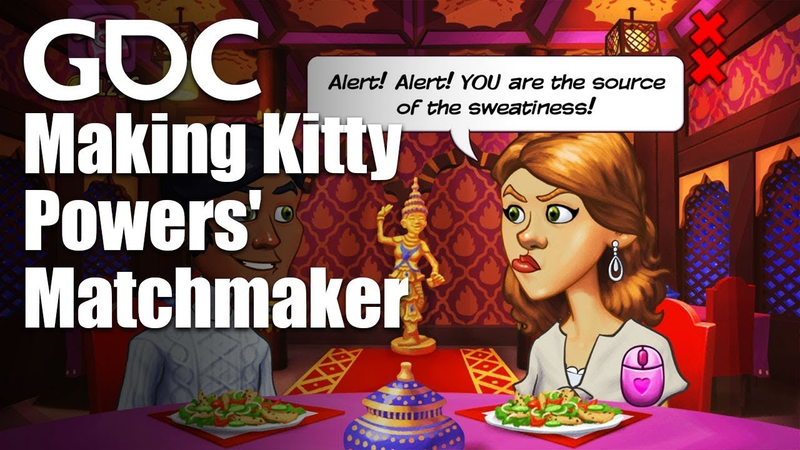
Making Kitty Powers' Matchmaker - Adventures of a Videogame Drag Queen
The development of the mobile dating simulator Kitty Powers' Matchmaker serves as a case study for independent game design, focusing on the integration of humor, inclusivity, and procedural generation.
- Kitty Powers' Matchmaker utilized a complex procedural generation system to create characters defined by five personality categories, including specific traits like guilty pleasures and bad habits to ensure depth.
- The game's script was designed as a modular, novel-length text database, enabling thousands of unique dialogue combinations and sarcastic interactions between the host and players.
- Development of the project spanned approximately two years and relied on a remote, collaborative workflow that managed vast text assets through shared spreadsheets.

Landing Page Review: Accelebot (Indie Game Marketing)
This analysis evaluates the landing page and promotional trailer for Accelebot, a 2D mobile platformer for iOS.
- The trailer fails to demonstrate the game's core unique selling point, which is the specific control scheme involving device tilting and tapping to jump.
- Marketing copy should avoid sarcastic or self-deprecating humor, as it risks undermining the professional credibility of the project.
- Email lists for mobile games often see conversion rates below 20%, making the quality of initial community outreach more important than raw subscriber volume.

Making Release Day Just Another Monday
The transition to a high-frequency update model for RuneScape centers on replacing rigid, siloed waterfall development with a decentralized structure of autonomous, cross-disciplinary scrum teams.
- Jagex transitioned the RuneScape development process from a traditional waterfall model with functional silos to six autonomous, cross-discipline scrum teams to maintain a high-frequency update schedule.
- The studio implemented a strict, centralized release process that ensures game updates are deployed every Monday, allowing the team to avoid the common pitfalls of delayed releases.
- To maintain coherence across autonomous teams, Jagex utilizes 'councils' of interested individuals who focus on specific game aspects like lore, combat, and balance, alongside shared resources like a centralized analytics team.
Zirkon Zaga: Jonas Plays Your Game #003
The indie platformer Zirkon Zaga, developed in Unity, serves as a case study for balancing aesthetic choices with mechanical refinement.
- Prioritize refining core movement and camera mechanics before expanding level content to avoid costly downstream rework.
- Fix the wall-jump mechanic by implementing fixed velocity values instead of additive velocity to ensure predictable jump heights.
- Address critical navigation barriers by adding an invert Y-axis option for camera controls and implementing a checkpoint system to reduce player frustration.