Game Design reports and market data
Documents
Lessons From Theatre That Can Transform XR Experiences
Extended Reality development gains significant depth by adopting fundamental theatrical principles, shifting the medium from a passive viewing experience to an active, spatial reality.
- XR developers should treat physical space as a core design element by authoring experiences that adapt to the user's environment, such as virtual characters using real-world furniture for cover.
- To increase immersion, developers should move away from traditional cinematic framing and instead stage narrative action around the player, forcing them to look and interact to follow the story.
- Enhance interpersonal presence in XR by layering responsive gestures and 'look-at' mechanics into character AI, allowing virtual entities to acknowledge and interact with the player's physical movement.

5 MISTAKES I Made When I Started Making Games
Independent game development requires a strategic shift from purely creative impulses to structured business management.
- Create a comprehensive game design document to serve as a project roadmap, which prevents scope creep and keeps development timelines on track.
- Diversify revenue streams by securing funding through Kickstarter, Patreon, sponsorships, and publisher advances rather than relying solely on post-launch sales.
- Treat community building as essential infrastructure by using devlogs and consistent social media engagement to drive Steam wishlists and secure a loyal audience.

LIVE | Making Weapons for Back 4 Blood with Brad Boyles
Weapon design in modern first-person shooters requires a rigorous synthesis of technical efficiency and mechanical authenticity.
- Weapon design in high-fidelity shooters like Back 4 Blood relies on a synthesis of simulation software and physical references to ensure mechanical accuracy in reload animations and functional movement.
- The production pipeline has shifted from manual, Photoshop-based workflows to procedural texturing tools like Substance Painter, significantly increasing output efficiency for small teams.
- Artists utilize height maps and high-poly baking to simulate complex surface details, while maintaining traditional hard-surface modeling methodologies.
The Making of Genesis Noir with Evan Anthony and Jeremy Abel | 303
The development of Genesis Noir serves as a case study in transitioning from motion graphics and web design into the independent game industry.
- Marketing and promotional efforts should be integrated directly into the game engine workflow, as these activities can consume up to 50% of the total development cycle.
- Securing professional publishing partnerships is essential for managing the logistical complexities of console certification, localization, and multi-platform deployment.
- Independent developers can successfully transition from motion graphics to game development by leveraging vertical slices and detailed pitch decks to secure both crowdfunding and external funding.
Your Indie Game WILL SUFFER Without It
Effective game development requires a transition from intuitive, solo-based workflows to structured project management.
- Formalizing development through Game Design Documents (GDDs) and milestone-based scheduling is essential to prevent bloated budgets, excessive costs, and creative drift.
- A GDD functions as a foundational roadmap that prevents scope creep by clearly defining project boundaries and discouraging the addition of non-essential mechanics.
- Implementing strict, self-imposed monthly milestones allows developers to identify necessary content cuts early, ensuring projects remain on track for completion.

GDC 2022 Main Stage: The Developer's Renaissance
The modern game industry is undergoing a fundamental transformation, moving away from rigid, industrial-era management toward models defined by collective intelligence, radical inclusivity, and creator advocacy.
- Studios like Eidos-Montréal are successfully replacing traditional hierarchical oversight with decentralized power and employee autonomy to maintain productivity during labor volatility.
- Structural operational shifts, such as the implementation of a four-day work week, are being used to improve employee well-being and long-term performance.
- Sony Interactive Entertainment has transitioned DEI from performative gestures to a data-driven business function by integrating employee networks into executive decision-making and tying outcomes to core KPIs.

Decision Trees: Video Game's Secret Weapon for Story and Gameplay
Decision trees serve as a foundational architectural tool in game design, enabling developers to create reactive, choice-driven narratives that provide players with a sense of agency.
- Decision trees function as the core architectural framework for managing complex, branching narratives and conditional gameplay logic in modern game design.
- The Mass Effect trilogy demonstrates the potential for massive combinatorial complexity, with cumulative narrative decisions resulting in hundreds of trillions of unique story variations.
- Decision trees enable the creation of persistent game states by tracking player choices across multiple titles, ensuring that actions have long-term, meaningful consequences.
'Real World Level Design' & 'Playgrounds and Level Design'
The playground philosophy redefines level design by shifting focus from linear, prescriptive obstacle courses toward persistent, modular environments.
- The playground philosophy replaces linear obstacle courses with node-based, modular environments where platforms act as objectives and routes serve as skill-based rewards.
- This modular architecture allows developers to prototype and refine core movement mechanics and gameplay systems within a flexible environment before finalizing geometry.
- Designers can enhance player immersion by treating the 'experience bleed'—the period before entering the game—as a deliberate design phase influenced by physical surroundings and social engagement.
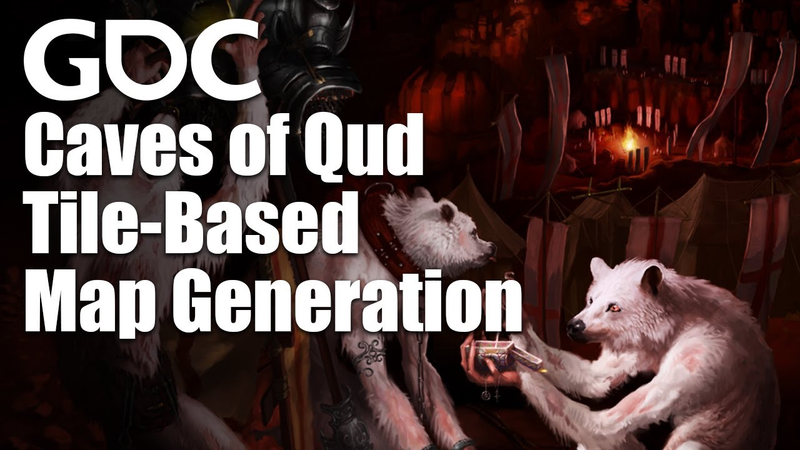
Tile-Based Map Generation using Wave Function Collapse in 'Caves of Qud'
The procedural generation of game environments in the title Caves of Qud utilizes Wave Function Collapse (WFC), a texture synthesis algorithm that generates complex, tile-based maps from simple, user-defined training inputs.
- Wave Function Collapse (WFC) in 'Caves of Qud' uses a 'texture mode' approach, where small training inputs (typically 8x8 or 16x16 pixels) are used to generate arbitrarily large, structurally coherent game maps.
- The algorithm operates by decomposing input images into N x N tiles (usually 3x3), which serve as the basic atoms for calculating valid adjacencies and propagating patterns across the output.
- Adding extra colors to the training input can create essential spatial coherence, such as distinguishing between the 'inside' and 'outside' of structures, which allows for the placement of furniture and plants within generated rooms.
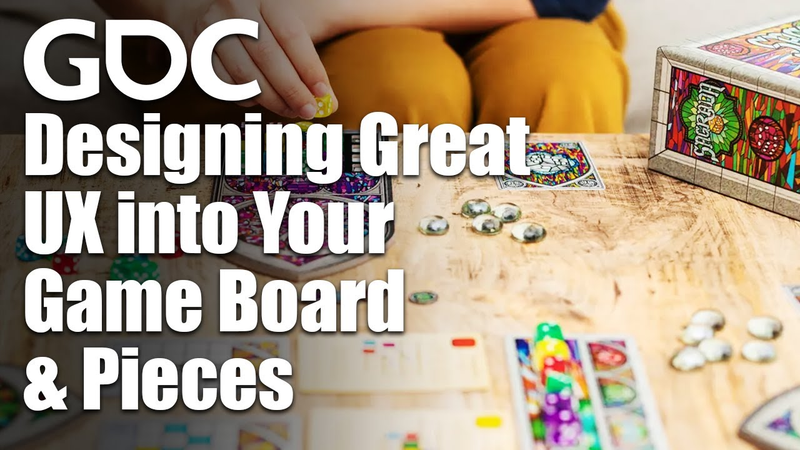
Designing Great UX into Your Game Board and Pieces
Prioritizing intuitive user experience in board game design requires shifting the burden of learning from the player to the developer.
- Prioritize UX design within the game board and pieces themselves to reduce reliance on rulebooks, as players intuitively attempt to learn games by assembling components and identifying patterns before reading instructions.
- Use iterative prototyping tools like laser cutters and 3D printers to test board layouts early, as late-stage production changes are significantly more costly than refining physical components during development.
- Streamline the user experience by replacing ambiguous or language-dependent iconography with clear, consistent visual cues, such as using specific colors to map dice results to victory point conditions.
Testing 6 Commercial Games That Were Made by YouTubers
The landscape of independent game development has shifted significantly as prominent content creators transition into professional developers.
- Creator-led games like Hyperbolica, Wrought Flesh, and Olobollo demonstrate that YouTubers can successfully implement complex technical systems, such as non-Euclidean geometry and intricate stat mechanics, that meet or exceed indie industry standards.
- Titles including Archvale, Swords and Magic and Stuff, and Len's Island show that creator-developed projects often achieve high visual fidelity and polished tactile feedback comparable to established professional studios.
- A recurring development gap exists where high-quality visual and audio presentation is decoupled from intuitive gameplay, leading to friction in areas like crafting interfaces and tutorials.
Garena Free Fire Deconstruction - The Metacast by Naavik
Garena Free Fire serves as a primary case study for the efficacy of mobile-first design in the global gaming market.
- Garena Free Fire achieved over one billion downloads by prioritizing mobile-first design, specifically optimizing performance and mechanics for low-end Android devices to capture underserved global markets.
- The game’s monetization strategy uniquely combines cosmetic items with temporary power-ups, successfully balancing revenue generation with player fairness to maintain high lifetime value.
- Garena Free Fire serves as a critical financial pillar for Sea Limited, providing the capital necessary to diversify into broader digital ecosystems such as e-commerce.