France

56 documents·9 publishers

Documents

Page 1
Report2 pages

Nacon Announces Insolvency and Judicial Reorganisation Proceedings

Nacon, a subsidiary of the Bigben Group and listed on Euronext Paris, announced on 25 February 2026 that it has filed for insolvency and requested the initiation of judicial reorganisation proceedings before the Commercial Court of Lille Métropole. The filing follows a liquidity crisis triggered by Bigben Interactive’s failure to repay part of its bond loan after an unexpected refusal from its banking pool. Nacon stated that its available assets are insufficient to meet current liabilities, prompting a rapid financial restructuring with creditors to safeguard operations and preserve jobs.

The court‑initiated procedure, known in France as “redressement judiciaire,” freezes existing debts for up to 18 months, allowing the company to present a viable continuation plan. The hearing is scheduled for early March, and until a decision is made, the company’s shares remain suspended on Euronext Paris. Employee representatives were notified of the insolvency filing on 24 February.

Financially, Nacon reported IFRS revenue of €167.9 million for 2024/25 and an operating profit of €1.1 million, supported by a workforce of over 1,000 employees across 25 subsidiaries and a distribution network covering 100 countries. The company’s portfolio includes 16 development studios, AA publishing, and premium gaming peripherals, positioning it as a unified entity within the video‑game market. The reorganisation aims to renegotiate debt, protect staff, and secure a sustainable operational future under court supervision.

  • Nacon has filed for insolvency and initiated judicial reorganisation proceedings with the Commercial Court of Lille Métropole as of 25 February 2026.
  • The filing was triggered by a liquidity crisis following parent company Bigben Interactive’s failure to repay a bond loan after being denied support by its banking pool.
  • The 'redressement judiciaire' process freezes existing debts for up to 18 months, allowing Nacon to develop a restructuring plan while its shares remain suspended on Euronext Paris.
  • Nacon reported 2024/25 IFRS revenue of €167.9 million and an operating profit of €1.1 million prior to the filing.
  • The company maintains a significant operational footprint, employing over 1,000 staff across 25 subsidiaries and managing a portfolio of 16 development studios and gaming peripheral lines.
Nacon
Page 1
Report83 pages

Annual Financial Report: 2019/20

1. FOCUS HOME INTERACTIVE presentation pages 5 to 9 2. Declaration by the person responsible page 11 3. Management Board’s report pages 15 to 33 4. Supervisory Board’s report pages 37 to 41 5.

  • Focus Home Interactive's gross profit grew 20% to €36.6M, with a gross margin of 31% (up from 29% last year), and operating profit increased 36% to €19.2M for the year ended March 31, 2020.
  • The Group held a net cash position of €18M on March 31, 2020.
  • Focus Home Interactive has established new collaborations with Saber (for new projects and porting existing titles to Nintendo Switch and mobile) and Sumo Digital (for a new multiplayer game developed by Sumo Newcastle).
  • The company successfully released "World War Z" in April 2019, developed with Saber and based on the Paramount film.
  • Focus Home Interactive held 8,295 of its own shares valued at €148,978 as part of a liquidity contract and an additional 151,759 shares under its stock buyback program as of March 31, 2020.
+1
Pullup Entertainment
Page 1
Report97 pages

Annual Financial Report and CSR Report: 2021/2022

ANNUAL FINANCIAL REPORT AS OF 31 MARCH 2022 1. INTRODUCTION pages 3 to 7 2. DECLARATION BY THE PERSON RESPONSIBLE page 8 3. MANAGEMENT REPORT pages 9 to 24 4. BOARD REPORT ON CORPORATE GOVERNANCE pages 25 to 33 5. AUDITOR’S REPORT ON THE CONSOLIDATED FINANCIAL STATEMENTS FOR YEAR ENDED 31 MARCH 2022 pages 34 to 36 6.

  • Focus Entertainment acquired 77.5% of Dotemu for €53.5M on September 30, 2021, resulting in goodwill of €60.7M and significantly increasing the gross value of goodwill from €6.257M to €72.747M.
  • The company's commitments to studios and right holders dramatically increased from €39.290M in 2021 to €120.786M in 2022, with €59.183M due within one year.
  • Focus Entertainment paid a €2.9M fine to the European Commission on July 12, 2021, related to an investigation into alleged technical and contractual restrictions on PC game circulation in Europe.
  • The proportion of sales billed in US dollars was 55% of consolidated revenue as of March 31, 2022, exposing the company to currency risk, though game sales in USD can partially offset USD-denominated costs.
  • The company bought back 181,643 shares by March 31, 2022, as part of a program authorizing the buyback of up to 250,000 shares, and held 299,365 of its own shares at that date.
+2
Pullup Entertainment
Page 1
Report97 pages

Annual Financial Report and CSR Report: 2022/2023

ANNUAL FINANCIAL REPORT AS OF 31 MARCH 2023 1. INTRODUCTION pages 3 to 7 2. DECLARATION BY THE CHIEF EXECUTIVE OFFICER page 8 3. MANAGEMENT REPORT pages 9 to 24 4. REPORT ON CORPORATE GOVERNANCE pages 25 to 34 5. STATUTORY AUDITORS’ REPORT ON THE CONSOLIDATED FINANCIAL STATEMENTS AS OF 31 MARCH 2023 pages 35 to 37 6.

  • On June 16, 2022, Dotemu successfully launched Teenage Mutant Ninja Turtles: Shredder’s Revenge, selling over 1 million copies within one week of its release for PC, Nintendo Switch, PlayStation 4, and Xbox One.
  • On September 5, 2022, FOCUS ENTERTAINMENT acquired 66.67% of WW1 Game Series B.V. (renamed BlackMill Games B.V.) for €5.5 million, making it the sixth development studio to join the Group.
  • The company changed its name from Focus Home Interactive to FOCUS ENTERTAINMENT on April 1, 2022, to better reflect its main business lines and values.
  • Goodwill increased by €3,151 from March 31, 2022, to March 31, 2023, reaching €71,826, though Dotemu's goodwill decreased by €8,886 during the same period.
  • The average workforce increased from 307 on March 31, 2022, to 398 on March 31, 2023, with significant growth in production roles (201 to 269) and administration (52 to 85).
+2
Pullup Entertainment
Page 1
Report106 pages

Annual Financial Report and CSR Report: 2023-2024

ANNUAL FINANCIAL REPORT AS OF 31 MARCH 2024 1. INTRODUCTION pages 3 to 6 2. DECLARATION BY THE CHIEF EXECUTIVE OFFICER page 7 3. MANAGEMENT REPORT pages 8 to 26 4. REPORT ON CORPORATE GOVERNANCE pages 27 to 38 ON THE CONSOLIDATED FINANCIAL STATEMENTS AS OF 31 MARCH 2024 pages 39 to 40 6.

  • PULLUP Entertainment (formerly FOCUS ENTERTAINMENT) reported a consolidated net loss of €19,244K for the financial year ended March 31, 2024, a significant decrease from the €10,261K net profit in the previous year, representing a 288% decline.
  • Revenue decreased by 3% to €187,334K as of March 31, 2024, from €194,104K in the prior year, while game development costs nearly doubled, increasing by 99% to €64,726K from €32,509K.
  • The company acquired UK studio Dovetail Games, known for simulation franchises like Train Simulator Classic and Train Sim World, with the acquisition consolidated into PULLUP Entertainment's accounts from April 20, 2023, and expected to have a slightly accretive impact on profit margin.
  • PULLUP Entertainment drew an additional €20M on its credit line for the Dovetail Games acquisition and pledged 50.1% of Dotemu shares and 98% of Dovetail Games Holding shares to creditors.
  • The company's net debt increased significantly from €27,260K to €132,646K as of March 31, 2024, primarily due to new bank loans totaling €70,500K.
+1
Pullup Entertainment
Page 1
Report36 pages

Half-Year Financial Report: S1 2025/2026

RAPPORT FINANCIER SEMESTRIEL S1 2025/2026 1. ATTESTATION DE LA PERSONNE RESPONSABLE page 3 2. RAPPORT DE GESTION pages 4 à 10 3. RAPPORT D’EXAMEN LIMITÉ DES COMMISSAIRES AUX COMPTES SUR LES COMPTES CONSOLIDÉS SEMESTRIELS page 11 4.

  • PULLUP Entertainment refinanced its senior debt on July 30, 2025, securing €168 million in new bank financing, replacing an existing syndicated credit of €117.5 million that was due in 2028.
  • The company's equity (Capitaux propres) decreased from €166,475k on March 31, 2025, to €156,808k on September 30, 2025.
  • PULLUP Entertainment expanded its executive committee with the appointment of Geoffroy Sardin as Deputy CEO for operational management (effective April 1, 2025) and Marion Dufour as HR Director.
  • The Group's workforce increased from 606 employees on March 31, 2025, to 623 employees on September 30, 2025, with notable growth in Focus Entertainment Publishing (166 to 174), Deck13 (83 to 87), and Dovetail (182 to 186).
  • Commitments to studios and rights holders decreased from €111,806k on March 31, 2025, to €86,490k on September 30, 2025, with the majority (€81,077k) owed to studios.
Pullup Entertainment
Page 1
Report44 pages

Half-Year Report 2021: DONTNOD

Public limited company (Société Anonyme) with share capital of €168,018.74 Registered office: Parc du Pont de Flandre “Le Beauvaisis” 11 rue de Cambrai, 75019 Paris Paris Trade and Companies Register no. 504 161 902 MANAGEMENT REPORT ON THE CONSOLIDATED FINANCIAL STATEMENTS FOR THE SIX MONTHS ENDED JUNE 30, 2021 1.<sub>FIRST </sub>HALF 2021 HIGHLIGHTS In view of the exceptional circumstances surrounding the coronavirus (Covid-19) health crisis and the ensuing government recommendations, DONTNOD ...

  • DONTNOD's total operating revenues increased by 19% to €12.8 million in H1 2021, up from €10.8 million in H1 2020, driven by a ramp-up in co-production and self-publishing.
  • The company successfully completed a €50 million capital increase on January 28, 2021, with Tencent Holdings Limited contributing €30 million, strengthening DONTNOD's shareholding structure.
  • Revenues fell 62% to €2.3 million in H1 2021 from €6.1 million in H1 2020, as the company shifts towards a self-publishing strategy, with only one co-production project currently contributing to publisher revenues.
  • Capitalized production doubled from €3.8 million in H1 2020 to €7.8 million in H1 2021, due to increased development under Project 8 with Focus Home Interactive, and other projects including those in Montreal and with PortaPlay.
  • DONTNOD allocated 415,554 new ordinary shares, representing 5% of current share capital, through various bonus share and founders' warrant plans, subject to vesting periods and share price targets (e.g., €40 target for some plans).
+1
Don't Nod
Page 1
Presentation8 pages

Major Organizational, Operational and Portfolio Reset to Reclaim Creative Leadership and Restore Sustainable Growth

Ubisoft has initiated a major organizational and operational reset designed to reclaim creative leadership and restore sustainable growth in an increasingly selective AAA market. This strategic pivot addresses rising development costs and the competitive challenges of establishing new intellectual properties. The transformation is built upon three primary pillars: the implementation of a new operating model, a refocused game portfolio with a revised three-year roadmap, and a significant rightsizing of the global organization to improve agility and reduce fixed costs.

The new operating model decentralizes production into five distinct Creative Houses supported by a centralized Creative Network and Core Services. These houses are specialized by genre and business model, focusing on billionaire brands like Assassin’s Creed and Far Cry, competitive shooters such as Rainbow Six and Ghost Recon, live-service experiences, immersive narrative universes, and casual family-friendly titles. To support this focus, Ubisoft has discontinued six games—including the Prince of Persia: The Sands of Time remake and four unannounced titles—while allocating additional development time to seven other projects to ensure higher quality standards.

Financial restructuring is a critical component of this reset, with the company targeting a total reduction in fixed costs of approximately €500 million by March 2028 compared to FY23 levels. This includes the closure of studios in Halifax and Stockholm, alongside restructurings in Abu Dhabi, RedLynx, and Massive. For FY26, the group anticipates net bookings of approximately €1.5 billion and a non-IFRS EBIT loss of around €1 billion, largely due to a €650 million one-off accelerated depreciation from canceled and delayed titles. Moving forward, the group aims to reach a run-rate fixed cost base of €1.25 billion by 2028, prioritizing robust cash generation and a more disciplined approach to capital allocation.

  • Ubisoft is targeting a €500 million reduction in fixed costs by March 2028 compared to FY23 levels to restore sustainable growth.
  • The company is restructuring into five specialized Creative Houses to focus on core franchises like Assassin’s Creed, Far Cry, and Rainbow Six while improving operational agility.
  • Ubisoft has canceled six projects, including the Prince of Persia: The Sands of Time remake and four unannounced titles, while extending development timelines for seven others to prioritize quality.
  • The company projects an FY26 non-IFRS EBIT loss of approximately €1 billion, driven by €650 million in one-off depreciation charges from canceled and delayed games.
  • To achieve a target run-rate fixed cost base of €1.25 billion by 2028, Ubisoft is closing studios in Halifax and Stockholm and restructuring operations in Abu Dhabi, RedLynx, and Massive.
+1
UbisoftJan 2026
Page 1
Report31 pages

Les Français et le jeu vidéo: 2025

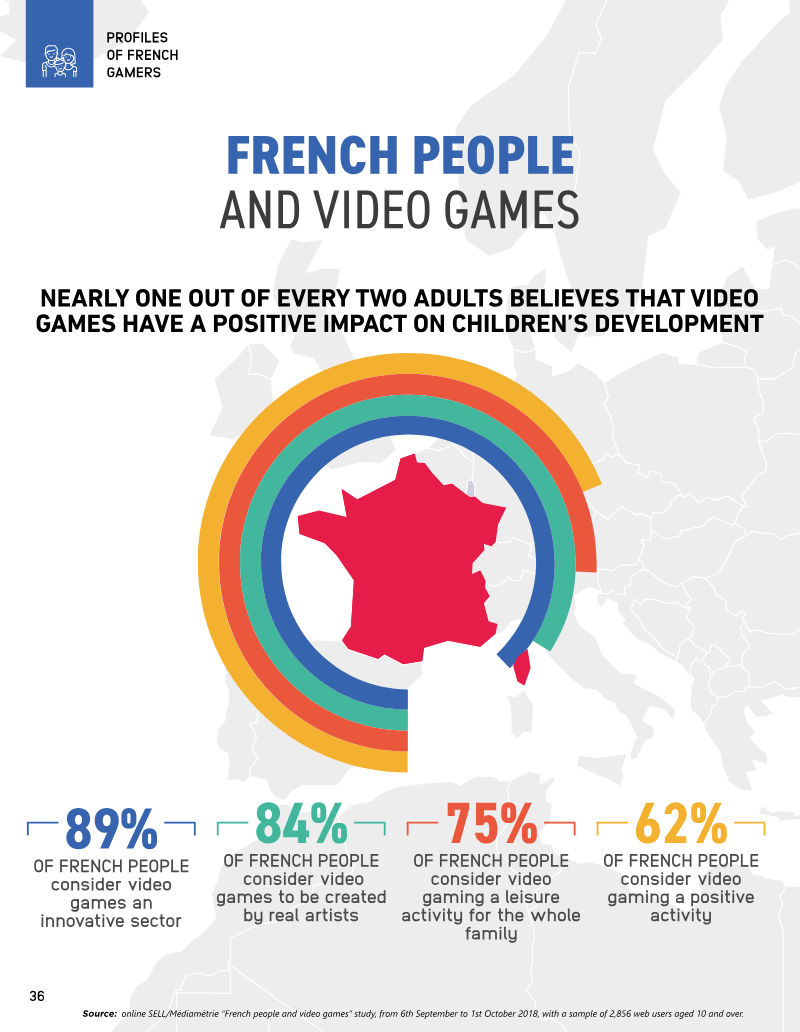
The French video game market has reached a historic peak in engagement, with 40.2 million individuals—representing 66% of the national population—identifying as players. The demographic profile of the average gamer has stabilized at 40 years old, characterized by near gender parity. Notably, women now constitute a 55% majority within the 16-30 age bracket, while the senior segment has expanded to 5.4 million participants. This broad adoption is accompanied by an increase in weekly playtime to nearly eight hours, driven largely by a preference for social and multiplayer experiences. Approximately 86% of players utilize multiplayer modes, and 60% report forming direct friendships through gaming, illustrating the medium's role as a primary driver of social cohesion across generations.

Professional interest in the sector is also rising, particularly among young adults, over a third of whom have considered industry careers. This cultural integration is supported by a robust regulatory and educational framework. Parental involvement is high, with 67% of parents actively monitoring their children’s gaming habits and 95% expressing awareness of parental control systems. The PEGI classification system remains the cornerstone of consumer protection, utilizing independent verification bodies to ensure content appropriateness across more than 35,000 titles. This system facilitates informed purchasing decisions and maintains safety standards for the nation's "digital native" demographics.

The industry’s operational landscape is anchored by the Syndicat des Éditeurs de Logiciels de Loisirs (SELL), which represents major publishers and manages significant cultural milestones such as Paris Games Week. Beyond market intelligence and event organization, the sector emphasizes social responsibility through initiatives like PédagoJeux and various inclusion-focused partnerships. These efforts ensure that the French gaming ecosystem remains both economically vibrant and socially responsible, balancing rapid growth with a commitment to player safety and diversity.

  • The French video game market has reached 40.2 million players, representing 66% of the national population with an average player age of 40.
  • Social and multiplayer gaming are primary engagement drivers, with 86% of players using multiplayer modes and 60% reporting the formation of direct friendships through gaming.
  • Gender parity is a defining characteristic of the market, with women now comprising a 55% majority of players in the 16–30 age demographic.
  • Parental engagement is high, as 67% of parents actively monitor gaming habits and 95% are aware of parental control systems.
  • The PEGI classification system serves as the primary consumer protection framework, covering more than 35,000 titles to ensure content appropriateness.
+1
SELL – Syndicat des Éditeurs de Logiciels de LoisirsJul 2025
Page 1
Report36 pages

Mobile Games: State of the Market & Playtime Q3 2023

Mobile games: state of the market & playtime Joint report of Apptica & Gamelight The purpose of this study is to analyse the state of gaming category in Q3 2023. All data presented in this report has been collected from Apptica and Gamelight platforms. "Games" category is defined by a store's tag. The basis of this analysis is made up of data from the Apptica's Store, Ad and Market Intelligence sections and Gamelight's playtime and app usage data.

  • iOS remains the dominant platform for mobile gaming revenue, accounting for 56.01% of the total global share compared to 43.99% for Android.
  • The United States and Japan are the leading revenue generators among major markets, contributing $2.92 billion and $2.03 billion respectively, with the six analyzed countries accounting for 59% of global gaming revenue.
  • South Korea experienced the highest growth in game installs at 32% compared to Q3 2022, while the United States and France saw declines of 5% and 0.7%, respectively.
  • Card games are the most engaging genre globally with an average playtime of 41.68 minutes, consistently ranking as the top genre for user engagement across analyzed regions.
  • Average daily playtime is higher on iOS (38.69 minutes) than on Android (32.17 minutes) across the studied markets.
+6
AppticaJan 2023
Page 1
Report20 pages

Pour une Pratique Responsable du Jeu Vidéo: France

The guide presents a comprehensive overview of the French video‑game ecosystem in 2023, emphasizing the need for responsible consumption and the protection of minors. It argues that widespread digital engagement—now a daily habit for two‑thirds of adults and more than half of teenagers—requires coordinated action from industry, parents, and public authorities to ensure safe and balanced play.

Survey data collected from the SELL‑GSD/GameTrack panels at the end of 2021 reveal that 70 % of French residents play video games at least occasionally, with 53 % doing so regularly. Daily play is reported by 68 % of adults and 52 % of children aged 10‑17, while 95 % of parents are aware of parental‑control tools; only 44 % actually use them, and 51 % know of them without applying them. Parental involvement varies: 13 % supervise every session, 22 % select titles, 25 % advise against certain games, and 40 % allow autonomous play without consent. Moreover, 64 % of parents admit to playing with their children at least occasionally, highlighting the family‑oriented dimension of gaming.

The market analysis shows a split between physical and digital sales, with physical units representing 34 % of volume and 40 % of value, while digital formats account for the remainder. PEGI age‑rating labels dominate purchase decisions, being consulted by 67 % of adult buyers and 64 % of parents, and the system’s classification process involves independent bodies (NICAM and VSC) to certify titles across the Pan‑European market.

The publication also details the functionality of console‑based parental‑control systems, online interaction moderation tools, and the educational outreach conducted by the SELL and its partner network PédaGoJeux. Campaigns such as Safer Internet Day and a series of PEGI‑focused awareness drives illustrate the sector’s proactive stance on fostering a safer, more informed gaming environment for all French users.

  • Gaming is a mainstream activity in France, with 70% of residents playing occasionally and 53% playing regularly as of late 2021.
  • While 95% of parents are aware of parental-control tools, only 44% actively use them, leaving a significant gap between awareness and implementation.
  • Parental involvement in gaming is inconsistent: 40% of parents allow children to play autonomously without consent, while only 13% supervise every session.
  • The French market remains hybrid, with physical media accounting for 34% of unit volume and 40% of total market value.
  • PEGI age-rating labels are a primary consumer tool, consulted by 67% of adult buyers and 64% of parents to inform purchase decisions.
SELL – Syndicat des Éditeurs de Logiciels de LoisirsJan 2023
Page 1
Report18 pages

Annual Survey of Video Games in France 2022

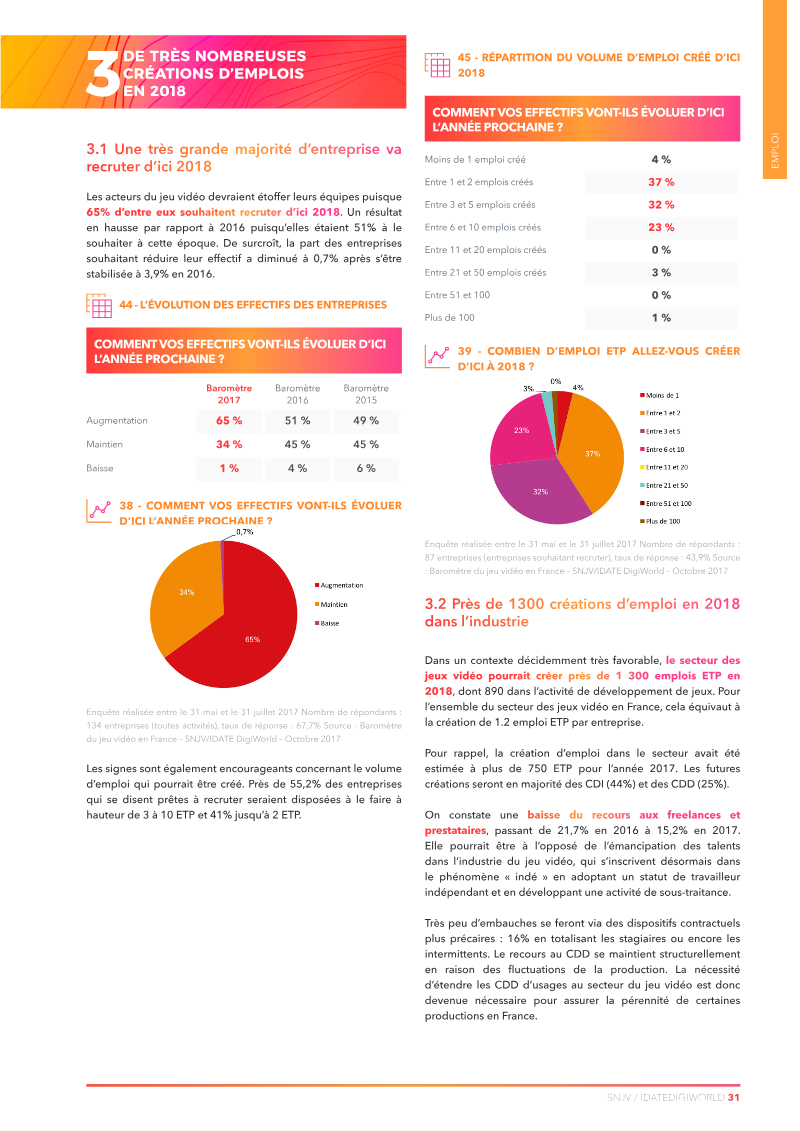
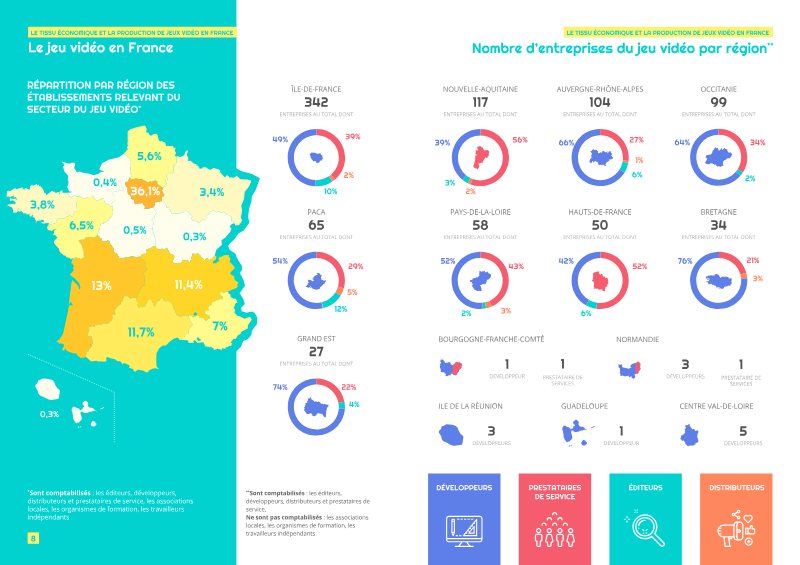
The 2023 annual survey of the French video game industry provides a comprehensive analysis of the sector’s economic health, production trends, and workforce dynamics during 2022. Conducted by the Syndicat National du Jeu Vidéo (SNJV) between February and June 2023, the study relies on a self-administered online questionnaire sent to 577 qualified development companies, achieving a 23% participation rate. The scope covers approximately 1,000 companies across France, including 580 development studios, with a significant concentration of 44.6% located in the Île-de-France region.

Findings indicate a robust but maturing production landscape, with nearly 1,260 games in development and over 850 new intellectual properties created. While the number of games in production fell by 7% compared to 2020, the industry saw a rise in professionalization, with 62% of studios working with publishers. Financial growth is evident, as 27% of studios now generate over 1 million euros in revenue, a 9-point increase from 2020. However, the sector remains dominated by smaller entities, with 55% of companies earning less than 300,000 euros annually. Despite this growth, optimism has tempered; only 28.6% of respondents expect revenue growth in the coming year, compared to 66% in 2020.

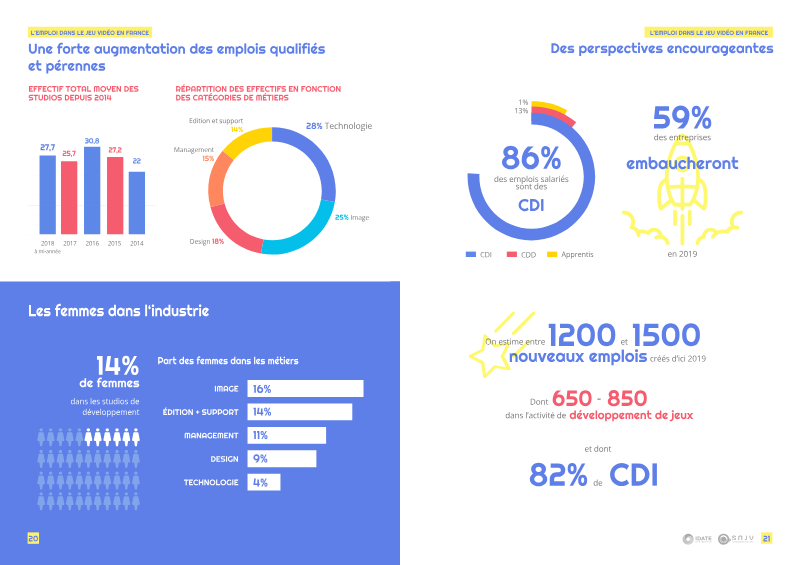
Employment remains stable with 76% of staff on permanent contracts, though gender diversity shows slow progress, with women making up 24% of the workforce. The industry is also navigating structural shifts in work culture, as 33% of companies have adopted full-time remote work. Corporate Social Responsibility is emerging as a priority, with 65.5% of companies implementing gender equality actions and nearly half planning carbon footprint assessments. France remains highly attractive to 85% of studios, primarily due to tax incentives and the quality of specialized training.

  • The French video game industry is maturing financially, with 27% of studios generating over 1 million euros in revenue, a 9-point increase since 2020.
  • Despite revenue gains, industry optimism has declined significantly, with only 28.6% of studios expecting growth compared to 66% in 2020.
  • The production landscape remains highly concentrated in the Île-de-France region, which hosts 44.6% of the nation's development studios.
  • While the industry is professionalizing—evidenced by 62% of studios working with publishers—the total volume of games in development fell by 7% compared to 2020.
  • The sector is dominated by small-scale operations, as 55% of companies continue to generate less than 300,000 euros in annual revenue.
Syndicat National du Jeu VidéoJan 2022

Publishers

Related Topics